
Homework Answers

Add Answer to:
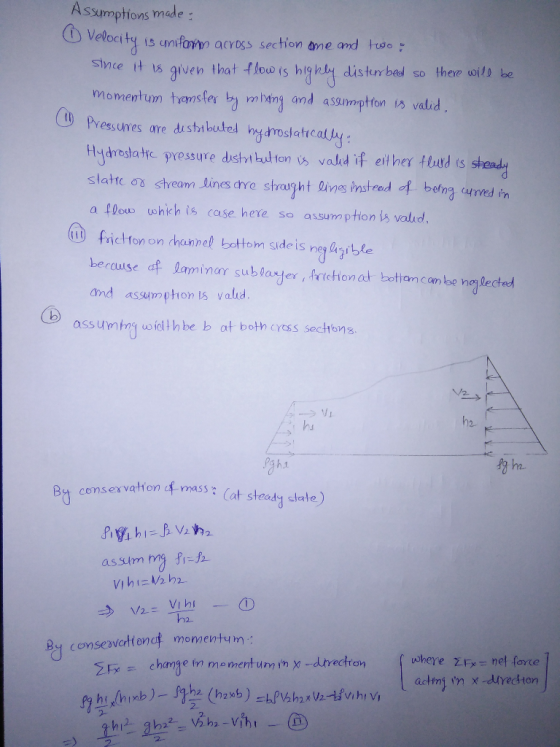
3. Water flows in a rectangular channel of width, w. In some cases, the water may...
Water flows under the partially opened sluice gate, which is in a rectangular channel
 Water flows under the partially opened sluice gate, which is in a rectangular channel. Suppose that yA =7.5 m and yB = 2.5 m. (Figure 1) Part A Determine if a hydraulic jump forms. Hydraulic jump cannot occur. Hydraulic jump can occur. PartB Find the depth yc at the downstream end of the jump.
water flows at a rate of 20 m3/s through a rectangular channel 4.0 m wide from...
 water flows at a rate of 20 m3/s through a rectangular channel 4.0 m wide from a "steep slope" to a 'mild slope", creating a hydraulic jump. The upstream depth of flow is 1.20 m Find the following: (a) the downstream depth of flow, (b) the energy loss in the jump, anid (c) the upstream and downstream velocities 2)
Water flows in a rectangular channel with a velocity of 2.5 m/s and a depth of...
Water flows in a rectangular channel with a velocity of 2.5 m/s and a depth of 1.5 m. A door downstream suddenly closes completely, causing surge move to upstream. Determine : a) Velocity Surge(w) b) The depth behind the surge (y2)
Water flows under the partially opened sluice gate, which is in a rectangular channel. If the water has the depth shown, determine if a hydraulic jump forms, and if so, find the depth yc at the downs...
 Water flows under the partially opened sluice gate, which is in
a rectangular channel. If the water has the depth shown, determine
if a hydraulic jump forms, and if so, find the depth yc at the
downstream end of the jump.
6 m ус
6 m ус
Water flows under the partially opened sluice gate, which is in
a rectangular channel. If the water has the depth shown, determine
if a hydraulic jump forms, and if so, find the depth yc at the
downstream end of the jump.
6 m ус
6 m ус
Water flows in a 100 ft wide rectangular channel at flow rate = 300 ft3/sec
Water flows in a 100 ft wide rectangular channel at flow rate = 300 ft3/sec. Manning's n = 0.015 and the bottom slope = 0.002. Calculate/answer the following: a. the uniform (normal) flow depth assuming the channel is wide and shallow. b. the critical flow depth. c. the flow depth upstream of a hydraulic jump with downstream depth = normal depth. d. the type of channel slope at the given normal depth: mild, critical, or steep (select one). f. the basis for your answer in...
Water flows at 10.8(103) t/min through a rectangular channel having a width of 6 ft (Figure 1)
 Water flows at 10.8(103) t/min through a rectangular channel having a width of 6 ft (Figure 1) Part A Determine the critical depth of the flow. Part C What is the necessary increase in elevation h of the channel bed to create the depth yB = 4.05 ft?
Water (ρ-1000 kg/m3) flows in a rectangular channel over the 1 m drop. If the width...
 Water (ρ-1000 kg/m3) flows in a rectangular channel over the 1 m drop. If the width of the channel is 1.5 m, determine the volumetric flow rate in the channel. Assume water is an ideal fluid. 0.5 m 1 m 2 m Figure 3
Water flows in an open rectangular channel at a depth of 1 m with a velocity of 4 m/s.
4.72) Water flows in an open rectangular channel at a depth of 1 m with a velocity of 4 m/s. The bottom of the channel drops over a short length a distance of 1 m. Calculate the two possible depths of flow after the drop. Neglect all losses. 4.73) If the head loss in Problem 4.72 across the channel drop is 0.2 m, determine the two possible depths of flow.
The rectangular channel is 1.5 m wide, and the water flows with velocity V = 3.55...
 The rectangular channel is 1.5 m wide, and the water flows with velocity V = 3.55 m/s. Suppose that yı = 0.9 m. (Figure 1) Determine the required height h of the bump so that the flow can change to subcritical flow after it passes over the properly designed bump. Express your answer to three significant figures and include the appropriate units. h = 2.23x10⁻²m Submit Previous Answers Correct Part D Figure 1 of 1 > What is the depth...
 water flows at a rate of 20 m3/s through a rectangular channel 4.0 m wide from a "steep slope" to a 'mild slope", creating a hydraulic jump. The upstream depth of flow is 1.20 m Find the following: (a) the downstream depth of flow, (b) the energy loss in the jump, anid (c) the upstream and downstream velocities 2)
 Water flows under the partially opened sluice gate, which is in
a rectangular channel. If the water has the depth shown, determine
if a hydraulic jump forms, and if so, find the depth yc at the
downstream end of the jump.
6 m ус
6 m ус
Water flows under the partially opened sluice gate, which is in
a rectangular channel. If the water has the depth shown, determine
if a hydraulic jump forms, and if so, find the depth yc at the
downstream end of the jump.
6 m ус
6 m ус
 Water (ρ-1000 kg/m3) flows in a rectangular channel over the 1 m drop. If the width of the channel is 1.5 m, determine the volumetric flow rate in the channel. Assume water is an ideal fluid. 0.5 m 1 m 2 m Figure 3
 The rectangular channel is 1.5 m wide, and the water flows with velocity V = 3.55 m/s. Suppose that yı = 0.9 m. (Figure 1) Determine the required height h of the bump so that the flow can change to subcritical flow after it passes over the properly designed bump. Express your answer to three significant figures and include the appropriate units. h = 2.23x10⁻²m Submit Previous Answers Correct Part D Figure 1 of 1 > What is the depth...
Most questions answered within 3 hours.
-
Where is the error in this code sequence?
String s1 = "Hello";
String s2 = "ello";...
asked 11 months ago -
Financial data for Joel de Paris, Inc., for last year
follow:
Joel de Paris, Inc.
Balance...
asked 11 months ago -
Consider this reaction:
Al2(SO4)3 (aq)+ BaCl3
(aq) Al2Cl6 (aq)- +
3BaSO4(s) . What is the...
asked 11 months ago -
Suppose that Savneet is considering increasing her
recent random sample from 20 car rentals to 40...
asked 11 months ago -
Trucks arrive at an unloading terminal at an average rate of 120
per hour.
Trucks arrive...
asked 11 months ago -
Why are methanol and ethanol completely soluble in water while
octanol is not very little soluble....
asked 11 months ago -
A facilities manager at a university reads in a research report
that the mean amount of...
asked 11 months ago -
When the CuSO4 is rehydrated by adding water to the anhydrous
compound, is this an endothermic...
asked 11 months ago -
A ray of sunlight is passing from diamond into crown glass; the
angle of incidence is...
asked 11 months ago -
A block of mass 0.249 kg is placed on top of a light, vertical
spring of...
asked 11 months ago -
how do the kidneys compensate in the presences of acidosis
a) trigger hyperventilate
b) reserve acid...
asked 11 months ago -
Question 501 pts
The rental rate of capital to the firm increases. Which of the
following...
asked 11 months ago