
Homework Answers


Add Answer to:
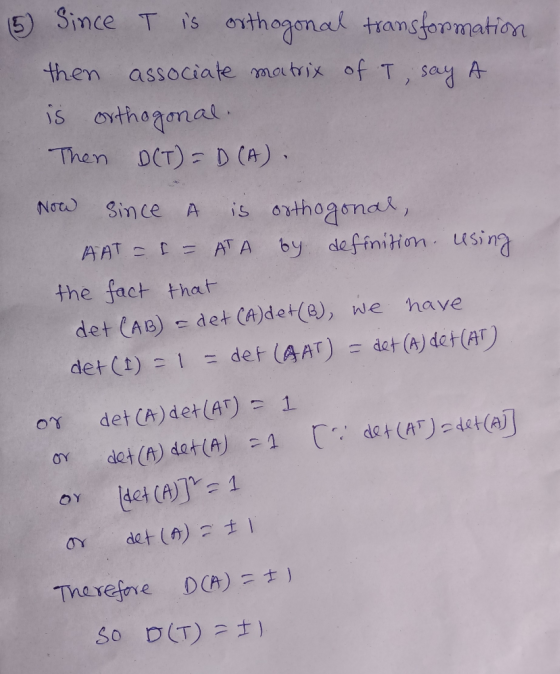
full proofs for both and please write legibly
5. Let T be an orthogonal transformation on...
Advanced linear algebra, need full proof thanks Let V be an inner product space (real or comple...
 advanced linear algebra, need full proof thanks
Let V be an inner product space (real or complex, possibly
infinite-dimensional). Let
{v1, . . . , vn} be an orthonormal set of vectors.
4. Let V be an inner product space (real or complex, possibly infinite-dimensional. Let [vi,..., Vn) be an orthonormal set of vectors. a) Show that 1 (b) Show that for every x e V, with equality holding if and only if x spanfvi,..., vn) (c) Consider the space...
advanced linear algebra, need full proof thanks
Let V be an inner product space (real or complex, possibly
infinite-dimensional). Let
{v1, . . . , vn} be an orthonormal set of vectors.
4. Let V be an inner product space (real or complex, possibly infinite-dimensional. Let [vi,..., Vn) be an orthonormal set of vectors. a) Show that 1 (b) Show that for every x e V, with equality holding if and only if x spanfvi,..., vn) (c) Consider the space...
1). Let V be an n-dimensional inner product space, let L be a linear transformation L...
 1). Let V be an n-dimensional inner product space, let L be a linear transformation L : V + V. a) Define for inner product space V the phrase "L:V - V" is an orthogonal transforma- tion". b) Define "orthogonal matrix" b) If v1, ..., Vn is an orthonormal basis for V define the matrix of L relative to this basis and prove that it is an orthogonal matrix A.
Let V be a finite-dimensional vector space, and let B be a basis of V. Show...
Let V be a finite-dimensional vector space, and let B be a basis of V. Show that there is an inner product on V for which B is orthonormal.
Orthogonal projections. In class we showed that if V is a finite-dimensional inner product space ...
 Orthogonal projections. In class we showed that if V is a finite-dimensional inner product space and U-V s a subspace, then U㊥ U↓-V, (U 1-U, and Pb is well-defined Inspecting the proofs, convince yourself that all that was needed was for U to be finite- dimensional. (In fact, your book does it this way). Then answer the following questions (a) Let V be an inner product space. Prove that for any u V. if u 0, we have proj, Pspan(v)...
Let V be a finite-dimensional complex vector space and let T from V to V be...
Let V be a finite-dimensional complex vector space and let T from V to V be a linear transformation. Show that V is the direct sum of U and W where W and U are T-invariant subspaces and the restriction of T on U is nilpotent and the restriction of T on W is an isomorphism.
3. Let V be a finite dimensional inner product space, and suppose that T is a...
 3. Let V be a finite dimensional inner product space, and suppose that T is a linear operator on this space. (i) Let B be an ordered orthonormal basis for V and let U be the linear operator on V determined by [U19 = (T);. Then, for all 01,09 € V, (01, T(02)) = (U(V1), v2) (ii) Prove that the conclusion of the previous part does not hold, in general, if the basis 8 is not orthonormal.
Exercise 11.5.9 Let U and V be finite dimensional spaces over F and let θ : U linear map. v be a ...
 Vectors pure and applied
Exercise 11.5.9 Let U and V be finite dimensional spaces over F and let θ : U linear map. v be a (i) Show that o is injective if and only if, given any finite dimensional vector space W map : V W such that over F and given any linear map α : U-+ W, there is a linear (ii) Show that θ is surjective if and only if, given any finite dimensional vector space...
Vectors pure and applied
Exercise 11.5.9 Let U and V be finite dimensional spaces over F and let θ : U linear map. v be a (i) Show that o is injective if and only if, given any finite dimensional vector space W map : V W such that over F and given any linear map α : U-+ W, there is a linear (ii) Show that θ is surjective if and only if, given any finite dimensional vector space...
(1 point) Let {uj, u2, u2 ) be an orthonormal basis for an inner product space...
 (1 point) Let {uj, u2, u2 ) be an orthonormal basis for an inner product space V. Suppose y = qui + buz + cuz is so that|lvl1 = V116. (v, uz) = 10, and (v. uz) = 4. Find the possible values for a, b, and c. a = CE (1 point) Suppose U1, U2, Uz is an orthogonal set of vectors in Rº. Let w be a vector in Span(v1, 02, 03) such that UjUi = 42, 02.02...
Let uj = [1,1,1]* and u2 = [1,2,2]t be vectors in R3 and V be the...
 Let uj = [1,1,1]* and u2 = [1,2,2]t be vectors in R3 and V be the vector space spanned by {u1, U2}. a. 6pt Use Gram-Schmidt orthogonalization to find an orthonormal basis for V. b. 4pt Let w = [1,0,1)+. Find the vector in V that is closest to w.
Proofs are not necessary Exercise 6.8.12. Determine if the following statements are true or false. If...
 Proofs are not necessary
Exercise 6.8.12. Determine if the following statements are true or false. If a statement is true, prove it. If a statement is false, give a counterexample or some other proof showing it is false. Unless otherwise specified, let V and W be a finite-dimensional vector space over field F, let (v1, ..., Un} be a basis of V, let {1,...,n} be a subset of W (possibly with repeated vectors), and let 6: V W be the...
Proofs are not necessary
Exercise 6.8.12. Determine if the following statements are true or false. If a statement is true, prove it. If a statement is false, give a counterexample or some other proof showing it is false. Unless otherwise specified, let V and W be a finite-dimensional vector space over field F, let (v1, ..., Un} be a basis of V, let {1,...,n} be a subset of W (possibly with repeated vectors), and let 6: V W be the...
 advanced linear algebra, need full proof thanks
Let V be an inner product space (real or complex, possibly
infinite-dimensional). Let
{v1, . . . , vn} be an orthonormal set of vectors.
4. Let V be an inner product space (real or complex, possibly infinite-dimensional. Let [vi,..., Vn) be an orthonormal set of vectors. a) Show that 1 (b) Show that for every x e V, with equality holding if and only if x spanfvi,..., vn) (c) Consider the space...
advanced linear algebra, need full proof thanks
Let V be an inner product space (real or complex, possibly
infinite-dimensional). Let
{v1, . . . , vn} be an orthonormal set of vectors.
4. Let V be an inner product space (real or complex, possibly infinite-dimensional. Let [vi,..., Vn) be an orthonormal set of vectors. a) Show that 1 (b) Show that for every x e V, with equality holding if and only if x spanfvi,..., vn) (c) Consider the space...
 1). Let V be an n-dimensional inner product space, let L be a linear transformation L : V + V. a) Define for inner product space V the phrase "L:V - V" is an orthogonal transforma- tion". b) Define "orthogonal matrix" b) If v1, ..., Vn is an orthonormal basis for V define the matrix of L relative to this basis and prove that it is an orthogonal matrix A.
 Orthogonal projections. In class we showed that if V is a finite-dimensional inner product space and U-V s a subspace, then U㊥ U↓-V, (U 1-U, and Pb is well-defined Inspecting the proofs, convince yourself that all that was needed was for U to be finite- dimensional. (In fact, your book does it this way). Then answer the following questions (a) Let V be an inner product space. Prove that for any u V. if u 0, we have proj, Pspan(v)...
 3. Let V be a finite dimensional inner product space, and suppose that T is a linear operator on this space. (i) Let B be an ordered orthonormal basis for V and let U be the linear operator on V determined by [U19 = (T);. Then, for all 01,09 € V, (01, T(02)) = (U(V1), v2) (ii) Prove that the conclusion of the previous part does not hold, in general, if the basis 8 is not orthonormal.
 Vectors pure and applied
Exercise 11.5.9 Let U and V be finite dimensional spaces over F and let θ : U linear map. v be a (i) Show that o is injective if and only if, given any finite dimensional vector space W map : V W such that over F and given any linear map α : U-+ W, there is a linear (ii) Show that θ is surjective if and only if, given any finite dimensional vector space...
Vectors pure and applied
Exercise 11.5.9 Let U and V be finite dimensional spaces over F and let θ : U linear map. v be a (i) Show that o is injective if and only if, given any finite dimensional vector space W map : V W such that over F and given any linear map α : U-+ W, there is a linear (ii) Show that θ is surjective if and only if, given any finite dimensional vector space...
 (1 point) Let {uj, u2, u2 ) be an orthonormal basis for an inner product space V. Suppose y = qui + buz + cuz is so that|lvl1 = V116. (v, uz) = 10, and (v. uz) = 4. Find the possible values for a, b, and c. a = CE (1 point) Suppose U1, U2, Uz is an orthogonal set of vectors in Rº. Let w be a vector in Span(v1, 02, 03) such that UjUi = 42, 02.02...
 Let uj = [1,1,1]* and u2 = [1,2,2]t be vectors in R3 and V be the vector space spanned by {u1, U2}. a. 6pt Use Gram-Schmidt orthogonalization to find an orthonormal basis for V. b. 4pt Let w = [1,0,1)+. Find the vector in V that is closest to w.
 Proofs are not necessary
Exercise 6.8.12. Determine if the following statements are true or false. If a statement is true, prove it. If a statement is false, give a counterexample or some other proof showing it is false. Unless otherwise specified, let V and W be a finite-dimensional vector space over field F, let (v1, ..., Un} be a basis of V, let {1,...,n} be a subset of W (possibly with repeated vectors), and let 6: V W be the...
Proofs are not necessary
Exercise 6.8.12. Determine if the following statements are true or false. If a statement is true, prove it. If a statement is false, give a counterexample or some other proof showing it is false. Unless otherwise specified, let V and W be a finite-dimensional vector space over field F, let (v1, ..., Un} be a basis of V, let {1,...,n} be a subset of W (possibly with repeated vectors), and let 6: V W be the...
Most questions answered within 3 hours.
-
Where is the error in this code sequence?
String s1 = "Hello";
String s2 = "ello";...
asked 11 months ago -
Financial data for Joel de Paris, Inc., for last year
follow:
Joel de Paris, Inc.
Balance...
asked 11 months ago -
Consider this reaction:
Al2(SO4)3 (aq)+ BaCl3
(aq) Al2Cl6 (aq)- +
3BaSO4(s) . What is the...
asked 11 months ago -
Suppose that Savneet is considering increasing her
recent random sample from 20 car rentals to 40...
asked 11 months ago -
Trucks arrive at an unloading terminal at an average rate of 120
per hour.
Trucks arrive...
asked 11 months ago -
Why are methanol and ethanol completely soluble in water while
octanol is not very little soluble....
asked 11 months ago -
A facilities manager at a university reads in a research report
that the mean amount of...
asked 11 months ago -
When the CuSO4 is rehydrated by adding water to the anhydrous
compound, is this an endothermic...
asked 11 months ago -
A ray of sunlight is passing from diamond into crown glass; the
angle of incidence is...
asked 11 months ago -
A block of mass 0.249 kg is placed on top of a light, vertical
spring of...
asked 11 months ago -
how do the kidneys compensate in the presences of acidosis
a) trigger hyperventilate
b) reserve acid...
asked 11 months ago -
Question 501 pts
The rental rate of capital to the firm increases. Which of the
following...
asked 11 months ago