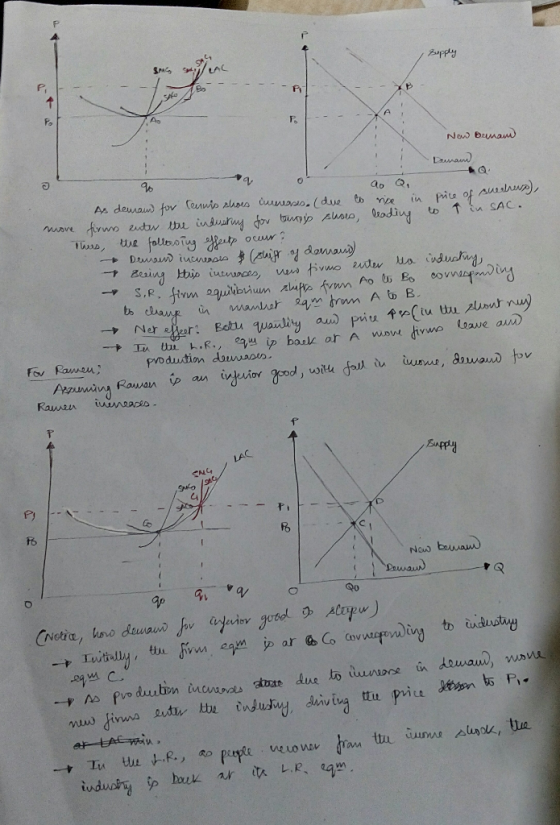
With the aid of diagrams, explain the effects of the following shocks on the competitive market...
With the aid of diagrams, explain the effects of the following
shocks on the competitive market in the short-run and long-run.
Assume the industry has a constant cost.
a. What happens in the market for tennis shoes when the price of
snickers increases.
b. What happens in the market for ramen when income falls assuming
ramen is an inferior good.
Homework Answers
Add Answer to:
With the aid of diagrams, explain the effects of the following
shocks on the competitive market...
The market for coffee is perfectly competitive, has a large number of identical firms, and is...
 The market for coffee is perfectly competitive, has a large number of identical firms, and is in LONG-RUN equilibrium. The market demand curve is downward sloping, and the cost schedules have their usual shapes. Market price for a unit of coffee is $10. There is a decrease in the price of tea, a substitute for coffee. [A] In the SHORT RUN, in appropriate diagrams, show what happens to price, industry output, and the output and profits of a representative firm...
A watermelon farmer is operating in a perfectly competitive market. The market price of watermelon is...
A watermelon farmer is operating in a perfectly competitive market. The market price of watermelon is $5 per pound and each farmer produces 1,000 pounds per week. The average variable cost per unit is $3 per pound and the average fixed cost per unit is $1. a. What is a watermelon farmer’s profit in the short run? Explain. b. What happens to the total number of farms in the long run? Why? c. If technology reduces the cost of watermelon...
Pena Price < Quy Refer to Figure 12-15. Suppose atypical form in a perfectly competitive market...
 Pena Price < Quy Refer to Figure 12-15. Suppose atypical form in a perfectly competitive market is coming economic profits in the short run. Which of the diagrams in the fire depicts what happens in the industry as it transitions to a long-run equilbrium! Panel Panel
Suppose the apple market is competitive. State the long run equilibrium condition of a typical profit-maximizing...
Suppose the apple market is competitive. State the long run equilibrium condition of a typical profit-maximizing firm operating in a competitive market. Express your answer using marginal cost and average cost. Assume the market for apple is now operating at her long run equilibrium. Draw side-by-side diagrams to show the long run equilibrium conditions for a typical apple farmer and the market for apples. Label your diagrams clearly. Recently, there is a fall in the price of fertilizers used for...
Assume that the perfectly competitive market for ethanol is in long-run equilibrium. Now suppose that the...
Assume that the perfectly competitive market for ethanol is in long-run equilibrium. Now suppose that the price of gasoline, a substitute for ethanol, increases. Explain what will happen in the market for ethanol. 1) Describe how this change will affect short-run economic profits. 2) What will happen to the number of firms producing ethanol in the long run? 3) How will price and output in this industry adjust in the long run?
Suppose the apple market is competitive. a. State the long run equilibrium condition of a typical...
Suppose the apple market is competitive. a. State the long run equilibrium condition of a typical profit-maximizing firm operating in a competitive market. Express your answer using marginal cost and average cost. (2 marks) b. Assume the market for apple is now operating at her long run equilibrium. Draw side-by-side diagrams to show the long run equilibrium conditions for a typical apple farmer and the market for apples. Label your diagrams clearly. (6 marks) c. Recently, there is a fall...
For each of the following events, explain the short-run and long-run effects on output and the...
For each of the following events, explain the short-run and long-run effects on output and the price level, assuming policymakers take no action. Answer the questions using sticky-wage theory. a) The stock market declines sharply, reducing consumer’s wealth. b) Now suppose that a stock market crash causes aggregate demand to fall. Use your diagram to show what happens to output and the price level in the short run. What happens to the unemployment rate? c) A recessions overseas causes foreigners...
Q7 (20 marks) Suppose the market for disposable gloves is competitive and it is originally operating...
 Q7
(20 marks) Suppose the market for disposable gloves is competitive and it is originally operating at the long run equilibrium. An important raw material of producing disposable gloves is natural rubber. Suppose there is a drastic increase in the price of natural rubber. a. With the aid of side-by-side diagrams, explain the impacts of the above change on the equilibrium price and equilibrium quantity in the market for disposable gloves, as well as the profit maximizing output level of...
Q7
(20 marks) Suppose the market for disposable gloves is competitive and it is originally operating at the long run equilibrium. An important raw material of producing disposable gloves is natural rubber. Suppose there is a drastic increase in the price of natural rubber. a. With the aid of side-by-side diagrams, explain the impacts of the above change on the equilibrium price and equilibrium quantity in the market for disposable gloves, as well as the profit maximizing output level of...
Consider the competitive market for copper. Assume that,regardless of how many firms are in the...
 7. Short-run supply and long-run equilibrium Consider the competitive market for copper. Assume that, regardless of how many firms are in the industry, every firm in the industry is identical and faces the marginal cost (MC), average total cost (ATC), and average variable cost (AVC) curves shown on the following graph. The following diagram shows the market demand for copper. Use the orange points (square symbol) to plot the initial short-run industry supply curve when there are 20 firms in the market. (Hint:...
 The market for coffee is perfectly competitive, has a large number of identical firms, and is in LONG-RUN equilibrium. The market demand curve is downward sloping, and the cost schedules have their usual shapes. Market price for a unit of coffee is $10. There is a decrease in the price of tea, a substitute for coffee. [A] In the SHORT RUN, in appropriate diagrams, show what happens to price, industry output, and the output and profits of a representative firm...
 Pena Price < Quy Refer to Figure 12-15. Suppose atypical form in a perfectly competitive market is coming economic profits in the short run. Which of the diagrams in the fire depicts what happens in the industry as it transitions to a long-run equilbrium! Panel Panel
 Q7
(20 marks) Suppose the market for disposable gloves is competitive and it is originally operating at the long run equilibrium. An important raw material of producing disposable gloves is natural rubber. Suppose there is a drastic increase in the price of natural rubber. a. With the aid of side-by-side diagrams, explain the impacts of the above change on the equilibrium price and equilibrium quantity in the market for disposable gloves, as well as the profit maximizing output level of...
Q7
(20 marks) Suppose the market for disposable gloves is competitive and it is originally operating at the long run equilibrium. An important raw material of producing disposable gloves is natural rubber. Suppose there is a drastic increase in the price of natural rubber. a. With the aid of side-by-side diagrams, explain the impacts of the above change on the equilibrium price and equilibrium quantity in the market for disposable gloves, as well as the profit maximizing output level of...
Most questions answered within 3 hours.
-
Where is the error in this code sequence?
String s1 = "Hello";
String s2 = "ello";...
asked 11 months ago -
Financial data for Joel de Paris, Inc., for last year
follow:
Joel de Paris, Inc.
Balance...
asked 11 months ago -
Consider this reaction:
Al2(SO4)3 (aq)+ BaCl3
(aq) Al2Cl6 (aq)- +
3BaSO4(s) . What is the...
asked 11 months ago -
Suppose that Savneet is considering increasing her
recent random sample from 20 car rentals to 40...
asked 11 months ago -
Trucks arrive at an unloading terminal at an average rate of 120
per hour.
Trucks arrive...
asked 11 months ago -
Why are methanol and ethanol completely soluble in water while
octanol is not very little soluble....
asked 11 months ago -
A facilities manager at a university reads in a research report
that the mean amount of...
asked 11 months ago -
When the CuSO4 is rehydrated by adding water to the anhydrous
compound, is this an endothermic...
asked 11 months ago -
A ray of sunlight is passing from diamond into crown glass; the
angle of incidence is...
asked 11 months ago -
A block of mass 0.249 kg is placed on top of a light, vertical
spring of...
asked 11 months ago -
how do the kidneys compensate in the presences of acidosis
a) trigger hyperventilate
b) reserve acid...
asked 11 months ago -
Question 501 pts
The rental rate of capital to the firm increases. Which of the
following...
asked 11 months ago