description of Object Oriented Analysis using UML for POS
description of Object Oriented Analysis using UML for POS
Homework Answers
To define object-oriented analysis we must first define what we mean by an object. The definition of an object, according to most dictionaries, is “a tangible, material thing.” Drilling down a bit more to the realm of computer science, an object can be most anything in a programmatic sense, from a variable or data model to a function, class, or method. Moving even deeper into the realm of object-oriented programming, an object is an instance of a thing that typically represents a real world object and has all the same types of characteristics (properties), behaviors (methods), and states (data). When discussing OOADconcepts, an object most closely resembles the object-oriented programmingversion of an object, in that it is a representation of a real world object with behaviors, characteristics, and states.
With that out of the way, we can define object-oriented analysis (OOA). In short, OOA is an iterative stage of analysis, which takes place during the software development life cycle, that aims to model the functional requirements of the software while remaining completely independent of any potential implementationrequirements. To accomplish this task via OOAD practices, an object-oriented analysis will focus everything through the lens of objects. This forces OOA to combine all behaviors, characteristics, and states together into one analysis process, rather than splitting them up into separate stages, as many other methodologies would do.
To accomplish this goal, a typical OOA phase consists of five stages:
Find and define the objects.
Organize the objects.
Describe how the objects interact with one another.
Define the external behavior of the objects.
Define the internal behavior of the objects.
For example, a typical implementation of OOA is to create an object model for an application. The object modelmight describe the names, relationships, behaviors, and characteristics of each object in the system. With this information established for each object, the design process that follows is much simpler.
Disadvantages of Object-Oriented Analysis and Design
Ill-Suited to Procedural Applications: Given the object-oriented nature of OOAD, it is quite difficult (although not impossible) to practice OOADtechniques within a procedural programming language, or often to apply the techniques to non-object business logic. Whereas procedural applications are often logically bound by concepts of scope and modularity, object-oriented applications, of course, emphasize objects that simulate the real world, making OOAD methods ill-suited for procedural languages and applications.
Too Complex for Simple Applications: While arguably not a disadvantage that is applicable to all projects, it’s certainly the case that OOAD practices are generally not ideal for simpler projects. Many developers have their own personal hard and fast rules to help when deciding whether a project should be procedural or object-oriented, but in most cases, the more basic the needs of the application, the more likely a less-structured, procedural approach is the best fit. As always, we must always use our own best judgment.
uml for point of scale:_
usecase daugram;

Object Oriented analysis Implement a Stack using List by inheritance. The implementation shall be in both...
Object Oriented analysis Implement a Stack using List by inheritance. The implementation shall be in both UML and Java Code.
Object oriented analysis question Define a Self Driving Car Class with all the bells and whistles....
Object oriented analysis question Define a Self Driving Car Class with all the bells and whistles. Plus UML Diagram
Java is an object-oriented programming language that enables us to define classes and to instantiate them...
Java is an object-oriented programming language that enables us to define classes and to instantiate them into objects. These objects then call each other’s methods to implement the behavior of the application. The Unified Modeling Language (UML) is an object-oriented visual notation to document the design of object-oriented classes. For this discussion, you will practice designing a Java class called Course, drawing a UML class diagram for the Course class, and then implementing the Course class in Java code. Review...
Programming Assignment 5: UML Diagram Objectives: After successfully completing this assignment, students will practice Object Oriented...
Programming Assignment 5: UML Diagram Objectives: After successfully completing this assignment, students will practice Object Oriented design by creating an UML diagram for a Java program. Program Statement: Bank System You were asked to create a simple UML diagram for a bank system. Each bank has a specific identification number, a name, and a location that needs to be stored. Tellers serve customers’ loans, checking and savings accounts. The bank must know each tellers’ name and identification number for record...
Some code in c ++ and its UML to apply inheritance and get and set methods, the code must be about computers, also applying object-oriented programming I need a code in C++ applying OOP with the top...
Some code in c ++ and its UML to apply inheritance and get and set methods, the code must be about computers, also applying object-oriented programming I need a code in C++ applying OOP with the topic of computers, then in the code must include the get method returns the variable value, and the set method sets the value.
Object-Oriented Analysis: 7. Specify a guideline for when an abstraction should be modeled as a class and when it s...
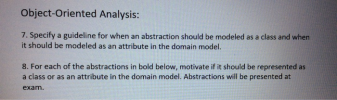 Object-Oriented Analysis: 7. Specify a guideline for when an abstraction should be modeled as a class and when it should be modeled as an attribute in the domain model. 8. For each of the abstractions in bold below, motivate if it should be represented as a class or as an attribute in the domain model. Abstractions will be presented at exam
Object-Oriented Analysis: 7. Specify a guideline for when an abstraction should be modeled as a class and when it...
Object-Oriented Analysis: 7. Specify a guideline for when an abstraction should be modeled as a class and when it should be modeled as an attribute in the domain model. 8. For each of the abstractions in bold below, motivate if it should be represented as a class or as an attribute in the domain model. Abstractions will be presented at exam
Object-Oriented Analysis: 7. Specify a guideline for when an abstraction should be modeled as a class and when it...
Subject Name: Object Oriented Analysis and Design Explain the following diagram (Minimum 1 page answer required)...
 Subject Name: Object Oriented Analysis and
Design
Explain the following diagram (Minimum 1 page answer
required)
Dynamic Modeling Structure in Motion
Subject Name: Object Oriented Analysis and
Design
Explain the following diagram (Minimum 1 page answer
required)
Dynamic Modeling Structure in Motion
Create a UML object diagram using the following requirements text as a guide: The Wuv Luvs...
Create a UML object diagram using the following requirements text as a guide: The Wuv Luvs are a football team The football team has a stadium called City Field. The stadium has a souvenier stand that is a stand. The stadium has a concession stand that is a stand. The football team has a head coach who is a coach.
Use Java please... Activity 1. Suppose we want to have an object-oriented design for an invoicing...
 Use Java please...
Activity 1. Suppose we want to have an object-oriented design for an invoicing system, that includes invoices, one or more line items in each invoice, address of the invoice, list of products, etc. Try to design this system by indicating the required classes, responsibilities of each class, and the collaborating classes to fulfill each responsibility, and draw the CRC cards as well as UML diagram of the classes and their relationships. Then, indicate the methods of each...
Use Java please...
Activity 1. Suppose we want to have an object-oriented design for an invoicing system, that includes invoices, one or more line items in each invoice, address of the invoice, list of products, etc. Try to design this system by indicating the required classes, responsibilities of each class, and the collaborating classes to fulfill each responsibility, and draw the CRC cards as well as UML diagram of the classes and their relationships. Then, indicate the methods of each...
If possible, write this code in object oriented programming, if not in object oriented that's okay...
If possible, write this code in object oriented programming, if not in object oriented that's okay I can convert it. All in C++ language Generate a list of random numbers using srand and rand, sort the random numbers and put the sorted list into a text file (.txt) using for loop and use stream insertion operator to a text file. Also, put it in a binary file (not using a for loop or stream insertion [use right system caller]). All...
 Object-Oriented Analysis: 7. Specify a guideline for when an abstraction should be modeled as a class and when it should be modeled as an attribute in the domain model. 8. For each of the abstractions in bold below, motivate if it should be represented as a class or as an attribute in the domain model. Abstractions will be presented at exam
Object-Oriented Analysis: 7. Specify a guideline for when an abstraction should be modeled as a class and when it...
Object-Oriented Analysis: 7. Specify a guideline for when an abstraction should be modeled as a class and when it should be modeled as an attribute in the domain model. 8. For each of the abstractions in bold below, motivate if it should be represented as a class or as an attribute in the domain model. Abstractions will be presented at exam
Object-Oriented Analysis: 7. Specify a guideline for when an abstraction should be modeled as a class and when it...
 Subject Name: Object Oriented Analysis and
Design
Explain the following diagram (Minimum 1 page answer
required)
Dynamic Modeling Structure in Motion
Subject Name: Object Oriented Analysis and
Design
Explain the following diagram (Minimum 1 page answer
required)
Dynamic Modeling Structure in Motion
 Use Java please...
Activity 1. Suppose we want to have an object-oriented design for an invoicing system, that includes invoices, one or more line items in each invoice, address of the invoice, list of products, etc. Try to design this system by indicating the required classes, responsibilities of each class, and the collaborating classes to fulfill each responsibility, and draw the CRC cards as well as UML diagram of the classes and their relationships. Then, indicate the methods of each...
Use Java please...
Activity 1. Suppose we want to have an object-oriented design for an invoicing system, that includes invoices, one or more line items in each invoice, address of the invoice, list of products, etc. Try to design this system by indicating the required classes, responsibilities of each class, and the collaborating classes to fulfill each responsibility, and draw the CRC cards as well as UML diagram of the classes and their relationships. Then, indicate the methods of each...
Most questions answered within 3 hours.
-
Where is the error in this code sequence?
String s1 = "Hello";
String s2 = "ello";...
asked 11 months ago -
Financial data for Joel de Paris, Inc., for last year
follow:
Joel de Paris, Inc.
Balance...
asked 11 months ago -
Consider this reaction:
Al2(SO4)3 (aq)+ BaCl3
(aq) Al2Cl6 (aq)- +
3BaSO4(s) . What is the...
asked 11 months ago -
Suppose that Savneet is considering increasing her
recent random sample from 20 car rentals to 40...
asked 11 months ago -
Trucks arrive at an unloading terminal at an average rate of 120
per hour.
Trucks arrive...
asked 11 months ago -
Why are methanol and ethanol completely soluble in water while
octanol is not very little soluble....
asked 11 months ago -
A facilities manager at a university reads in a research report
that the mean amount of...
asked 11 months ago -
When the CuSO4 is rehydrated by adding water to the anhydrous
compound, is this an endothermic...
asked 11 months ago -
A ray of sunlight is passing from diamond into crown glass; the
angle of incidence is...
asked 11 months ago -
A block of mass 0.249 kg is placed on top of a light, vertical
spring of...
asked 11 months ago -
how do the kidneys compensate in the presences of acidosis
a) trigger hyperventilate
b) reserve acid...
asked 11 months ago -
Question 501 pts
The rental rate of capital to the firm increases. Which of the
following...
asked 11 months ago