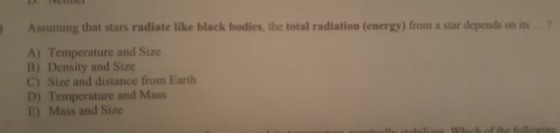
please explain reasoning or assumptions for the answer
Homework Answers
Total energy density of a black body at temperature T,is
where, A is a constant.
So, the total energy is
So, the total energy depends upon the volume of the object, i.e.,
the size of the object and upon its temperature T.
So, option (A) is correct.
i.e.,
Temperature and size.
Add Answer to:
please explain reasoning or assumptions for the
answer
Assuming that stars radiate like black bodies, the...
A reminder about the laws of radiation and order-of-magnitude skills. Our bodies radiate energy due to...
A reminder about the laws of radiation and order-of-magnitude skills. Our bodies radiate energy due to their heat. The temperature of a human body is something like 98◦ F, which is about Tbody≈ 310 K. Our body also gains energy from the thermal emission of the material around us. (a) Estimate the total energy emitted by a typical person due to thermal radiation in one day. (b) Besides radiating energy, our bodies also absorb energy from the atmosphere that surrounds...
Astronomy Ranking Task: Star Evolution & Lookback Time Exercise #1 Description: Imagine that the four stars...
 Astronomy Ranking Task: Star Evolution & Lookback Time Exercise #1 Description: Imagine that the four stars listed below all became Main Sequence (MS) stars at exactly the same time 10 billion years ago but in different locations of the universe. Cosmo Star is an O spectral class star with a MS lifetime of 3 million years. Its life will eventually end as a SN type II and become a black hole. Cosmo Star is located in a galaxy 10 billion...
could you please answer all questions. like and comment are rewarded. 1. An electron decays from...
 could you please answer all questions. like and comment are
rewarded.
1. An electron decays from its first excited state to its ground state in a 1-dimensional infinite square well of width 5.0 nm, emitting a photon. Calculate the wavelength of the photon. 2. A water turbine with diameter 40 cm is driven by a flow with constant speed. The turbine is fully immersed in the flow, and the generator driven by the turbine con- verts the energy of the...
could you please answer all questions. like and comment are
rewarded.
1. An electron decays from its first excited state to its ground state in a 1-dimensional infinite square well of width 5.0 nm, emitting a photon. Calculate the wavelength of the photon. 2. A water turbine with diameter 40 cm is driven by a flow with constant speed. The turbine is fully immersed in the flow, and the generator driven by the turbine con- verts the energy of the...
choose correct answer. no explanation needed QUESTION 36 What does the apparent magnitude of a star...
 choose correct answer. no explanation needed
QUESTION 36 What does the apparent magnitude of a star tell us about that star? its mass how bright it appears from Earth its radius how much energy it is emitting QUESTION 37 What is the reason sunspots appear darker than surrounding regions on the Sun's surface? They actually are fairly bright, but appear dark against the even brighter background of the surrounding photosphere. They are too cold to emit any visible light. They...
choose correct answer. no explanation needed
QUESTION 36 What does the apparent magnitude of a star tell us about that star? its mass how bright it appears from Earth its radius how much energy it is emitting QUESTION 37 What is the reason sunspots appear darker than surrounding regions on the Sun's surface? They actually are fairly bright, but appear dark against the even brighter background of the surrounding photosphere. They are too cold to emit any visible light. They...
1.What process is pushing back against gravity in the very center (the core) of sun-like stars?...
1.What process is pushing back against gravity in the very center (the core) of sun-like stars? 2."... the length of time a star spends on the main sequence is determined almost entirely by its mass with the counterintuitive result that less massive stars live longer." What is the fundamental reason why massive stars live a much shorter time than the Sun, even though they might have 30 times as much mass – and thus more fuel – available? 3.The text...
please list assumptions, show work, and explain your reasoning carefully! please don't forget all this thanks...
 please list assumptions, show work, and
explain your reasoning carefully! please don't forget all this
thanks
4. The aerodynamic behavior of a flying insect is to investigate in a water tunnel using a 10X scale model. The lift force F is believed to be a function of wing size L, flight speed u, flapping frequency w, fluid density P, and fluid viscosity u. Assume that air has a density 1/1000th and a dynamic viscosity 1/100th that of water. (a). List...
please list assumptions, show work, and
explain your reasoning carefully! please don't forget all this
thanks
4. The aerodynamic behavior of a flying insect is to investigate in a water tunnel using a 10X scale model. The lift force F is believed to be a function of wing size L, flight speed u, flapping frequency w, fluid density P, and fluid viscosity u. Assume that air has a density 1/1000th and a dynamic viscosity 1/100th that of water. (a). List...
Please answer with providing pictures. State any assumptions made and make sure to include all units...
 Please answer with providing pictures. State any assumptions
made and make sure to include all units with the answers and
calculations! Thanks
You are studying for the first physics exam and forget to watch the time. The next morning you ignore your alarm clock until you realize you will not reach the bus unless you run as fast as you can to the bus station in 15min. Carrying your school books during the run results in a total energy use...
Please answer with providing pictures. State any assumptions
made and make sure to include all units with the answers and
calculations! Thanks
You are studying for the first physics exam and forget to watch the time. The next morning you ignore your alarm clock until you realize you will not reach the bus unless you run as fast as you can to the bus station in 15min. Carrying your school books during the run results in a total energy use...
answer all please Problem 1. A block of mass m = 735 g is located on...
 answer all please
Problem 1. A block of mass m = 735 g is located on an incline which makes an angle of 40 with the horizontal The friction coefficient between the block and the incline is K = 0.21. The block is released and it is let slide down the incline. (a) Draw a free body diagram and identify all forces acting on the block. Find the acceleration of the block (b) If the block moves d = 0.42...
answer all please
Problem 1. A block of mass m = 735 g is located on an incline which makes an angle of 40 with the horizontal The friction coefficient between the block and the incline is K = 0.21. The block is released and it is let slide down the incline. (a) Draw a free body diagram and identify all forces acting on the block. Find the acceleration of the block (b) If the block moves d = 0.42...
A 6.05-kg black cat and her four black kittens, each with mass o.792 kg, sleep snuggled...
 A 6.05-kg black cat and her four black kittens, each with mass o.792 kg, sleep snuggled together on a mat on a cool night, with their bodies forming a hemisphere. Assume the hemisphere has a surface temperature of 27.9°c, an emissivity of 0.970, and a uniform density of 1046 kg/m (a) Find the radius of the hemisphere (b) Find the area of its curved surface. m2 (c) Find the radiated power emitted by the cats at their curved surface (d)...
please help me solve these PHYS 122 Explain or justify all answers Astronomy: Stars & Galaxies...
 please help me solve these
PHYS 122 Explain or justify all answers Astronomy: Stars & Galaxies HOMEWORK Unit III 1) How are the p-p chain and the CNO cycle similar? What kinds of stars have each as their main fusion reaction? 2) What is the underlying physical reason that there is a mass-luminosity relation? Explain. 3) Why does a star's life expectancy depend on its mass? EXPLAIN 4) What are the main sequence lifespans of (a) a 25 solar mass...
please help me solve these
PHYS 122 Explain or justify all answers Astronomy: Stars & Galaxies HOMEWORK Unit III 1) How are the p-p chain and the CNO cycle similar? What kinds of stars have each as their main fusion reaction? 2) What is the underlying physical reason that there is a mass-luminosity relation? Explain. 3) Why does a star's life expectancy depend on its mass? EXPLAIN 4) What are the main sequence lifespans of (a) a 25 solar mass...
 Astronomy Ranking Task: Star Evolution & Lookback Time Exercise #1 Description: Imagine that the four stars listed below all became Main Sequence (MS) stars at exactly the same time 10 billion years ago but in different locations of the universe. Cosmo Star is an O spectral class star with a MS lifetime of 3 million years. Its life will eventually end as a SN type II and become a black hole. Cosmo Star is located in a galaxy 10 billion...
 could you please answer all questions. like and comment are
rewarded.
1. An electron decays from its first excited state to its ground state in a 1-dimensional infinite square well of width 5.0 nm, emitting a photon. Calculate the wavelength of the photon. 2. A water turbine with diameter 40 cm is driven by a flow with constant speed. The turbine is fully immersed in the flow, and the generator driven by the turbine con- verts the energy of the...
could you please answer all questions. like and comment are
rewarded.
1. An electron decays from its first excited state to its ground state in a 1-dimensional infinite square well of width 5.0 nm, emitting a photon. Calculate the wavelength of the photon. 2. A water turbine with diameter 40 cm is driven by a flow with constant speed. The turbine is fully immersed in the flow, and the generator driven by the turbine con- verts the energy of the...
 choose correct answer. no explanation needed
QUESTION 36 What does the apparent magnitude of a star tell us about that star? its mass how bright it appears from Earth its radius how much energy it is emitting QUESTION 37 What is the reason sunspots appear darker than surrounding regions on the Sun's surface? They actually are fairly bright, but appear dark against the even brighter background of the surrounding photosphere. They are too cold to emit any visible light. They...
choose correct answer. no explanation needed
QUESTION 36 What does the apparent magnitude of a star tell us about that star? its mass how bright it appears from Earth its radius how much energy it is emitting QUESTION 37 What is the reason sunspots appear darker than surrounding regions on the Sun's surface? They actually are fairly bright, but appear dark against the even brighter background of the surrounding photosphere. They are too cold to emit any visible light. They...
 please list assumptions, show work, and
explain your reasoning carefully! please don't forget all this
thanks
4. The aerodynamic behavior of a flying insect is to investigate in a water tunnel using a 10X scale model. The lift force F is believed to be a function of wing size L, flight speed u, flapping frequency w, fluid density P, and fluid viscosity u. Assume that air has a density 1/1000th and a dynamic viscosity 1/100th that of water. (a). List...
please list assumptions, show work, and
explain your reasoning carefully! please don't forget all this
thanks
4. The aerodynamic behavior of a flying insect is to investigate in a water tunnel using a 10X scale model. The lift force F is believed to be a function of wing size L, flight speed u, flapping frequency w, fluid density P, and fluid viscosity u. Assume that air has a density 1/1000th and a dynamic viscosity 1/100th that of water. (a). List...
 Please answer with providing pictures. State any assumptions
made and make sure to include all units with the answers and
calculations! Thanks
You are studying for the first physics exam and forget to watch the time. The next morning you ignore your alarm clock until you realize you will not reach the bus unless you run as fast as you can to the bus station in 15min. Carrying your school books during the run results in a total energy use...
Please answer with providing pictures. State any assumptions
made and make sure to include all units with the answers and
calculations! Thanks
You are studying for the first physics exam and forget to watch the time. The next morning you ignore your alarm clock until you realize you will not reach the bus unless you run as fast as you can to the bus station in 15min. Carrying your school books during the run results in a total energy use...
 answer all please
Problem 1. A block of mass m = 735 g is located on an incline which makes an angle of 40 with the horizontal The friction coefficient between the block and the incline is K = 0.21. The block is released and it is let slide down the incline. (a) Draw a free body diagram and identify all forces acting on the block. Find the acceleration of the block (b) If the block moves d = 0.42...
answer all please
Problem 1. A block of mass m = 735 g is located on an incline which makes an angle of 40 with the horizontal The friction coefficient between the block and the incline is K = 0.21. The block is released and it is let slide down the incline. (a) Draw a free body diagram and identify all forces acting on the block. Find the acceleration of the block (b) If the block moves d = 0.42...
 A 6.05-kg black cat and her four black kittens, each with mass o.792 kg, sleep snuggled together on a mat on a cool night, with their bodies forming a hemisphere. Assume the hemisphere has a surface temperature of 27.9°c, an emissivity of 0.970, and a uniform density of 1046 kg/m (a) Find the radius of the hemisphere (b) Find the area of its curved surface. m2 (c) Find the radiated power emitted by the cats at their curved surface (d)...
 please help me solve these
PHYS 122 Explain or justify all answers Astronomy: Stars & Galaxies HOMEWORK Unit III 1) How are the p-p chain and the CNO cycle similar? What kinds of stars have each as their main fusion reaction? 2) What is the underlying physical reason that there is a mass-luminosity relation? Explain. 3) Why does a star's life expectancy depend on its mass? EXPLAIN 4) What are the main sequence lifespans of (a) a 25 solar mass...
please help me solve these
PHYS 122 Explain or justify all answers Astronomy: Stars & Galaxies HOMEWORK Unit III 1) How are the p-p chain and the CNO cycle similar? What kinds of stars have each as their main fusion reaction? 2) What is the underlying physical reason that there is a mass-luminosity relation? Explain. 3) Why does a star's life expectancy depend on its mass? EXPLAIN 4) What are the main sequence lifespans of (a) a 25 solar mass...
Most questions answered within 3 hours.
-
Where is the error in this code sequence?
String s1 = "Hello";
String s2 = "ello";...
asked 10 months ago -
Financial data for Joel de Paris, Inc., for last year
follow:
Joel de Paris, Inc.
Balance...
asked 10 months ago -
Consider this reaction:
Al2(SO4)3 (aq)+ BaCl3
(aq) Al2Cl6 (aq)- +
3BaSO4(s) . What is the...
asked 10 months ago -
Suppose that Savneet is considering increasing her
recent random sample from 20 car rentals to 40...
asked 10 months ago -
Trucks arrive at an unloading terminal at an average rate of 120
per hour.
Trucks arrive...
asked 10 months ago -
Why are methanol and ethanol completely soluble in water while
octanol is not very little soluble....
asked 10 months ago -
A facilities manager at a university reads in a research report
that the mean amount of...
asked 10 months ago -
When the CuSO4 is rehydrated by adding water to the anhydrous
compound, is this an endothermic...
asked 10 months ago -
A ray of sunlight is passing from diamond into crown glass; the
angle of incidence is...
asked 10 months ago -
A block of mass 0.249 kg is placed on top of a light, vertical
spring of...
asked 10 months ago -
how do the kidneys compensate in the presences of acidosis
a) trigger hyperventilate
b) reserve acid...
asked 10 months ago -
Question 501 pts
The rental rate of capital to the firm increases. Which of the
following...
asked 10 months ago