Consider the following Reaction . Mg(OH) 2 ( aq ) + H 3 PO 4 (...
Consider the following Reaction . Mg(OH) 2 ( aq ) + H 3 PO 4 ( l ) Mg 3 (PO 4 ) 2 ( aq ) + H 2 O ( A chemist allows 30.6g of Mg(OH) 2 and 63.6g H 3 PO 4 to react. When the reaction is finished, the chemist collects 34.7g Mg 3 (PO 4 ) 2 . Determine the limiting reagent, theoretical yield, and percent yield for the reaction. [Hint: first step balance the Chemical Reaction]
Homework Answers

Quantities with Chemical Reactions Worksheet Name Date Write the balanced equation described in each problem and t...
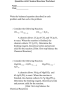 Quantities with Chemical Reactions Worksheet Name Date Write the balanced equation described in each problem and then solve the problem 1. Consider the following Reaction. CH, 6) +02.01, CO2 (s) + H20 A chemist allows 23.2g of CH, and 78.3g 0, to react. When the reaction is finished, the chemist collects 52.7g CO2. Determine the limiting reagent, theoretical yield, and percent yield for the reaction. (Hint: first step balance the Chemical Reaction] 2. Consider the following Reaction. Mg(OH)2 (ap +...
Consider the following reaction. MgCl2(aq)+2NaOH(aq)⟶Mg(OH)2(s)+2NaCl(aq) A 166.0 mL solution of 0.381 M MgCl2 reacts with a...
Consider the following reaction. MgCl2(aq)+2NaOH(aq)⟶Mg(OH)2(s)+2NaCl(aq) A 166.0 mL solution of 0.381 M MgCl2 reacts with a 47.33 mL solution of 0.568 M NaOH to produce Mg(OH)2 and NaCl. Identify the limiting reactant. NaOH Mg(OH)2 MgCl2 NaCl Caclulate the mass of Mg(OH)2 that can be produced. The actual mass of Mg(OH)2 isolated was 0.559 g. Calculate the percent yield of Mg(OH)2.
Consider the reaction Mg(OH)2(s) + 2HCl(aq) – MgCl2(aq) +2H2O(l). What is the mass of Mg(OH),(s) needed...
 Consider the reaction Mg(OH)2(s) + 2HCl(aq) – MgCl2(aq) +2H2O(l). What is the mass of Mg(OH),(s) needed to react with 25 ml of 0.20 M HCl(aq)? 230g 0.29g 0.158 470g
Consider the reaction: Mg(OH)2 (s) = Mg(aq) + 2 OH- (aq) At equilibrium, a 1.0 L...
 Consider the reaction: Mg(OH)2 (s) = Mg(aq) + 2 OH- (aq) At equilibrium, a 1.0 L reaction vessel contains 5.3 moles of Mg(OH)2 and concentrations of 0.0080 M and 0.010 M of Mg and OH respectively. What is Kc for this equilibrium? Consider the reaction: N2 (g) + 3 Br(g) = 2 NBr) (g) At equilibrium, the concentrations of Nz and Bra are 0.34 M and 0.70 M respectively, and the concentration of NBrs is 0.090 M. What is Kc...
24 3 points Consider the reaction: Pa(s) + 6 H2() + 4 PH3(g) If 88.6 L...
 24 3 points Consider the reaction: Pa(s) + 6 H2() + 4 PH3(g) If 88.6 L of H2, measured at STP, is allowed to react with 158.3 g of P, which of the following are true? (select all that apply) Pe is the limiting reagent The theoretical yield is 48.3 L Hy is the limiting reagent The theoretical yield is 114L The theoretical yield is 59.1L The actual yield is 114 L
someone please answer these questions :) c) Calculate the amount of heat released when 15.5g of...
 someone please answer these questions :)
c) Calculate the amount of heat released when 15.5g of carbon reacts d) What mass of carbon must react to produce 1575 kJ of heat? 3) For the reaction: 2 Li + F2 → 2 LiF a) What mass of LiF will be formed is 10.5 g of Li reacts with 37.2 g of F2? b) What is the limiting reactant? c) If 21.0g of LiF is actually produced, what is the percent yield?...
someone please answer these questions :)
c) Calculate the amount of heat released when 15.5g of carbon reacts d) What mass of carbon must react to produce 1575 kJ of heat? 3) For the reaction: 2 Li + F2 → 2 LiF a) What mass of LiF will be formed is 10.5 g of Li reacts with 37.2 g of F2? b) What is the limiting reactant? c) If 21.0g of LiF is actually produced, what is the percent yield?...
Part ID-1170218098koffsetenext /myct/itemView?as DOLL Exercise 8.62 Review | Constants | Periodic Table Consider the following reaction...
 Part ID-1170218098koffsetenext /myct/itemView?as DOLL Exercise 8.62 Review | Constants | Periodic Table Consider the following reaction between sulfur trioxide and water t > H2S0,(ag) A chemist allows 61.5 g of SO3 and 11.2 g of H2 O to react. When the reaction is finished, the chemist collects 59.8 g of H2SO4 roblem ID=11 Express your answer as a chemical formula Submit Reguest Answer Part B Determine the theoretical yield for the resction. Request Answer Subrnit ▼ Part C Dete mire...
1. Consider the reaction: MnO2 (s) + 4 HCl (g)MnCl2 (s) + Cl2 (g) + 2 H20 (g) If 10.00 g of MnO2 ...
 1. Consider the reaction: MnO2 (s) + 4 HCl (g)MnCl2 (s) + Cl2 (g) + 2 H20 (g) If 10.00 g of MnO2 and 10.00 g of HCl are reacted, how many grams of MnCl2 can be produced? Show all calculations 2. Consider the following unbalanced equation: NH4NOs(aq) + Na PO4(aq)(NH4)3PO4(aq NaNOs(aq) Assuming you start with 50.0 g of NHNOs and 50.0 g of NasPO4, which is the limiting reagent? What is the theoretical yield (g) of ammonium phosphate? a....
Consider this reaction: 2 AI (s) + 6 H*(aq) - 2 A1** (aq) + 3 H,...
 Consider this reaction: 2 AI (s) + 6 H*(aq) - 2 A1** (aq) + 3 H, (9) Which reactant is the reducing agent and why? Select one or more: a. H (aq), because it is reduced b. Al(s), because it is oxidised c. H (aq), because it is oxidised d. Al(s), because it is reduced The student synthesise aluminum oxide according to this reaction: 4 Al(s) + 30 (9) - 2 A1,03(s) Considering the mass of the limiting reactant she...
Two Parts: A chemist mixes a solution containing 33.14 g of Pb(NO3)2 with a second solution...
Two Parts: A chemist mixes a solution containing 33.14 g of Pb(NO3)2 with a second solution containing 12.82 g of NaCl. The chemical reaction is: Pb(NO3)2 (aq) + 2 NaCl (aq) ----> PbCl2 (s) + 2 NaNO3 (aq) a) Calculate the theoretical yield of PbCl2. (Hint: You first need to find the limiting reactant) b) The chemist actually collects 23.65 g of solid PbCl2 . Calculate the percent yield.
 Quantities with Chemical Reactions Worksheet Name Date Write the balanced equation described in each problem and then solve the problem 1. Consider the following Reaction. CH, 6) +02.01, CO2 (s) + H20 A chemist allows 23.2g of CH, and 78.3g 0, to react. When the reaction is finished, the chemist collects 52.7g CO2. Determine the limiting reagent, theoretical yield, and percent yield for the reaction. (Hint: first step balance the Chemical Reaction] 2. Consider the following Reaction. Mg(OH)2 (ap +...
 Consider the reaction Mg(OH)2(s) + 2HCl(aq) – MgCl2(aq) +2H2O(l). What is the mass of Mg(OH),(s) needed to react with 25 ml of 0.20 M HCl(aq)? 230g 0.29g 0.158 470g
 Consider the reaction: Mg(OH)2 (s) = Mg(aq) + 2 OH- (aq) At equilibrium, a 1.0 L reaction vessel contains 5.3 moles of Mg(OH)2 and concentrations of 0.0080 M and 0.010 M of Mg and OH respectively. What is Kc for this equilibrium? Consider the reaction: N2 (g) + 3 Br(g) = 2 NBr) (g) At equilibrium, the concentrations of Nz and Bra are 0.34 M and 0.70 M respectively, and the concentration of NBrs is 0.090 M. What is Kc...
 24 3 points Consider the reaction: Pa(s) + 6 H2() + 4 PH3(g) If 88.6 L of H2, measured at STP, is allowed to react with 158.3 g of P, which of the following are true? (select all that apply) Pe is the limiting reagent The theoretical yield is 48.3 L Hy is the limiting reagent The theoretical yield is 114L The theoretical yield is 59.1L The actual yield is 114 L
 someone please answer these questions :)
c) Calculate the amount of heat released when 15.5g of carbon reacts d) What mass of carbon must react to produce 1575 kJ of heat? 3) For the reaction: 2 Li + F2 → 2 LiF a) What mass of LiF will be formed is 10.5 g of Li reacts with 37.2 g of F2? b) What is the limiting reactant? c) If 21.0g of LiF is actually produced, what is the percent yield?...
someone please answer these questions :)
c) Calculate the amount of heat released when 15.5g of carbon reacts d) What mass of carbon must react to produce 1575 kJ of heat? 3) For the reaction: 2 Li + F2 → 2 LiF a) What mass of LiF will be formed is 10.5 g of Li reacts with 37.2 g of F2? b) What is the limiting reactant? c) If 21.0g of LiF is actually produced, what is the percent yield?...
 Part ID-1170218098koffsetenext /myct/itemView?as DOLL Exercise 8.62 Review | Constants | Periodic Table Consider the following reaction between sulfur trioxide and water t > H2S0,(ag) A chemist allows 61.5 g of SO3 and 11.2 g of H2 O to react. When the reaction is finished, the chemist collects 59.8 g of H2SO4 roblem ID=11 Express your answer as a chemical formula Submit Reguest Answer Part B Determine the theoretical yield for the resction. Request Answer Subrnit ▼ Part C Dete mire...
 1. Consider the reaction: MnO2 (s) + 4 HCl (g)MnCl2 (s) + Cl2 (g) + 2 H20 (g) If 10.00 g of MnO2 and 10.00 g of HCl are reacted, how many grams of MnCl2 can be produced? Show all calculations 2. Consider the following unbalanced equation: NH4NOs(aq) + Na PO4(aq)(NH4)3PO4(aq NaNOs(aq) Assuming you start with 50.0 g of NHNOs and 50.0 g of NasPO4, which is the limiting reagent? What is the theoretical yield (g) of ammonium phosphate? a....
 Consider this reaction: 2 AI (s) + 6 H*(aq) - 2 A1** (aq) + 3 H, (9) Which reactant is the reducing agent and why? Select one or more: a. H (aq), because it is reduced b. Al(s), because it is oxidised c. H (aq), because it is oxidised d. Al(s), because it is reduced The student synthesise aluminum oxide according to this reaction: 4 Al(s) + 30 (9) - 2 A1,03(s) Considering the mass of the limiting reactant she...
Most questions answered within 3 hours.
-
Where is the error in this code sequence?
String s1 = "Hello";
String s2 = "ello";...
asked 11 months ago -
Financial data for Joel de Paris, Inc., for last year
follow:
Joel de Paris, Inc.
Balance...
asked 11 months ago -
Consider this reaction:
Al2(SO4)3 (aq)+ BaCl3
(aq) Al2Cl6 (aq)- +
3BaSO4(s) . What is the...
asked 11 months ago -
Suppose that Savneet is considering increasing her
recent random sample from 20 car rentals to 40...
asked 11 months ago -
Trucks arrive at an unloading terminal at an average rate of 120
per hour.
Trucks arrive...
asked 11 months ago -
Why are methanol and ethanol completely soluble in water while
octanol is not very little soluble....
asked 11 months ago -
A facilities manager at a university reads in a research report
that the mean amount of...
asked 11 months ago -
When the CuSO4 is rehydrated by adding water to the anhydrous
compound, is this an endothermic...
asked 11 months ago -
A ray of sunlight is passing from diamond into crown glass; the
angle of incidence is...
asked 11 months ago -
A block of mass 0.249 kg is placed on top of a light, vertical
spring of...
asked 11 months ago -
how do the kidneys compensate in the presences of acidosis
a) trigger hyperventilate
b) reserve acid...
asked 11 months ago -
Question 501 pts
The rental rate of capital to the firm increases. Which of the
following...
asked 11 months ago