Draw the structure of the monomer(s) employed to form each of the following polymers shown in...
Draw the structure of the monomer(s) employed to form each of the following polymers shown in the table of polymers of commerical importance.
(a) polyvinyl chloride
(b) nylon 6,6
(c) polyethylene terephthalate
Homework Answers

Add Answer to:
Draw the structure of the monomer(s) employed to form each of
the following polymers shown in...
please draw the Structure of monomer of the following polymers and classify whether they are thermosetting...
please draw the Structure of monomer of the following polymers and classify whether they are thermosetting or thermoplastic? Phenol formaldehyde Polystyrene Polyethylene Nylon 6,6
Draw both the monomer and polymer structures of the following polymers Nylon 6,6 Poly(ethylene terephthalate)
Draw both the monomer and polymer structures of the following polymers Nylon 6,6 Poly(ethylene terephthalate)
please answer all questions 1. (2) Give the structure of the monomer that would be used...
 please answer all questions
1. (2) Give the structure of the monomer that would be used to produce each of the following polymers. -CH2-CH-CH2-CH-CH2-CH -CH2-CH-CH2-CH-CH2-CH- Ci Ci Ci CH3 CH3 CH3 2. (5) Where are you most likely to find each of the following polymers in your everyday life: polyethylene terephthalate (PET) high-density polyethylene (HDPE) polypropylene (PP) polyvinyl chloride (PVC) polystyrene 3. (1) Polyester is an example of an addition or a condensation polymer? 4. (1) What must be done...
please answer all questions
1. (2) Give the structure of the monomer that would be used to produce each of the following polymers. -CH2-CH-CH2-CH-CH2-CH -CH2-CH-CH2-CH-CH2-CH- Ci Ci Ci CH3 CH3 CH3 2. (5) Where are you most likely to find each of the following polymers in your everyday life: polyethylene terephthalate (PET) high-density polyethylene (HDPE) polypropylene (PP) polyvinyl chloride (PVC) polystyrene 3. (1) Polyester is an example of an addition or a condensation polymer? 4. (1) What must be done...
Draw the structure of the monomer used in the production of the following polymers. Polybutadiene, Natural...
Draw the structure of the monomer used in the production of the following polymers. Polybutadiene, Natural Rubber, & Neoprene (Structure for each)
Use the figure to the below to answer the next three questions: Metal Polymers Polyetylengl WT...
 Use the figure to the below to answer the next three questions: Metal Polymers Polyetylengl WT w Lowergy 0.01 COST | 17) Which of the following polymers is the most recyclable? a) Polyethylene b) Polystyrene c) Polyethylene terephthalate) = PET d) poly(vinyl chloride) - UPVC 18) If they all could be recycled regardless of their materials properties, which of the following polymers should have the highest recycling value? a) Nylon b) Aluminum c) Polyethylene terephthalate) = PET d) poly(vinyl chloride)...
Answer these two questions 1- Which of the following polymers is crystalline: (a) Starch (b) Thermosetting...
Answer these two questions 1- Which of the following polymers is crystalline: (a) Starch (b) Thermosetting (c) elastomers (d) polyacrylonitrile 2-Which of the following polymers has copolymer structure: (a) polyethylene (b) nylon 6,6 (c) polystyrène (d) propylene
i) Which of the following is not true about step-growth polymers? Formation of step-growth polymers usually...
i) Which of the following is not true about step-growth polymers? Formation of step-growth polymers usually results in the loss of a small molecule. Step-growth polymers are formed by the reaction of bifunctional molecules. Step-growth polymers can be formed by a free radical mechanism. Step-growth polymers are also known as condensation polymers. Step-growth polymers do not reach high molecular weight until the reaction has gone nearly to completion. ii) Which of the following are not termination methods in radical polymerization?...
5) Rank the following polymers in terms of the listed properties from 1 (lowest value) to...
 5) Rank the following polymers in terms of the listed properties from 1 (lowest value) to 5 (highest value). Explain the results. 19 -C-C- (Highly Cross- Liaked Structure) -C-C- -C-C- Polyethylene Epoxy Polyvinyl Chloride Polystyrene Chloride Tensile Strength Tensile Use Temperature Stiffness Polyethylene Epoxy Polyvinyl Chloride Polystyrene Polyvinylidene Chloride
Draw the repeating unit of the following condensation polymers and identify the monomer(s) used in their...
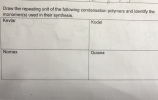 Draw the repeating unit of the following condensation polymers and identify the monomer(s) used in their synthesis. Kevlar Kodel Nomex Quiana
3 Match the following polymer with the common product in which it is used (see intro...
 3 Match the following polymer with the common product in which it is used (see intro for help). 1. polystyrene 2. nylon 3. polypropylene 4. low density polyethylene 5. polycarbonate a. Plastic Bags b. Water Pipes c. Cookware d. Egg containers e. Milk cartons 6. polyethylene f. Carpet and Knitted fabrics 7. polyvinylchloride 9. Automobile bumpers 8. polytetrafluoroethylene h. Rope 4. Shown below are monomers for common polymers that get made. Draw two repeating units of the polymer structure for...
 please answer all questions
1. (2) Give the structure of the monomer that would be used to produce each of the following polymers. -CH2-CH-CH2-CH-CH2-CH -CH2-CH-CH2-CH-CH2-CH- Ci Ci Ci CH3 CH3 CH3 2. (5) Where are you most likely to find each of the following polymers in your everyday life: polyethylene terephthalate (PET) high-density polyethylene (HDPE) polypropylene (PP) polyvinyl chloride (PVC) polystyrene 3. (1) Polyester is an example of an addition or a condensation polymer? 4. (1) What must be done...
please answer all questions
1. (2) Give the structure of the monomer that would be used to produce each of the following polymers. -CH2-CH-CH2-CH-CH2-CH -CH2-CH-CH2-CH-CH2-CH- Ci Ci Ci CH3 CH3 CH3 2. (5) Where are you most likely to find each of the following polymers in your everyday life: polyethylene terephthalate (PET) high-density polyethylene (HDPE) polypropylene (PP) polyvinyl chloride (PVC) polystyrene 3. (1) Polyester is an example of an addition or a condensation polymer? 4. (1) What must be done...
 Use the figure to the below to answer the next three questions: Metal Polymers Polyetylengl WT w Lowergy 0.01 COST | 17) Which of the following polymers is the most recyclable? a) Polyethylene b) Polystyrene c) Polyethylene terephthalate) = PET d) poly(vinyl chloride) - UPVC 18) If they all could be recycled regardless of their materials properties, which of the following polymers should have the highest recycling value? a) Nylon b) Aluminum c) Polyethylene terephthalate) = PET d) poly(vinyl chloride)...
 5) Rank the following polymers in terms of the listed properties from 1 (lowest value) to 5 (highest value). Explain the results. 19 -C-C- (Highly Cross- Liaked Structure) -C-C- -C-C- Polyethylene Epoxy Polyvinyl Chloride Polystyrene Chloride Tensile Strength Tensile Use Temperature Stiffness Polyethylene Epoxy Polyvinyl Chloride Polystyrene Polyvinylidene Chloride
 Draw the repeating unit of the following condensation polymers and identify the monomer(s) used in their synthesis. Kevlar Kodel Nomex Quiana
 3 Match the following polymer with the common product in which it is used (see intro for help). 1. polystyrene 2. nylon 3. polypropylene 4. low density polyethylene 5. polycarbonate a. Plastic Bags b. Water Pipes c. Cookware d. Egg containers e. Milk cartons 6. polyethylene f. Carpet and Knitted fabrics 7. polyvinylchloride 9. Automobile bumpers 8. polytetrafluoroethylene h. Rope 4. Shown below are monomers for common polymers that get made. Draw two repeating units of the polymer structure for...
Most questions answered within 3 hours.
-
Where is the error in this code sequence?
String s1 = "Hello";
String s2 = "ello";...
asked 10 months ago -
Financial data for Joel de Paris, Inc., for last year
follow:
Joel de Paris, Inc.
Balance...
asked 10 months ago -
Consider this reaction:
Al2(SO4)3 (aq)+ BaCl3
(aq) Al2Cl6 (aq)- +
3BaSO4(s) . What is the...
asked 10 months ago -
Suppose that Savneet is considering increasing her
recent random sample from 20 car rentals to 40...
asked 10 months ago -
Trucks arrive at an unloading terminal at an average rate of 120
per hour.
Trucks arrive...
asked 10 months ago -
Why are methanol and ethanol completely soluble in water while
octanol is not very little soluble....
asked 10 months ago -
A facilities manager at a university reads in a research report
that the mean amount of...
asked 10 months ago -
When the CuSO4 is rehydrated by adding water to the anhydrous
compound, is this an endothermic...
asked 10 months ago -
A ray of sunlight is passing from diamond into crown glass; the
angle of incidence is...
asked 10 months ago -
A block of mass 0.249 kg is placed on top of a light, vertical
spring of...
asked 10 months ago -
how do the kidneys compensate in the presences of acidosis
a) trigger hyperventilate
b) reserve acid...
asked 10 months ago -
Question 501 pts
The rental rate of capital to the firm increases. Which of the
following...
asked 10 months ago