
Homework Answers

Add Answer to:
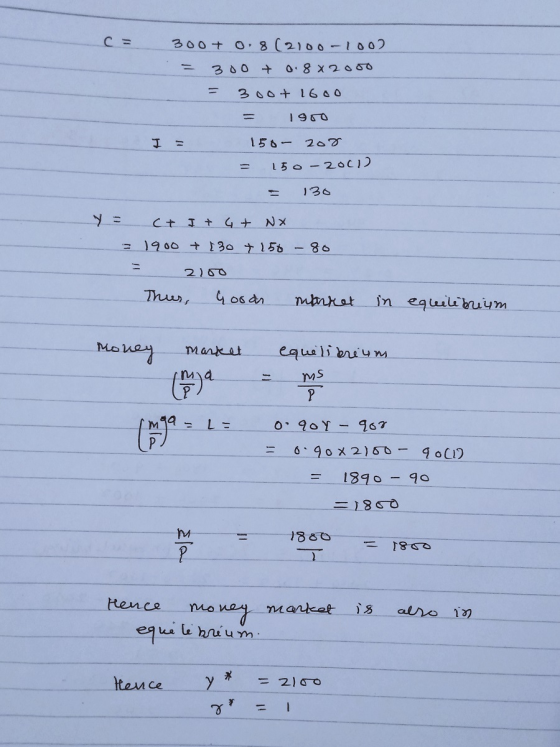
5. Consider the economy of Hicksonia, which can be described by the following equations: (1) C=300+...
6. An open economy is described by the following equations C = 1000 + 0.6(Y-T) I 20, 000 200r G 5...
 Answer the question (c)
6. An open economy is described by the following equations C = 1000 + 0.6(Y-T) I 20, 000 200r G 5000 T = 5000 MD MS = 60.000 CA = NX = 2000-0.1Y-1000e KA = 5500+ 2(r-r") r"--10 (a) Derive the IS curve (Y as a function of r and e), LM curve (Y as a function of r) and the BP curve (r as a function of Y, e, and the capital mobility parameter z)...
Answer the question (c)
6. An open economy is described by the following equations C = 1000 + 0.6(Y-T) I 20, 000 200r G 5000 T = 5000 MD MS = 60.000 CA = NX = 2000-0.1Y-1000e KA = 5500+ 2(r-r") r"--10 (a) Derive the IS curve (Y as a function of r and e), LM curve (Y as a function of r) and the BP curve (r as a function of Y, e, and the capital mobility parameter z)...
The money market for this economy is described by the equations: (M/P) = 0.4Y - 40r...
 The money market for this economy is described by the equations: (M/P) = 0.4Y - 40r M = 1200 P=1 12. Derive a formula for the LM curve, showing Y as a function of r. 13. What are the short run values of Y and ? 14. What are the short run values of Y and rif G increases by 200? What is the multiplier? Is the value different from what you calculated for question 9? Explain why it is...
Assume an goods and services market of an economy is characterized by the following equations: C...
Assume an goods and services market of an economy is characterized by the following equations: C = 0.8 (Y - T) I = 800 -20r Y=C+I+G T = 1000 G = 1000 1. Derive a formula for the IS curve, showing Y as a function of r. The money market for this economy is described by the equations: (M/P) d = 0.4Y - 40r M = 1200 P=1 a) Derive a formula for the LM curve, showing Y as a...
1. Consider an economy described by the following: C = 400 +0SY -IA - TRỊ I...
 1. Consider an economy described by the following: C = 400 +0SY -IA - TRỊ I = 150 -0.18-10 G = 200, T = 2Y, TR = 100 transfers, G- Where consumption, I investment, t is the marginal tax rate, TR government purchases, and is the interest rate. a. Derive the Is relation. (Hint: You want an equation with Y on the left hand side and everything else on the right.) b. What is equilibrium Y if the interest rate...
Assume an goods and services market of an economy is characterized by the following equations: C...
Assume an goods and services market of an economy is characterized by the following equations: C = 0.8 (Y - T) I = 800 -20r Y = C + I + G T = 1000 G = 1000 9. Consider for the moment the Keynesian Cross model. What will happen to the GDP if G increases by 200? What is the multiplier? 10.Keep considering the Keynesian Cross model. What will happen to the GDP if T increases by 200? What...
4. An economy can be described by the following equations: C = 5+.8(Y-T) I = 2-r...
 4. An economy can be described by the following equations: C = 5+.8(Y-T) I = 2-r G = 2 T = 2 L(r,Y) = 4 + 4y -.5r M = 2 P=1 Solve algebraically for an equation for the IS curve (with 'r' on the left-hand side). Do the same for the LM curve. Finally, solve for the equilibrium values of 'r' and 'Y' in the ISLM model:
Consider the Mundel-Fleming small open economy model: Y=C(Y-T)+1(1) + G Y = F(K,L) (M/P) L(r+z® Y)...
 Consider the Mundel-Fleming small open economy model: Y=C(Y-T)+1(1) + G Y = F(K,L) (M/P) L(r+z® Y) Goods Money C = 50+0.8(Y- T) M 3000 I = 200-20r r*=5 NX = 200-508 P = 3 G=T= 150 L(Y, r) Y - 30r 1- find the IS* equation (hint : y as a function of e) 2- find the LM* equation (hint, also relates y and maybe e) 3-draw the IS-LM curve I y 4- find the equilibrium interest rate (trick question!)...
2. (16 points) An economy is initially described by the following equations: C = 500+ 0.75(Y...
 2. (16 points) An economy is initially described by the following equations: C = 500+ 0.75(Y – T) I = 1,000 - 50r M/P=Y - 2007 G= 1,000 T= 1,000 M = 6,000 P=2 (a) Derive the equations for the IS curve and the LM curve. Note: Both equations should either show Y as a function of r only, or s as a function of Y only, like you've seen in class. (b) Solve for the equilibrium interest rate and...
A small open economy is described by the following set of equations: C = 300 +...
A small open economy is described by the following set of equations: C = 300 + 0.6(Y − T) I = 700 − 80r NX = 200 − 50ε G = T = 500 (Balanced Budget) (M/P)^d = Y − 200r M = 3, 000 P = 3 r ∗ = 5 (a) Derive and graph the IS∗ and LM∗ curves. (b) Calculate the equilibrium exchange rate, income and net exports. (c) Assume a floating exchange rate. Calculate what happens...
Problem 4: (30 points) The following equations describe an economy (Think of C, I, G etc.,...
 Problem 4: (30 points) The following equations describe an economy (Think of C, I, G etc., as being measured in billions and i' as a percentage; a 6 percent interest rate implies i =6): C = 100+0.75(1-t)Y t=0.2 I= 150 - 301 NX = -100 G = 400 L = 2Y - 80i M B = 1600 a. What is the equation that describes the IS curve? (10 points) b. What is the general definition of the IS curve? (2...
 Answer the question (c)
6. An open economy is described by the following equations C = 1000 + 0.6(Y-T) I 20, 000 200r G 5000 T = 5000 MD MS = 60.000 CA = NX = 2000-0.1Y-1000e KA = 5500+ 2(r-r") r"--10 (a) Derive the IS curve (Y as a function of r and e), LM curve (Y as a function of r) and the BP curve (r as a function of Y, e, and the capital mobility parameter z)...
Answer the question (c)
6. An open economy is described by the following equations C = 1000 + 0.6(Y-T) I 20, 000 200r G 5000 T = 5000 MD MS = 60.000 CA = NX = 2000-0.1Y-1000e KA = 5500+ 2(r-r") r"--10 (a) Derive the IS curve (Y as a function of r and e), LM curve (Y as a function of r) and the BP curve (r as a function of Y, e, and the capital mobility parameter z)...
 The money market for this economy is described by the equations: (M/P) = 0.4Y - 40r M = 1200 P=1 12. Derive a formula for the LM curve, showing Y as a function of r. 13. What are the short run values of Y and ? 14. What are the short run values of Y and rif G increases by 200? What is the multiplier? Is the value different from what you calculated for question 9? Explain why it is...
 1. Consider an economy described by the following: C = 400 +0SY -IA - TRỊ I = 150 -0.18-10 G = 200, T = 2Y, TR = 100 transfers, G- Where consumption, I investment, t is the marginal tax rate, TR government purchases, and is the interest rate. a. Derive the Is relation. (Hint: You want an equation with Y on the left hand side and everything else on the right.) b. What is equilibrium Y if the interest rate...
 4. An economy can be described by the following equations: C = 5+.8(Y-T) I = 2-r G = 2 T = 2 L(r,Y) = 4 + 4y -.5r M = 2 P=1 Solve algebraically for an equation for the IS curve (with 'r' on the left-hand side). Do the same for the LM curve. Finally, solve for the equilibrium values of 'r' and 'Y' in the ISLM model:
 Consider the Mundel-Fleming small open economy model: Y=C(Y-T)+1(1) + G Y = F(K,L) (M/P) L(r+z® Y) Goods Money C = 50+0.8(Y- T) M 3000 I = 200-20r r*=5 NX = 200-508 P = 3 G=T= 150 L(Y, r) Y - 30r 1- find the IS* equation (hint : y as a function of e) 2- find the LM* equation (hint, also relates y and maybe e) 3-draw the IS-LM curve I y 4- find the equilibrium interest rate (trick question!)...
 2. (16 points) An economy is initially described by the following equations: C = 500+ 0.75(Y – T) I = 1,000 - 50r M/P=Y - 2007 G= 1,000 T= 1,000 M = 6,000 P=2 (a) Derive the equations for the IS curve and the LM curve. Note: Both equations should either show Y as a function of r only, or s as a function of Y only, like you've seen in class. (b) Solve for the equilibrium interest rate and...
 Problem 4: (30 points) The following equations describe an economy (Think of C, I, G etc., as being measured in billions and i' as a percentage; a 6 percent interest rate implies i =6): C = 100+0.75(1-t)Y t=0.2 I= 150 - 301 NX = -100 G = 400 L = 2Y - 80i M B = 1600 a. What is the equation that describes the IS curve? (10 points) b. What is the general definition of the IS curve? (2...
Most questions answered within 3 hours.
-
Where is the error in this code sequence?
String s1 = "Hello";
String s2 = "ello";...
asked 11 months ago -
Financial data for Joel de Paris, Inc., for last year
follow:
Joel de Paris, Inc.
Balance...
asked 11 months ago -
Consider this reaction:
Al2(SO4)3 (aq)+ BaCl3
(aq) Al2Cl6 (aq)- +
3BaSO4(s) . What is the...
asked 11 months ago -
Suppose that Savneet is considering increasing her
recent random sample from 20 car rentals to 40...
asked 11 months ago -
Trucks arrive at an unloading terminal at an average rate of 120
per hour.
Trucks arrive...
asked 11 months ago -
Why are methanol and ethanol completely soluble in water while
octanol is not very little soluble....
asked 11 months ago -
A facilities manager at a university reads in a research report
that the mean amount of...
asked 11 months ago -
When the CuSO4 is rehydrated by adding water to the anhydrous
compound, is this an endothermic...
asked 11 months ago -
A ray of sunlight is passing from diamond into crown glass; the
angle of incidence is...
asked 11 months ago -
A block of mass 0.249 kg is placed on top of a light, vertical
spring of...
asked 11 months ago -
how do the kidneys compensate in the presences of acidosis
a) trigger hyperventilate
b) reserve acid...
asked 11 months ago -
Question 501 pts
The rental rate of capital to the firm increases. Which of the
following...
asked 11 months ago