
Homework Answers


Add Answer to:
6.5 (8 pts) Determine the magnitude (in dB) and the phase (in degrees) of H(a) at...
I just need answers to f,g,and h connected motor is connected to Vi-L 120 3T/6 V-rms, 50 Hz three e resistance and inductance of each phase is 8-Ω and 0.04 H, respectively. The PS. A three-phase p...
 I just need answers to f,g,and h
connected motor is connected to Vi-L 120 3T/6 V-rms, 50 Hz three e resistance and inductance of each phase is 8-Ω and 0.04 H, respectively. The PS. A three-phase phase source. The wire between a source and the motor has 0.1-Ω of resistance and 1 mH inductance. nd the phase voltage. (2 pts.) a single-phase diagram of the system with its values. (5 pts.) c) Find the line current (magnitude and phase) for...
I just need answers to f,g,and h
connected motor is connected to Vi-L 120 3T/6 V-rms, 50 Hz three e resistance and inductance of each phase is 8-Ω and 0.04 H, respectively. The PS. A three-phase phase source. The wire between a source and the motor has 0.1-Ω of resistance and 1 mH inductance. nd the phase voltage. (2 pts.) a single-phase diagram of the system with its values. (5 pts.) c) Find the line current (magnitude and phase) for...
For the circuit shown in the figure above: Obtain an expression for H() Vo/Vi in standard form Generate spectral plots for the magnitude and phase of H (w), given that R-100Ω, L-0.1 mH, and C-1 μF De...
 For the circuit shown in the figure above: Obtain an expression for H() Vo/Vi in standard form Generate spectral plots for the magnitude and phase of H (w), given that R-100Ω, L-0.1 mH, and C-1 μF Determine the cutoff frequency we and the slope of the magnitude (in dB) when wwc >1
For the circuit shown in the figure above: Obtain an expression for H() Vo/Vi in standard form Generate spectral plots for the magnitude and phase of H (w),...
For the circuit shown in the figure above: Obtain an expression for H() Vo/Vi in standard form Generate spectral plots for the magnitude and phase of H (w), given that R-100Ω, L-0.1 mH, and C-1 μF Determine the cutoff frequency we and the slope of the magnitude (in dB) when wwc >1
For the circuit shown in the figure above: Obtain an expression for H() Vo/Vi in standard form Generate spectral plots for the magnitude and phase of H (w),...
a. For the following Bode diagram, determine: Bode Diagram (7 marks Magnitude (dB) Phase (deg! Frequency...
 a. For the following Bode diagram, determine: Bode Diagram (7 marks Magnitude (dB) Phase (deg! Frequency (rad/s! 1. The gain margin. 2. The phase margin. 3. Gain crossover frequency. 4. Phase crossover frequency. 5. Comment on the stability of this system.
3. Consider the transfer function: ls0 (s +0.5(s +2(s +3)(s +4(s+10) (s +3.5) (s +4.5) (s 5.5) (s...
 3. Consider the transfer function: ls0 (s +0.5(s +2(s +3)(s +4(s+10) (s +3.5) (s +4.5) (s 5.5) (s 6.5)(s +20.5) (a) [6] Find the phase angle (degrees) and gain (in dB, Bode units) for the following frequencies (in rad/sec) rail Gp(ju) dB 0.1 21 56 b) [3 What is the gain crossover frequency for this system? (c) [8] Design a PD controller so that-0.3 ± 0.3] is a pole of the closed-loop system.
3. Consider the transfer function: ls0 (s...
3. Consider the transfer function: ls0 (s +0.5(s +2(s +3)(s +4(s+10) (s +3.5) (s +4.5) (s 5.5) (s 6.5)(s +20.5) (a) [6] Find the phase angle (degrees) and gain (in dB, Bode units) for the following frequencies (in rad/sec) rail Gp(ju) dB 0.1 21 56 b) [3 What is the gain crossover frequency for this system? (c) [8] Design a PD controller so that-0.3 ± 0.3] is a pole of the closed-loop system.
3. Consider the transfer function: ls0 (s...
Determine DC gain and crossover frequency from the following Bode plots. Magnitude (dB) Phase (deg) -180...
 Determine DC gain and crossover frequency from the following Bode plots. Magnitude (dB) Phase (deg) -180 10-1 100 103 10 Frequency (rad/s) DC gain = 10.8, cr = 1.2 rad/s DC gain = 2.5, wc = 4.2 rad/s DC gain = 5.0 dB, -2.5 rad/s • DC gain = 1.8 dB, -2.1 rad/
%from graph: find the % cut off frequency (where magnitude is -dB) find the pass band...
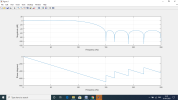 %from graph:
find the % cut off frequency (where magnitude is -dB)
find the pass band ripple
find stop band attenuation
- 5 X Figure 5 File Edit View 18 Insert Tools Desktop Window . 3 Help O E Magnitude (dB) 100 150 200 250 Frequency (Hz) Phase (degrees) 8000 100 150 200 250 Frequency (Hz) 1 Type here to search o e mêm 9 12:41 A ENG 10 10-04-2020 W O
%from graph:
find the % cut off frequency (where magnitude is -dB)
find the pass band ripple
find stop band attenuation
- 5 X Figure 5 File Edit View 18 Insert Tools Desktop Window . 3 Help O E Magnitude (dB) 100 150 200 250 Frequency (Hz) Phase (degrees) 8000 100 150 200 250 Frequency (Hz) 1 Type here to search o e mêm 9 12:41 A ENG 10 10-04-2020 W O
21 Vi Z2 Vo Figure 1 1. Ref: Figure 1. Let Z1 L (an inductor), Z2 - R (a resistor). Vi Calculate the magnitude and phase of the transfer function H(w) Figure 1 T 2. Repeat #1 with L = 100 mH, R 1kΩ....
 21 Vi Z2 Vo Figure 1 1. Ref: Figure 1. Let Z1 L (an inductor), Z2 - R (a resistor). Vi Calculate the magnitude and phase of the transfer function H(w) Figure 1 T 2. Repeat #1 with L = 100 mH, R 1kΩ. a) Plot the frequency response in dB* on a both on a linear scale and then a log scale from ω-1 to 100,000,000 rad/sec with points every decade (1 b) 1,000 etc). 10 100 Plot the...
For all problems -given a transfer function G(s) sketch the magnitude and phase characteristics in the...
 For all problems -given a transfer function G(s) sketch the magnitude and phase characteristics in the logarithmic scale (i.e. Bode-plots) of the system using the following rules-of-thumb: i. "Normalize" the G(s) by extracting poles/zeros, substituting s-jw and writing the TF using DC-gain KO and time-constants i. Arange break-points (poles, zeros or on for complex-conjugate poles) in ascending order ii Based on the term Ko(ju)Fk, determine: initial slope of the magnitude-response asymptote for low frequencies as F k 20 dB/dec (e.g....
Q2. Fill in the following table based on the magnitude and phase plots shown below. Freq...
 Q2. Fill in the following table based on the magnitude and phase plots shown below. Freq (rad/s) Mag (dB) Mag Phase 40 20 0 -20 -40 .1 Magnitude (dB) 1 2 100 10 Frequency w rad/s) 5 90 10 45 0 Phase (deg) 40 -45 -90 -135 -180 100 10 100 Frequency w rad/s)
Using Matlab, plot the magnitude and phase of the transfer function (vo/vi) vs. frequency range 1-100...
 Using Matlab, plot the magnitude and phase of the transfer
function (vo/vi) vs. frequency range 1-100 kHz. Use log scale for
the frequency axis, dB scale for the magnitude axis, and degrees
for the phase axis. Note dB = 20log10(vo/vi). The 10 stands for
base 10. I need help writing a MATLAB code to output this plot and
also coming up with the vo/vi function itself.
0.1807 H 1402 nF 0.1624 H 1.560nF 1.559 mH
Using Matlab, plot the magnitude and phase of the transfer
function (vo/vi) vs. frequency range 1-100 kHz. Use log scale for
the frequency axis, dB scale for the magnitude axis, and degrees
for the phase axis. Note dB = 20log10(vo/vi). The 10 stands for
base 10. I need help writing a MATLAB code to output this plot and
also coming up with the vo/vi function itself.
0.1807 H 1402 nF 0.1624 H 1.560nF 1.559 mH
 I just need answers to f,g,and h
connected motor is connected to Vi-L 120 3T/6 V-rms, 50 Hz three e resistance and inductance of each phase is 8-Ω and 0.04 H, respectively. The PS. A three-phase phase source. The wire between a source and the motor has 0.1-Ω of resistance and 1 mH inductance. nd the phase voltage. (2 pts.) a single-phase diagram of the system with its values. (5 pts.) c) Find the line current (magnitude and phase) for...
I just need answers to f,g,and h
connected motor is connected to Vi-L 120 3T/6 V-rms, 50 Hz three e resistance and inductance of each phase is 8-Ω and 0.04 H, respectively. The PS. A three-phase phase source. The wire between a source and the motor has 0.1-Ω of resistance and 1 mH inductance. nd the phase voltage. (2 pts.) a single-phase diagram of the system with its values. (5 pts.) c) Find the line current (magnitude and phase) for...
 For the circuit shown in the figure above: Obtain an expression for H() Vo/Vi in standard form Generate spectral plots for the magnitude and phase of H (w), given that R-100Ω, L-0.1 mH, and C-1 μF Determine the cutoff frequency we and the slope of the magnitude (in dB) when wwc >1
For the circuit shown in the figure above: Obtain an expression for H() Vo/Vi in standard form Generate spectral plots for the magnitude and phase of H (w),...
For the circuit shown in the figure above: Obtain an expression for H() Vo/Vi in standard form Generate spectral plots for the magnitude and phase of H (w), given that R-100Ω, L-0.1 mH, and C-1 μF Determine the cutoff frequency we and the slope of the magnitude (in dB) when wwc >1
For the circuit shown in the figure above: Obtain an expression for H() Vo/Vi in standard form Generate spectral plots for the magnitude and phase of H (w),...
 a. For the following Bode diagram, determine: Bode Diagram (7 marks Magnitude (dB) Phase (deg! Frequency (rad/s! 1. The gain margin. 2. The phase margin. 3. Gain crossover frequency. 4. Phase crossover frequency. 5. Comment on the stability of this system.
 3. Consider the transfer function: ls0 (s +0.5(s +2(s +3)(s +4(s+10) (s +3.5) (s +4.5) (s 5.5) (s 6.5)(s +20.5) (a) [6] Find the phase angle (degrees) and gain (in dB, Bode units) for the following frequencies (in rad/sec) rail Gp(ju) dB 0.1 21 56 b) [3 What is the gain crossover frequency for this system? (c) [8] Design a PD controller so that-0.3 ± 0.3] is a pole of the closed-loop system.
3. Consider the transfer function: ls0 (s...
3. Consider the transfer function: ls0 (s +0.5(s +2(s +3)(s +4(s+10) (s +3.5) (s +4.5) (s 5.5) (s 6.5)(s +20.5) (a) [6] Find the phase angle (degrees) and gain (in dB, Bode units) for the following frequencies (in rad/sec) rail Gp(ju) dB 0.1 21 56 b) [3 What is the gain crossover frequency for this system? (c) [8] Design a PD controller so that-0.3 ± 0.3] is a pole of the closed-loop system.
3. Consider the transfer function: ls0 (s...
 Determine DC gain and crossover frequency from the following Bode plots. Magnitude (dB) Phase (deg) -180 10-1 100 103 10 Frequency (rad/s) DC gain = 10.8, cr = 1.2 rad/s DC gain = 2.5, wc = 4.2 rad/s DC gain = 5.0 dB, -2.5 rad/s • DC gain = 1.8 dB, -2.1 rad/
 %from graph:
find the % cut off frequency (where magnitude is -dB)
find the pass band ripple
find stop band attenuation
- 5 X Figure 5 File Edit View 18 Insert Tools Desktop Window . 3 Help O E Magnitude (dB) 100 150 200 250 Frequency (Hz) Phase (degrees) 8000 100 150 200 250 Frequency (Hz) 1 Type here to search o e mêm 9 12:41 A ENG 10 10-04-2020 W O
%from graph:
find the % cut off frequency (where magnitude is -dB)
find the pass band ripple
find stop band attenuation
- 5 X Figure 5 File Edit View 18 Insert Tools Desktop Window . 3 Help O E Magnitude (dB) 100 150 200 250 Frequency (Hz) Phase (degrees) 8000 100 150 200 250 Frequency (Hz) 1 Type here to search o e mêm 9 12:41 A ENG 10 10-04-2020 W O
 21 Vi Z2 Vo Figure 1 1. Ref: Figure 1. Let Z1 L (an inductor), Z2 - R (a resistor). Vi Calculate the magnitude and phase of the transfer function H(w) Figure 1 T 2. Repeat #1 with L = 100 mH, R 1kΩ. a) Plot the frequency response in dB* on a both on a linear scale and then a log scale from ω-1 to 100,000,000 rad/sec with points every decade (1 b) 1,000 etc). 10 100 Plot the...
 For all problems -given a transfer function G(s) sketch the magnitude and phase characteristics in the logarithmic scale (i.e. Bode-plots) of the system using the following rules-of-thumb: i. "Normalize" the G(s) by extracting poles/zeros, substituting s-jw and writing the TF using DC-gain KO and time-constants i. Arange break-points (poles, zeros or on for complex-conjugate poles) in ascending order ii Based on the term Ko(ju)Fk, determine: initial slope of the magnitude-response asymptote for low frequencies as F k 20 dB/dec (e.g....
 Q2. Fill in the following table based on the magnitude and phase plots shown below. Freq (rad/s) Mag (dB) Mag Phase 40 20 0 -20 -40 .1 Magnitude (dB) 1 2 100 10 Frequency w rad/s) 5 90 10 45 0 Phase (deg) 40 -45 -90 -135 -180 100 10 100 Frequency w rad/s)
 Using Matlab, plot the magnitude and phase of the transfer
function (vo/vi) vs. frequency range 1-100 kHz. Use log scale for
the frequency axis, dB scale for the magnitude axis, and degrees
for the phase axis. Note dB = 20log10(vo/vi). The 10 stands for
base 10. I need help writing a MATLAB code to output this plot and
also coming up with the vo/vi function itself.
0.1807 H 1402 nF 0.1624 H 1.560nF 1.559 mH
Using Matlab, plot the magnitude and phase of the transfer
function (vo/vi) vs. frequency range 1-100 kHz. Use log scale for
the frequency axis, dB scale for the magnitude axis, and degrees
for the phase axis. Note dB = 20log10(vo/vi). The 10 stands for
base 10. I need help writing a MATLAB code to output this plot and
also coming up with the vo/vi function itself.
0.1807 H 1402 nF 0.1624 H 1.560nF 1.559 mH
Most questions answered within 3 hours.
-
Where is the error in this code sequence?
String s1 = "Hello";
String s2 = "ello";...
asked 11 months ago -
Financial data for Joel de Paris, Inc., for last year
follow:
Joel de Paris, Inc.
Balance...
asked 11 months ago -
Consider this reaction:
Al2(SO4)3 (aq)+ BaCl3
(aq) Al2Cl6 (aq)- +
3BaSO4(s) . What is the...
asked 11 months ago -
Suppose that Savneet is considering increasing her
recent random sample from 20 car rentals to 40...
asked 11 months ago -
Trucks arrive at an unloading terminal at an average rate of 120
per hour.
Trucks arrive...
asked 11 months ago -
Why are methanol and ethanol completely soluble in water while
octanol is not very little soluble....
asked 11 months ago -
A facilities manager at a university reads in a research report
that the mean amount of...
asked 11 months ago -
When the CuSO4 is rehydrated by adding water to the anhydrous
compound, is this an endothermic...
asked 11 months ago -
A ray of sunlight is passing from diamond into crown glass; the
angle of incidence is...
asked 11 months ago -
A block of mass 0.249 kg is placed on top of a light, vertical
spring of...
asked 11 months ago -
how do the kidneys compensate in the presences of acidosis
a) trigger hyperventilate
b) reserve acid...
asked 11 months ago -
Question 501 pts
The rental rate of capital to the firm increases. Which of the
following...
asked 11 months ago