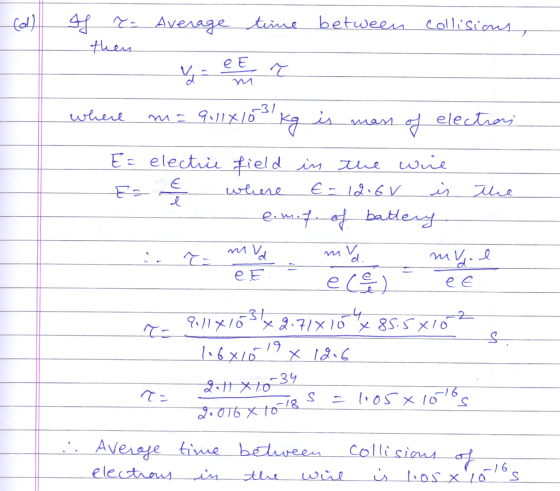
 the emf provided by the battery
is 12.6 V
the emf provided by the battery
is 12.6 V
Homework Answers
Add Answer to:
the emf provided by the battery
is 12.6 V
1 Current Density and Drift Speed a)...
Help please Current Density and Drift Speed A group of charges, each with charge q, moves...
 Help please
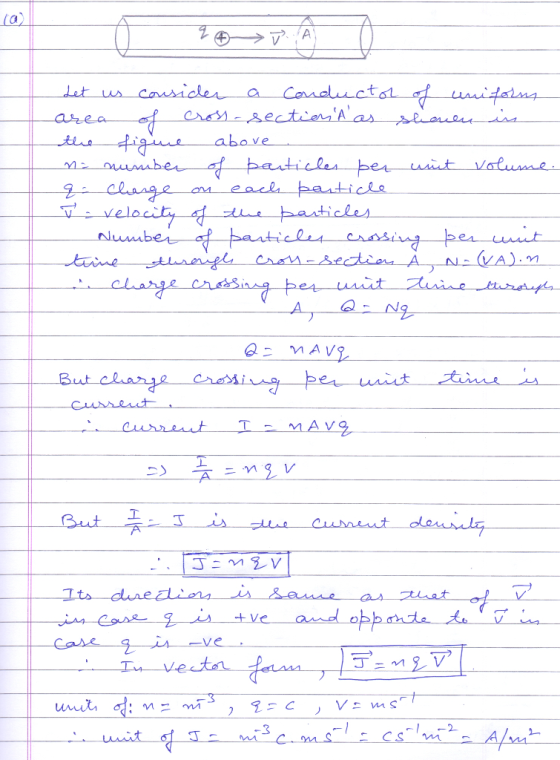
Current Density and Drift Speed A group of charges, each with charge q, moves with velocity v^vector. The number of particles per unit volume is n. What is the current density J^vector of these charges, in magnitude and direction? Make sure that your answer has units of A/m^2. We want to calculate how long it takes an electron to get from a car battery to the starter motor after the ignition switch is turned. Assume that the current...
Help please
Current Density and Drift Speed A group of charges, each with charge q, moves with velocity v^vector. The number of particles per unit volume is n. What is the current density J^vector of these charges, in magnitude and direction? Make sure that your answer has units of A/m^2. We want to calculate how long it takes an electron to get from a car battery to the starter motor after the ignition switch is turned. Assume that the current...
1. When a current flows in an aluminum wire of diameter 4.67 mm, the drift speed...
1. When a current flows in an aluminum wire of diameter 4.67 mm, the drift speed of the conduction electrons is 0.000135 m/s. How many electrons are flowing past a given point each second? The conduction electron density in aluminum is 6.00×1028 m−3. 2. When a current flows in an aluminum wire of diameter 2.15 mm, the drift speed of the conduction electrons is 0.000249 m/s. How many electrons are flowing past a given point each second? The conduction electron...
A small but measurable current of 8.7 × 10⁻¹⁰ A exists in a copper wire whose...
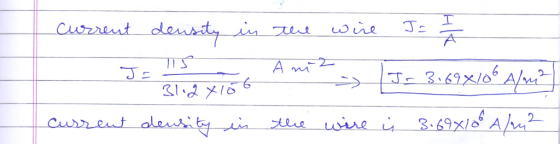
A small but measurable current of 8.7 × 10⁻¹⁰ A exists in a copper wire whose diameter is 2.3 mm. The number of charge carriers per unit volume is 8.49 × 1028 m-3. Assuming the current is uniform, calculate the (a) current density and (b) electron drift speed.
A small but measurable current of 8.9 × 10⁻¹⁰ A exists in a copper wire whose...
A small but measurable current of 8.9 × 10⁻¹⁰ A exists in a copper wire whose diameter is 2.2 mm. The number of charge carriers per unit volume is 8.49 × 1028 m-3. Assuming the current is uniform, calculate the (a) current density and (b) electron drift speed.
A small but measurable current of 8.1 × 10⁻¹⁰ A exists in a copper wire whose...
A small but measurable current of 8.1 × 10⁻¹⁰ A exists in a copper wire whose diameter is 2.3 mm. The number of charge carriers per unit volume is 8.49 × 1028 m-3. Assuming the current is uniform, calculate the (a) current density and (b) electron drift speed.
Question 1: a) What are current density and drift speed? Why is the drift speed always...
 Question 1: a) What are current density and drift speed? Why is the drift speed always smaller than the actual speed of electron? (4) I b) 10.0 m length of wire consists of 4.0 m of copper followed by 6.0 m of aluminum, both of diameter 1.4 mm. A voltage difference of 80 mV is placed across the composite wire (a) What is the total resistance (sum) of the two wires? (b) What is the current through the wire? (c)...
A small but measurable current of 9.3 x 10⁻¹⁰ A exists in a copper wire whose...
A small but measurable current of 9.3 x 10⁻¹⁰ A exists in a copper wire whose diameter is 3.6 mm. The number of charge carriers per unit volume is 8.49 x 1028 m-3. Assuming the current is uniform, calculate the (a) current density and (b) electron drift speed.
0 A exists in a copper wire whose diameter is 3.6 mm. The number of charge...
 0 A exists in a copper wire whose diameter is 3.6 mm. The number of charge carriers per unit volume is 8.49 x 1028 m 3. Assuming the current is uniform, calculate the (a) current density and (b) electron drift speed. (a) Number (b) Number Units Units
How long does it take electrons to get from a car battery to the starting motor?...
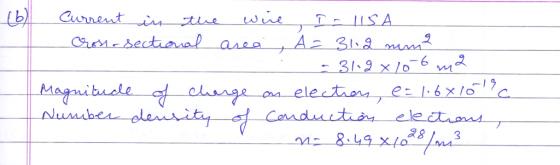
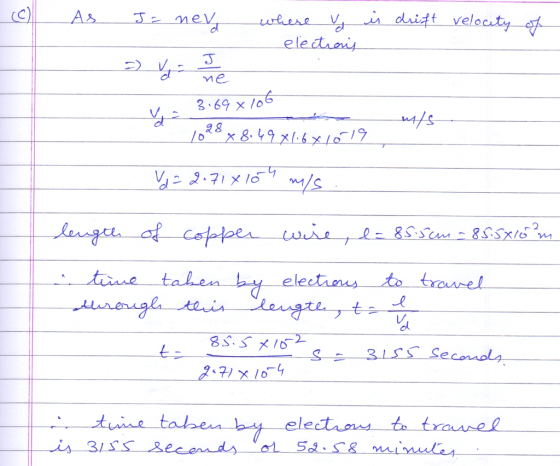
How long does it take electrons to get from a car battery to the starting motor? Assume the current is 250 A and the electrons travel through a copper wire with cross-sectional area 0.19 cm2 and length 0.79 m. The number of charge carriers per unit volume is 8.49·1028 m-3.
How long does it take electrons to get from a car battery to the starting motor?...
How long does it take electrons to get from a car battery to the starting motor? Assume the current is 280 A and the electrons travel through a copper wire with cross-sectional area 0.260 cm2 and length 1.00 m. The number of charge carriers per unit volume is 8.49 × 1028 m-3.
 Help please
Current Density and Drift Speed A group of charges, each with charge q, moves with velocity v^vector. The number of particles per unit volume is n. What is the current density J^vector of these charges, in magnitude and direction? Make sure that your answer has units of A/m^2. We want to calculate how long it takes an electron to get from a car battery to the starter motor after the ignition switch is turned. Assume that the current...
Help please
Current Density and Drift Speed A group of charges, each with charge q, moves with velocity v^vector. The number of particles per unit volume is n. What is the current density J^vector of these charges, in magnitude and direction? Make sure that your answer has units of A/m^2. We want to calculate how long it takes an electron to get from a car battery to the starter motor after the ignition switch is turned. Assume that the current...
 Question 1: a) What are current density and drift speed? Why is the drift speed always smaller than the actual speed of electron? (4) I b) 10.0 m length of wire consists of 4.0 m of copper followed by 6.0 m of aluminum, both of diameter 1.4 mm. A voltage difference of 80 mV is placed across the composite wire (a) What is the total resistance (sum) of the two wires? (b) What is the current through the wire? (c)...
 0 A exists in a copper wire whose diameter is 3.6 mm. The number of charge carriers per unit volume is 8.49 x 1028 m 3. Assuming the current is uniform, calculate the (a) current density and (b) electron drift speed. (a) Number (b) Number Units Units
Most questions answered within 3 hours.
-
Where is the error in this code sequence?
String s1 = "Hello";
String s2 = "ello";...
asked 11 months ago -
Financial data for Joel de Paris, Inc., for last year
follow:
Joel de Paris, Inc.
Balance...
asked 11 months ago -
Consider this reaction:
Al2(SO4)3 (aq)+ BaCl3
(aq) Al2Cl6 (aq)- +
3BaSO4(s) . What is the...
asked 11 months ago -
Suppose that Savneet is considering increasing her
recent random sample from 20 car rentals to 40...
asked 11 months ago -
Trucks arrive at an unloading terminal at an average rate of 120
per hour.
Trucks arrive...
asked 11 months ago -
Why are methanol and ethanol completely soluble in water while
octanol is not very little soluble....
asked 11 months ago -
A facilities manager at a university reads in a research report
that the mean amount of...
asked 11 months ago -
When the CuSO4 is rehydrated by adding water to the anhydrous
compound, is this an endothermic...
asked 11 months ago -
A ray of sunlight is passing from diamond into crown glass; the
angle of incidence is...
asked 11 months ago -
A block of mass 0.249 kg is placed on top of a light, vertical
spring of...
asked 11 months ago -
how do the kidneys compensate in the presences of acidosis
a) trigger hyperventilate
b) reserve acid...
asked 11 months ago -
Question 501 pts
The rental rate of capital to the firm increases. Which of the
following...
asked 11 months ago