A fuel cell designed to react grain alcohol with oxygen has the following net reaction: C2H5OH(l)...
A fuel cell designed to react grain alcohol with oxygen has the
following net reaction:
C2H5OH(l) + 3 O2(g) –––> 2 CO2(g) + 3 H2O(l)
The maximum work that 1 mole of alcohol can yield by this process
is 1320 kJ. What is the
theoretical maximum voltage that this cell can achieve?
NOTE: The first step in solving this problem is to determine n, the
number of moles of electrons
transferred when this reaction takes place as written.
A) 1.14 V B) 2.28 V C) 2.01 V D) 0.760 V E) 13.7 V
Homework Answers
no. of electron transferred = change in oxidation no. of oxygen * 6 = (0- (-2)) * 6 = 12
now for a cell reaction
G = - n F
Ecell
-1320 * 1000 = - 12 * 96500 * Ecell
so Ecell = 1320000 / (12*96500) = 1.139
so maximum voltage of cell = 1.14 Volt (Answer is option A)
Add Answer to:
A fuel cell designed to react grain alcohol with oxygen has the
following net reaction:
C2H5OH(l)...
3. A fuel cell designed to react grain alcohol with oxygen has the following net reaction:...
 3. A fuel cell designed to react grain alcohol with oxygen has the following net reaction: C2H5OH(1) + 302(g) → 2CO2(g) + 3H2O(1) The maximum work one mole of alcohol can yield by this process is 1320 kJ. What is the theoretical maximum voltage this cell can achieve?
QUESTION 3 A fuel cell designed to react grain alcohol with oxygen has the following net...
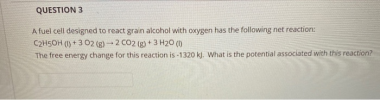 QUESTION 3 A fuel cell designed to react grain alcohol with oxygen has the following net reaction: C2H5OH (1) + 3 O2(g) 2 CO2 (g) + 3 H20 (1) The free energy change for this reaction is -1320 k). What is the potential associated with this reaction?
Gases are most likely to be found in a phase diagram under conditions of high temperature...
 Gases are most likely to be found in a phase diagram under conditions of high temperature and high pressure high temperature and low pressure low temperature and high pressure low temperature and low pressure moderate temperature and pressure Problems in this section are worth six each plus 4 additional point for work shown in the blue booklet. The half-life of the radioisotope^158 Eu is 0.77 h. How much time is required for a 160.0-g sample of^158 Eu to decay to...
(a) A muscle can be thought of as a fuel cell, producing work from the metabolism...
 (a) A muscle can be thought of as a fuel cell, producing work from the metabolism of glucose (C6H1206): C6H1206 (glucose) +202(9) + 2H2O(l) + CO2(g). (0.1) Here g and I refer to the gaseous and liquid states, respectively. Using data given in the table, please determine the values of AH and AG for this reaction for one mole of glucose, assuming that the reaction takes place at room temperature and atmospheric pressure. Substance CH 20. (glucose) 0 (9) H200...
5) How many moles of hydrogen gas are needed to react with oxygen to form one...
 5) How many moles of hydrogen gas are needed to react with oxygen to form one mole of 5) water? 2H2(8) + O268) - 2H20(1) A) 4 mol B) 1 mol C) 2 mol D) 0.5 mol E) 6 mol 6) Incomplete combustion occurs when there is insufficient oxygen to react with a compound. The suffocating gas carbon monoxide is a product of incomplete combustion. How many moles of oxygen gas are required for the complete combustion of 11.0 moles...
12. (30 Points) A muscle can be thought of as a fuel cell, producing work from...
 12. (30 Points) A muscle can be thought of as a fuel cell, producing work from the metabolism of glucose C.H1206+603-6002+6H20. (a) Determine AH for the reaction (1) Determine AG for the reaction (c) What is the maximum amount of work that a muscle can perform, for each mole of glucose consumed, assuming ideal operation (d) How much heat is transferred in this process is it in or out of system?). IRUN II 30), LKR ), and Anderson (1996). Please...
 3. A fuel cell designed to react grain alcohol with oxygen has the following net reaction: C2H5OH(1) + 302(g) → 2CO2(g) + 3H2O(1) The maximum work one mole of alcohol can yield by this process is 1320 kJ. What is the theoretical maximum voltage this cell can achieve?
 QUESTION 3 A fuel cell designed to react grain alcohol with oxygen has the following net reaction: C2H5OH (1) + 3 O2(g) 2 CO2 (g) + 3 H20 (1) The free energy change for this reaction is -1320 k). What is the potential associated with this reaction?
 Gases are most likely to be found in a phase diagram under conditions of high temperature and high pressure high temperature and low pressure low temperature and high pressure low temperature and low pressure moderate temperature and pressure Problems in this section are worth six each plus 4 additional point for work shown in the blue booklet. The half-life of the radioisotope^158 Eu is 0.77 h. How much time is required for a 160.0-g sample of^158 Eu to decay to...
 (a) A muscle can be thought of as a fuel cell, producing work from the metabolism of glucose (C6H1206): C6H1206 (glucose) +202(9) + 2H2O(l) + CO2(g). (0.1) Here g and I refer to the gaseous and liquid states, respectively. Using data given in the table, please determine the values of AH and AG for this reaction for one mole of glucose, assuming that the reaction takes place at room temperature and atmospheric pressure. Substance CH 20. (glucose) 0 (9) H200...
 5) How many moles of hydrogen gas are needed to react with oxygen to form one mole of 5) water? 2H2(8) + O268) - 2H20(1) A) 4 mol B) 1 mol C) 2 mol D) 0.5 mol E) 6 mol 6) Incomplete combustion occurs when there is insufficient oxygen to react with a compound. The suffocating gas carbon monoxide is a product of incomplete combustion. How many moles of oxygen gas are required for the complete combustion of 11.0 moles...
 12. (30 Points) A muscle can be thought of as a fuel cell, producing work from the metabolism of glucose C.H1206+603-6002+6H20. (a) Determine AH for the reaction (1) Determine AG for the reaction (c) What is the maximum amount of work that a muscle can perform, for each mole of glucose consumed, assuming ideal operation (d) How much heat is transferred in this process is it in or out of system?). IRUN II 30), LKR ), and Anderson (1996). Please...
Most questions answered within 3 hours.
-
Where is the error in this code sequence?
String s1 = "Hello";
String s2 = "ello";...
asked 10 months ago -
Financial data for Joel de Paris, Inc., for last year
follow:
Joel de Paris, Inc.
Balance...
asked 10 months ago -
Consider this reaction:
Al2(SO4)3 (aq)+ BaCl3
(aq) Al2Cl6 (aq)- +
3BaSO4(s) . What is the...
asked 10 months ago -
Suppose that Savneet is considering increasing her
recent random sample from 20 car rentals to 40...
asked 10 months ago -
Trucks arrive at an unloading terminal at an average rate of 120
per hour.
Trucks arrive...
asked 10 months ago -
Why are methanol and ethanol completely soluble in water while
octanol is not very little soluble....
asked 10 months ago -
A facilities manager at a university reads in a research report
that the mean amount of...
asked 10 months ago -
When the CuSO4 is rehydrated by adding water to the anhydrous
compound, is this an endothermic...
asked 10 months ago -
A ray of sunlight is passing from diamond into crown glass; the
angle of incidence is...
asked 10 months ago -
A block of mass 0.249 kg is placed on top of a light, vertical
spring of...
asked 10 months ago -
how do the kidneys compensate in the presences of acidosis
a) trigger hyperventilate
b) reserve acid...
asked 10 months ago -
Question 501 pts
The rental rate of capital to the firm increases. Which of the
following...
asked 10 months ago