![[10 pts] Each of the following diagrams shows the fields (to scale) on either side of the boundary between two linear media. B. B, Case 1 Case 2 Case 3 For each diagram, state whether or not the fields shown are physically possible. Explain your reasoning for each case Case 1 Case 2 Case 3 If you have any reasoning that may apply to all three cases, you may write your explanation below](http://img.homeworklib.com/questions/261a4f80-bfa3-11ea-a2c9-357f2126f151.png?x-oss-process=image/resize,w_560)
Homework Answers
Here we use the fact that the tangential component of E field is continuous and the normal component of B field is continuous.
Explaination for each case is sepately given in the below picture.
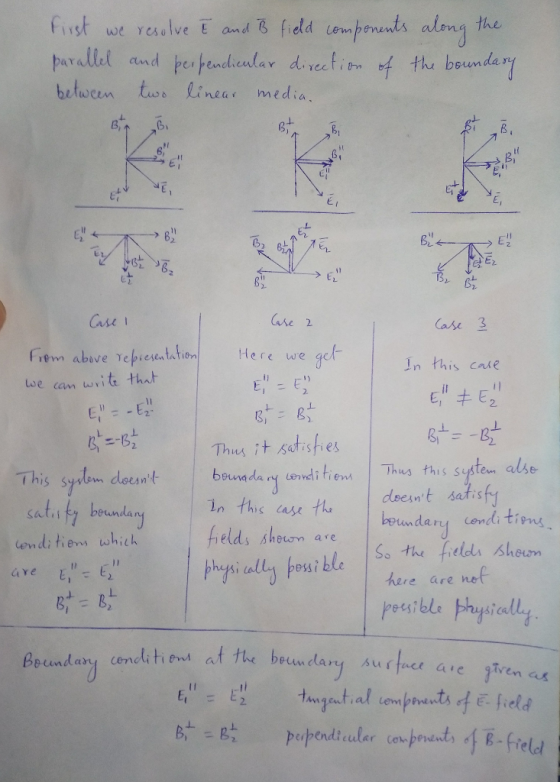
I have explained the solution in the image.
If you like my answer give a thumbs up and if you have any doubt feel free to comment and let me know.
Add Answer to:
[10 pts] Each of the following diagrams shows the fields (to scale) on either side of...
The diagram shows three scales. On each scale are different object(s) on one side which balance...
 The diagram shows three scales. On each scale are different object(s) on one side which balance the object(s) on the other side. DIAGRAM 1 DIAGRAM 2 DIAGRAM 3 How many will balance ae?
TWO BOTTOM PROBLEMS PLEASE Force and Magnetic Fields III Each diagram below shows the location of...
 TWO BOTTOM PROBLEMS PLEASE
Force and Magnetic Fields III Each diagram below shows the location of one or more wires and three charges labeled A, B, and C. Also shown is the direction of the force exerted on each charge by the magnetic field of the wire or wires. Some of these forces are physically impossible. If a given force is impossible, explain why. If a given force is physically possible, determine the direction in which the charge must be...
TWO BOTTOM PROBLEMS PLEASE
Force and Magnetic Fields III Each diagram below shows the location of one or more wires and three charges labeled A, B, and C. Also shown is the direction of the force exerted on each charge by the magnetic field of the wire or wires. Some of these forces are physically impossible. If a given force is impossible, explain why. If a given force is physically possible, determine the direction in which the charge must be...
explain for each please! Problem 4.2 The following are top view diagrams of a container of...
 explain for each please!
Problem 4.2 The following are top view diagrams of a container of water that has flat sides. Some of the diagrams represent qualitatively correct paths for light through the container of water and some do not. A. State a summary of the qualitative behavior of light as it passes through a container with flat sides (rectangular base). Your summary should include all possible cases. B. For each of the diagrams below, state whether the path shown...
explain for each please!
Problem 4.2 The following are top view diagrams of a container of water that has flat sides. Some of the diagrams represent qualitatively correct paths for light through the container of water and some do not. A. State a summary of the qualitative behavior of light as it passes through a container with flat sides (rectangular base). Your summary should include all possible cases. B. For each of the diagrams below, state whether the path shown...
Problem 7 (20 points): Each graph below shows the relative intensity versus 0 for a double slit experiment. The horizontal scale is the same for all graphs. The only possible differences among the ca...
 Problem 7 (20 points): Each graph below shows the relative intensity versus 0 for a double slit experiment. The horizontal scale is the same for all graphs. The only possible differences among the cases are the values of the slit width (a) and distance between the centers of the slits (d). Case For each of the three cases, calculate the ratio- a) 0.5 b) Rank the cases according to distance between the centers Case 2 of the slits (d), from...
Each of the following diagrams shows a planet orbiting a star. Each diagram is labeled with...
 Each of the following diagrams shows a planet orbiting a star. Each diagram is labeled with the planet's mass (in Earth masses) and its average orbital distance (in AU). Assume that all four stars are identical. Use Kepler's third law to rank the planets from left to right based on their orbital periods, from longest to shortest. If you think that two (or more) of the diagrams should be ranked as equal, drag one on top of the other(s) to...
BLOCK DIAGRAMS Below are sample block diagrams. Block 1 shows horizontal (flat lying) rock layers...
 BLOCK DIAGRAMS Below are sample block diagrams. Block 1 shows horizontal (flat lying) rock layers; block 2 shows dipping rock layers, Block 3 is an anticline and block 4 is a syncline. Remember from the Lecture Notes that the top of a block diagram is the map view and the sides are the cross section views. A GUIDE TO BLOCK DIAGRAMS Shows What's Happening n MAP VIEW ton Top t0 Shown Whats Happening n NORTH-SOUTH direction Shows What's Haccening EAST-WEST...
Develop a Network Diagram from the following chart (10 pts). You may either do your network...
Develop a Network Diagram from the following chart (10 pts). You may either do your network diagram in WORD, DIA or another software program. You can also write out your diagram by hand (neatly please) and insert a picture of your drawing. Act. Dep. Dur. A 2 B 3 C 2 D A,B,C 12 E A,B,C 4 F E 2 G E 2 H F,G 3 I H,D 1 What is the Critical Path for this project? (eg. A ...
Q2 MOSFET and I-V Curves (Total 30 pts) Q2.1 Consider the band diagrams (conduction band) of...
 Q2 MOSFET and I-V Curves (Total 30 pts) Q2.1 Consider the band diagrams (conduction band) of a N-MOSFET along the channel (x) direction as shown in fig. 1. In fig. 1, the solid curve shows the band diagram with the gate voltage VG = 0. All the variables have their usual meaning. Which of the dashed curves (case I or case II) in fig. 1 represents of the band diagram (conduction band) of the N-MOSFET with VG >0? 5 pts...
Problem 3. (25 pts) The timing diagram for three state cases represents the high impedance state with a line between the low (0) and high (0) states, as ill figure: ustrated in the following 0 L...
 Problem 3. (25 pts) The timing diagram for three state cases represents the high impedance state with a line between the low (0) and high (0) states, as ill figure: ustrated in the following 0 Low (0) High Impedance (Z)1 High (1) a. (15 pts) Draw the timing diagrams for the outputs A,B,C,D of the following circuit given the input diagrams in the next page. (NOTE: to help you, dashed lines are shown for the different levels) b. (10 pts)...
Below you see four different situations and force diagrams for a circled system object for each...
 Below you see four different situations and force diagrams for a
circled system object for each situation. The first three involve
an elevator. The fourth involves a box sliding over a smooth
horizontal surface. In each case the initial velocity of the object
is shown.
Consider: How can you make sure the motion of the elevator/box
is consistent with the given force diagram? (Hint: what is the
direction of the sum of the forces in each force diagram?) Explain
your...
Below you see four different situations and force diagrams for a
circled system object for each situation. The first three involve
an elevator. The fourth involves a box sliding over a smooth
horizontal surface. In each case the initial velocity of the object
is shown.
Consider: How can you make sure the motion of the elevator/box
is consistent with the given force diagram? (Hint: what is the
direction of the sum of the forces in each force diagram?) Explain
your...
 The diagram shows three scales. On each scale are different object(s) on one side which balance the object(s) on the other side. DIAGRAM 1 DIAGRAM 2 DIAGRAM 3 How many will balance ae?
 TWO BOTTOM PROBLEMS PLEASE
Force and Magnetic Fields III Each diagram below shows the location of one or more wires and three charges labeled A, B, and C. Also shown is the direction of the force exerted on each charge by the magnetic field of the wire or wires. Some of these forces are physically impossible. If a given force is impossible, explain why. If a given force is physically possible, determine the direction in which the charge must be...
TWO BOTTOM PROBLEMS PLEASE
Force and Magnetic Fields III Each diagram below shows the location of one or more wires and three charges labeled A, B, and C. Also shown is the direction of the force exerted on each charge by the magnetic field of the wire or wires. Some of these forces are physically impossible. If a given force is impossible, explain why. If a given force is physically possible, determine the direction in which the charge must be...
 explain for each please!
Problem 4.2 The following are top view diagrams of a container of water that has flat sides. Some of the diagrams represent qualitatively correct paths for light through the container of water and some do not. A. State a summary of the qualitative behavior of light as it passes through a container with flat sides (rectangular base). Your summary should include all possible cases. B. For each of the diagrams below, state whether the path shown...
explain for each please!
Problem 4.2 The following are top view diagrams of a container of water that has flat sides. Some of the diagrams represent qualitatively correct paths for light through the container of water and some do not. A. State a summary of the qualitative behavior of light as it passes through a container with flat sides (rectangular base). Your summary should include all possible cases. B. For each of the diagrams below, state whether the path shown...
 Problem 7 (20 points): Each graph below shows the relative intensity versus 0 for a double slit experiment. The horizontal scale is the same for all graphs. The only possible differences among the cases are the values of the slit width (a) and distance between the centers of the slits (d). Case For each of the three cases, calculate the ratio- a) 0.5 b) Rank the cases according to distance between the centers Case 2 of the slits (d), from...
 Each of the following diagrams shows a planet orbiting a star. Each diagram is labeled with the planet's mass (in Earth masses) and its average orbital distance (in AU). Assume that all four stars are identical. Use Kepler's third law to rank the planets from left to right based on their orbital periods, from longest to shortest. If you think that two (or more) of the diagrams should be ranked as equal, drag one on top of the other(s) to...
 BLOCK DIAGRAMS Below are sample block diagrams. Block 1 shows horizontal (flat lying) rock layers; block 2 shows dipping rock layers, Block 3 is an anticline and block 4 is a syncline. Remember from the Lecture Notes that the top of a block diagram is the map view and the sides are the cross section views. A GUIDE TO BLOCK DIAGRAMS Shows What's Happening n MAP VIEW ton Top t0 Shown Whats Happening n NORTH-SOUTH direction Shows What's Haccening EAST-WEST...
 Q2 MOSFET and I-V Curves (Total 30 pts) Q2.1 Consider the band diagrams (conduction band) of a N-MOSFET along the channel (x) direction as shown in fig. 1. In fig. 1, the solid curve shows the band diagram with the gate voltage VG = 0. All the variables have their usual meaning. Which of the dashed curves (case I or case II) in fig. 1 represents of the band diagram (conduction band) of the N-MOSFET with VG >0? 5 pts...
 Problem 3. (25 pts) The timing diagram for three state cases represents the high impedance state with a line between the low (0) and high (0) states, as ill figure: ustrated in the following 0 Low (0) High Impedance (Z)1 High (1) a. (15 pts) Draw the timing diagrams for the outputs A,B,C,D of the following circuit given the input diagrams in the next page. (NOTE: to help you, dashed lines are shown for the different levels) b. (10 pts)...
 Below you see four different situations and force diagrams for a
circled system object for each situation. The first three involve
an elevator. The fourth involves a box sliding over a smooth
horizontal surface. In each case the initial velocity of the object
is shown.
Consider: How can you make sure the motion of the elevator/box
is consistent with the given force diagram? (Hint: what is the
direction of the sum of the forces in each force diagram?) Explain
your...
Below you see four different situations and force diagrams for a
circled system object for each situation. The first three involve
an elevator. The fourth involves a box sliding over a smooth
horizontal surface. In each case the initial velocity of the object
is shown.
Consider: How can you make sure the motion of the elevator/box
is consistent with the given force diagram? (Hint: what is the
direction of the sum of the forces in each force diagram?) Explain
your...
Most questions answered within 3 hours.
-
Where is the error in this code sequence?
String s1 = "Hello";
String s2 = "ello";...
asked 10 months ago -
Financial data for Joel de Paris, Inc., for last year
follow:
Joel de Paris, Inc.
Balance...
asked 10 months ago -
Consider this reaction:
Al2(SO4)3 (aq)+ BaCl3
(aq) Al2Cl6 (aq)- +
3BaSO4(s) . What is the...
asked 10 months ago -
Suppose that Savneet is considering increasing her
recent random sample from 20 car rentals to 40...
asked 10 months ago -
Trucks arrive at an unloading terminal at an average rate of 120
per hour.
Trucks arrive...
asked 10 months ago -
Why are methanol and ethanol completely soluble in water while
octanol is not very little soluble....
asked 10 months ago -
A facilities manager at a university reads in a research report
that the mean amount of...
asked 10 months ago -
When the CuSO4 is rehydrated by adding water to the anhydrous
compound, is this an endothermic...
asked 10 months ago -
A ray of sunlight is passing from diamond into crown glass; the
angle of incidence is...
asked 10 months ago -
A block of mass 0.249 kg is placed on top of a light, vertical
spring of...
asked 10 months ago -
how do the kidneys compensate in the presences of acidosis
a) trigger hyperventilate
b) reserve acid...
asked 10 months ago -
Question 501 pts
The rental rate of capital to the firm increases. Which of the
following...
asked 10 months ago