
Homework Answers
Add Answer to:
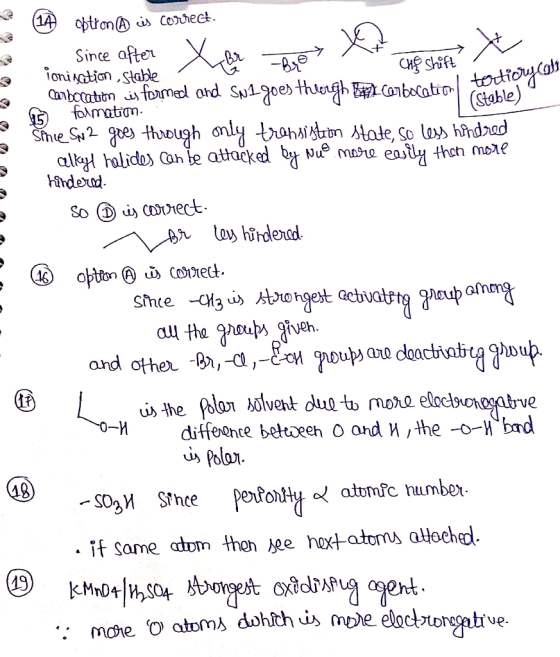
14. SNİ Reactivity in a Protic Solvent: CI (D) Br 15. SN2 Reactivity in an Aprotic...
HWS 5: Due 10/30/2019 15 points total SN1, SN2, Elimination pt 1 1. (10 pts) For...
 HWS 5: Due 10/30/2019 15 points total SN1, SN2, Elimination pt 1 1. (10 pts) For the following reactions: a. Label the Nucleophile (Nu) and whether it is strong or weak b. Label the Electrophile (E) and whether it is primary, secondary, or tertiary and circle the leaving group C. Label the Solvent and whether it is polar protic or polar aprotic d. Categorize each as preferring SN1, Preferring SN2, or could do either e. Draw the product of the...
+ Fit to page Page view 1. (10 pts) For the following reactions: a. Label the...
 + Fit to page Page view 1. (10 pts) For the following reactions: a. Label the Nucleophile (Nu) and whether it is strong or weak b. Label the Electrophile (E) and whether it is primary, secondary, or tertiary and circle the leaving group c. Label the Solvent and whether it is polar protic or polar aprotic d. Categorize each as preferring SN1, Preferring SN2, or could do either e Draw the product of the reaction, based upon your categorization, remember...
Propose a mechanism from the reaction in the box NaOH H,CH2CH.CH DMF Use the reaction for...
 Propose a mechanism from the reaction in the box
NaOH H,CH2CH.CH DMF Use the reaction for 28-32 28. What is the classification of the alkyl halide? a.) methyl b.) 1° c.) 2° d.) 30 29. Is the base strong or weak? a.) Strong b.) Weak 30. Is the solvent protic or aprotic? a.) Protic b.) Aprotic 31. According to the base and solvent, which substitution mechanism will the reaction undergo? a.) SNI b.) SN2 32. The stereochemistry of the reactant...
Propose a mechanism from the reaction in the box
NaOH H,CH2CH.CH DMF Use the reaction for 28-32 28. What is the classification of the alkyl halide? a.) methyl b.) 1° c.) 2° d.) 30 29. Is the base strong or weak? a.) Strong b.) Weak 30. Is the solvent protic or aprotic? a.) Protic b.) Aprotic 31. According to the base and solvent, which substitution mechanism will the reaction undergo? a.) SNI b.) SN2 32. The stereochemistry of the reactant...
please explain!! 3 e) Which solvent is a polar protic solvent? a) ether c) ethanol b)...
 please explain!!
3 e) Which solvent is a polar protic solvent? a) ether c) ethanol b) dimethylformamide d) hexane Circle the correct name for the molecule shown below. Br (trans)-3-bromo-4-methyl-4-heptene (E3-bromo-4-methyl-3-heptene (Z)3-bromo-4-methyl-3-heptene (cis)-3-bromo-4-methyl-3-heptene g) Circle the reaction that would have the fastest rate. NaSH DMF SH NaOH OH B DMF NaSH DMF Br SH NaOH Br он DMF h) Circle the strongest nucleophile in methanol (CH,OH) F Br
please explain!!
3 e) Which solvent is a polar protic solvent? a) ether c) ethanol b) dimethylformamide d) hexane Circle the correct name for the molecule shown below. Br (trans)-3-bromo-4-methyl-4-heptene (E3-bromo-4-methyl-3-heptene (Z)3-bromo-4-methyl-3-heptene (cis)-3-bromo-4-methyl-3-heptene g) Circle the reaction that would have the fastest rate. NaSH DMF SH NaOH OH B DMF NaSH DMF Br SH NaOH Br он DMF h) Circle the strongest nucleophile in methanol (CH,OH) F Br
A. Identify the solvent that most raises the barrier to formation (AG*) in an Sn2 reaction....
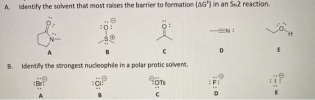 A. Identify the solvent that most raises the barrier to formation (AG*) in an Sn2 reaction. 0.. Сон EN: B D А C E B. Identify the strongest nucleophile in a polar protic solvent. :Br: OTS 0.. :F: E А D B
+ HBr 1. O+ Br Ph 2. CNaOH но Ph f SNI Nucleophilic substitution g SN2...
 + HBr 1. O+ Br Ph 2. CNaOH но Ph f SNI Nucleophilic substitution g SN2 Nucleophilic substitution a -Proton transfer b- Lewis acid/base c Electrophilic addition d- El Elimination -E2 Elimination The rections above involve synthesis or reactions of alcohols and ethers. Identify the mechanism by which they proceed from among the mechanisms listed. Use the letters a - g for your answers ol..
This is an example of a structural formula: Directions: Using structural formulas, diagram the mechanism: Label...
 This is an example of a structural formula:
Directions:
Using structural formulas, diagram the mechanism:
Label the type of mechanism by choosing from the following
list:
3A. SN1—
3B. SN2
3C. E1
3D. E2
3E. Radical substitution
3F. Acid-base
3G. Addition via carbocation
3H. Addition via onium bridge
3I. Radical addition
3J. Inversion if there's stereochemistry
3K. Racemization of any stereochemistry
3L. Zaitsev major product
3M. Hoffman major product
3N. Anti
3O. Antiperiplanar
3P. Carbocation
3Q. Polar protic solvent
3R....
This is an example of a structural formula:
Directions:
Using structural formulas, diagram the mechanism:
Label the type of mechanism by choosing from the following
list:
3A. SN1—
3B. SN2
3C. E1
3D. E2
3E. Radical substitution
3F. Acid-base
3G. Addition via carbocation
3H. Addition via onium bridge
3I. Radical addition
3J. Inversion if there's stereochemistry
3K. Racemization of any stereochemistry
3L. Zaitsev major product
3M. Hoffman major product
3N. Anti
3O. Antiperiplanar
3P. Carbocation
3Q. Polar protic solvent
3R....
Sul B Sx2 Either Syl or S2 None of these D) 103) What substitution reaction mechanism...
 Sul B Sx2 Either Syl or S2 None of these D) 103) What substitution reaction mechanism is most likely for the following conversion? A) SI SN2 Either Snl or S2 None of these 105) Which of the following is a strong nucleophile? OH H0 A) B) C) D) E) CH OH ΝΗ, All of these 108) Which of the following is a weakest nucleophile in a polar protic solvent? A) F B) CH Br D) E) All of these 111)...
5. Identify the major product expected to form at the completion of the following synthetic sequence....
 5. Identify the major product expected to form at the completion of the following synthetic sequence. O OH SO3, H2SO4 Br2 H2O H3O*-H2O но ОН Br ОН Он Он Br о Он Br но но Но НО но Br SO3H Br Br (A) (B) (C) (D) (E) 6.Which of the following synthetic sequences is expected to yield 2-chloro-4-nitrobenzoic acid in highest yleld? 1. KMnO OH Cla- FeCl HNO3- H2SO heat (A) 2. H30 1. KMnO4 , OH HNO- H2SO Clo-...
USE THE FOLOWING CHOICES TO ANSWER QUESTIONS 6 THROUGH A) SNI B) SN2 CJEI D) E2...
 USE THE FOLOWING CHOICES TO ANSWER QUESTIONS 6 THROUGH A) SNI B) SN2 CJEI D) E2 D) D WHICH MEHANISM's INCLUDE 4 CANBOCATION INTERMEDIATE? А) А B)B C) BOTH A AND C THE RATE LAW; RATE = k [SUBSTRATE] [incleophile] PEST DESCRIBES WHICH MECHAVISM? ASA B) B 2 ۵(ه و( 8 GOCHT THE REACTION OF CAZ-Bp. WOULD MOST LIKELY FOLLOW WHICH MECHANISM ? A) A DO WHICH MEU4MSMS Work BEST WITH APROTIC Sol Vewis? A) * B) B c) BOTH...
 HWS 5: Due 10/30/2019 15 points total SN1, SN2, Elimination pt 1 1. (10 pts) For the following reactions: a. Label the Nucleophile (Nu) and whether it is strong or weak b. Label the Electrophile (E) and whether it is primary, secondary, or tertiary and circle the leaving group C. Label the Solvent and whether it is polar protic or polar aprotic d. Categorize each as preferring SN1, Preferring SN2, or could do either e. Draw the product of the...
 + Fit to page Page view 1. (10 pts) For the following reactions: a. Label the Nucleophile (Nu) and whether it is strong or weak b. Label the Electrophile (E) and whether it is primary, secondary, or tertiary and circle the leaving group c. Label the Solvent and whether it is polar protic or polar aprotic d. Categorize each as preferring SN1, Preferring SN2, or could do either e Draw the product of the reaction, based upon your categorization, remember...
 Propose a mechanism from the reaction in the box
NaOH H,CH2CH.CH DMF Use the reaction for 28-32 28. What is the classification of the alkyl halide? a.) methyl b.) 1° c.) 2° d.) 30 29. Is the base strong or weak? a.) Strong b.) Weak 30. Is the solvent protic or aprotic? a.) Protic b.) Aprotic 31. According to the base and solvent, which substitution mechanism will the reaction undergo? a.) SNI b.) SN2 32. The stereochemistry of the reactant...
Propose a mechanism from the reaction in the box
NaOH H,CH2CH.CH DMF Use the reaction for 28-32 28. What is the classification of the alkyl halide? a.) methyl b.) 1° c.) 2° d.) 30 29. Is the base strong or weak? a.) Strong b.) Weak 30. Is the solvent protic or aprotic? a.) Protic b.) Aprotic 31. According to the base and solvent, which substitution mechanism will the reaction undergo? a.) SNI b.) SN2 32. The stereochemistry of the reactant...
 please explain!!
3 e) Which solvent is a polar protic solvent? a) ether c) ethanol b) dimethylformamide d) hexane Circle the correct name for the molecule shown below. Br (trans)-3-bromo-4-methyl-4-heptene (E3-bromo-4-methyl-3-heptene (Z)3-bromo-4-methyl-3-heptene (cis)-3-bromo-4-methyl-3-heptene g) Circle the reaction that would have the fastest rate. NaSH DMF SH NaOH OH B DMF NaSH DMF Br SH NaOH Br он DMF h) Circle the strongest nucleophile in methanol (CH,OH) F Br
please explain!!
3 e) Which solvent is a polar protic solvent? a) ether c) ethanol b) dimethylformamide d) hexane Circle the correct name for the molecule shown below. Br (trans)-3-bromo-4-methyl-4-heptene (E3-bromo-4-methyl-3-heptene (Z)3-bromo-4-methyl-3-heptene (cis)-3-bromo-4-methyl-3-heptene g) Circle the reaction that would have the fastest rate. NaSH DMF SH NaOH OH B DMF NaSH DMF Br SH NaOH Br он DMF h) Circle the strongest nucleophile in methanol (CH,OH) F Br
 A. Identify the solvent that most raises the barrier to formation (AG*) in an Sn2 reaction. 0.. Сон EN: B D А C E B. Identify the strongest nucleophile in a polar protic solvent. :Br: OTS 0.. :F: E А D B
 + HBr 1. O+ Br Ph 2. CNaOH но Ph f SNI Nucleophilic substitution g SN2 Nucleophilic substitution a -Proton transfer b- Lewis acid/base c Electrophilic addition d- El Elimination -E2 Elimination The rections above involve synthesis or reactions of alcohols and ethers. Identify the mechanism by which they proceed from among the mechanisms listed. Use the letters a - g for your answers ol..
 This is an example of a structural formula:
Directions:
Using structural formulas, diagram the mechanism:
Label the type of mechanism by choosing from the following
list:
3A. SN1—
3B. SN2
3C. E1
3D. E2
3E. Radical substitution
3F. Acid-base
3G. Addition via carbocation
3H. Addition via onium bridge
3I. Radical addition
3J. Inversion if there's stereochemistry
3K. Racemization of any stereochemistry
3L. Zaitsev major product
3M. Hoffman major product
3N. Anti
3O. Antiperiplanar
3P. Carbocation
3Q. Polar protic solvent
3R....
This is an example of a structural formula:
Directions:
Using structural formulas, diagram the mechanism:
Label the type of mechanism by choosing from the following
list:
3A. SN1—
3B. SN2
3C. E1
3D. E2
3E. Radical substitution
3F. Acid-base
3G. Addition via carbocation
3H. Addition via onium bridge
3I. Radical addition
3J. Inversion if there's stereochemistry
3K. Racemization of any stereochemistry
3L. Zaitsev major product
3M. Hoffman major product
3N. Anti
3O. Antiperiplanar
3P. Carbocation
3Q. Polar protic solvent
3R....
 Sul B Sx2 Either Syl or S2 None of these D) 103) What substitution reaction mechanism is most likely for the following conversion? A) SI SN2 Either Snl or S2 None of these 105) Which of the following is a strong nucleophile? OH H0 A) B) C) D) E) CH OH ΝΗ, All of these 108) Which of the following is a weakest nucleophile in a polar protic solvent? A) F B) CH Br D) E) All of these 111)...
 5. Identify the major product expected to form at the completion of the following synthetic sequence. O OH SO3, H2SO4 Br2 H2O H3O*-H2O но ОН Br ОН Он Он Br о Он Br но но Но НО но Br SO3H Br Br (A) (B) (C) (D) (E) 6.Which of the following synthetic sequences is expected to yield 2-chloro-4-nitrobenzoic acid in highest yleld? 1. KMnO OH Cla- FeCl HNO3- H2SO heat (A) 2. H30 1. KMnO4 , OH HNO- H2SO Clo-...
 USE THE FOLOWING CHOICES TO ANSWER QUESTIONS 6 THROUGH A) SNI B) SN2 CJEI D) E2 D) D WHICH MEHANISM's INCLUDE 4 CANBOCATION INTERMEDIATE? А) А B)B C) BOTH A AND C THE RATE LAW; RATE = k [SUBSTRATE] [incleophile] PEST DESCRIBES WHICH MECHAVISM? ASA B) B 2 ۵(ه و( 8 GOCHT THE REACTION OF CAZ-Bp. WOULD MOST LIKELY FOLLOW WHICH MECHANISM ? A) A DO WHICH MEU4MSMS Work BEST WITH APROTIC Sol Vewis? A) * B) B c) BOTH...
Most questions answered within 3 hours.
-
Where is the error in this code sequence?
String s1 = "Hello";
String s2 = "ello";...
asked 10 months ago -
Financial data for Joel de Paris, Inc., for last year
follow:
Joel de Paris, Inc.
Balance...
asked 10 months ago -
Consider this reaction:
Al2(SO4)3 (aq)+ BaCl3
(aq) Al2Cl6 (aq)- +
3BaSO4(s) . What is the...
asked 10 months ago -
Suppose that Savneet is considering increasing her
recent random sample from 20 car rentals to 40...
asked 10 months ago -
Trucks arrive at an unloading terminal at an average rate of 120
per hour.
Trucks arrive...
asked 10 months ago -
Why are methanol and ethanol completely soluble in water while
octanol is not very little soluble....
asked 10 months ago -
A facilities manager at a university reads in a research report
that the mean amount of...
asked 10 months ago -
When the CuSO4 is rehydrated by adding water to the anhydrous
compound, is this an endothermic...
asked 10 months ago -
A ray of sunlight is passing from diamond into crown glass; the
angle of incidence is...
asked 10 months ago -
A block of mass 0.249 kg is placed on top of a light, vertical
spring of...
asked 10 months ago -
how do the kidneys compensate in the presences of acidosis
a) trigger hyperventilate
b) reserve acid...
asked 10 months ago -
Question 501 pts
The rental rate of capital to the firm increases. Which of the
following...
asked 10 months ago