
Homework Answers
Add Answer to:
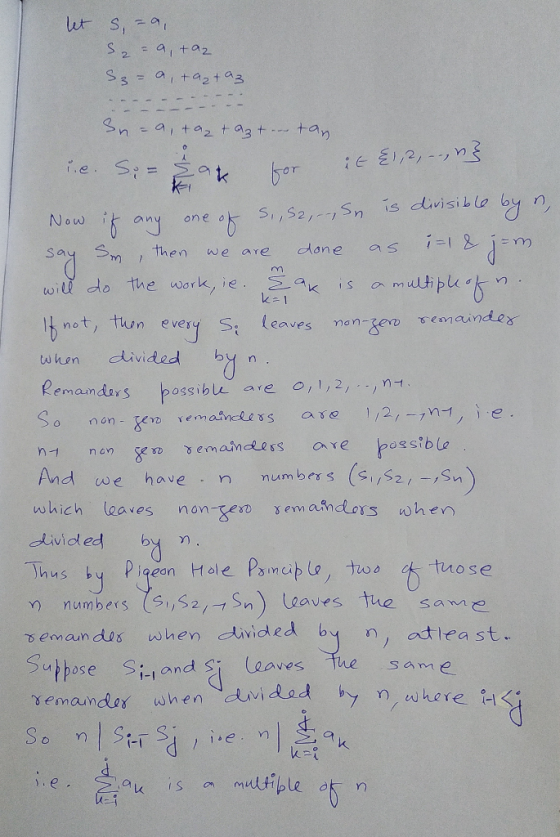
To be proven Let neN and (an, az, ..., an) Ezh. always Prove that there are...
(2) Consider the following examples. (a) Let A = n.) for each neN. What is Ain...
 (2) Consider the following examples. (a) Let A = n.) for each neN. What is Ain A, for any i,j EN? What is an An? (b) Let Bn = (0,1/n) for each neN. What is Bin B; for any i, j e N? What is aan Bn? (c) What's the deal with these examples? Do they relate to Helly's Theorem? What might be going wrong here?
Let H be a separable Hilbert space with basis {en}neN and define P2 as the orthogonal...
 Let H be a separable Hilbert space with basis {en}neN and define P2 as the orthogonal projection onto spanfe1,., e,}. Show that, for any T E B (H), the sequence PTP converges strongly to T HINT: A sequence of operators Tn E B (H) converges strongly to T if ||Th - Tnh|| converges to 0 Vh E H.
Let H be a separable Hilbert space with basis {en}neN and define P2 as the orthogonal projection onto spanfe1,., e,}. Show that,...
Let H be a separable Hilbert space with basis {en}neN and define P2 as the orthogonal projection onto spanfe1,., e,}. Show that, for any T E B (H), the sequence PTP converges strongly to T HINT: A sequence of operators Tn E B (H) converges strongly to T if ||Th - Tnh|| converges to 0 Vh E H.
Let H be a separable Hilbert space with basis {en}neN and define P2 as the orthogonal projection onto spanfe1,., e,}. Show that,...
Let (an)nen be a bounded sequence in R. For all n e N define bn =...
 Let (an)nen be a bounded sequence in R. For all n e N define bn = sup{am, On+1, On+2,...}. (You do not have to show that the supremum exists.) (a) Prove that the sequence (bn)nen is a monotone sequence. (b) Prove that the sequence (bn)nen is convergent. (c) Prove or disprove: lim an = lim bre. 100 000
13 a. Let Let (and new be a sequence of reel numbers and let o cael....
 13 a. Let Let (and new be a sequence of reel numbers and let o cael. Assume that for some NEN I calanl In), N. Prove that linn an 1 anti b. het (annsyl be the sequence defined by anti & Satan (i) Prove that to EN Lan 1.2. (11) Prove that and give its limit (an) converges C. Using the canchy's definition of continuity , prove the funetion g(x) = 2x+1 x-4 is continuous at l.
Q2 (10 points) Vn2 + 4 – n, n E N. 2. Let (an) neN be...
 Q2 (10 points) Vn2 + 4 – n, n E N. 2. Let (an) neN be the sequence with a, (a) Prove that lim,→0 an 0. lim,-00 bn, and prove the limit exists, by using the definition. (b) Let bn = n an . Find L =
3. (15 pts.) Let A e Rmxn be a full rank matrix, m > n. Suppose that Let r = Ax-b. Prove that reprthogonal to Az minimizes llAz-b12. 3. (15 pts.) Let A e Rmxn be a full rank matrix, m >...
 3. (15 pts.) Let A e Rmxn be a full rank matrix, m > n. Suppose that Let r = Ax-b. Prove that reprthogonal to Az minimizes llAz-b12.
3. (15 pts.) Let A e Rmxn be a full rank matrix, m > n. Suppose that Let r = Ax-b. Prove that reprthogonal to Az minimizes llAz-b12.
3. (15 pts.) Let A e Rmxn be a full rank matrix, m > n. Suppose that Let r = Ax-b. Prove that reprthogonal to Az minimizes llAz-b12.
Let H be a separable Hilbert space with basis en]nen and define P as the orthogonal projection onto span(e,... ,en)...
 Let H be a separable Hilbert space with basis en]nen and define P as the orthogonal projection onto span(e,... ,en) (a) A sequence of operators T, E B(H) is said to converge strongly to T if |Th-Tnhl converges to 0 for all h EH (note that strong convergence is actually weaker than operator norm convergence-think of this as the difference between pointwise and uniform convergence). Show that, for any T E B(H), the sequence P,T Pn converges strongly to T....
Assume b.1 is proven. Please help prove b.2 (b) Let f: V V be any linear...
 Assume b.1 is proven. Please help prove b.2
(b) Let f: V V be any linear map of vector spaces over a field K. Recall that, for any polynomial p(X) = 0 ¢X€ K[X] and any vE v p(X) p(u) 2ef°(v). i-0 The kernel of p(X) is defined to be {v € V : p(X) - v = 0}. Ker(p(X)) (b.1) Show that Ker(p(X)) is a linear subspace of V. When p(X) = X - A where E K, explain...
Assume b.1 is proven. Please help prove b.2
(b) Let f: V V be any linear map of vector spaces over a field K. Recall that, for any polynomial p(X) = 0 ¢X€ K[X] and any vE v p(X) p(u) 2ef°(v). i-0 The kernel of p(X) is defined to be {v € V : p(X) - v = 0}. Ker(p(X)) (b.1) Show that Ker(p(X)) is a linear subspace of V. When p(X) = X - A where E K, explain...
A1. Let M be an R-module and let I, J be ideals in FR (a) Prove...
 A1. Let M be an R-module and let I, J be ideals in FR (a) Prove that Ann(I +J) -Ann(I) n Ann(J). (b) Prove that Ann(InJ)2 Ann(I) + Ann(J). (c) Give an example where the inclusion in (b) is strict. (d) If R is commutative ald unital and I, J are cornaximal (that is, 1 +J-(1)), prove that Ann(InJ) Ann(I)+Ann(J).
Let H be a normal subgroup of a group G and let K be any subgroup of G. Prove that the subset HK ...
 2.
problem 3.
Let H be a normal subgroup of a group G and let K be any subgroup of G. Prove that the subset HK of G defined by is a subgroup of G Let G S, H ), (12) (34), (13) (24), (1 4) (23)J, and K ((13)). We know that H is a normal subgroup of S, so HK is a subgroup of S4 by Problem 2. (a) Calculate HK (b) To which familiar group is HK...
2.
problem 3.
Let H be a normal subgroup of a group G and let K be any subgroup of G. Prove that the subset HK of G defined by is a subgroup of G Let G S, H ), (12) (34), (13) (24), (1 4) (23)J, and K ((13)). We know that H is a normal subgroup of S, so HK is a subgroup of S4 by Problem 2. (a) Calculate HK (b) To which familiar group is HK...
 (2) Consider the following examples. (a) Let A = n.) for each neN. What is Ain A, for any i,j EN? What is an An? (b) Let Bn = (0,1/n) for each neN. What is Bin B; for any i, j e N? What is aan Bn? (c) What's the deal with these examples? Do they relate to Helly's Theorem? What might be going wrong here?
 Let H be a separable Hilbert space with basis {en}neN and define P2 as the orthogonal projection onto spanfe1,., e,}. Show that, for any T E B (H), the sequence PTP converges strongly to T HINT: A sequence of operators Tn E B (H) converges strongly to T if ||Th - Tnh|| converges to 0 Vh E H.
Let H be a separable Hilbert space with basis {en}neN and define P2 as the orthogonal projection onto spanfe1,., e,}. Show that,...
Let H be a separable Hilbert space with basis {en}neN and define P2 as the orthogonal projection onto spanfe1,., e,}. Show that, for any T E B (H), the sequence PTP converges strongly to T HINT: A sequence of operators Tn E B (H) converges strongly to T if ||Th - Tnh|| converges to 0 Vh E H.
Let H be a separable Hilbert space with basis {en}neN and define P2 as the orthogonal projection onto spanfe1,., e,}. Show that,...
 Let (an)nen be a bounded sequence in R. For all n e N define bn = sup{am, On+1, On+2,...}. (You do not have to show that the supremum exists.) (a) Prove that the sequence (bn)nen is a monotone sequence. (b) Prove that the sequence (bn)nen is convergent. (c) Prove or disprove: lim an = lim bre. 100 000
 13 a. Let Let (and new be a sequence of reel numbers and let o cael. Assume that for some NEN I calanl In), N. Prove that linn an 1 anti b. het (annsyl be the sequence defined by anti & Satan (i) Prove that to EN Lan 1.2. (11) Prove that and give its limit (an) converges C. Using the canchy's definition of continuity , prove the funetion g(x) = 2x+1 x-4 is continuous at l.
 Q2 (10 points) Vn2 + 4 – n, n E N. 2. Let (an) neN be the sequence with a, (a) Prove that lim,→0 an 0. lim,-00 bn, and prove the limit exists, by using the definition. (b) Let bn = n an . Find L =
 3. (15 pts.) Let A e Rmxn be a full rank matrix, m > n. Suppose that Let r = Ax-b. Prove that reprthogonal to Az minimizes llAz-b12.
3. (15 pts.) Let A e Rmxn be a full rank matrix, m > n. Suppose that Let r = Ax-b. Prove that reprthogonal to Az minimizes llAz-b12.
3. (15 pts.) Let A e Rmxn be a full rank matrix, m > n. Suppose that Let r = Ax-b. Prove that reprthogonal to Az minimizes llAz-b12.
 Let H be a separable Hilbert space with basis en]nen and define P as the orthogonal projection onto span(e,... ,en) (a) A sequence of operators T, E B(H) is said to converge strongly to T if |Th-Tnhl converges to 0 for all h EH (note that strong convergence is actually weaker than operator norm convergence-think of this as the difference between pointwise and uniform convergence). Show that, for any T E B(H), the sequence P,T Pn converges strongly to T....
 Assume b.1 is proven. Please help prove b.2
(b) Let f: V V be any linear map of vector spaces over a field K. Recall that, for any polynomial p(X) = 0 ¢X€ K[X] and any vE v p(X) p(u) 2ef°(v). i-0 The kernel of p(X) is defined to be {v € V : p(X) - v = 0}. Ker(p(X)) (b.1) Show that Ker(p(X)) is a linear subspace of V. When p(X) = X - A where E K, explain...
Assume b.1 is proven. Please help prove b.2
(b) Let f: V V be any linear map of vector spaces over a field K. Recall that, for any polynomial p(X) = 0 ¢X€ K[X] and any vE v p(X) p(u) 2ef°(v). i-0 The kernel of p(X) is defined to be {v € V : p(X) - v = 0}. Ker(p(X)) (b.1) Show that Ker(p(X)) is a linear subspace of V. When p(X) = X - A where E K, explain...
 A1. Let M be an R-module and let I, J be ideals in FR (a) Prove that Ann(I +J) -Ann(I) n Ann(J). (b) Prove that Ann(InJ)2 Ann(I) + Ann(J). (c) Give an example where the inclusion in (b) is strict. (d) If R is commutative ald unital and I, J are cornaximal (that is, 1 +J-(1)), prove that Ann(InJ) Ann(I)+Ann(J).
 2.
problem 3.
Let H be a normal subgroup of a group G and let K be any subgroup of G. Prove that the subset HK of G defined by is a subgroup of G Let G S, H ), (12) (34), (13) (24), (1 4) (23)J, and K ((13)). We know that H is a normal subgroup of S, so HK is a subgroup of S4 by Problem 2. (a) Calculate HK (b) To which familiar group is HK...
2.
problem 3.
Let H be a normal subgroup of a group G and let K be any subgroup of G. Prove that the subset HK of G defined by is a subgroup of G Let G S, H ), (12) (34), (13) (24), (1 4) (23)J, and K ((13)). We know that H is a normal subgroup of S, so HK is a subgroup of S4 by Problem 2. (a) Calculate HK (b) To which familiar group is HK...
Most questions answered within 3 hours.
-
Where is the error in this code sequence?
String s1 = "Hello";
String s2 = "ello";...
asked 11 months ago -
Financial data for Joel de Paris, Inc., for last year
follow:
Joel de Paris, Inc.
Balance...
asked 11 months ago -
Consider this reaction:
Al2(SO4)3 (aq)+ BaCl3
(aq) Al2Cl6 (aq)- +
3BaSO4(s) . What is the...
asked 11 months ago -
Suppose that Savneet is considering increasing her
recent random sample from 20 car rentals to 40...
asked 11 months ago -
Trucks arrive at an unloading terminal at an average rate of 120
per hour.
Trucks arrive...
asked 11 months ago -
Why are methanol and ethanol completely soluble in water while
octanol is not very little soluble....
asked 11 months ago -
A facilities manager at a university reads in a research report
that the mean amount of...
asked 11 months ago -
When the CuSO4 is rehydrated by adding water to the anhydrous
compound, is this an endothermic...
asked 11 months ago -
A ray of sunlight is passing from diamond into crown glass; the
angle of incidence is...
asked 11 months ago -
A block of mass 0.249 kg is placed on top of a light, vertical
spring of...
asked 11 months ago -
how do the kidneys compensate in the presences of acidosis
a) trigger hyperventilate
b) reserve acid...
asked 11 months ago -
Question 501 pts
The rental rate of capital to the firm increases. Which of the
following...
asked 11 months ago