Hydrostatic equation
Homework Answers
Request Answer!
We need at least 10 more requests to produce the answer.
0 / 10 have requested this problem solution
The more requests, the faster the answer.
Fluid mechanics Problem 3.027 (GO Tutorial) Your answer is partially correct. Try again. (a) What is...
 Fluid mechanics
Problem 3.027 (GO Tutorial) Your answer is partially correct. Try again. (a) What is the maximum gage pressure in the odd tank shown in the figure? (b) Where will the maximum pressure occur? (c) what is the hydrostatic force acting on the top (CD) of the last chamber on the right-hand side of the tank? Assume T = 10℃ Open to Closed top 1 m Plan view (view E-E) EOpen to atmosphene 2 m 1 m Air Air...
Fluid mechanics
Problem 3.027 (GO Tutorial) Your answer is partially correct. Try again. (a) What is the maximum gage pressure in the odd tank shown in the figure? (b) Where will the maximum pressure occur? (c) what is the hydrostatic force acting on the top (CD) of the last chamber on the right-hand side of the tank? Assume T = 10℃ Open to Closed top 1 m Plan view (view E-E) EOpen to atmosphene 2 m 1 m Air Air...
The figure shows a cylindrical tank of 80 em in diameter which is fully filled with water. In order to increase the flow from the tank to the exit pipe on the left, an additional pressure is appl...
 The figure shows a cylindrical tank of 80 em in diameter which is fully filled with water. In order to increase the flow from the tank to the exit pipe on the left, an additional pressure is applied to the water surface by an air compressor to supply air to the upper air chamber of the tank. The external walls of the tank are exposed to the atmospheric conditions of the area. You are required to determine the hydrostatic conditions...
What is the resultant hydrostatic force on the gate? What is the distance of the line...
 What is the resultant hydrostatic force on the gate?
What is the distance of the line of action (or the center of
pressure) of the resultant hydrostatic from the shaft?
If the weight of the gate is assumed negligible, what is the
magnitude of the force
based on problem 2.49 in text A semicircular gate is installed in the side of water storage reservoir that is at angle of 0=60 reservoir. The depth of water in the tank is H...
What is the resultant hydrostatic force on the gate?
What is the distance of the line of action (or the center of
pressure) of the resultant hydrostatic from the shaft?
If the weight of the gate is assumed negligible, what is the
magnitude of the force
based on problem 2.49 in text A semicircular gate is installed in the side of water storage reservoir that is at angle of 0=60 reservoir. The depth of water in the tank is H...
11. Determine ddistance of the hydrostatic force from hinge 11. SMTKN 81.757 kN 12. Compute weight...
 11. Determine ddistance of the hydrostatic force from hinge 11. SMTKN 81.757 kN 12. Compute weight "w", fastened to the center of the gate, is necessary barely to keep the gate from opening. What will be the resultant reaction at the hinge 13. SITUATIONS A cylindrical log having a diameter of 2m and a length of 4m is placed in the position shown in figure below. Sp. Gr. of ol is 0.8. Determine Vertical component of the force acting on...
The figure Tank3png shows a water tank where a wall is a vertical flat-plate that is composed of ...
 The figure Tank3png shows a water tank where a wall is a vertical flat-plate that is composed of two rectangular faces of areas Ai and A2 with widths w 1.0 m, W2 2.0 m respectively, and one semicircular face of area A3, with radius R 0.5 m. The dimensions h 1.0 m, h2- 1.0 m, as shown in the figure. The density of water, p -103kg/m3, acceleration due to gravity, g = 10 m/s The figure 4 shows a water...
In problems about liquids in hydrostatic equilibrium
 ± Tactics Box 14.1 Hydrostatics Learning Goal:To practice Tactics Box 14.1 Hydrostatics.In problems about liquids in hydrostatic equilibrium, you often need to find the pressure at some point in the liquid. This Tactics Box outlines a set of rules for thinking about such hydrostatic problems.TACTICS EOX 14+ Hydrostatics1. Draw a picture. Show open surfaces, pistons, boundaries, and other features that affect the pressure. Include height and area measurements and fluid densities. identify the points at which you need to find the...
FLUID FLOW OPERATIONS QUESTION Air is pumped at a rate of 10L/min from one pressurized tank to an...
 FLUID FLOW OPERATIONS QUESTION
Air is pumped at a rate of 10L/min from one pressurized tank to
another through a reducing bend as shown in the figure below. The
bend has an area of 5 cm on the side of Tank 1 and 1 cm on the side
of Tank 2. If the angle of the bend, θ, is (a) 30 degrees or (b) 0
degrees, what is the force exerted by the pipe walls on the fluid?
If the...
FLUID FLOW OPERATIONS QUESTION
Air is pumped at a rate of 10L/min from one pressurized tank to
another through a reducing bend as shown in the figure below. The
bend has an area of 5 cm on the side of Tank 1 and 1 cm on the side
of Tank 2. If the angle of the bend, θ, is (a) 30 degrees or (b) 0
degrees, what is the force exerted by the pipe walls on the fluid?
If the...
QUESTION TWO (15 marks) A. A small chemical-industry tank fitted with a manometer as shown contains...
 QUESTION TWO (15 marks) A. A small chemical-industry tank fitted with a manometer as shown contains a dense fluid with specific gravity S 3.0 and 20 cm deep. Workers should have added water to a depth of 15 cm above the dense fluid. What height Ah do you expect to find when you inspect the tank? (7 marks) 15 cm Water Ah? 20 cm S 3.0 B. A sea-water aquarium is planned to have a circular window with diameter D-80...
For the following questions, use the equation below for the water pressure as a function of...
For the following questions, use the equation below for the water pressure as a function of depth: P = (9800 Pa/m)*d + 101,300 Pa PART A: A cube of plastic that has dimensions of 1.8 m x 1.8 m x 1.8 m, is submerged in a tank of water such that the top surface of the cube is 1.8 m below the surface of the water. First, let's determine the water pressure acting on the top and bottom of the...
4. Consider the pressure distribution acting on the side of the tank as shown below. (A)...
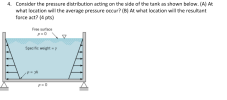 4. Consider the pressure distribution acting on the side of the tank as shown below. (A) At what location will the average pressure occur? (B) At what location will the resultant force act? (4 pts) Free surface p 0 Specific weight =y p = yh p = 0
 Fluid mechanics
Problem 3.027 (GO Tutorial) Your answer is partially correct. Try again. (a) What is the maximum gage pressure in the odd tank shown in the figure? (b) Where will the maximum pressure occur? (c) what is the hydrostatic force acting on the top (CD) of the last chamber on the right-hand side of the tank? Assume T = 10℃ Open to Closed top 1 m Plan view (view E-E) EOpen to atmosphene 2 m 1 m Air Air...
Fluid mechanics
Problem 3.027 (GO Tutorial) Your answer is partially correct. Try again. (a) What is the maximum gage pressure in the odd tank shown in the figure? (b) Where will the maximum pressure occur? (c) what is the hydrostatic force acting on the top (CD) of the last chamber on the right-hand side of the tank? Assume T = 10℃ Open to Closed top 1 m Plan view (view E-E) EOpen to atmosphene 2 m 1 m Air Air...
 The figure shows a cylindrical tank of 80 em in diameter which is fully filled with water. In order to increase the flow from the tank to the exit pipe on the left, an additional pressure is applied to the water surface by an air compressor to supply air to the upper air chamber of the tank. The external walls of the tank are exposed to the atmospheric conditions of the area. You are required to determine the hydrostatic conditions...
 What is the resultant hydrostatic force on the gate?
What is the distance of the line of action (or the center of
pressure) of the resultant hydrostatic from the shaft?
If the weight of the gate is assumed negligible, what is the
magnitude of the force
based on problem 2.49 in text A semicircular gate is installed in the side of water storage reservoir that is at angle of 0=60 reservoir. The depth of water in the tank is H...
What is the resultant hydrostatic force on the gate?
What is the distance of the line of action (or the center of
pressure) of the resultant hydrostatic from the shaft?
If the weight of the gate is assumed negligible, what is the
magnitude of the force
based on problem 2.49 in text A semicircular gate is installed in the side of water storage reservoir that is at angle of 0=60 reservoir. The depth of water in the tank is H...
 11. Determine ddistance of the hydrostatic force from hinge 11. SMTKN 81.757 kN 12. Compute weight "w", fastened to the center of the gate, is necessary barely to keep the gate from opening. What will be the resultant reaction at the hinge 13. SITUATIONS A cylindrical log having a diameter of 2m and a length of 4m is placed in the position shown in figure below. Sp. Gr. of ol is 0.8. Determine Vertical component of the force acting on...
 The figure Tank3png shows a water tank where a wall is a vertical flat-plate that is composed of two rectangular faces of areas Ai and A2 with widths w 1.0 m, W2 2.0 m respectively, and one semicircular face of area A3, with radius R 0.5 m. The dimensions h 1.0 m, h2- 1.0 m, as shown in the figure. The density of water, p -103kg/m3, acceleration due to gravity, g = 10 m/s The figure 4 shows a water...
 FLUID FLOW OPERATIONS QUESTION
Air is pumped at a rate of 10L/min from one pressurized tank to
another through a reducing bend as shown in the figure below. The
bend has an area of 5 cm on the side of Tank 1 and 1 cm on the side
of Tank 2. If the angle of the bend, θ, is (a) 30 degrees or (b) 0
degrees, what is the force exerted by the pipe walls on the fluid?
If the...
FLUID FLOW OPERATIONS QUESTION
Air is pumped at a rate of 10L/min from one pressurized tank to
another through a reducing bend as shown in the figure below. The
bend has an area of 5 cm on the side of Tank 1 and 1 cm on the side
of Tank 2. If the angle of the bend, θ, is (a) 30 degrees or (b) 0
degrees, what is the force exerted by the pipe walls on the fluid?
If the...
 QUESTION TWO (15 marks) A. A small chemical-industry tank fitted with a manometer as shown contains a dense fluid with specific gravity S 3.0 and 20 cm deep. Workers should have added water to a depth of 15 cm above the dense fluid. What height Ah do you expect to find when you inspect the tank? (7 marks) 15 cm Water Ah? 20 cm S 3.0 B. A sea-water aquarium is planned to have a circular window with diameter D-80...
 4. Consider the pressure distribution acting on the side of the tank as shown below. (A) At what location will the average pressure occur? (B) At what location will the resultant force act? (4 pts) Free surface p 0 Specific weight =y p = yh p = 0
Most questions answered within 3 hours.
-
Where is the error in this code sequence?
String s1 = "Hello";
String s2 = "ello";...
asked 11 months ago -
Financial data for Joel de Paris, Inc., for last year
follow:
Joel de Paris, Inc.
Balance...
asked 11 months ago -
Consider this reaction:
Al2(SO4)3 (aq)+ BaCl3
(aq) Al2Cl6 (aq)- +
3BaSO4(s) . What is the...
asked 11 months ago -
Suppose that Savneet is considering increasing her
recent random sample from 20 car rentals to 40...
asked 11 months ago -
Trucks arrive at an unloading terminal at an average rate of 120
per hour.
Trucks arrive...
asked 11 months ago -
Why are methanol and ethanol completely soluble in water while
octanol is not very little soluble....
asked 11 months ago -
A facilities manager at a university reads in a research report
that the mean amount of...
asked 11 months ago -
When the CuSO4 is rehydrated by adding water to the anhydrous
compound, is this an endothermic...
asked 11 months ago -
A ray of sunlight is passing from diamond into crown glass; the
angle of incidence is...
asked 11 months ago -
A block of mass 0.249 kg is placed on top of a light, vertical
spring of...
asked 11 months ago -
how do the kidneys compensate in the presences of acidosis
a) trigger hyperventilate
b) reserve acid...
asked 11 months ago -
Question 501 pts
The rental rate of capital to the firm increases. Which of the
following...
asked 11 months ago