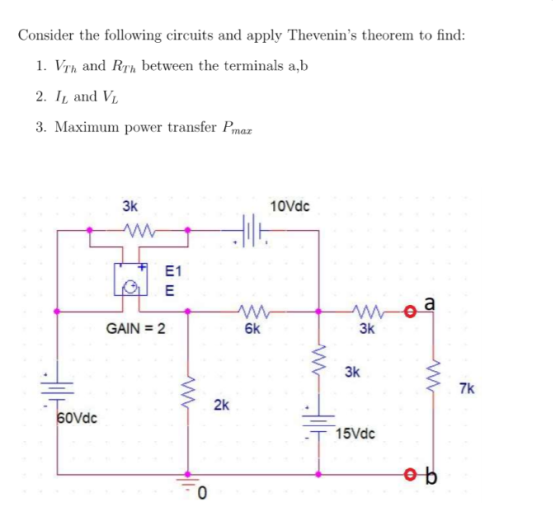
Please, explain each step. Thanks
Homework Answers

Add Answer to:
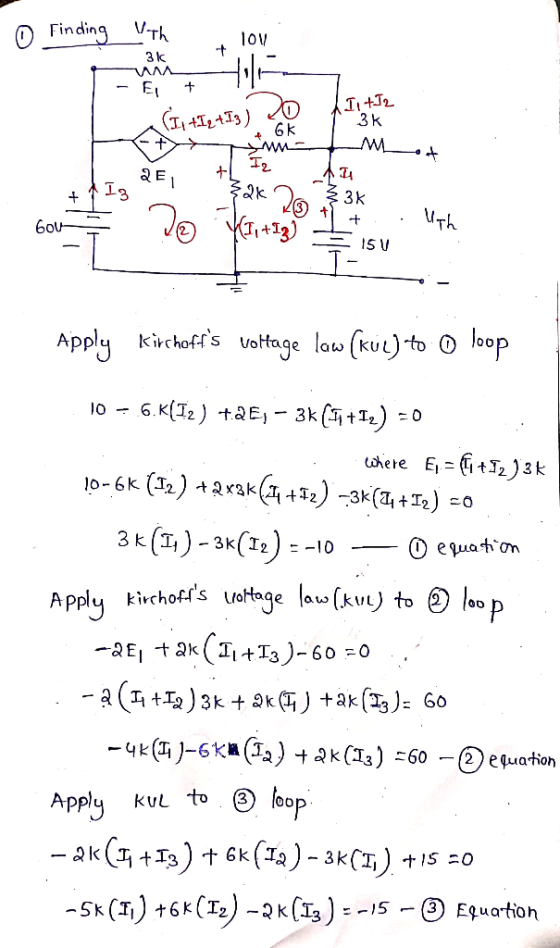
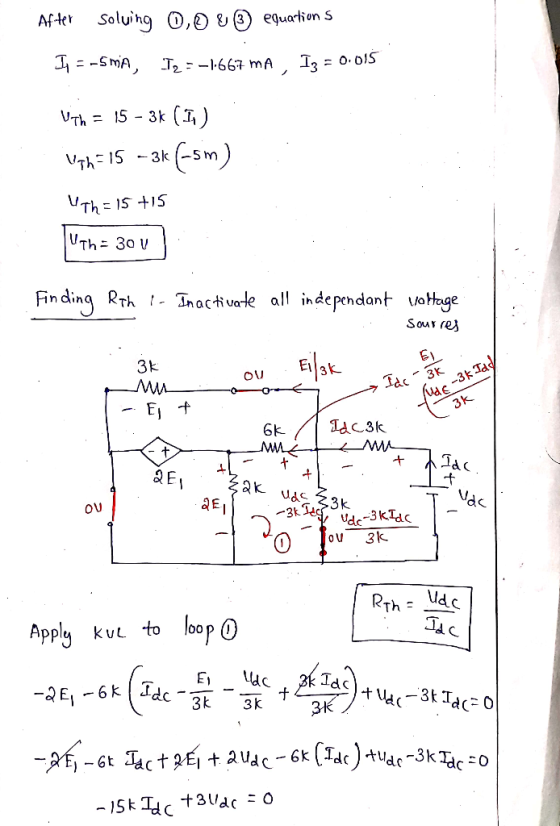
Please, explain each step. Thanks
Consider the following circuits and apply Thevenin's theorem to find: 1....
Thevenin's Theorem. "Any two-terminal, linear bilateral DC network can be replaced by an equivalent circuit consisting...
 Thevenin's Theorem. "Any two-terminal, linear bilateral DC network can be replaced by an equivalent circuit consisting of a voltage source and a series resistor."This means that a circuit such as the one in Figure 1 can be replaced by a power supply and a series resistor, allowing for a quicker analysis of changes in load resistance,(RO) R3 Figure 1 Some of the advantages offered by this theorem are: • It allows the determination of any given voltage or current in...
Algorithms: Please explain each step! Thanks! (20 points) Use the Master Theorem to solve the following...
 Algorithms:
Please explain each step! Thanks!
(20 points) Use the Master Theorem to solve the following recurrence relations. For each recurrence, either give the asympotic solution using the Master Theorem (state which case), or else state the Master Theorem doesn't apply (d) T(n) T() + T (4) + n2
(20 points) Use the Master Theorem to solve the following recurrence relations. For each recurrence, either give the asympotic solution using the Master Theorem (state which case), or else state the...
Algorithms:
Please explain each step! Thanks!
(20 points) Use the Master Theorem to solve the following recurrence relations. For each recurrence, either give the asympotic solution using the Master Theorem (state which case), or else state the Master Theorem doesn't apply (d) T(n) T() + T (4) + n2
(20 points) Use the Master Theorem to solve the following recurrence relations. For each recurrence, either give the asympotic solution using the Master Theorem (state which case), or else state the...
would you like please answer all questions in part 3 THEVENIN'S THEOREM AND MAXIMUM POWER TRANSFER...
 would you like please answer all questions in part 3
THEVENIN'S THEOREM AND MAXIMUM POWER TRANSFER 131 Part 3 Maximum Power Transfer (Experimental Approach) (a) Construct the network of Fig. 11.8. Insert the measured value of each resistor R EIOV 95.732 218S2 325 2 . 424e R FIG. 11.8 Eths Vabs 6.8v Rths Resissn (b) The Thevenin equivalent circuit will now be determined for the network to the lel of the terminals a-b without disturbing the structure of the network....
would you like please answer all questions in part 3
THEVENIN'S THEOREM AND MAXIMUM POWER TRANSFER 131 Part 3 Maximum Power Transfer (Experimental Approach) (a) Construct the network of Fig. 11.8. Insert the measured value of each resistor R EIOV 95.732 218S2 325 2 . 424e R FIG. 11.8 Eths Vabs 6.8v Rths Resissn (b) The Thevenin equivalent circuit will now be determined for the network to the lel of the terminals a-b without disturbing the structure of the network....
V1 = 20 V2 = 25 EXPERIMENT NO. 6 Thevenin & Norton Theorem Introduction Any linear...
 V1 = 20 V2 = 25
EXPERIMENT NO. 6 Thevenin & Norton Theorem Introduction Any linear network having a number of voltage, current sources and resistors can be replaced by a simple equivalent circuit consisting of a single voltage source in series with a resistance, where the value of the voltage source is equalto the open circuit voltage and the resistance is the equivalent resistance measuredbetweenthe open circuit terminals with all independent deactivated Objective To verify Thevenin's and Norton's theoremusing...
V1 = 20 V2 = 25
EXPERIMENT NO. 6 Thevenin & Norton Theorem Introduction Any linear network having a number of voltage, current sources and resistors can be replaced by a simple equivalent circuit consisting of a single voltage source in series with a resistance, where the value of the voltage source is equalto the open circuit voltage and the resistance is the equivalent resistance measuredbetweenthe open circuit terminals with all independent deactivated Objective To verify Thevenin's and Norton's theoremusing...
If you can explain each step I would appreciate it! Thanks. 17. What is T, and...
 If you can explain each step I would
appreciate it! Thanks.
17. What is T, and T2 if the pulleys are frictionless and the coefficient of kinetic friction between the block and the table is 0.4, and the coefficient of static friction is 0.5. The table is at 0= 30° above the horizontal. (here you have numbers but you can try this one with variables) M= 3k UK', us 3 kg =M 8 kg =2/3 M
If you can explain each step I would
appreciate it! Thanks.
17. What is T, and T2 if the pulleys are frictionless and the coefficient of kinetic friction between the block and the table is 0.4, and the coefficient of static friction is 0.5. The table is at 0= 30° above the horizontal. (here you have numbers but you can try this one with variables) M= 3k UK', us 3 kg =M 8 kg =2/3 M
Consider the IVP, 1. Apply the Fundamental Existence and Uniqueness Theorem to show that a solution...
Consider the IVP, 1. Apply the Fundamental Existence and Uniqueness Theorem to show that a solution exists. 2. Use the Runge-Kutta method with various step-sizes to estimate the maximum t-value, , for which the solution is defined on the interval . Include a few representative graphs with your submission, and the lists of points. 3. Find the exact solution to the IVP and solve for analytically. How close was your approximation from the previous question? 4. The Runge-Kutta method continues...
Could someone please write worked solutions? Thanks R. Figure 1 Consider the filter circuit that is...
 Could someone please write worked solutions? Thanks
R. Figure 1 Consider the filter circuit that is shown in Figure 1 1. Determine the voltage at node a in terms of the passive component variables. (7 marks) 2. Determine the Laplace transfer function H(s) = Vo/Vi. Subsequently, identify the resulting filter type including its order. (9 marks) 3. If R-1k and C-10HF, determine the gain, cut-off frequency, and the quality factor of this filter. (6 marks) 4. If the input signal...
Could someone please write worked solutions? Thanks
R. Figure 1 Consider the filter circuit that is shown in Figure 1 1. Determine the voltage at node a in terms of the passive component variables. (7 marks) 2. Determine the Laplace transfer function H(s) = Vo/Vi. Subsequently, identify the resulting filter type including its order. (9 marks) 3. If R-1k and C-10HF, determine the gain, cut-off frequency, and the quality factor of this filter. (6 marks) 4. If the input signal...
Please step by step and thanks for occupying your time. 4. Value and Debt Consider the...
 Please step by step and thanks for occupying your time.
4. Value and Debt Consider the following model: (1 -T) Veidt Industries (VI) has one million shares outstanding with a market price of $13.5 per share. VI's permanent debt is $6.25 million. The company and investors pay tax at the following rates Corporate income: 30% . Personal income: T-10% (equity) ·Ti-25% (interest) Although investors expected VI to maintain its existing debt permanently, management plans to announce that VI will repay...
Please step by step and thanks for occupying your time.
4. Value and Debt Consider the following model: (1 -T) Veidt Industries (VI) has one million shares outstanding with a market price of $13.5 per share. VI's permanent debt is $6.25 million. The company and investors pay tax at the following rates Corporate income: 30% . Personal income: T-10% (equity) ·Ti-25% (interest) Although investors expected VI to maintain its existing debt permanently, management plans to announce that VI will repay...
3. a) Consider a boost converter shown in the figure below. Briefly explain the principle of...
 3. a) Consider a boost converter shown in the figure below. Briefly explain the principle of operation of the circuit as a step-up converter, ie, how the input voltage is stepped up and how energy transfer occurs from input to the output in each cycle. Find expressions for vi(l) when the switch is closed and when it is off. Sketch it for one eycle and find its average value, Vu. Find the relationship between input and output voltages by setting...
Prelab Consider the circuits (systems) in Figure 1 2000 1k2 Vo Vi 10pF 2H (b) 2002...
 Prelab Consider the circuits (systems) in Figure 1 2000 1k2 Vo Vi 10pF 2H (b) 2002 Figure We want to understand what these systems do, and how they are expected to behave. Because they are "physical systems" they are causal. For each of the circuits: 1. Use the integration-in-time-domain properties of the Laplace transfom to derive the impedance of the capacitors and inductors. Since both capacitors and inductors are causal systems, what are the regions of convergence of their Laplace...
 Thevenin's Theorem. "Any two-terminal, linear bilateral DC network can be replaced by an equivalent circuit consisting of a voltage source and a series resistor."This means that a circuit such as the one in Figure 1 can be replaced by a power supply and a series resistor, allowing for a quicker analysis of changes in load resistance,(RO) R3 Figure 1 Some of the advantages offered by this theorem are: • It allows the determination of any given voltage or current in...
 Algorithms:
Please explain each step! Thanks!
(20 points) Use the Master Theorem to solve the following recurrence relations. For each recurrence, either give the asympotic solution using the Master Theorem (state which case), or else state the Master Theorem doesn't apply (d) T(n) T() + T (4) + n2
(20 points) Use the Master Theorem to solve the following recurrence relations. For each recurrence, either give the asympotic solution using the Master Theorem (state which case), or else state the...
Algorithms:
Please explain each step! Thanks!
(20 points) Use the Master Theorem to solve the following recurrence relations. For each recurrence, either give the asympotic solution using the Master Theorem (state which case), or else state the Master Theorem doesn't apply (d) T(n) T() + T (4) + n2
(20 points) Use the Master Theorem to solve the following recurrence relations. For each recurrence, either give the asympotic solution using the Master Theorem (state which case), or else state the...
 would you like please answer all questions in part 3
THEVENIN'S THEOREM AND MAXIMUM POWER TRANSFER 131 Part 3 Maximum Power Transfer (Experimental Approach) (a) Construct the network of Fig. 11.8. Insert the measured value of each resistor R EIOV 95.732 218S2 325 2 . 424e R FIG. 11.8 Eths Vabs 6.8v Rths Resissn (b) The Thevenin equivalent circuit will now be determined for the network to the lel of the terminals a-b without disturbing the structure of the network....
would you like please answer all questions in part 3
THEVENIN'S THEOREM AND MAXIMUM POWER TRANSFER 131 Part 3 Maximum Power Transfer (Experimental Approach) (a) Construct the network of Fig. 11.8. Insert the measured value of each resistor R EIOV 95.732 218S2 325 2 . 424e R FIG. 11.8 Eths Vabs 6.8v Rths Resissn (b) The Thevenin equivalent circuit will now be determined for the network to the lel of the terminals a-b without disturbing the structure of the network....
 V1 = 20 V2 = 25
EXPERIMENT NO. 6 Thevenin & Norton Theorem Introduction Any linear network having a number of voltage, current sources and resistors can be replaced by a simple equivalent circuit consisting of a single voltage source in series with a resistance, where the value of the voltage source is equalto the open circuit voltage and the resistance is the equivalent resistance measuredbetweenthe open circuit terminals with all independent deactivated Objective To verify Thevenin's and Norton's theoremusing...
V1 = 20 V2 = 25
EXPERIMENT NO. 6 Thevenin & Norton Theorem Introduction Any linear network having a number of voltage, current sources and resistors can be replaced by a simple equivalent circuit consisting of a single voltage source in series with a resistance, where the value of the voltage source is equalto the open circuit voltage and the resistance is the equivalent resistance measuredbetweenthe open circuit terminals with all independent deactivated Objective To verify Thevenin's and Norton's theoremusing...
 If you can explain each step I would
appreciate it! Thanks.
17. What is T, and T2 if the pulleys are frictionless and the coefficient of kinetic friction between the block and the table is 0.4, and the coefficient of static friction is 0.5. The table is at 0= 30° above the horizontal. (here you have numbers but you can try this one with variables) M= 3k UK', us 3 kg =M 8 kg =2/3 M
If you can explain each step I would
appreciate it! Thanks.
17. What is T, and T2 if the pulleys are frictionless and the coefficient of kinetic friction between the block and the table is 0.4, and the coefficient of static friction is 0.5. The table is at 0= 30° above the horizontal. (here you have numbers but you can try this one with variables) M= 3k UK', us 3 kg =M 8 kg =2/3 M
 Could someone please write worked solutions? Thanks
R. Figure 1 Consider the filter circuit that is shown in Figure 1 1. Determine the voltage at node a in terms of the passive component variables. (7 marks) 2. Determine the Laplace transfer function H(s) = Vo/Vi. Subsequently, identify the resulting filter type including its order. (9 marks) 3. If R-1k and C-10HF, determine the gain, cut-off frequency, and the quality factor of this filter. (6 marks) 4. If the input signal...
Could someone please write worked solutions? Thanks
R. Figure 1 Consider the filter circuit that is shown in Figure 1 1. Determine the voltage at node a in terms of the passive component variables. (7 marks) 2. Determine the Laplace transfer function H(s) = Vo/Vi. Subsequently, identify the resulting filter type including its order. (9 marks) 3. If R-1k and C-10HF, determine the gain, cut-off frequency, and the quality factor of this filter. (6 marks) 4. If the input signal...
 Please step by step and thanks for occupying your time.
4. Value and Debt Consider the following model: (1 -T) Veidt Industries (VI) has one million shares outstanding with a market price of $13.5 per share. VI's permanent debt is $6.25 million. The company and investors pay tax at the following rates Corporate income: 30% . Personal income: T-10% (equity) ·Ti-25% (interest) Although investors expected VI to maintain its existing debt permanently, management plans to announce that VI will repay...
Please step by step and thanks for occupying your time.
4. Value and Debt Consider the following model: (1 -T) Veidt Industries (VI) has one million shares outstanding with a market price of $13.5 per share. VI's permanent debt is $6.25 million. The company and investors pay tax at the following rates Corporate income: 30% . Personal income: T-10% (equity) ·Ti-25% (interest) Although investors expected VI to maintain its existing debt permanently, management plans to announce that VI will repay...
 3. a) Consider a boost converter shown in the figure below. Briefly explain the principle of operation of the circuit as a step-up converter, ie, how the input voltage is stepped up and how energy transfer occurs from input to the output in each cycle. Find expressions for vi(l) when the switch is closed and when it is off. Sketch it for one eycle and find its average value, Vu. Find the relationship between input and output voltages by setting...
 Prelab Consider the circuits (systems) in Figure 1 2000 1k2 Vo Vi 10pF 2H (b) 2002 Figure We want to understand what these systems do, and how they are expected to behave. Because they are "physical systems" they are causal. For each of the circuits: 1. Use the integration-in-time-domain properties of the Laplace transfom to derive the impedance of the capacitors and inductors. Since both capacitors and inductors are causal systems, what are the regions of convergence of their Laplace...
Most questions answered within 3 hours.
-
Where is the error in this code sequence?
String s1 = "Hello";
String s2 = "ello";...
asked 10 months ago -
Financial data for Joel de Paris, Inc., for last year
follow:
Joel de Paris, Inc.
Balance...
asked 10 months ago -
Consider this reaction:
Al2(SO4)3 (aq)+ BaCl3
(aq) Al2Cl6 (aq)- +
3BaSO4(s) . What is the...
asked 10 months ago -
Suppose that Savneet is considering increasing her
recent random sample from 20 car rentals to 40...
asked 10 months ago -
Trucks arrive at an unloading terminal at an average rate of 120
per hour.
Trucks arrive...
asked 10 months ago -
Why are methanol and ethanol completely soluble in water while
octanol is not very little soluble....
asked 10 months ago -
A facilities manager at a university reads in a research report
that the mean amount of...
asked 10 months ago -
When the CuSO4 is rehydrated by adding water to the anhydrous
compound, is this an endothermic...
asked 10 months ago -
A ray of sunlight is passing from diamond into crown glass; the
angle of incidence is...
asked 10 months ago -
A block of mass 0.249 kg is placed on top of a light, vertical
spring of...
asked 10 months ago -
how do the kidneys compensate in the presences of acidosis
a) trigger hyperventilate
b) reserve acid...
asked 10 months ago -
Question 501 pts
The rental rate of capital to the firm increases. Which of the
following...
asked 10 months ago