A bullet traveling at 250 m/s hits a wooden block initially at
rest and is embedded in it. The speed of the block just after the
bullet is embedded is 7 m/s. What is the ratio of the mass of the
block to the mass of the bullet?
This question was answered before, here is the explanation: -How
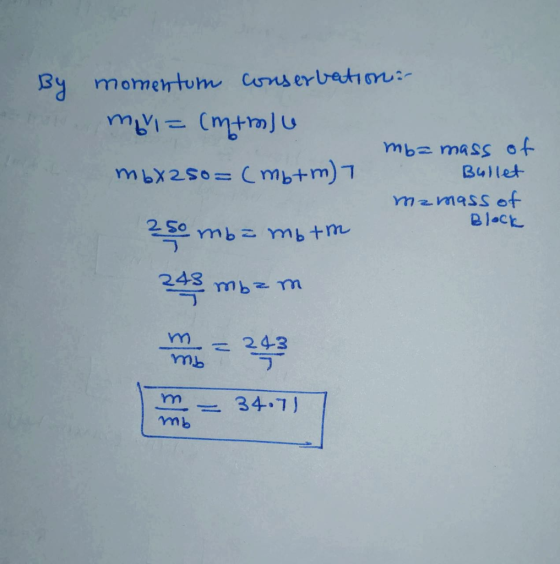
did this person get to the step, 243/7 * m_b = m?
Homework Answers
mb= mass of bullet
m= mass of block
v1= initial velocity of bullet
v= velocity of bullet+ block
By conservation of momentum
mb v1= (mb+m) v
mb* 250= (mb+m)*7
(250/7)mb= mb+m
250/7= (mb+m)/mb = (mb/mb)+(m/mb)= 1+( m/mb)
250/7=1 +(m/mb)
m/ mb =( 250/7)-1= (250-7)/7= 243/7= 34.71
Add Answer to:
A bullet traveling at 250 m/s hits a wooden block initially at
rest and is embedded...
A bullet of mass Mb is fired horizontally with speed Vi at a wooden block of...
A bullet of mass Mb is fired horizontally with speed Vi at a wooden block of mass Mw resting on a frictionless table. The bullet hits the block and becomes completely embedded within it. After the bullet has come to rest within the block, the block, with the bullet in it, is traveling at speed Vf . 1)Which of the following best describes this collision? a)perfectly elastic b)partially inelastic c)perfectly inelastic 2) Which of the following quantities, if any, are...
A 12.0-q bullet is fired horizontally into a 103-q wooden block that is initially at rest...
 A 12.0-q bullet is fired horizontally into a 103-q wooden block that is initially at rest on a frictionless horizontal surface and connected to a spring having spring constant 158 N/m. The bullet becomes the bullet-block system compresses the spring by a maximum of 81.5 cm, what was the speed of the bullet at impact with the block? embedded in the block. m/s
A 12.0-g bullet is fired horizontally into a 113-g wooden block that is initially at rest...
A 12.0-g bullet is fired horizontally into a 113-g wooden block that is initially at rest on a frictionless horizontal surface and connected to a spring having spring constant 159 N/m. The bullet becomes embedded in the block. If the bullet-block system compresses the spring by a maximum of 89.0 cm, what was the speed of the bullet at impact with the block? m/s
A 0.012-kg bullet, traveling at 850 m/s, hits a 2-kg block of wood that is initially...
A 0.012-kg bullet, traveling at 850 m/s, hits a 2-kg block of wood that is initially at rest, and goes straight through it. Assume that the final velocity of the bullet relative to the block is 400 m/s, and that the system is isolated. (a) What is the coefficient of restitution for this collision? (b) How much kinetic energy is “lost” in the collision? (c) What is the final velocity of the block?
A 15 gr bullet traveling at 500 m/s strikes the 5 kg wooden block and exists...
A 15 gr bullet traveling at 500 m/s strikes the 5 kg wooden block and exists the other side at 15 m/s as shown. The wooden block is initially at rest. Determine: a) The velocity of the wooden block just after the bullet exit it b) the average normal force on the wooden block if the bullets passes through it in 1.0 ms (millisecond) c) The time the block slides before it stops The coefficient of kinetic friction between the...
A 12.0-g bullet is fired horizontally into a 115-g wooden block that is initially at rest...
A 12.0-g bullet is fired horizontally into a 115-g wooden block that is initially at rest on a frictionless horizontal surface and connected to a spring having spring constant 146 N/m. The bullet becomes embedded in the block. If the bullet-block system compresses the spring by a maximum of 88.5 cm, what was the speed of the bullet at impact with the block?
A bullet of mass m 8.00 g traveling with 85 m/s is fired into a block...
 A bullet of mass m 8.00 g traveling with 85 m/s is fired into a block M of mass M 250 g that is initially at rest on the table of height h 1.00 m. The bullet remains in the block. Determine how far the block travels.
7.HW. A bullet is fired into a block of wood sitting on a block of ice....
 7.HW. A bullet is fired into a block of wood sitting on a block of ice. The bullet has an initial velocity of 500m/s and a mass of 0.005kg. The wooden block has a mass of 1.2kg and is initially at rest. The bullet remains embedded in the wood afterward. (so hit and stick situation) A)Assuming that momentum is conserved, find the velocity of the block of wood and bullet after the Collision. (so momentum before = momentum. V1’=V2'=V') B)What...
A 6.60 g bullet moving at 603 m/s strikes a 660 g wooden block at rest on a frictionless surface
A 6.60 g bullet moving at 603 m/s strikes a 660 g wooden block at rest on a frictionless surface. The bullet emerges, traveling in the same direction with its speed reduced to 457 m/s. (a) What is the resulting speed of the block? (b) What is the speed of the bullet-block center of mass?
A 2.50 q bullet, traveling at a speed of 480 m/s, strikes the wooden block of...
 A 2.50 q bullet, traveling at a speed of 480 m/s, strikes the wooden block of a ballistic pendulum, such as that in Figure 7.14. The block has a mass of 270 g. (a) (b) +m Figure 7.14 (a) Find the speed of the bullet/block combination immediately after the collision. m/s (b) How high does the combination rise above its initial position? m
 A 12.0-q bullet is fired horizontally into a 103-q wooden block that is initially at rest on a frictionless horizontal surface and connected to a spring having spring constant 158 N/m. The bullet becomes the bullet-block system compresses the spring by a maximum of 81.5 cm, what was the speed of the bullet at impact with the block? embedded in the block. m/s
 A bullet of mass m 8.00 g traveling with 85 m/s is fired into a block M of mass M 250 g that is initially at rest on the table of height h 1.00 m. The bullet remains in the block. Determine how far the block travels.
 7.HW. A bullet is fired into a block of wood sitting on a block of ice. The bullet has an initial velocity of 500m/s and a mass of 0.005kg. The wooden block has a mass of 1.2kg and is initially at rest. The bullet remains embedded in the wood afterward. (so hit and stick situation) A)Assuming that momentum is conserved, find the velocity of the block of wood and bullet after the Collision. (so momentum before = momentum. V1’=V2'=V') B)What...
 A 2.50 q bullet, traveling at a speed of 480 m/s, strikes the wooden block of a ballistic pendulum, such as that in Figure 7.14. The block has a mass of 270 g. (a) (b) +m Figure 7.14 (a) Find the speed of the bullet/block combination immediately after the collision. m/s (b) How high does the combination rise above its initial position? m
Most questions answered within 3 hours.
-
Where is the error in this code sequence?
String s1 = "Hello";
String s2 = "ello";...
asked 11 months ago -
Financial data for Joel de Paris, Inc., for last year
follow:
Joel de Paris, Inc.
Balance...
asked 11 months ago -
Consider this reaction:
Al2(SO4)3 (aq)+ BaCl3
(aq) Al2Cl6 (aq)- +
3BaSO4(s) . What is the...
asked 11 months ago -
Suppose that Savneet is considering increasing her
recent random sample from 20 car rentals to 40...
asked 11 months ago -
Trucks arrive at an unloading terminal at an average rate of 120
per hour.
Trucks arrive...
asked 11 months ago -
Why are methanol and ethanol completely soluble in water while
octanol is not very little soluble....
asked 11 months ago -
A facilities manager at a university reads in a research report
that the mean amount of...
asked 11 months ago -
When the CuSO4 is rehydrated by adding water to the anhydrous
compound, is this an endothermic...
asked 11 months ago -
A ray of sunlight is passing from diamond into crown glass; the
angle of incidence is...
asked 11 months ago -
A block of mass 0.249 kg is placed on top of a light, vertical
spring of...
asked 11 months ago -
how do the kidneys compensate in the presences of acidosis
a) trigger hyperventilate
b) reserve acid...
asked 11 months ago -
Question 501 pts
The rental rate of capital to the firm increases. Which of the
following...
asked 11 months ago