![Given the following structure: 4. struct int x; float y[10]; bool z; char w } s; and assume that the base address of s is 200](http://img.homeworklib.com/questions/4b3fe9a0-c0ac-11ea-921c-8b2eae139185.png?x-oss-process=image/resize,w_560)
Homework Answers
Dear Student,
below i have written the complete explanation:
===================================================================
first we must know the size of each element.
Data Type Size
int 4
float 4
bool 1
char 1
Since the base address is 200
hence int will take 4 bytes of memory i.e 200-203
float y[10] will take the memory = 40 bytes (since y is an array) hence address is 204 - 243
bool z will take 1 byte of memory hence address will be 244 - 245
char w will take 1 byte of memory hence base address would be 246.
Ans: Address of w is : 246
===============================================================
Kindly Check and Verify Thanks...!!!
Add Answer to:
Given the following structure: 4. struct int x; float y[10]; bool z; char w } s;...
help 9. Consider the following code segment: Struct some Int a: Long bi Char c Void foo (struct some s) S.a -21 s.b 1989: Int main0 Struct some thing: Foo (thing) Label the following stack diagra...
 help
9. Consider the following code segment: Struct some Int a: Long bi Char c Void foo (struct some s) S.a -21 s.b 1989: Int main0 Struct some thing: Foo (thing) Label the following stack diagram-from the perspective of function foo-each field of the struct should be clearly marked. Assume 8 byte wide words. 0x060 0x068 0x070 0x078 0x080 Ox088 Ox090 0x098 0x100 Ox108 Old base pointer Return address
9. Consider the following code segment: Struct some Int a: Long...
help
9. Consider the following code segment: Struct some Int a: Long bi Char c Void foo (struct some s) S.a -21 s.b 1989: Int main0 Struct some thing: Foo (thing) Label the following stack diagram-from the perspective of function foo-each field of the struct should be clearly marked. Assume 8 byte wide words. 0x060 0x068 0x070 0x078 0x080 Ox088 Ox090 0x098 0x100 Ox108 Old base pointer Return address
9. Consider the following code segment: Struct some Int a: Long...
Given the following program: #include <stdio.h> struct student { int id; char name[20]; char grade; };...
Given the following program: #include <stdio.h> struct student { int id; char name[20]; char grade; }; void func(struct student stud); int main() { struct student astud; astud.id=9401; strcpy(astud.name, "Joe"); astud.grade = 'A'; func(astud); return 0; } Abdelghani Bellaachia, CSCI 1121 Page: 16 void func(struct student astud) { printf(" Id is: %d \n", astud.id); printf(" Name is: %s \n", astud.name); printf(" Grade is: %c \n", astud.grade); } Modify this program to include the address of a student as a separate structure....
C Programming Explain what these function(s) do: struct thing{ int x; float y; }; struct node...
C Programming Explain what these function(s) do: struct thing{ int x; float y; }; struct node { struct thing *t; struct node *next; struct node *prev; }; struct dll{ struct node *head; struct node *tail; int length; }; struct thing *func( struct dll *list, int num) { struct node *curr = list ->head; while(curr != list ->tail) { if(curr ->t->x== num) return curr->t; curr=curr->next; } return NULL; }
Given the structure definition in a 32-bit environment: struct contact { char name[22] char gender; int...
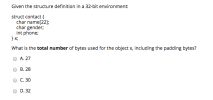 Given the structure definition in a 32-bit environment: struct contact { char name[22] char gender; int phone; X, What is the total number of bytes used for the object x, including the padding bytes? O A. 27 O B. 28 O C. 30 O D. 32
Given the following main program: int main() { int x; int y = 10;...
Given the following main program: int main() { int x; int y = 10; int z = 20; x = add(y,z); return 0; } Which function is correctly written to store the value in x? int add(int a, int b) { return a+b; } float add(float a, float b) { float x; x = a + b; return x; } void add(int y, int z) { int x; x...
Given the following: struct Val { int num1; float num2; } ; struct Person { int...
Given the following: struct Val { int num1; float num2; } ; struct Person { int age; float income; }; Val t, s; Person p1, p2, p3; s.num1 = 0; s.num2 = 2.5; //initialize s p2.age = 25; p2.income = 9999.99; //initialize p2 t = s; //assignment one p1 = s; //assignment two p2 = p3; //assignment three p3.age = s.num1; //assignment four p3.income = s.num1; //assignment five p2.age = t.num2; //assignment six For each assignment statements above...
struct my_coord { int x; int y; double altitude; }; struct my_line { struct my_coord first;...
struct my_coord { int x; int y; double altitude; }; struct my_line { struct my_coord first; struct my_coord second; char name[10]; }; struct my_coord var; struct my_coord array[3]; struct my_line one_line; struct my_line two_lines[2]; Draw the memory layout of the prior four variables; var, array, one_line, and two_lines on a line of boxes. Label the start of each variable and clearly show how many bytes each element within each structure variable consumes.
Trace the following program and display the exact outpust #incl udeci ostream» using namespace std const int siz-10 int ffx(Float ati,Float b(l, int s): bool ifp(int n) int mainO loat arysiz]-(6...
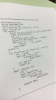 Trace the following program and display the exact outpust #incl udeci ostream» using namespace std const int siz-10 int ffx(Float ati,Float b(l, int s): bool ifp(int n) int mainO loat arysiz]-(6,19,5,3,2,17,40,90,19,80) float ary2tsiz)-to int i,x x-ffx(aryl,ary2, ,siz): cout<<"n The values are: for(1-0:1<" ; it) ary2[i] ; cout<<" coutくくendl ; return 0; oerio int ffx(float all,float bll, int S) int i,p-0; for(i 0: i<s ; i++){ )// end for LD++]=a[i]; return p; if(ifp(ali])) bool ifp(int n)l bool ans-true for (i=2:ic, itt)...
Suppose we have three variables declared as char *pc; int *pi; struct point {double x; double...
Suppose we have three variables declared as char *pc; int *pi; struct point {double x; double y;}; struct point *p1; struct point *p2[10]; Assume sizeof(char)=1, sizeof(int)=4, sizeof(double)=8. The values of pc, pi, p1 and p2 are 240, 258, 410 and 480 respectively. What are the values of pc+1, pi+2, p1+4 and p2+3
Given the struct xx with the following members: int x-3; char namell-"hello"; What would be the...
 Given the struct xx with the following members: int x-3; char namell-"hello"; What would be the output of the following program? 1. void main) 2. 3. struct xx "s-malloc(sizeof(struct xx)); 4, printf("%d",s->x); 5. printf("%s",s->name); 3 hello Garbage value hello 3 Garbage Value Compiler error None of the above
 help
9. Consider the following code segment: Struct some Int a: Long bi Char c Void foo (struct some s) S.a -21 s.b 1989: Int main0 Struct some thing: Foo (thing) Label the following stack diagram-from the perspective of function foo-each field of the struct should be clearly marked. Assume 8 byte wide words. 0x060 0x068 0x070 0x078 0x080 Ox088 Ox090 0x098 0x100 Ox108 Old base pointer Return address
9. Consider the following code segment: Struct some Int a: Long...
help
9. Consider the following code segment: Struct some Int a: Long bi Char c Void foo (struct some s) S.a -21 s.b 1989: Int main0 Struct some thing: Foo (thing) Label the following stack diagram-from the perspective of function foo-each field of the struct should be clearly marked. Assume 8 byte wide words. 0x060 0x068 0x070 0x078 0x080 Ox088 Ox090 0x098 0x100 Ox108 Old base pointer Return address
9. Consider the following code segment: Struct some Int a: Long...
 Given the structure definition in a 32-bit environment: struct contact { char name[22] char gender; int phone; X, What is the total number of bytes used for the object x, including the padding bytes? O A. 27 O B. 28 O C. 30 O D. 32
 Trace the following program and display the exact outpust #incl udeci ostream» using namespace std const int siz-10 int ffx(Float ati,Float b(l, int s): bool ifp(int n) int mainO loat arysiz]-(6,19,5,3,2,17,40,90,19,80) float ary2tsiz)-to int i,x x-ffx(aryl,ary2, ,siz): cout<<"n The values are: for(1-0:1<" ; it) ary2[i] ; cout<<" coutくくendl ; return 0; oerio int ffx(float all,float bll, int S) int i,p-0; for(i 0: i<s ; i++){ )// end for LD++]=a[i]; return p; if(ifp(ali])) bool ifp(int n)l bool ans-true for (i=2:ic, itt)...
 Given the struct xx with the following members: int x-3; char namell-"hello"; What would be the output of the following program? 1. void main) 2. 3. struct xx "s-malloc(sizeof(struct xx)); 4, printf("%d",s->x); 5. printf("%s",s->name); 3 hello Garbage value hello 3 Garbage Value Compiler error None of the above
Most questions answered within 3 hours.
-
Where is the error in this code sequence?
String s1 = "Hello";
String s2 = "ello";...
asked 1 year ago -
Financial data for Joel de Paris, Inc., for last year
follow:
Joel de Paris, Inc.
Balance...
asked 1 year ago -
Consider this reaction:
Al2(SO4)3 (aq)+ BaCl3
(aq) Al2Cl6 (aq)- +
3BaSO4(s) . What is the...
asked 1 year ago -
Suppose that Savneet is considering increasing her
recent random sample from 20 car rentals to 40...
asked 1 year ago -
Trucks arrive at an unloading terminal at an average rate of 120
per hour.
Trucks arrive...
asked 1 year ago -
Why are methanol and ethanol completely soluble in water while
octanol is not very little soluble....
asked 1 year ago -
A facilities manager at a university reads in a research report
that the mean amount of...
asked 1 year ago -
When the CuSO4 is rehydrated by adding water to the anhydrous
compound, is this an endothermic...
asked 1 year ago -
A ray of sunlight is passing from diamond into crown glass; the
angle of incidence is...
asked 1 year ago -
A block of mass 0.249 kg is placed on top of a light, vertical
spring of...
asked 1 year ago -
how do the kidneys compensate in the presences of acidosis
a) trigger hyperventilate
b) reserve acid...
asked 1 year ago -
Question 501 pts
The rental rate of capital to the firm increases. Which of the
following...
asked 1 year ago