The country of Uncoordinated requires 5 units of labor to produce one unit of corn and...
The country of Uncoordinated requires 5 units of labor to produce one unit of corn and 10 units of labor to produce one unit of housing. Uncoordinated has 100 total units of labor available. Uncoordinated has Leontief preferences (right-angle indifference curves) with the bend at equal shares of housing and corn.The country of Gifted requires 1 unit of labor to produce one unit of corn and 1 unit of labor to produce one unit of housing. Gifted has 10 units of labor available and Leontief preferences (right-angle indifference curves) with the bend at 2 units of corn for every unit of housing.a)Find the autarky levels of output for both countries.b)Identify which country has the comparative advantage in the production of each of the goods.c)Identify which country has the absolute advantage in the production of each of the goods.d)Develop a scheme of international trade that leaves both countries better off. In other words, show how specialization and trade can generate higher levels ofconsumption.e)Is the scheme developed in (d) the only possible welfare improving trade outcome? Why or why not?
Homework Answers
Request Answer!
We need at least 10 more requests to produce the answer.
0 / 10 have requested this problem solution
The more requests, the faster the answer.
Add Answer to:
The country of Uncoordinated requires 5 units of labor to
produce one unit of corn and...
1. Suppose country A can produce 30 units of Corn per time period (if it specializes...
1. Suppose country A can produce 30 units of Corn per time period (if it specializes in Corn). Country A can produce 4 outfits per time period (if it specializes in outfits). If country B specializes in Corn, it can produce 40 units per time period. If country B specialized in Outfits, it can produce 3 outfits per time period. A has a comparative advantage in Corn. B has a comparative advantage in Outfits. neither country has a comparative advantage....
Suppose that a worker in Kansas can produce either 5 units of corn or 1 unit...
Suppose that a worker in Kansas can produce either 5 units of corn or 1 unit of wheat per year, and a worker in Nebraska can produce either 8 units of corn or 2 units of wheat per year. Kansas has 5 workers and Nebraska has 10 workers. Without trade, Kansas produces and consumes 10 units of corn and 3 units of wheat per year while Nebraska produces and consumes 40 units of corn and 10 units of wheat. Suppose...
Suppose that: In Malaysia the unit labor requirement (ULR) to produce a pound of rice and a pencil are 1 and 2 hours of...
 Suppose that: In Malaysia the unit labor requirement (ULR) to produce a pound of rice and a pencil are 1 and 2 hours of labor respectively; In Indonesia, the unit labor requirement to produce a pound of rice and a pencil are 2 and 3 hours respectively; each country has 10,000 hours of labor to allocate between the production of rice and pencils; and in autarky, Malaysia consumes 5,000 pounds of rice and 2,500 pencils. When trade occurs, the world...
Assume two countries Argentina and Brazil that produce two goods, corn and wine. Assume that land...
Assume two countries Argentina and Brazil that produce two goods, corn and wine. Assume that land is specific to corn, capital is specific to wine, and labor is free to move between the two industries. Assume that Brazil has a comparative advantage in corn, and Argentina has a comparative in wine. Brazil and Argentina sign a free trade agreement, and we want to study the consequences of this trade agreement. a) Is it possible that real wages move in opposite...
The table below outlines the possible tradeoffs of producing units of cloth and corn, using one...
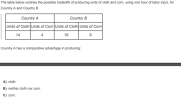 The table below outlines the possible tradeoffs of producing units of cloth and corn, using one hour of labor input, for Country A and Country B. Country A Country B Units of Cloth Units of Corn Units of Cloth| Units of Corn 14 / 4 / 16 / 8 Country A has a comparative advantage in producing: A) cloth. B) neither cloth nor corn. C) corn.
Consider two neighboring island countries called Dolorium and Content. They each have 4 million labor hours available per week that they can use to produce jeans, corn, or a combination of both
 Consider two neighboring island countries called Dolorium and
Content. They each have 4 million labor hours available per week
that they can use to produce jeans, corn, or a combination of both.
The following table shows the number of jeans or corn that can be
produced using 1 hour of labor.CountryJeansCorn(Pairs per hour of labor)(Bushels per hour of labor)Dolorium416Content510Initially, suppose Content uses 1 million hours of labor per
week to produce jeans and 3 million hours per week to produce...
Consider two neighboring island countries called Dolorium and
Content. They each have 4 million labor hours available per week
that they can use to produce jeans, corn, or a combination of both.
The following table shows the number of jeans or corn that can be
produced using 1 hour of labor.CountryJeansCorn(Pairs per hour of labor)(Bushels per hour of labor)Dolorium416Content510Initially, suppose Content uses 1 million hours of labor per
week to produce jeans and 3 million hours per week to produce...
Country A has 16,000 units of labor and can produce 2 goods, manufactures and food. A’s...
Country A has 16,000 units of labor and can produce 2 goods, manufactures and food. A’s producers take 2 units of labor to produce one unit of manufactures and 8 units to produce one unit of food. Country B has 36,000 units of labor and takes 6 units of labor to produce one unit of manufactures and 5 units to produce one unit of food. What is the price of manufactures in terms of food at which A and B...
Question 15 A country can produce either 25 pounds of fish or 7 bushels of corn....
Question 15 A country can produce either 25 pounds of fish or 7 bushels of corn. What is the opportunity cost of producing one bushel of corn? Enter a number rounded to two decimal places. Question 16 England and Scotland both produce scones and sweaters. Suppose that an English worker can produce 30 scones per hour or 2 sweater per hour. Suppose that a Scottish worker can produce 40 scones per hour or 4 sweaters per hour. Who will produce...
Assume that in country A, the unit labor requirement for producing good X is 100 hours,...
Assume that in country A, the unit labor requirement for producing good X is 100 hours, and the unit labor requirement for good Y is 20 hours. Meanwhile in country B, the unit labor requirement for producing good X is 80 hours and the unit labor requirement for good Y is 40 hours. Answer the following: Explain which country has an absolute advantage in each good. Explain which country has a comparative advantage in each good. Under the Theory of...
Assume that in country A, the unit labor requirement for producing good X is 100 hours,...
Assume that in country A, the unit labor requirement for producing good X is 100 hours, and the unit labor requirement for good Y is 20 hours. Meanwhile in country B, the unit labor requirement for producing good X is 80 hours and the unit labor requirement for good Y is 40 hours. Answer the following: Explain which country has an absolute advantage in each good. Explain which country has a comparative advantage in each good. Under the Theory of...
 Suppose that: In Malaysia the unit labor requirement (ULR) to produce a pound of rice and a pencil are 1 and 2 hours of labor respectively; In Indonesia, the unit labor requirement to produce a pound of rice and a pencil are 2 and 3 hours respectively; each country has 10,000 hours of labor to allocate between the production of rice and pencils; and in autarky, Malaysia consumes 5,000 pounds of rice and 2,500 pencils. When trade occurs, the world...
 The table below outlines the possible tradeoffs of producing units of cloth and corn, using one hour of labor input, for Country A and Country B. Country A Country B Units of Cloth Units of Corn Units of Cloth| Units of Corn 14 / 4 / 16 / 8 Country A has a comparative advantage in producing: A) cloth. B) neither cloth nor corn. C) corn.
Most questions answered within 3 hours.
-
Where is the error in this code sequence?
String s1 = "Hello";
String s2 = "ello";...
asked 11 months ago -
Financial data for Joel de Paris, Inc., for last year
follow:
Joel de Paris, Inc.
Balance...
asked 11 months ago -
Consider this reaction:
Al2(SO4)3 (aq)+ BaCl3
(aq) Al2Cl6 (aq)- +
3BaSO4(s) . What is the...
asked 11 months ago -
Suppose that Savneet is considering increasing her
recent random sample from 20 car rentals to 40...
asked 11 months ago -
Trucks arrive at an unloading terminal at an average rate of 120
per hour.
Trucks arrive...
asked 11 months ago -
Why are methanol and ethanol completely soluble in water while
octanol is not very little soluble....
asked 11 months ago -
A facilities manager at a university reads in a research report
that the mean amount of...
asked 11 months ago -
When the CuSO4 is rehydrated by adding water to the anhydrous
compound, is this an endothermic...
asked 11 months ago -
A ray of sunlight is passing from diamond into crown glass; the
angle of incidence is...
asked 11 months ago -
A block of mass 0.249 kg is placed on top of a light, vertical
spring of...
asked 11 months ago -
how do the kidneys compensate in the presences of acidosis
a) trigger hyperventilate
b) reserve acid...
asked 11 months ago -
Question 501 pts
The rental rate of capital to the firm increases. Which of the
following...
asked 11 months ago