
Homework Answers
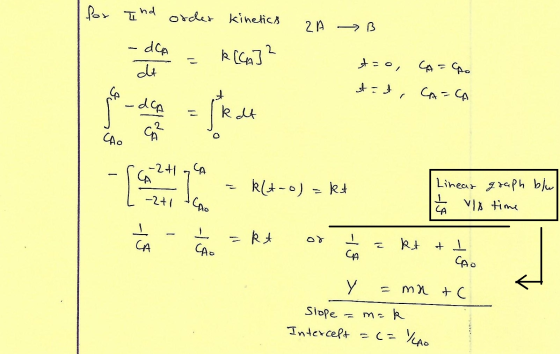
![where A represent for (CH3)3CBr Ifor I8 oxr kinetics A B CA- GAO - dep CA- CA - da Rdt J CA kdt a -(a) Jm(a)] n(GA) An (Go)](http://img.homeworklib.com/questions/83c66860-c0d5-11ea-b1f5-479023d1e2d1.png?x-oss-process=image/resize,w_560)
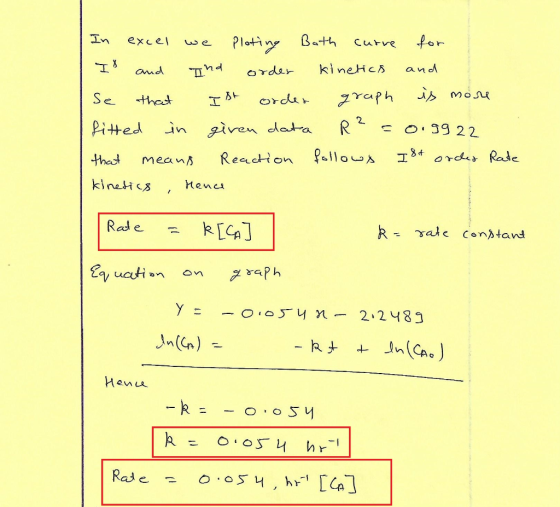
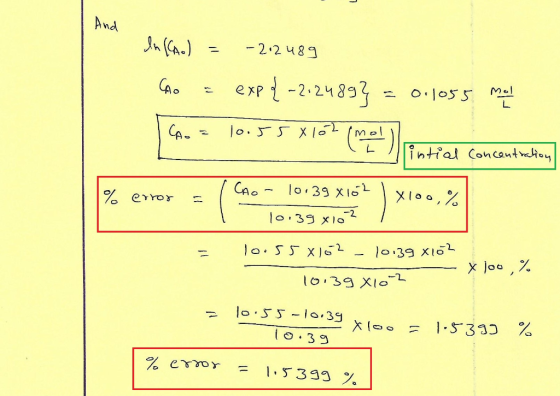
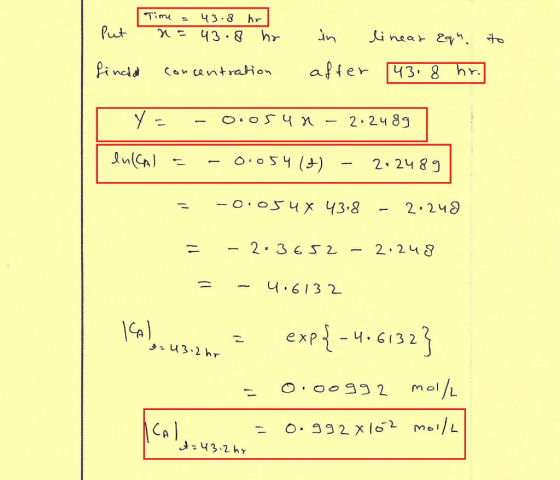
![time(h) In[(CH3)3CBr] 1/(Cнз)3СВI] (Сн3)3СBr, mol/L 0.1039 9.624639076 10 -2.264326381 3.15 0.0896 -2.412399959 11.16071429 6](http://img.homeworklib.com/questions/85100230-c0d5-11ea-bb52-73757742f932.png?x-oss-process=image/resize,w_560)
Add Answer to:
41 The following data was experimentally obtained for the reaction: 2 of 2 (CH3)3CBr + H2O...
(CH3)3CBr + H2O → (CH3)3COH + HBT Initial (CH3),CBr] Initial [H0] Experiment1 Experiment 2 Experiment 3...
 (CH3)3CBr + H2O → (CH3)3COH + HBT Initial (CH3),CBr] Initial [H0] Experiment1 Experiment 2 Experiment 3 mol L 5.0 x 10 5.0 x 10⁴ 1.0 x 10" mol L 2.0 x 10 4.0 x 10 4.0 x 10 Initial rate mol L 'min 2.0 x 10 2.0 x 10 4.0 x 10 a. ratek [(CH3)3CBr] O b. ratek [H2O] cratek [(CH3)3CBr)[H20] d. rate=k[(CH3),CBr] [H2012 L Moving to another question will save this response.
For the reaction of (CH3)3CBr with OH-, (CH3)3CBr + OH- ÷ (CH3)3COH + Br- The following...
For the reaction of (CH3)3CBr with OH-, (CH3)3CBr + OH- ÷ (CH3)3COH + Br- The following data were obtained in the laboratory. TIME (s) [(CH3)3CBr] 0 0.100 30 0.074 60 0.055 90 0.041 Plot these data as ln [(CH3)3CBr] versus time. Sketch your graph. Is the reaction first order or second order? What is the value of the rate constant?
March 4, 2020 5. The reaction of 'butyl-bromide (CH3)3CBr with water is represented by the equation:...
 March 4, 2020 5. The reaction of 'butyl-bromide (CH3)3CBr with water is represented by the equation: (CH3),CBr + H2O → (CH3)3COH + HBr The following data were obtained from three experiments: Experiment 1 Experiment 2 Experiment 3 Initial [(CH3)3CBr mol L-1 5.0 x 10⁻² 5.0 x 10⁻² 1.0 x 10⁻¹ Initial [H0] mol L 2.0 x 10⁻² 4.0 x 10² | 4.0 x 10⁻² Initial rate mol L-'min 2.0 x 10⁻⁶ 2.0 x 10⁻⁶ 4.0 x 10⁻⁶ a) What is...
Question 17 (3 points) The following set of data was obtained by the method of initial...
 Question 17 (3 points) The following set of data was obtained by the method of initial rates for the reaction: (H3C)3CBr + OH- → (H3C)3COH + Br- [(H3C)3CBr] (M) [OH-] (M) Initial Rate (M/s) 0.25 0.25 1.1 x 10⁻⁴ 0.50 0.25 2.2 x 10⁻⁴ 0.50 0.50 2.2 * 10-4 What is the rate law for this reaction, including the value for the rate constant k? You may omit units. Question 18 (3 points) For a particular first-order reaction, it takes...
4. For the reaction: (CH3),CBr +1 → (CH3),CI + Br* the following data were collected: (CH3)3Br)...
 4. For the reaction: (CH3),CBr +1 → (CH3),CI + Br* the following data were collected: (CH3)3Br) (M) Time (s) 0.600 0 0.424 10.0 0.300 20.0 0.212 30.0 0.150 40.0 Determine the rate law for this reaction and calculate the rate constant. (20 points)
4. For the reaction: (CH3),CBr +1 → (CH3),CI + Br* the following data were collected: (CH3)3Br)...
 4. For the reaction: (CH3),CBr +1 → (CH3),CI + Br* the following data were collected: (CH3)3Br) (M) Time (s) 0.600 0 0.424 10.0 0.300 20.0 0.212 30.0 0.150 40.0 Determine the rate law for this reaction and calculate the rate constant. (20 points)
4. For the reaction: (CH3),CBr +1 → (CH3),CI + Br* the following data were collected: (CH3)3Br)...
 4. For the reaction: (CH3),CBr +1 → (CH3),CI + Br* the following data were collected: (CH3)3Br) (M) Time (s) 0.600 0 0.424 10.0 0.300 20.0 0.212 30.0 0.150 40.0 Determine the rate law for this reaction and calculate the rate constant. (20 points)
4. For the reaction: (CH3),CBr +1 → (CH3),CI + Br* the following data were collected: (CH3)3Br)...
 4. For the reaction: (CH3),CBr +1 → (CH3),CI + Br* the following data were collected: (CH3)3Br) (M) Time (s) 0.600 0 0.424 10.0 0.300 20.0 0.212 30.0 0.150 40.0 Determine the rate law for this reaction and calculate the rate constant. (20 points)
1/ The Following data was obtained while observing a reaction between nitric oxide and hydrogen: F2(g)...
1/ The Following data was obtained while observing a reaction between nitric oxide and hydrogen: F2(g) + 2CLO2(g) -----> 2FCLO2(g) Experiment Initial(F2) Initial(CLO2) Initial rate (mol/L) (mol/L) (mol/L*s) 1/ 0.10 0.010 1.2 x 10^-3 2/ 0.10 0.040 4.8 x 10^-3 3/ 0.20 0.010 2.4 x 10^-3 A/ write the rate law for this reaction B/ calculate the rate constant for the reaction C/ what is the order of this reaction 2/ consider the reaction N2(g) + 3H2(g) ----> 2NH3(g). At...
The following data were obtained for the reaction given below. 2 C102(aq) + 2 OH "(aq)...
 The following data were obtained for the reaction given below. 2 C102(aq) + 2 OH "(aq) → CIO3- (aq) + ClO2" (aq) + H20(1) Rate - AC10,1 (CIO). (mol/L) (OH), (mol/L) Initial Rate (mol/L's) 0.0500 0.100 5.75 x 10⁻² 0.100 0.100 2.30 x 10⁻¹ 0.100 0.0500 1.15 x 101 (a) Determine the rate law and the value of the rate constant. (Rate equations take the general form 'rate = k. [A] [B]'.) rate law chemPad Help X.X° El Greek rate...
 (CH3)3CBr + H2O → (CH3)3COH + HBT Initial (CH3),CBr] Initial [H0] Experiment1 Experiment 2 Experiment 3 mol L 5.0 x 10 5.0 x 10⁴ 1.0 x 10" mol L 2.0 x 10 4.0 x 10 4.0 x 10 Initial rate mol L 'min 2.0 x 10 2.0 x 10 4.0 x 10 a. ratek [(CH3)3CBr] O b. ratek [H2O] cratek [(CH3)3CBr)[H20] d. rate=k[(CH3),CBr] [H2012 L Moving to another question will save this response.
 March 4, 2020 5. The reaction of 'butyl-bromide (CH3)3CBr with water is represented by the equation: (CH3),CBr + H2O → (CH3)3COH + HBr The following data were obtained from three experiments: Experiment 1 Experiment 2 Experiment 3 Initial [(CH3)3CBr mol L-1 5.0 x 10⁻² 5.0 x 10⁻² 1.0 x 10⁻¹ Initial [H0] mol L 2.0 x 10⁻² 4.0 x 10² | 4.0 x 10⁻² Initial rate mol L-'min 2.0 x 10⁻⁶ 2.0 x 10⁻⁶ 4.0 x 10⁻⁶ a) What is...
 Question 17 (3 points) The following set of data was obtained by the method of initial rates for the reaction: (H3C)3CBr + OH- → (H3C)3COH + Br- [(H3C)3CBr] (M) [OH-] (M) Initial Rate (M/s) 0.25 0.25 1.1 x 10⁻⁴ 0.50 0.25 2.2 x 10⁻⁴ 0.50 0.50 2.2 * 10-4 What is the rate law for this reaction, including the value for the rate constant k? You may omit units. Question 18 (3 points) For a particular first-order reaction, it takes...
 4. For the reaction: (CH3),CBr +1 → (CH3),CI + Br* the following data were collected: (CH3)3Br) (M) Time (s) 0.600 0 0.424 10.0 0.300 20.0 0.212 30.0 0.150 40.0 Determine the rate law for this reaction and calculate the rate constant. (20 points)
 4. For the reaction: (CH3),CBr +1 → (CH3),CI + Br* the following data were collected: (CH3)3Br) (M) Time (s) 0.600 0 0.424 10.0 0.300 20.0 0.212 30.0 0.150 40.0 Determine the rate law for this reaction and calculate the rate constant. (20 points)
 4. For the reaction: (CH3),CBr +1 → (CH3),CI + Br* the following data were collected: (CH3)3Br) (M) Time (s) 0.600 0 0.424 10.0 0.300 20.0 0.212 30.0 0.150 40.0 Determine the rate law for this reaction and calculate the rate constant. (20 points)
 4. For the reaction: (CH3),CBr +1 → (CH3),CI + Br* the following data were collected: (CH3)3Br) (M) Time (s) 0.600 0 0.424 10.0 0.300 20.0 0.212 30.0 0.150 40.0 Determine the rate law for this reaction and calculate the rate constant. (20 points)
 The following data were obtained for the reaction given below. 2 C102(aq) + 2 OH "(aq) → CIO3- (aq) + ClO2" (aq) + H20(1) Rate - AC10,1 (CIO). (mol/L) (OH), (mol/L) Initial Rate (mol/L's) 0.0500 0.100 5.75 x 10⁻² 0.100 0.100 2.30 x 10⁻¹ 0.100 0.0500 1.15 x 101 (a) Determine the rate law and the value of the rate constant. (Rate equations take the general form 'rate = k. [A] [B]'.) rate law chemPad Help X.X° El Greek rate...
Most questions answered within 3 hours.
-
Where is the error in this code sequence?
String s1 = "Hello";
String s2 = "ello";...
asked 1 year ago -
Financial data for Joel de Paris, Inc., for last year
follow:
Joel de Paris, Inc.
Balance...
asked 1 year ago -
Consider this reaction:
Al2(SO4)3 (aq)+ BaCl3
(aq) Al2Cl6 (aq)- +
3BaSO4(s) . What is the...
asked 1 year ago -
Suppose that Savneet is considering increasing her
recent random sample from 20 car rentals to 40...
asked 1 year ago -
Trucks arrive at an unloading terminal at an average rate of 120
per hour.
Trucks arrive...
asked 1 year ago -
Why are methanol and ethanol completely soluble in water while
octanol is not very little soluble....
asked 1 year ago -
A facilities manager at a university reads in a research report
that the mean amount of...
asked 1 year ago -
When the CuSO4 is rehydrated by adding water to the anhydrous
compound, is this an endothermic...
asked 1 year ago -
A ray of sunlight is passing from diamond into crown glass; the
angle of incidence is...
asked 1 year ago -
A block of mass 0.249 kg is placed on top of a light, vertical
spring of...
asked 1 year ago -
how do the kidneys compensate in the presences of acidosis
a) trigger hyperventilate
b) reserve acid...
asked 1 year ago -
Question 501 pts
The rental rate of capital to the firm increases. Which of the
following...
asked 1 year ago