
Homework Answers
Request Answer!
We need at least 10 more requests to produce the answer.
0 / 10 have requested this problem solution
The more requests, the faster the answer.
Add Answer to:
1.) Based on the experimental data below, determine the rate law for the reaction: 2H, +2NO...
4. Determine the rate law for the following reaction based on the experimental data in the...
4. Determine the rate law for the following reaction based on the experimental data in the table.2NO (g) + O2 (g) 2NO2 (g) Work: Answer:_________________________ b) If I mix 0.0189 M nitrogen monoxide and 0.0222 M oxygen, what will the rate of reaction be? (hint – you need to solve for an additional part of the rate law to answer this)
Part B: What is the value of the rate constant (including proper units) at this temperature?...
 Part B: What is the value of the rate constant (including proper
units) at this temperature?
13. The following data were collected for the reaction between hydrogen gas and niti oxide at 700°C 2 H2(g) + 2 NO(g) + 2 H2O(g) + N2(g) Experiment | [Hz]o (M) 0.010 0.0050 0.010 [NO]. (M) 0.025 0.025 0.0125 Initial Rate (M/sec) 2.4 x 10⁻⁶ 1.2 x 10⁻⁶ 0.60 x 10⁻⁶ 25 a. What is the overall order of the reaction? (*)>(6.023) = 160.3600)...
Part B: What is the value of the rate constant (including proper
units) at this temperature?
13. The following data were collected for the reaction between hydrogen gas and niti oxide at 700°C 2 H2(g) + 2 NO(g) + 2 H2O(g) + N2(g) Experiment | [Hz]o (M) 0.010 0.0050 0.010 [NO]. (M) 0.025 0.025 0.0125 Initial Rate (M/sec) 2.4 x 10⁻⁶ 1.2 x 10⁻⁶ 0.60 x 10⁻⁶ 25 a. What is the overall order of the reaction? (*)>(6.023) = 160.3600)...
8. An instructor asked the class, "Can you substitute hydrogen in nitrous oxide booster in your...
 8. An instructor asked the class, "Can you substitute hydrogen in nitrous oxide booster in your car engine, and if so what would be a representative reaction occurring in your car engine?" A half alert student thought he heard the instructor ask for the reaction between hydrogen and nitric oxide (instead of nitrous oxide NO2) and took off to perform the calculations. He assumed the reaction would be: 2H2 (g) + 2NO (g) → 2H,0 (g) + N2 (g) The...
For the reaction: 2NO(g) + O_2(g) rightarrow 2NO_2(g) Determine the rate law: rate = k[NO]^m [O_2]^n...
 For the reaction: 2NO(g) + O_2(g) rightarrow 2NO_2(g) Determine the rate law: rate = k[NO]^m [O_2]^n Determine also the rate constant: k = (rate)/[NO]^m [O_2]^n
Experimental rate data for the reaction 2H2(g) + Cl2(g) → 2HCl(g) are given in the chart...
Experimental rate data for the reaction 2H2(g) + Cl2(g) → 2HCl(g) are given in the chart below. Experiment [H2] [Cl2] Rate in M×s-1 1 0.0020 0.0075 3.8 x 10⁻³ 2 0.0020 0.0025 1.3 x 10⁻³ 3 0.0050 0.0025 1.3 x 10⁻³ 4 0.0050 0.0010 0.5 x 10⁻³ a). What are the orders of the reaction for H2 and Cl2 individually? SHOW WORK. b).Then write the rate law for this overall reaction:
For the following chemical reaction. 2NO(g) + O2(g) -> 2NO(g)
 5. For the following chemical reaction. 2NO(g) + O2(g) -> 2NO(g) Use the experimental data shown below and the method of initial rates to determine the complete rate law for the reaction. Show your work. [5]
Part A From the data, determine the rate law for the reaction. You may want to...
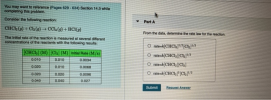 Part A From the data, determine the rate law for the reaction. You may want to reference (Pages 629 - 634) Section 14.3 while completing this problem. Consider the following reaction: CHCl(9) + Cl2(g) → CCL (9) + HC1() The Initial rate of the reaction is measured at several different concentrations of the reactants with the following results: [CHCI](M) [CI] (M) initial Rate (M/s) 0.010 0.010 0.0034 0.020 0.010 0.0068 rate=K[CHC13]/2Cl2}\/2 O rate-k[CHCI)(CI)" Oratenk(CHCI)(C1) O rate=k[CHC13) C1,]1/2 0.020 0.040 0.020...
Question 30 HNO2 at 800 C. Determine the rate law for the reaction The data in...
 Question 30 HNO2 at 800 C. Determine the rate law for the reaction The data in the below table were collected for the reaction No2+ (1/2) H2-H ExperimentNOl molsitH2lmoles/it Initial rate of reaction moles/lit sec 0.001 0.002 0.003 0.004 0.004 0.004 0.004 0.004 0.004 0.001 0.00 0.003 0.008 0.018 0.008 0.016 O Rate kN0221H21
The rate law for the reaction 2H2(g) + 2NO(g) ----> N2(g) + 2H2O(g) is rate=k[H2][NO]2. What...
The rate law for the reaction 2H2(g) + 2NO(g) ----> N2(g) + 2H2O(g) is rate=k[H2][NO]2. What is the rate constant at 800 degrees C when [NO] = 0.050 M and [H2] = 0.010 M and the rate of the reaction is 1.5 M/s
Using The Following Data, Determine the Rate Law For The Reaction. Part A. 2NO(g)+O(g) --> 2NO2(g)...
Using The Following Data, Determine the Rate Law For The Reaction. Part A. 2NO(g)+O(g) --> 2NO2(g) Experiment [NO] [O2] Initial Rate (M/s] 1 0.0126 0.0125 1.41x10^-2 2 0.0252 0.0250 1.13x10^-1 3 0.0252 0.0125 5.64x10^-2 Part B. S2O8charge2-(ag)+3 I charge 1-(aq) ----> 2SO4charge2-(aq)+I3charge1-(aq) Experiment [S2O8charge2-] [ I charge1-] Initial Rate (M/s) 1 0.023 0.048 6.8x10^-6 2 0.054 0.048 1.6x10^-5 3 0.054 0.019 6.3x10^-6
 Part B: What is the value of the rate constant (including proper
units) at this temperature?
13. The following data were collected for the reaction between hydrogen gas and niti oxide at 700°C 2 H2(g) + 2 NO(g) + 2 H2O(g) + N2(g) Experiment | [Hz]o (M) 0.010 0.0050 0.010 [NO]. (M) 0.025 0.025 0.0125 Initial Rate (M/sec) 2.4 x 10⁻⁶ 1.2 x 10⁻⁶ 0.60 x 10⁻⁶ 25 a. What is the overall order of the reaction? (*)>(6.023) = 160.3600)...
Part B: What is the value of the rate constant (including proper
units) at this temperature?
13. The following data were collected for the reaction between hydrogen gas and niti oxide at 700°C 2 H2(g) + 2 NO(g) + 2 H2O(g) + N2(g) Experiment | [Hz]o (M) 0.010 0.0050 0.010 [NO]. (M) 0.025 0.025 0.0125 Initial Rate (M/sec) 2.4 x 10⁻⁶ 1.2 x 10⁻⁶ 0.60 x 10⁻⁶ 25 a. What is the overall order of the reaction? (*)>(6.023) = 160.3600)...
 8. An instructor asked the class, "Can you substitute hydrogen in nitrous oxide booster in your car engine, and if so what would be a representative reaction occurring in your car engine?" A half alert student thought he heard the instructor ask for the reaction between hydrogen and nitric oxide (instead of nitrous oxide NO2) and took off to perform the calculations. He assumed the reaction would be: 2H2 (g) + 2NO (g) → 2H,0 (g) + N2 (g) The...
 For the reaction: 2NO(g) + O_2(g) rightarrow 2NO_2(g) Determine the rate law: rate = k[NO]^m [O_2]^n Determine also the rate constant: k = (rate)/[NO]^m [O_2]^n
 5. For the following chemical reaction. 2NO(g) + O2(g) -> 2NO(g) Use the experimental data shown below and the method of initial rates to determine the complete rate law for the reaction. Show your work. [5]
 Part A From the data, determine the rate law for the reaction. You may want to reference (Pages 629 - 634) Section 14.3 while completing this problem. Consider the following reaction: CHCl(9) + Cl2(g) → CCL (9) + HC1() The Initial rate of the reaction is measured at several different concentrations of the reactants with the following results: [CHCI](M) [CI] (M) initial Rate (M/s) 0.010 0.010 0.0034 0.020 0.010 0.0068 rate=K[CHC13]/2Cl2}\/2 O rate-k[CHCI)(CI)" Oratenk(CHCI)(C1) O rate=k[CHC13) C1,]1/2 0.020 0.040 0.020...
 Question 30 HNO2 at 800 C. Determine the rate law for the reaction The data in the below table were collected for the reaction No2+ (1/2) H2-H ExperimentNOl molsitH2lmoles/it Initial rate of reaction moles/lit sec 0.001 0.002 0.003 0.004 0.004 0.004 0.004 0.004 0.004 0.001 0.00 0.003 0.008 0.018 0.008 0.016 O Rate kN0221H21
Most questions answered within 3 hours.
-
Where is the error in this code sequence?
String s1 = "Hello";
String s2 = "ello";...
asked 10 months ago -
Financial data for Joel de Paris, Inc., for last year
follow:
Joel de Paris, Inc.
Balance...
asked 10 months ago -
Consider this reaction:
Al2(SO4)3 (aq)+ BaCl3
(aq) Al2Cl6 (aq)- +
3BaSO4(s) . What is the...
asked 10 months ago -
Suppose that Savneet is considering increasing her
recent random sample from 20 car rentals to 40...
asked 10 months ago -
Trucks arrive at an unloading terminal at an average rate of 120
per hour.
Trucks arrive...
asked 10 months ago -
Why are methanol and ethanol completely soluble in water while
octanol is not very little soluble....
asked 10 months ago -
A facilities manager at a university reads in a research report
that the mean amount of...
asked 10 months ago -
When the CuSO4 is rehydrated by adding water to the anhydrous
compound, is this an endothermic...
asked 10 months ago -
A ray of sunlight is passing from diamond into crown glass; the
angle of incidence is...
asked 10 months ago -
A block of mass 0.249 kg is placed on top of a light, vertical
spring of...
asked 10 months ago -
how do the kidneys compensate in the presences of acidosis
a) trigger hyperventilate
b) reserve acid...
asked 10 months ago -
Question 501 pts
The rental rate of capital to the firm increases. Which of the
following...
asked 10 months ago