
Homework Answers
If you have doubts please comment I will help you 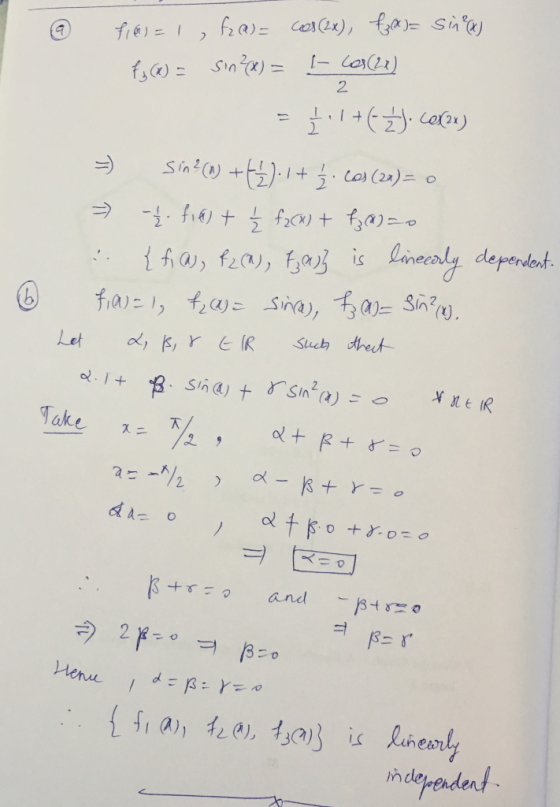
Add Answer to:
(a) Are the functions h(a) 1,(z) cos (2z) and fs(z) sin(x) linearly independent? (b) How about...
Question 5 Is the set of functions linearly dependent or linearly independent? f(x) = 7, g(x)...
 Question 5 Is the set of functions linearly dependent or linearly independent? f(x) = 7, g(x) = 5x +1, h(x) = 3x2 - 4x + 5 Linearly dependent Linearly independent Have no clue... Question 6 Given a solution to the DE below, find a second solution by using reduction of order. r’y' – 3xy + 5y = 0; y1 = r* cos(In x) y2 = xsin(In x) y2 = x2 sin Y2 = 2 * sin(In) . . y2 =...
(1 point) Are the functions f, g, and h given below linearly independent? f(x) = 621...
 (1 point) Are the functions f, g, and h given below linearly independent? f(x) = 621 + cos(9x), g(x) = 621 – cos(9x), h(x) = cos(9x). If they are independent, enter all zeroes. If they are not linearly independent, find a nontrivial solution to the equation below. Be sure you can justify your answer. (e24 + cos(9x)) + (e21 – cos(9x)) + (cos(9.x)) = 0.
(1 point) Are the functions f, g, and h given below linearly independent? f(x) = €3x...
 (1 point) Are the functions f, g, and h given below linearly independent? f(x) = €3x – cos(4x), g(x) = 23x + cos(4x), h(x) = cos(4x). If they are independent, enter all zeroes. If they are not linearly independent, find a nontrivial solution to the equation below. Be sure you can justify your answer. (e3x – cos(4x)) + (83x + cos(4x)) + (cos(4x)) = 0.
Linear Algebra (5) Are the functions 1, 1, r in the vector space RR = {f:...
 Linear Algebra
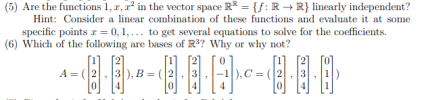
(5) Are the functions 1, 1, r in the vector space RR = {f: R R } linearly independent? Hint: Consider a linear combination of these functions and evaluate it at some specific points r = 0,1, ... to get several equations to solve for the coefficients. (6) Which of the following are bases of R3? Why or why not? 1-08 8 - 0 1 63.c-(07-08
Linear Algebra
(5) Are the functions 1, 1, r in the vector space RR = {f: R R } linearly independent? Hint: Consider a linear combination of these functions and evaluate it at some specific points r = 0,1, ... to get several equations to solve for the coefficients. (6) Which of the following are bases of R3? Why or why not? 1-08 8 - 0 1 63.c-(07-08
1. The Fourier series expansion of the function f(x) which is defined over one period by 3_ z, f(z) = 쓸 +Σ1@n cos...
 1. The Fourier series expansion of the function f(x) which is defined over one period by 3_ z, f(z) = 쓸 +Σ1@n cos nπχ +h,sin ηπΖ] is 1<zc2. Find the coefficients an r sin ax cosar x cos ar dr = We were unable to transcribe this image
1. The Fourier series expansion of the function f(x) which is defined over one period by 3_ z, f(z) = 쓸 +Σ1@n cos nπχ +h,sin ηπΖ] is 1
1. The Fourier series expansion of the function f(x) which is defined over one period by 3_ z, f(z) = 쓸 +Σ1@n cos nπχ +h,sin ηπΖ] is 1<zc2. Find the coefficients an r sin ax cosar x cos ar dr = We were unable to transcribe this image
1. The Fourier series expansion of the function f(x) which is defined over one period by 3_ z, f(z) = 쓸 +Σ1@n cos nπχ +h,sin ηπΖ] is 1
Let W denote the set of smooth functions f(x) in CⓇ such that f"(x) = -f(x)....
 Let W denote the set of smooth functions f(x) in CⓇ such that f"(x) = -f(x). That is, W = {f(x) in "S"(t) = -f(x)} . W is a subspace of C . For all a and b, a sin(x) + bcos(x) is in W. (a) Show that (sin(x), cos(x)} are linearly independent. Hint: Set an arbitrary linear combination equal to 0, and show the coefficients must be 0. (b) Let's say we knew that dim(W)=2. Show that (sin(x),cos(x)} is...
(5) Let W denote the set of smooth functions f(2) in CⓇ such that f'(x) =...
 (5) Let W denote the set of smooth functions f(2) in CⓇ such that f'(x) = -f(L). That is, W= {f() in C | F"(x) = -f(x)} In the previous worksheet, we showed that: • W is a subspace of Cº. . For all a and b, a sin(2) + b cos(x) is in W. (a) Show that (sin(x), cos(x)} are linearly independent. Hint: Set an arbitrary linear combination equal to 0, and show the coefficients must be 0. (b)...
Find the derivatives of the following functions. a) f(x) = sin(x²) b) g(x) = ln(cos(x)) c)...
 Find the derivatives of the following functions. a) f(x) = sin(x²) b) g(x) = ln(cos(x)) c) h(z) – In(1002? + 47x)? d) k(z) = resin(2)
(1 point) Determine which of the following pairs of functions are linearly independent. NO_ANSWER 1. f(t)...
 (1 point) Determine which of the following pairs of functions are linearly independent. NO_ANSWER 1. f(t) = 5t? + 35t, g(t) = 5t2 – 35t NO_ANSWER 2. f(t) = edt cos(ut), g(t) = edt sin(ut) ,70 NO_ANSWER 3. f(x) = 51, g(x) = 5(2-3) NO_ANSWER 4. f(t) = 3t , g(t) = 1t|
8. In a lossless Eq, λ and H. dielectric for which η,:20π, μ.-1,and E(z,t) 94πcos(wt +2z)...
 8. In a lossless Eq, λ and H. dielectric for which η,:20π, μ.-1,and E(z,t) 94πcos(wt +2z) a/m. Calculate 9. A plane wave in a lossless medium has H(z,t) 0.2 cos(ot-62)-y 2 sin(ot -6z) AV/m. Find a) The direction of wave propagating. b) εr and a. c) E(z,t). 10. The electric field component of an electromagnetic wave in free-space is given by E.z,t)Eocos(ay)sin wt -kx) V/rm (Hint: Use the identity 2 sin a cos b (sina+ b) +sin(a -b)) a) Find...
 Question 5 Is the set of functions linearly dependent or linearly independent? f(x) = 7, g(x) = 5x +1, h(x) = 3x2 - 4x + 5 Linearly dependent Linearly independent Have no clue... Question 6 Given a solution to the DE below, find a second solution by using reduction of order. r’y' – 3xy + 5y = 0; y1 = r* cos(In x) y2 = xsin(In x) y2 = x2 sin Y2 = 2 * sin(In) . . y2 =...
 (1 point) Are the functions f, g, and h given below linearly independent? f(x) = 621 + cos(9x), g(x) = 621 – cos(9x), h(x) = cos(9x). If they are independent, enter all zeroes. If they are not linearly independent, find a nontrivial solution to the equation below. Be sure you can justify your answer. (e24 + cos(9x)) + (e21 – cos(9x)) + (cos(9.x)) = 0.
 (1 point) Are the functions f, g, and h given below linearly independent? f(x) = €3x – cos(4x), g(x) = 23x + cos(4x), h(x) = cos(4x). If they are independent, enter all zeroes. If they are not linearly independent, find a nontrivial solution to the equation below. Be sure you can justify your answer. (e3x – cos(4x)) + (83x + cos(4x)) + (cos(4x)) = 0.
 Linear Algebra
(5) Are the functions 1, 1, r in the vector space RR = {f: R R } linearly independent? Hint: Consider a linear combination of these functions and evaluate it at some specific points r = 0,1, ... to get several equations to solve for the coefficients. (6) Which of the following are bases of R3? Why or why not? 1-08 8 - 0 1 63.c-(07-08
Linear Algebra
(5) Are the functions 1, 1, r in the vector space RR = {f: R R } linearly independent? Hint: Consider a linear combination of these functions and evaluate it at some specific points r = 0,1, ... to get several equations to solve for the coefficients. (6) Which of the following are bases of R3? Why or why not? 1-08 8 - 0 1 63.c-(07-08
 1. The Fourier series expansion of the function f(x) which is defined over one period by 3_ z, f(z) = 쓸 +Σ1@n cos nπχ +h,sin ηπΖ] is 1<zc2. Find the coefficients an r sin ax cosar x cos ar dr = We were unable to transcribe this image
1. The Fourier series expansion of the function f(x) which is defined over one period by 3_ z, f(z) = 쓸 +Σ1@n cos nπχ +h,sin ηπΖ] is 1
1. The Fourier series expansion of the function f(x) which is defined over one period by 3_ z, f(z) = 쓸 +Σ1@n cos nπχ +h,sin ηπΖ] is 1<zc2. Find the coefficients an r sin ax cosar x cos ar dr = We were unable to transcribe this image
1. The Fourier series expansion of the function f(x) which is defined over one period by 3_ z, f(z) = 쓸 +Σ1@n cos nπχ +h,sin ηπΖ] is 1
 Let W denote the set of smooth functions f(x) in CⓇ such that f"(x) = -f(x). That is, W = {f(x) in "S"(t) = -f(x)} . W is a subspace of C . For all a and b, a sin(x) + bcos(x) is in W. (a) Show that (sin(x), cos(x)} are linearly independent. Hint: Set an arbitrary linear combination equal to 0, and show the coefficients must be 0. (b) Let's say we knew that dim(W)=2. Show that (sin(x),cos(x)} is...
 (5) Let W denote the set of smooth functions f(2) in CⓇ such that f'(x) = -f(L). That is, W= {f() in C | F"(x) = -f(x)} In the previous worksheet, we showed that: • W is a subspace of Cº. . For all a and b, a sin(2) + b cos(x) is in W. (a) Show that (sin(x), cos(x)} are linearly independent. Hint: Set an arbitrary linear combination equal to 0, and show the coefficients must be 0. (b)...
 Find the derivatives of the following functions. a) f(x) = sin(x²) b) g(x) = ln(cos(x)) c) h(z) – In(1002? + 47x)? d) k(z) = resin(2)
 (1 point) Determine which of the following pairs of functions are linearly independent. NO_ANSWER 1. f(t) = 5t? + 35t, g(t) = 5t2 – 35t NO_ANSWER 2. f(t) = edt cos(ut), g(t) = edt sin(ut) ,70 NO_ANSWER 3. f(x) = 51, g(x) = 5(2-3) NO_ANSWER 4. f(t) = 3t , g(t) = 1t|
 8. In a lossless Eq, λ and H. dielectric for which η,:20π, μ.-1,and E(z,t) 94πcos(wt +2z) a/m. Calculate 9. A plane wave in a lossless medium has H(z,t) 0.2 cos(ot-62)-y 2 sin(ot -6z) AV/m. Find a) The direction of wave propagating. b) εr and a. c) E(z,t). 10. The electric field component of an electromagnetic wave in free-space is given by E.z,t)Eocos(ay)sin wt -kx) V/rm (Hint: Use the identity 2 sin a cos b (sina+ b) +sin(a -b)) a) Find...
Most questions answered within 3 hours.
-
Where is the error in this code sequence?
String s1 = "Hello";
String s2 = "ello";...
asked 11 months ago -
Financial data for Joel de Paris, Inc., for last year
follow:
Joel de Paris, Inc.
Balance...
asked 11 months ago -
Consider this reaction:
Al2(SO4)3 (aq)+ BaCl3
(aq) Al2Cl6 (aq)- +
3BaSO4(s) . What is the...
asked 11 months ago -
Suppose that Savneet is considering increasing her
recent random sample from 20 car rentals to 40...
asked 11 months ago -
Trucks arrive at an unloading terminal at an average rate of 120
per hour.
Trucks arrive...
asked 11 months ago -
Why are methanol and ethanol completely soluble in water while
octanol is not very little soluble....
asked 11 months ago -
A facilities manager at a university reads in a research report
that the mean amount of...
asked 11 months ago -
When the CuSO4 is rehydrated by adding water to the anhydrous
compound, is this an endothermic...
asked 11 months ago -
A ray of sunlight is passing from diamond into crown glass; the
angle of incidence is...
asked 11 months ago -
A block of mass 0.249 kg is placed on top of a light, vertical
spring of...
asked 11 months ago -
how do the kidneys compensate in the presences of acidosis
a) trigger hyperventilate
b) reserve acid...
asked 11 months ago -
Question 501 pts
The rental rate of capital to the firm increases. Which of the
following...
asked 11 months ago