
just question number 2 please, hate my teacher for all the a b c d e f g h.....
Homework Answers
Add Answer to:
just question number 2 please, hate my teacher for all
the a b c d e...
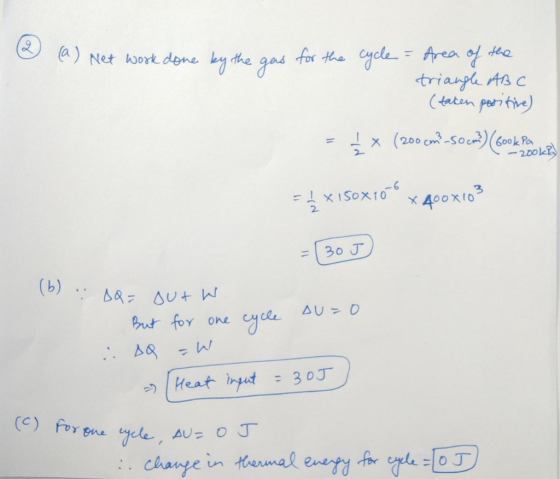
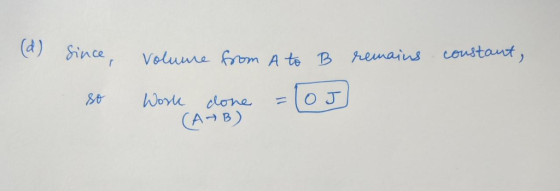
A monoatomic ideal gas is taken through the cycle A→B→C→A shown in the figure. Express all the answers below in terms of p0 and V0.
 A monoatomic ideal gas is taken through the cycle A→B→C→A shown in the figure. Express all the answers below in terms of p0 and V0.Part (a) Find the work WA→B done by the gas during process A →B.Part (b) Find the heat QA→B flowing into the gas during the process A →B.Part (c) Find the work WB→C done by the gas during the process B → C.Part (d) Find the heat QB→C flowing into the gas during the process B-C. Part (e) Find...
A Carnot engine operates us ing 1.0 mol e of monoatomic ideal gas as a working...
A Carnot engine operates us ing 1.0 mol e of monoatomic ideal gas as a working s ubstance. In t he first step, the gas is place d in thermal contact with a heat reservoir and expands isothermally to 3 .0 times its initial volume. (a) If the internal energy o f the gas after this step is 6.25 k J , calculate the temperature of the heat reservoir ( T h ) . (b) C alculate the heat absorbed...
A thermodynamic cycle ABC involving 2.5 mols of an ideal gas is shown below. (a) Find the absolute temperatures at points A, B, and C. (b) Find the work done by or on the system from A to B, from B t...
 A thermodynamic cycle ABC involving 2.5 mols of an ideal gas is shown below. (a) Find the absolute temperatures at points A, B, and C. (b) Find the work done by or on the system from A to B, from B to C, and from C to A (include the proper sign in each case). (c) Find the heat transferred to or from the system from A to B, from B to C, and from C to A (include the...
Help!!! Please explain why you chose the answers too pls: #1. What best describes what happens...
Help!!! Please explain why you chose the answers too pls: #1. What best describes what happens when the end of the hose of a running vacuum cleaner is placed on your arm? A. Your skin moves in the direction of negative pressure, partially into the end of the hose. B. The vacuum cleaner pulls your skin partially into the end of the hose. C. Your skin pushes itself partially into the end of the hose. D. The surrounding atmosphere pushes...
part C and E. Please label each part with its answer. 3. A Sterling engine using...
 part C and E. Please label each part with its answer.
3. A Sterling engine using 1.00 mol of an ideal gas initially at a volume of 24.6L and a temperature of 400K performs a cycle consisting of four steps: (1) An isothermal expansion at a temperature of 400K to twice its initial volume. (2) Cooling at constant volume to a temperature of 300K (3) An isothermal compression to its original volume (4) Heating at constant volume to its original...
part C and E. Please label each part with its answer.
3. A Sterling engine using 1.00 mol of an ideal gas initially at a volume of 24.6L and a temperature of 400K performs a cycle consisting of four steps: (1) An isothermal expansion at a temperature of 400K to twice its initial volume. (2) Cooling at constant volume to a temperature of 300K (3) An isothermal compression to its original volume (4) Heating at constant volume to its original...
Ideal Gas Process Problem natomic ideal gas is run through the cycle shown starting in state...
 Ideal Gas Process Problem natomic ideal gas is run through the cycle shown starting in state A. The temperature of the gas in state A 300 K. The cycle happens within a sealed chamber outfitted with a piston as necessary. P (Pa) A 5.00 x 10⁵ + The Herring Cycle 1.00 x 10⁵ + 14300k 2.00 6.00 The cycle is composed of three processes, A B, B C, and C - A. 1) For each individual process... (a) (b) Name...
General Physics Do parts: e-m and assume the gas is diatomic: U = (5/2)nRT (a) W...
 General Physics
Do parts: e-m and assume the gas is diatomic: U = (5/2)nRT
(a) W = 415.7 J
(b) on the piston
(c) 1039.25 J
(d) Q added = 1454.95 J
------------------Not so sure about part (e) and below
(e) W = 0 J
(f) N/A
(g) -1039.25 J
(g) = -1039.25 J
A cyclic process A cylinder contains 0.50 mol of ideal gas at 27.0 °C. First, the gas is heated to 127.0 °C while the pressure is...
General Physics
Do parts: e-m and assume the gas is diatomic: U = (5/2)nRT
(a) W = 415.7 J
(b) on the piston
(c) 1039.25 J
(d) Q added = 1454.95 J
------------------Not so sure about part (e) and below
(e) W = 0 J
(f) N/A
(g) -1039.25 J
(g) = -1039.25 J
A cyclic process A cylinder contains 0.50 mol of ideal gas at 27.0 °C. First, the gas is heated to 127.0 °C while the pressure is...
Answer all please, a, b, c and d to a light spring with a force of27.9...
 Answer all please, a, b, c and d
to a light spring with a force of27.9 N/m and set into from rest following (a) maximum speed of the osollating mass (b) speed of the escilating mass when the spring is compressed 1.5 cm (c) speed of the oscillating mass as it passes the point 1.5 cm from the equilibrium position LReading that has a period of 0815 37
Answer all please, a, b, c and d
to a light spring with a force of27.9 N/m and set into from rest following (a) maximum speed of the osollating mass (b) speed of the escilating mass when the spring is compressed 1.5 cm (c) speed of the oscillating mass as it passes the point 1.5 cm from the equilibrium position LReading that has a period of 0815 37
explain every answer choice well please and thank you. The picture shows 6 moles of an...
 explain every answer choice well please and thank you.
The picture shows 6 moles of an ideal gas in a piston, undergoing a cyclic process A-B-C-D-A. P(atm) P1 13.What does the expression (V2-V)( P2-P1) show? (A) The internal energy at point B. (B) The heat flowing into the gas going from point A to point B (C) The work done by the gas going around the cycle (D) The temperature difference between point B and point A. (E) None of...
explain every answer choice well please and thank you.
The picture shows 6 moles of an ideal gas in a piston, undergoing a cyclic process A-B-C-D-A. P(atm) P1 13.What does the expression (V2-V)( P2-P1) show? (A) The internal energy at point B. (B) The heat flowing into the gas going from point A to point B (C) The work done by the gas going around the cycle (D) The temperature difference between point B and point A. (E) None of...
 A thermodynamic cycle ABC involving 2.5 mols of an ideal gas is shown below. (a) Find the absolute temperatures at points A, B, and C. (b) Find the work done by or on the system from A to B, from B to C, and from C to A (include the proper sign in each case). (c) Find the heat transferred to or from the system from A to B, from B to C, and from C to A (include the...
 part C and E. Please label each part with its answer.
3. A Sterling engine using 1.00 mol of an ideal gas initially at a volume of 24.6L and a temperature of 400K performs a cycle consisting of four steps: (1) An isothermal expansion at a temperature of 400K to twice its initial volume. (2) Cooling at constant volume to a temperature of 300K (3) An isothermal compression to its original volume (4) Heating at constant volume to its original...
part C and E. Please label each part with its answer.
3. A Sterling engine using 1.00 mol of an ideal gas initially at a volume of 24.6L and a temperature of 400K performs a cycle consisting of four steps: (1) An isothermal expansion at a temperature of 400K to twice its initial volume. (2) Cooling at constant volume to a temperature of 300K (3) An isothermal compression to its original volume (4) Heating at constant volume to its original...
 Ideal Gas Process Problem natomic ideal gas is run through the cycle shown starting in state A. The temperature of the gas in state A 300 K. The cycle happens within a sealed chamber outfitted with a piston as necessary. P (Pa) A 5.00 x 10⁵ + The Herring Cycle 1.00 x 10⁵ + 14300k 2.00 6.00 The cycle is composed of three processes, A B, B C, and C - A. 1) For each individual process... (a) (b) Name...
 General Physics
Do parts: e-m and assume the gas is diatomic: U = (5/2)nRT
(a) W = 415.7 J
(b) on the piston
(c) 1039.25 J
(d) Q added = 1454.95 J
------------------Not so sure about part (e) and below
(e) W = 0 J
(f) N/A
(g) -1039.25 J
(g) = -1039.25 J
A cyclic process A cylinder contains 0.50 mol of ideal gas at 27.0 °C. First, the gas is heated to 127.0 °C while the pressure is...
General Physics
Do parts: e-m and assume the gas is diatomic: U = (5/2)nRT
(a) W = 415.7 J
(b) on the piston
(c) 1039.25 J
(d) Q added = 1454.95 J
------------------Not so sure about part (e) and below
(e) W = 0 J
(f) N/A
(g) -1039.25 J
(g) = -1039.25 J
A cyclic process A cylinder contains 0.50 mol of ideal gas at 27.0 °C. First, the gas is heated to 127.0 °C while the pressure is...
 Answer all please, a, b, c and d
to a light spring with a force of27.9 N/m and set into from rest following (a) maximum speed of the osollating mass (b) speed of the escilating mass when the spring is compressed 1.5 cm (c) speed of the oscillating mass as it passes the point 1.5 cm from the equilibrium position LReading that has a period of 0815 37
Answer all please, a, b, c and d
to a light spring with a force of27.9 N/m and set into from rest following (a) maximum speed of the osollating mass (b) speed of the escilating mass when the spring is compressed 1.5 cm (c) speed of the oscillating mass as it passes the point 1.5 cm from the equilibrium position LReading that has a period of 0815 37
 explain every answer choice well please and thank you.
The picture shows 6 moles of an ideal gas in a piston, undergoing a cyclic process A-B-C-D-A. P(atm) P1 13.What does the expression (V2-V)( P2-P1) show? (A) The internal energy at point B. (B) The heat flowing into the gas going from point A to point B (C) The work done by the gas going around the cycle (D) The temperature difference between point B and point A. (E) None of...
explain every answer choice well please and thank you.
The picture shows 6 moles of an ideal gas in a piston, undergoing a cyclic process A-B-C-D-A. P(atm) P1 13.What does the expression (V2-V)( P2-P1) show? (A) The internal energy at point B. (B) The heat flowing into the gas going from point A to point B (C) The work done by the gas going around the cycle (D) The temperature difference between point B and point A. (E) None of...
Most questions answered within 3 hours.
-
Where is the error in this code sequence?
String s1 = "Hello";
String s2 = "ello";...
asked 10 months ago -
Financial data for Joel de Paris, Inc., for last year
follow:
Joel de Paris, Inc.
Balance...
asked 10 months ago -
Consider this reaction:
Al2(SO4)3 (aq)+ BaCl3
(aq) Al2Cl6 (aq)- +
3BaSO4(s) . What is the...
asked 10 months ago -
Suppose that Savneet is considering increasing her
recent random sample from 20 car rentals to 40...
asked 10 months ago -
Trucks arrive at an unloading terminal at an average rate of 120
per hour.
Trucks arrive...
asked 10 months ago -
Why are methanol and ethanol completely soluble in water while
octanol is not very little soluble....
asked 10 months ago -
A facilities manager at a university reads in a research report
that the mean amount of...
asked 10 months ago -
When the CuSO4 is rehydrated by adding water to the anhydrous
compound, is this an endothermic...
asked 10 months ago -
A ray of sunlight is passing from diamond into crown glass; the
angle of incidence is...
asked 10 months ago -
A block of mass 0.249 kg is placed on top of a light, vertical
spring of...
asked 10 months ago -
how do the kidneys compensate in the presences of acidosis
a) trigger hyperventilate
b) reserve acid...
asked 10 months ago -
Question 501 pts
The rental rate of capital to the firm increases. Which of the
following...
asked 10 months ago