
Homework Answers

Add Answer to:
Problem 3: In aerodynamics and fluid mechanics, the functions and in f(x) = +, where f(z)...
Fluid Mechanics Problem Problem 3: Determine the velocity distribution between two parallel plates where there is...
 Fluid Mechanics Problem
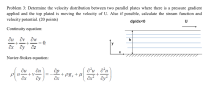
Problem 3: Determine the velocity distribution between two parallel plates where there is a pressure gradient applied and the top plated is moving the velocity of U. Also if possible, calculate the stream function and velocity potential. (20 points) dpldx<o Continuity equation Ou OW ?NCZ Navier-Stokes equation Ouolu op l1
Fluid Mechanics Problem
Problem 3: Determine the velocity distribution between two parallel plates where there is a pressure gradient applied and the top plated is moving the velocity of U. Also if possible, calculate the stream function and velocity potential. (20 points) dpldx<o Continuity equation Ou OW ?NCZ Navier-Stokes equation Ouolu op l1
Please answer without using previously posted answers. Thanks Let F(x, y) be a two-dimensional vector field. Spose further that there exists a scalar function, o, such that Then, F(x,y) is called a g...
 Please answer without using previously posted answers.
Thanks
Let F(x, y) be a two-dimensional vector field. Spose further that there exists a scalar function, o, such that Then, F(x,y) is called a gradient field, and φ s called a potential function. Ideal Fluid Flow Let F represent the two-dimensional velocity field of an inviscid fluid that is incompressible, ie. . F-0 (or divergence-free). F can be represented by (1), where ф is called the velocity potential-show that o is harmonic....
Please answer without using previously posted answers.
Thanks
Let F(x, y) be a two-dimensional vector field. Spose further that there exists a scalar function, o, such that Then, F(x,y) is called a gradient field, and φ s called a potential function. Ideal Fluid Flow Let F represent the two-dimensional velocity field of an inviscid fluid that is incompressible, ie. . F-0 (or divergence-free). F can be represented by (1), where ф is called the velocity potential-show that o is harmonic....
Problem 1 Consider the composition f(w(z)) of two complex valued functions of a complex variable, f(w)...
 Problem 1 Consider the composition f(w(z)) of two complex valued functions of a complex variable, f(w) and w(z), where z = x+iy and w=u+iv. Assume that both functions have continuous partial derivatives. Show that the chain rule can be written in complex form as of _ of ou , of Oz . . of az " dw dz * dw dz and Z of ou , of ou dw dz* dw ƏZ Show as a consequence that if f(w) is...
Problem (3) A function f(z) is analytic in the disk -1 where the modulus satisfies the bound Here b 2 a > 0 Find an...
 Problem (3) A function f(z) is analytic in the disk -1 where the modulus satisfies the bound Here b 2 a > 0 Find an optimal bound on |f'(0) in terms of a and b. Complete arguments required By optimal it is meant that (1) the bound holds for all functions with the stated property and (2) there actually is a function with the stated property such that the bound holds as an equality. The second part of this problem...
Fluid Mechanics Chapter 7 Intro QUESTION 1 If the number of parameters in a problem is...
 Fluid Mechanics Chapter 7 Intro
QUESTION 1 If the number of parameters in a problem is m and the number of primary dimensions is 3, then the number of resultant Pl terms is QUESTION 2 If an object travels with a velocity V, a distance, s, in time t. The Pl term formed by using the three variables is QUESTION 3 Friction in the pipe: The shear stress on the pipe-walls (Tw) is a function of flow velocity, V, fluid...
Fluid Mechanics Chapter 7 Intro
QUESTION 1 If the number of parameters in a problem is m and the number of primary dimensions is 3, then the number of resultant Pl terms is QUESTION 2 If an object travels with a velocity V, a distance, s, in time t. The Pl term formed by using the three variables is QUESTION 3 Friction in the pipe: The shear stress on the pipe-walls (Tw) is a function of flow velocity, V, fluid...
Hw2 Q1 Show that the function f(z) = z2 + z is analytic. Also find its...
 Hw2 Q1 Show that the function f(z) = z2 + z is analytic. Also find its derivative. (Hint: check CR Equations for Analyticity, and then proceed finding the derivative as shown in video 8 by any of the two rules shown in video 7] Q2 Verify that the following functions are harmonic i. u = x2 - y2 + 2x - y. ii. v=e* cos y. Q3 Verify that the given function is harmonic, and find the harmonic conjugate function...
Problem 4. (15 points each) Let F(x, y, z) = (0, x, y) G(x, y, z)...
 Problem 4. (15 points each) Let F(x, y, z) = (0, x, y) G(x, y, z) = (2x, z, y) + (x, y, z) = (3y, 2x, z). (a) For each field, either find a scalar potential function or prove that none exists. (b) For each field, either find a vector potential function or prove that none exists. (c) Let F(t) = (2, 2t, t2). For which of these vector fields is ñ a flow line? Justify your answer.
Solve the following problem using Lagrange multiplier method: Maximize f(x,y,z) = 4y-2z subject to the constraints...
 Solve the following problem using Lagrange multiplier method: Maximize f(x,y,z) = 4y-2z subject to the constraints 2x-y-z 2 x2+y2- 1 1. (1) (2) (Note: You need not check the Hessian matrix, just find the maximum by evaluating the values of f(x,y,z) at the potential solution points) Also, using sensitivity analysis, find the change in the maximum value of the function, f, if the above constraints are changed to: (3) (4) 2x -0.9y-z 2 x2+ y2- 0.9.
Solve the following problem...
Solve the following problem using Lagrange multiplier method: Maximize f(x,y,z) = 4y-2z subject to the constraints 2x-y-z 2 x2+y2- 1 1. (1) (2) (Note: You need not check the Hessian matrix, just find the maximum by evaluating the values of f(x,y,z) at the potential solution points) Also, using sensitivity analysis, find the change in the maximum value of the function, f, if the above constraints are changed to: (3) (4) 2x -0.9y-z 2 x2+ y2- 0.9.
Solve the following problem...
Solve the following problem using Lagrange multiplier method: Maximize f(x,y,z) = 4y-2z subject to the constraints...
 Solve the following problem using Lagrange multiplier method: Maximize f(x,y,z) = 4y-2z subject to the constraints 2x-y-z 2 x2+ y2- 1 (1) (2) (Note: You need not check the Hessian matrix, just find the maximum by evaluating the values of f(x,y,z) at the potential solution points) Also, using sensitivity analysis, find the change in the maximum value of the function, f, if the above constraints are changed to: (3) (4) 2x-0.9y-z =2 x2+y2- 0.9
Solve the following problem using Lagrange...
Solve the following problem using Lagrange multiplier method: Maximize f(x,y,z) = 4y-2z subject to the constraints 2x-y-z 2 x2+ y2- 1 (1) (2) (Note: You need not check the Hessian matrix, just find the maximum by evaluating the values of f(x,y,z) at the potential solution points) Also, using sensitivity analysis, find the change in the maximum value of the function, f, if the above constraints are changed to: (3) (4) 2x-0.9y-z =2 x2+y2- 0.9
Solve the following problem using Lagrange...
Problem #3: Find the residues of the following functions at z = 0 a) f(3) =...
 Problem #3: Find the residues of the following functions at z = 0 a) f(3) = 2* cos () b) f(3) = 1-cosa; c) f(3) = CS2 f(3) = 25(1 – 22) COS 2 COS 2 e) f(3) = 15e *e*1 f) f(3) = cosz - 1 9) f(3) = (sin 2)23 W f(z) = (eš – 1)2
 Fluid Mechanics Problem
Problem 3: Determine the velocity distribution between two parallel plates where there is a pressure gradient applied and the top plated is moving the velocity of U. Also if possible, calculate the stream function and velocity potential. (20 points) dpldx<o Continuity equation Ou OW ?NCZ Navier-Stokes equation Ouolu op l1
Fluid Mechanics Problem
Problem 3: Determine the velocity distribution between two parallel plates where there is a pressure gradient applied and the top plated is moving the velocity of U. Also if possible, calculate the stream function and velocity potential. (20 points) dpldx<o Continuity equation Ou OW ?NCZ Navier-Stokes equation Ouolu op l1
 Please answer without using previously posted answers.
Thanks
Let F(x, y) be a two-dimensional vector field. Spose further that there exists a scalar function, o, such that Then, F(x,y) is called a gradient field, and φ s called a potential function. Ideal Fluid Flow Let F represent the two-dimensional velocity field of an inviscid fluid that is incompressible, ie. . F-0 (or divergence-free). F can be represented by (1), where ф is called the velocity potential-show that o is harmonic....
Please answer without using previously posted answers.
Thanks
Let F(x, y) be a two-dimensional vector field. Spose further that there exists a scalar function, o, such that Then, F(x,y) is called a gradient field, and φ s called a potential function. Ideal Fluid Flow Let F represent the two-dimensional velocity field of an inviscid fluid that is incompressible, ie. . F-0 (or divergence-free). F can be represented by (1), where ф is called the velocity potential-show that o is harmonic....
 Problem 1 Consider the composition f(w(z)) of two complex valued functions of a complex variable, f(w) and w(z), where z = x+iy and w=u+iv. Assume that both functions have continuous partial derivatives. Show that the chain rule can be written in complex form as of _ of ou , of Oz . . of az " dw dz * dw dz and Z of ou , of ou dw dz* dw ƏZ Show as a consequence that if f(w) is...
 Problem (3) A function f(z) is analytic in the disk -1 where the modulus satisfies the bound Here b 2 a > 0 Find an optimal bound on |f'(0) in terms of a and b. Complete arguments required By optimal it is meant that (1) the bound holds for all functions with the stated property and (2) there actually is a function with the stated property such that the bound holds as an equality. The second part of this problem...
 Fluid Mechanics Chapter 7 Intro
QUESTION 1 If the number of parameters in a problem is m and the number of primary dimensions is 3, then the number of resultant Pl terms is QUESTION 2 If an object travels with a velocity V, a distance, s, in time t. The Pl term formed by using the three variables is QUESTION 3 Friction in the pipe: The shear stress on the pipe-walls (Tw) is a function of flow velocity, V, fluid...
Fluid Mechanics Chapter 7 Intro
QUESTION 1 If the number of parameters in a problem is m and the number of primary dimensions is 3, then the number of resultant Pl terms is QUESTION 2 If an object travels with a velocity V, a distance, s, in time t. The Pl term formed by using the three variables is QUESTION 3 Friction in the pipe: The shear stress on the pipe-walls (Tw) is a function of flow velocity, V, fluid...
 Hw2 Q1 Show that the function f(z) = z2 + z is analytic. Also find its derivative. (Hint: check CR Equations for Analyticity, and then proceed finding the derivative as shown in video 8 by any of the two rules shown in video 7] Q2 Verify that the following functions are harmonic i. u = x2 - y2 + 2x - y. ii. v=e* cos y. Q3 Verify that the given function is harmonic, and find the harmonic conjugate function...
 Problem 4. (15 points each) Let F(x, y, z) = (0, x, y) G(x, y, z) = (2x, z, y) + (x, y, z) = (3y, 2x, z). (a) For each field, either find a scalar potential function or prove that none exists. (b) For each field, either find a vector potential function or prove that none exists. (c) Let F(t) = (2, 2t, t2). For which of these vector fields is ñ a flow line? Justify your answer.
 Solve the following problem using Lagrange multiplier method: Maximize f(x,y,z) = 4y-2z subject to the constraints 2x-y-z 2 x2+y2- 1 1. (1) (2) (Note: You need not check the Hessian matrix, just find the maximum by evaluating the values of f(x,y,z) at the potential solution points) Also, using sensitivity analysis, find the change in the maximum value of the function, f, if the above constraints are changed to: (3) (4) 2x -0.9y-z 2 x2+ y2- 0.9.
Solve the following problem...
Solve the following problem using Lagrange multiplier method: Maximize f(x,y,z) = 4y-2z subject to the constraints 2x-y-z 2 x2+y2- 1 1. (1) (2) (Note: You need not check the Hessian matrix, just find the maximum by evaluating the values of f(x,y,z) at the potential solution points) Also, using sensitivity analysis, find the change in the maximum value of the function, f, if the above constraints are changed to: (3) (4) 2x -0.9y-z 2 x2+ y2- 0.9.
Solve the following problem...
 Solve the following problem using Lagrange multiplier method: Maximize f(x,y,z) = 4y-2z subject to the constraints 2x-y-z 2 x2+ y2- 1 (1) (2) (Note: You need not check the Hessian matrix, just find the maximum by evaluating the values of f(x,y,z) at the potential solution points) Also, using sensitivity analysis, find the change in the maximum value of the function, f, if the above constraints are changed to: (3) (4) 2x-0.9y-z =2 x2+y2- 0.9
Solve the following problem using Lagrange...
Solve the following problem using Lagrange multiplier method: Maximize f(x,y,z) = 4y-2z subject to the constraints 2x-y-z 2 x2+ y2- 1 (1) (2) (Note: You need not check the Hessian matrix, just find the maximum by evaluating the values of f(x,y,z) at the potential solution points) Also, using sensitivity analysis, find the change in the maximum value of the function, f, if the above constraints are changed to: (3) (4) 2x-0.9y-z =2 x2+y2- 0.9
Solve the following problem using Lagrange...
 Problem #3: Find the residues of the following functions at z = 0 a) f(3) = 2* cos () b) f(3) = 1-cosa; c) f(3) = CS2 f(3) = 25(1 – 22) COS 2 COS 2 e) f(3) = 15e *e*1 f) f(3) = cosz - 1 9) f(3) = (sin 2)23 W f(z) = (eš – 1)2
Most questions answered within 3 hours.
-
Where is the error in this code sequence?
String s1 = "Hello";
String s2 = "ello";...
asked 10 months ago -
Financial data for Joel de Paris, Inc., for last year
follow:
Joel de Paris, Inc.
Balance...
asked 10 months ago -
Consider this reaction:
Al2(SO4)3 (aq)+ BaCl3
(aq) Al2Cl6 (aq)- +
3BaSO4(s) . What is the...
asked 10 months ago -
Suppose that Savneet is considering increasing her
recent random sample from 20 car rentals to 40...
asked 10 months ago -
Trucks arrive at an unloading terminal at an average rate of 120
per hour.
Trucks arrive...
asked 10 months ago -
Why are methanol and ethanol completely soluble in water while
octanol is not very little soluble....
asked 10 months ago -
A facilities manager at a university reads in a research report
that the mean amount of...
asked 10 months ago -
When the CuSO4 is rehydrated by adding water to the anhydrous
compound, is this an endothermic...
asked 10 months ago -
A ray of sunlight is passing from diamond into crown glass; the
angle of incidence is...
asked 10 months ago -
A block of mass 0.249 kg is placed on top of a light, vertical
spring of...
asked 10 months ago -
how do the kidneys compensate in the presences of acidosis
a) trigger hyperventilate
b) reserve acid...
asked 10 months ago -
Question 501 pts
The rental rate of capital to the firm increases. Which of the
following...
asked 10 months ago