
Homework Answers
Introduction
Meaning of Demand:-
Demand for a commodity refers to the amount of goods or services which any person can buy at a given period of time. It is a known fact, that at a lower price, people tend to buy more of the goods and services being offered whereas at a higher price the quantity demanded decreases. This happens primarily because of the budget constraints of people. People have limited budgets and thus, for purchasing additional goods if they need to pay more some tend to go towards alternatives and the demand gets effected while other do not purchase the product at all with price rise.
Demand Curve:-
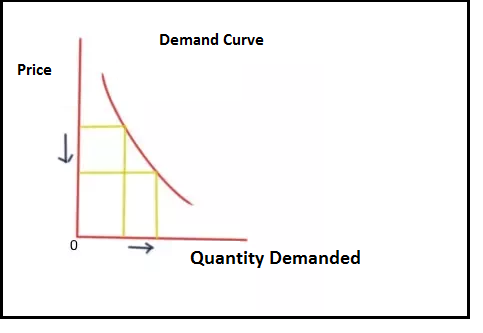
A demand curve represents the variation in quantity demanded over a period of time when compared to the prices charged by the supplier. The slope is usually downward sloping indicating lower purchase at higher price and vice versa.
An example of the same is follows:-
Case Specifics
While, demand also gets effected by external sources, since price is the most key determinant, the relationship of the demand curve is only limited to the price of the commodity. With tastes and preferences of the consumer changing, meaning that consumers now do not desire the products or services being offered by the seller, or have a keen interest in the product, the demand curve shifts rightward or leftward as is the case. Government regulations being favorable or unfavorable for business owners is another example of the same.
The biggest reason for this shift is the fact, that the change in demand has not happened because of change in prices charged by the suppliers. The change is independent of the prices charged by the producers. That change can be easily represented on the graph as above in which a fall in price indicates a rise in the consumption of the commodity.
On the Contrary, in case of shift in demand, the entire demand curve shifts regardless of the prices charged. This is as indicated.
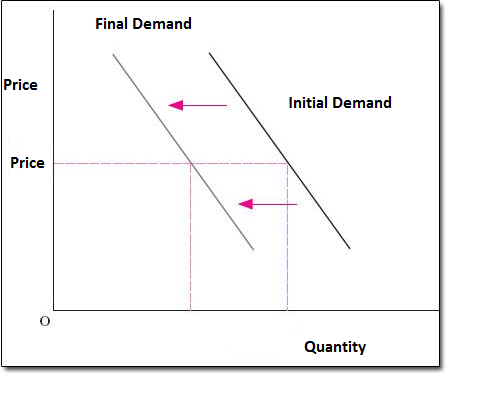
The above graph, illustrates how a shift in the quantity demanded takes place independent of the price of the commodity which stays same.
Parameters effecting Demand:-
The parameters that effect demand are as follows:-
1) The price of the goods and services being offered is the biggest determinant of demand. It is a known factor that reduced prices increase demand, whereas increase in prices tend to do the opposite for normal goods and services.
(2) The Price of related goods and services is another factor which effects the demand for the product. These goods are basically divided into two categories. Complementary the demand for which moves in a similar manner eg car and petrol. Whereas Suplimentary tends to move in the opposite direction eg-Tea and coffee.
(3) Income of the consumers is another factor. In countries with higher incomes, the overall demand tends to be much higher than in countries where income patterns are relatively low. This happens because with higher income, people tend to buy more products or services being offered.
(4) Taste or Preferences of the consumers, is another important factor with changes in preferences, the demand curves shifts towards the right or left depending on the mood of the customers. This is independent of the price charged for the product.
(5) Government Regulations are another critical factor, which if in favor of the supplier shift the demand curve towards the right and vice versa.
(6) Future expectations are another key determinant of demand. With the expected prices rising, people tend to demand more of the goods today.
Please feel free to ask your doubts in the comments section if any.
Add Answer to:
d. Suppose Oliver now reduces the budget spent on chocolates to $50. Present this effect graphically...
Which two phrases represent the views of globalization? Choose two answers. A pendulum that swings from...
Which two phrases represent the views of globalization? Choose two answers. A pendulum that swings from one extreme to another A competition among key financial centers and markets A continuing force sweeping through the world An unplanned result of corporate responses to a variety of opportunities A trading of goods and services between the most and least regulated countries What are two trade barriers? Choose two answers. Nontariffs Foreign languages The ocean Tariffs Shipping What is the effect of tariff...
Question 50 (1 point) A(n) _____ in oil prices and a(n) _____ in taxes will shift...
Question 50 (1 point) A(n) _____ in oil prices and a(n) _____ in taxes will shift short-run aggregate supply to the left. Question 50 options: a) decrease; increase b) decrease; decrease c) increase; decrease d) increase; increase Question 51 (1 point) Which of the following events will shift the aggregate demand curve to the right? Question 51 options: a) an increase in household debt b) a catastrophic hurricane hitting the northeastern United States c) a decrease in taxes d) a...
Most questions answered within 3 hours.
-
Where is the error in this code sequence?
String s1 = "Hello";
String s2 = "ello";...
asked 11 months ago -
Financial data for Joel de Paris, Inc., for last year
follow:
Joel de Paris, Inc.
Balance...
asked 11 months ago -
Consider this reaction:
Al2(SO4)3 (aq)+ BaCl3
(aq) Al2Cl6 (aq)- +
3BaSO4(s) . What is the...
asked 11 months ago -
Suppose that Savneet is considering increasing her
recent random sample from 20 car rentals to 40...
asked 11 months ago -
Trucks arrive at an unloading terminal at an average rate of 120
per hour.
Trucks arrive...
asked 11 months ago -
Why are methanol and ethanol completely soluble in water while
octanol is not very little soluble....
asked 11 months ago -
A facilities manager at a university reads in a research report
that the mean amount of...
asked 11 months ago -
When the CuSO4 is rehydrated by adding water to the anhydrous
compound, is this an endothermic...
asked 11 months ago -
A ray of sunlight is passing from diamond into crown glass; the
angle of incidence is...
asked 11 months ago -
A block of mass 0.249 kg is placed on top of a light, vertical
spring of...
asked 11 months ago -
how do the kidneys compensate in the presences of acidosis
a) trigger hyperventilate
b) reserve acid...
asked 11 months ago -
Question 501 pts
The rental rate of capital to the firm increases. Which of the
following...
asked 11 months ago