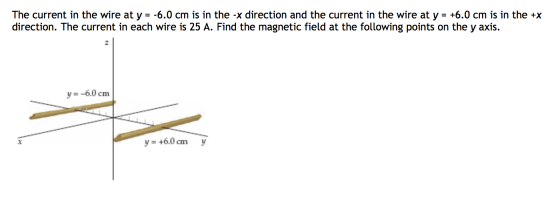
1. What is the magnetic field at y = -3.6cm. ______mT k?
6. What is the magnetic field at y = 0. ______mT k?
9. What is the magnetic field at y =+3.8. ______mT k?
12. What is the magnetic field at y = +9.5 cm. _____mT k?
Homework Answers
Magnetic field at a distance 'r' from the current carrying wire is given by, B = μoI/2πr
At y = -3.6 cm, B = -(4π * 10-7 * 25 / 2π)[1/(0.06 - 0.036) + 1/(0.06 + 0.036)] k = -0.26 mT k
At y = 0, B = -(4π * 10-7 * 25 / 2π)[1/0.06 + 1/0.06] k= -0.17 mT k
At y = 3.8 cm, B = -(4π * 10-7 * 25 / 2π)[1/(0.06 + 0.038) + 1/(0.06 - 0.038)] k = -0.28 mT k
At y = 9.5 cm, B = (4π * 10-7 * 25 / 2π)[-1/(0.06 + 0.095) + 1/(0.095 - 0.06)] k = 0.11 mT k
Add Answer to:
1. What is the magnetic field at y = -3.6cm. ______mT k?
6. What is the...
The x, y, and z components of a magnetic field are Bx = 0.11 T, By...
The x, y, and z components of a magnetic field are Bx = 0.11 T, By = 0.18 T, and Bz = 0.17 T. A 25-cm wire is oriented along the z axis and carries a current of 3.8 A. What is the magnitude of the magnetic force that acts on this wire? (N)
#10 Answer in units of T. 6. B = 12-3-k) 7. B = 120-k) 8. B...
 #10
Answer in units of T. 6. B = 12-3-k) 7. B = 120-k) 8. B = 120+k) 9. B =-; 10. B =- 007 (part 2 of 2) 10.0 points For given values of È and B, there exists a critical speed such that the electrons may move along the +a direction undeflected. If the speed of the electron is less than the criti- cal speed, along which direction will the elec trons be deflected? 1. = 30+) 009...
#10
Answer in units of T. 6. B = 12-3-k) 7. B = 120-k) 8. B = 120+k) 9. B =-; 10. B =- 007 (part 2 of 2) 10.0 points For given values of È and B, there exists a critical speed such that the electrons may move along the +a direction undeflected. If the speed of the electron is less than the criti- cal speed, along which direction will the elec trons be deflected? 1. = 30+) 009...
A long, straight wire carrying a current of I1 =5.0 A perpendicular to the xy plane...
A long, straight wire carrying a current of I1 =5.0 A perpendicular to the xy plane (page on a table) intersects the x-axis at the origin and points +z direction (out of page). A second, long wire carrying I2 = 12 A intersects the x-axis at x= 6.0 cm and points -z direction (into the page). Find the direction and magnitude of the net magnetic field due to these two currents at (x=0, y= 8.0 cm). First draw a neat...
A long, straight wire carrying a current of I1 =5.0 A perpendicular to the xy plane...
A long, straight wire carrying a current of I1 =5.0 A perpendicular to the xy plane (page on a table) intersects the x-axis at the origin and points +z direction (out of page). A second, long wire carrying I2 = 12 A intersects the x-axis at x= 6.0 cm and points -z direction (into the page). Find the direction and magnitude of the net magnetic field due to these two currents at (x=0, y= 8.0 cm). First draw a neat...
The goal of the problems is to determine the net magnetic field in regions around two...
The goal of the problems is to determine the net magnetic field in regions around two current carrying wires. There are 4 independent sets of problems: (i) parts A and B form one set problems; (ii) parts C and D form a second set problems; (iii) part E comprises the third set; and (iv) part F forms the last set. Use the following coordinate system for the following problems: (i) the positive z direction (+z) is straight up (ii) the...
We want to find the magnetic field at one corner of a square; the field is...
 We want to find the magnetic field at one corner of a square; the field is produced by currents that are located at the other three corners of the square. (See drawing.) The square is in the x-y plane and the currents are flowing parallel to the z axis. We define a positive current as one flowing in the + k direction. 13 The first current, of 7.15 A, is located 3.03 cm along the x axis, that is, at...
The x, y, and z components of a magnetic field are Bx = 0.10 T, By...
The x, y, and z components of a magnetic field are Bx = 0.10 T, By = 0.14 T, and Bz = 0.17 T. A 25-cm wire is oriented along the z axis and carries a current of 4.4 A. What is the magnitude of the magnetic force that acts on this wire?
Two long conductors lie in the x-y plane and run parallel to the x-axis. The first...
Two long conductors lie in the x-y plane and run parallel to the x-axis. The first wire is at y = 0 cm and carries a current of 10 A, directed in the + x-direction. The second wire is at y = 25 cm and carries a current of 25 A, directed in the – x-direction. a.) Use Ampere’s Law to find the magnetic field at wire 1, due to the current in wire 2. b.) What is the force...
The magnetic field in a region of space is specified by its x, y, and z...
 The magnetic field in a region of space is specified by its x, y, and z components which are respectively B_x = 0.138 T, B_y = 0.162 T, and B_z = 0.200 T. If a 30.0-cm wire carrying a current of 3.00 A is oriented along the e-axis with the current in the -z direction, determine the magnitude and direction of the force acting on the wire. magnitude N direction degree counterclockwise from the +x-axis
 #10
Answer in units of T. 6. B = 12-3-k) 7. B = 120-k) 8. B = 120+k) 9. B =-; 10. B =- 007 (part 2 of 2) 10.0 points For given values of È and B, there exists a critical speed such that the electrons may move along the +a direction undeflected. If the speed of the electron is less than the criti- cal speed, along which direction will the elec trons be deflected? 1. = 30+) 009...
#10
Answer in units of T. 6. B = 12-3-k) 7. B = 120-k) 8. B = 120+k) 9. B =-; 10. B =- 007 (part 2 of 2) 10.0 points For given values of È and B, there exists a critical speed such that the electrons may move along the +a direction undeflected. If the speed of the electron is less than the criti- cal speed, along which direction will the elec trons be deflected? 1. = 30+) 009...
 We want to find the magnetic field at one corner of a square; the field is produced by currents that are located at the other three corners of the square. (See drawing.) The square is in the x-y plane and the currents are flowing parallel to the z axis. We define a positive current as one flowing in the + k direction. 13 The first current, of 7.15 A, is located 3.03 cm along the x axis, that is, at...
 The magnetic field in a region of space is specified by its x, y, and z components which are respectively B_x = 0.138 T, B_y = 0.162 T, and B_z = 0.200 T. If a 30.0-cm wire carrying a current of 3.00 A is oriented along the e-axis with the current in the -z direction, determine the magnitude and direction of the force acting on the wire. magnitude N direction degree counterclockwise from the +x-axis
Most questions answered within 3 hours.
-
Where is the error in this code sequence?
String s1 = "Hello";
String s2 = "ello";...
asked 11 months ago -
Financial data for Joel de Paris, Inc., for last year
follow:
Joel de Paris, Inc.
Balance...
asked 11 months ago -
Consider this reaction:
Al2(SO4)3 (aq)+ BaCl3
(aq) Al2Cl6 (aq)- +
3BaSO4(s) . What is the...
asked 11 months ago -
Suppose that Savneet is considering increasing her
recent random sample from 20 car rentals to 40...
asked 11 months ago -
Trucks arrive at an unloading terminal at an average rate of 120
per hour.
Trucks arrive...
asked 11 months ago -
Why are methanol and ethanol completely soluble in water while
octanol is not very little soluble....
asked 11 months ago -
A facilities manager at a university reads in a research report
that the mean amount of...
asked 11 months ago -
When the CuSO4 is rehydrated by adding water to the anhydrous
compound, is this an endothermic...
asked 11 months ago -
A ray of sunlight is passing from diamond into crown glass; the
angle of incidence is...
asked 11 months ago -
A block of mass 0.249 kg is placed on top of a light, vertical
spring of...
asked 11 months ago -
how do the kidneys compensate in the presences of acidosis
a) trigger hyperventilate
b) reserve acid...
asked 11 months ago -
Question 501 pts
The rental rate of capital to the firm increases. Which of the
following...
asked 11 months ago