


Homework Answers


Add Answer to:
LiOIn pts The products of reaction of isoprene with HCI are shown in Figure 3-3. The...
3. Provide the structures for the products of the reaction shown below? (3 pts) + HCI
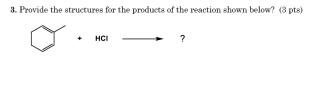 3. Provide the structures for the products of the reaction shown below? (3 pts) + HCI
3. 1,2-dimethyl-1,3-cyclohexadiene reacts with HCl to form up to four different products. HCI 4 possible products...
 3. 1,2-dimethyl-1,3-cyclohexadiene reacts with HCl to form up to four different products. HCI 4 possible products a. b. Give the structures for the four products. When the reaction is run at low temperature, two products are formed preferentially ldentify these two products. c. When the reaction temperature is increased, a single product is favored. Identify the major product under these reaction conditions
Please show your work The reaction of 1,3-pentadiene with hydrogen chloride (HCI) gives the product shown...
 Please show your work
The reaction of 1,3-pentadiene with hydrogen chloride (HCI) gives the product shown below (as a racemate). However, the reaction with deuterium chloride (DCI) produces two products, A and B (also as racemates), and the ratio of these is temperature dependent. Which product, A or B is favored at low temperatures (0°C) and What happens to the ratio at higher temperatures (40°C)? Explain these in terms of kinetic vs thermodynamic control. (20 points d. How might you...
Please show your work
The reaction of 1,3-pentadiene with hydrogen chloride (HCI) gives the product shown below (as a racemate). However, the reaction with deuterium chloride (DCI) produces two products, A and B (also as racemates), and the ratio of these is temperature dependent. Which product, A or B is favored at low temperatures (0°C) and What happens to the ratio at higher temperatures (40°C)? Explain these in terms of kinetic vs thermodynamic control. (20 points d. How might you...
4. [12 pts] Propose mechanisms for the formation of all 3 products shown in the reaction...
 4. [12 pts] Propose mechanisms for the formation of all 3 products shown in the reaction below: (draw curved arrows, intermediates, and resonance structures if necessary. NO NEED FOR TRANSITION STATES! CH CH CH CH Br Heat CH,CH,OH OCH.CH Mechanism.14 points) Mechanism 2 points) Mechanism.3 14 points) 5. [14 pts] Provide the major products of reacting the alkene shown in the middle of the scheme below with all the reagents independently. Draw the products' structures in the corresponding table below...
Under what conditions will the following reaction be the most product-favored? N2O(g) + NO2(g) <==> 3...
Under what conditions will the following reaction be the most product-favored? N2O(g) + NO2(g) <==> 3 NO(g) ; H = + 156 kJ A. low pressure, low temperature B. high pressure, low temperature C. high pressure, high temperature D. low pressure, high temperature
3. [1.5 pts] A subset of the organic products arising from Reaction #1 is shown below....
 3. [1.5 pts] A subset of the organic products arising from
Reaction #1 is shown below. Rank products D, E and F from most
abundant to least abundant (most abundant first).
[1.5 pts] A subset of the organic products arising from Reaction #1 is shown below. Rank products D, E and F from most abundant to least abundant (most abundant first). 3, REACTION #1 H2S04, hest OH Compound D Compound E Compound F
3. [1.5 pts] A subset of the organic products arising from
Reaction #1 is shown below. Rank products D, E and F from most
abundant to least abundant (most abundant first).
[1.5 pts] A subset of the organic products arising from Reaction #1 is shown below. Rank products D, E and F from most abundant to least abundant (most abundant first). 3, REACTION #1 H2S04, hest OH Compound D Compound E Compound F
Predict the structure of the major product formed by 1, 2-addition of HCI to 2-methyl-1, 3-butadiene...
 Predict the structure of the major product formed by 1, 2-addition of HCI to 2-methyl-1, 3-butadiene (isoprene). Predict the major product formed by 1, 4-addition of HCI to isoprene. Predict the structure of the major 1, 2-addition product formed by reaction of one mole of Br_2 with isoprene. Also predict the structure of the major 1, 4-addition product formed under these conditions. Which of the two molecules shown do you expect to be the major product formed by 1, 2-addition...
Enthalpically-favored, Entropically-unfavored Chemical Reaction Consider the chemical reaction A+B C+D, going in the indicated direction....
Enthalpically-favored, Entropically-unfavored Chemical Reaction Consider the chemical reaction A+B C+D, going in the indicated direction. Assume that it takes place under conditions of both constant temperature and constant pressure, and that the entropy of the products is less than the entropy of the reactants and the enthalpy of the products is less than the enthalpy of the reactants. (That is, both ΔS and ΔH are negative when the reaction goes in the indicated direction.) Answer the following question and...
3. Provide the structures for the products of the reaction shown below? (3 pts) ? HС
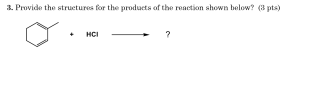 3. Provide the structures for the products of the reaction shown below? (3 pts) ? HС
In the reaction of HCl with 3-methylbut-1-ene, two products are isolated as follows. СІ HCI CI...
 In the reaction of HCl with 3-methylbut-1-ene, two products are isolated as follows. СІ HCI CI In an effort to explain the product distribution in this reaction, the following structural rearrangement has been proposed as reactive intermediates. What type of structural rearrangement is shown here? a. Two resonance forms b. A "Keto-enol tautomerism" C. A Carbocation shift d. A "1,2-Hydride shift"
 3. Provide the structures for the products of the reaction shown below? (3 pts) + HCI
 3. 1,2-dimethyl-1,3-cyclohexadiene reacts with HCl to form up to four different products. HCI 4 possible products a. b. Give the structures for the four products. When the reaction is run at low temperature, two products are formed preferentially ldentify these two products. c. When the reaction temperature is increased, a single product is favored. Identify the major product under these reaction conditions
 Please show your work
The reaction of 1,3-pentadiene with hydrogen chloride (HCI) gives the product shown below (as a racemate). However, the reaction with deuterium chloride (DCI) produces two products, A and B (also as racemates), and the ratio of these is temperature dependent. Which product, A or B is favored at low temperatures (0°C) and What happens to the ratio at higher temperatures (40°C)? Explain these in terms of kinetic vs thermodynamic control. (20 points d. How might you...
Please show your work
The reaction of 1,3-pentadiene with hydrogen chloride (HCI) gives the product shown below (as a racemate). However, the reaction with deuterium chloride (DCI) produces two products, A and B (also as racemates), and the ratio of these is temperature dependent. Which product, A or B is favored at low temperatures (0°C) and What happens to the ratio at higher temperatures (40°C)? Explain these in terms of kinetic vs thermodynamic control. (20 points d. How might you...
 4. [12 pts] Propose mechanisms for the formation of all 3 products shown in the reaction below: (draw curved arrows, intermediates, and resonance structures if necessary. NO NEED FOR TRANSITION STATES! CH CH CH CH Br Heat CH,CH,OH OCH.CH Mechanism.14 points) Mechanism 2 points) Mechanism.3 14 points) 5. [14 pts] Provide the major products of reacting the alkene shown in the middle of the scheme below with all the reagents independently. Draw the products' structures in the corresponding table below...
 3. [1.5 pts] A subset of the organic products arising from
Reaction #1 is shown below. Rank products D, E and F from most
abundant to least abundant (most abundant first).
[1.5 pts] A subset of the organic products arising from Reaction #1 is shown below. Rank products D, E and F from most abundant to least abundant (most abundant first). 3, REACTION #1 H2S04, hest OH Compound D Compound E Compound F
3. [1.5 pts] A subset of the organic products arising from
Reaction #1 is shown below. Rank products D, E and F from most
abundant to least abundant (most abundant first).
[1.5 pts] A subset of the organic products arising from Reaction #1 is shown below. Rank products D, E and F from most abundant to least abundant (most abundant first). 3, REACTION #1 H2S04, hest OH Compound D Compound E Compound F
 Predict the structure of the major product formed by 1, 2-addition of HCI to 2-methyl-1, 3-butadiene (isoprene). Predict the major product formed by 1, 4-addition of HCI to isoprene. Predict the structure of the major 1, 2-addition product formed by reaction of one mole of Br_2 with isoprene. Also predict the structure of the major 1, 4-addition product formed under these conditions. Which of the two molecules shown do you expect to be the major product formed by 1, 2-addition...
 3. Provide the structures for the products of the reaction shown below? (3 pts) ? HС
 In the reaction of HCl with 3-methylbut-1-ene, two products are isolated as follows. СІ HCI CI In an effort to explain the product distribution in this reaction, the following structural rearrangement has been proposed as reactive intermediates. What type of structural rearrangement is shown here? a. Two resonance forms b. A "Keto-enol tautomerism" C. A Carbocation shift d. A "1,2-Hydride shift"
Most questions answered within 3 hours.
-
Where is the error in this code sequence?
String s1 = "Hello";
String s2 = "ello";...
asked 11 months ago -
Financial data for Joel de Paris, Inc., for last year
follow:
Joel de Paris, Inc.
Balance...
asked 11 months ago -
Consider this reaction:
Al2(SO4)3 (aq)+ BaCl3
(aq) Al2Cl6 (aq)- +
3BaSO4(s) . What is the...
asked 11 months ago -
Suppose that Savneet is considering increasing her
recent random sample from 20 car rentals to 40...
asked 11 months ago -
Trucks arrive at an unloading terminal at an average rate of 120
per hour.
Trucks arrive...
asked 11 months ago -
Why are methanol and ethanol completely soluble in water while
octanol is not very little soluble....
asked 11 months ago -
A facilities manager at a university reads in a research report
that the mean amount of...
asked 11 months ago -
When the CuSO4 is rehydrated by adding water to the anhydrous
compound, is this an endothermic...
asked 11 months ago -
A ray of sunlight is passing from diamond into crown glass; the
angle of incidence is...
asked 11 months ago -
A block of mass 0.249 kg is placed on top of a light, vertical
spring of...
asked 11 months ago -
how do the kidneys compensate in the presences of acidosis
a) trigger hyperventilate
b) reserve acid...
asked 11 months ago -
Question 501 pts
The rental rate of capital to the firm increases. Which of the
following...
asked 11 months ago