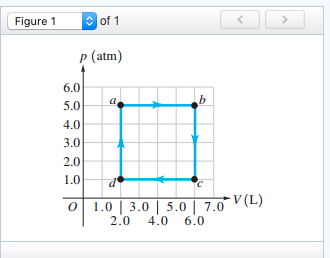
(Figure 1) shows a pV diagram for a heat engine that uses 1.40 moles of an ideal gas. The internal energy of the gas changes by the following amounts:
ΔUa→b=+4040J, ΔUb→c=−4848J, ΔUc→d=−808J, and ΔUd→a=+1616J
Part A
How much heat goes into this gas per cycle?
Express your answer in joules to three significant figures.
Answer: ______ J
Part B
Where in the cycle does the heat go into the gas?
Select all that apply.
| c→d |
| b→c |
| d→a |
| a→b |
Part C
How much heat is ejected by the gas per cycle?
Express your answer in joules to three significant figures.
Answer: _______ J
Part D
Where in the cycle does the heat get ejected by the gas?
Select all that apply.
| a→b |
| d→a |
| c→d |
| b→c |
Part E
How much work does this engine do each cycle?
Express your answer in joules to three significant figures.
Answer: _______ J
Part F
What is the thermal efficiency of the engine?
Express your answer as a percentage to two significant figures.
Answer: ______ %
Homework Answers
1 atm = 101325 pascals
1L = 10-3 m3
Part A
W= area of squre = 4*101325*4*10^-3 = 1621.2 J answer
the heat goes into the gas
Q =W + ΔU
Qda = 0 +1616 = +1616 J > 0
Qab = Wab+ Uab > 0
Qbc = 0+Ubc < 0
Qcd = −808 +Wcd <
so heat enter into the system in d -> a and a -> b only
and rejected in b->c and c- >d
heat entered = Qda + Qab
Qda = 1616 J becuase Wda = 0
Qab = Uab + Wab = 4040+ 5*101325*4*10^-3 = 6066.5
so entered heat = 1616 + 6066.5 = 7682.5 J
heat rejected = Qbc + Qcd
Qbc = - 4848 J
Qcd = −808 - 1*101325*4*10^-3 = -1213.3 J
so rejected heat = 4848+1213.3 = 6061.3 J
the thermal efficiency of the engine = Work/heat entered *100
=1621.2 /7682.5 *100 = 21.1025057 %
Add Answer to:
(Figure 1) shows a pV diagram for a heat
engine that uses 1.40 moles of an...
(Figure 1) shows a pV diagram for a heat engine that uses 1.40 moles of an...
 (Figure 1) shows a pV diagram for a heat engine that uses 1.40
moles of an ideal gas. The internal energy of the gas changes by
the following amounts: ΔUa→b=+4040J, ΔUb→c=−4848J, ΔUc→d=−808J, and
ΔUd→a=+1616J
How much heat is ejected by the gas per cycle? Express your
answer in joules to three significant figures.
How much work does this engine do each cycle? Express your
answer in joules to three significant figures.
What is the thermal efficiency of the engine? Express...
(Figure 1) shows a pV diagram for a heat engine that uses 1.40
moles of an ideal gas. The internal energy of the gas changes by
the following amounts: ΔUa→b=+4040J, ΔUb→c=−4848J, ΔUc→d=−808J, and
ΔUd→a=+1616J
How much heat is ejected by the gas per cycle? Express your
answer in joules to three significant figures.
How much work does this engine do each cycle? Express your
answer in joules to three significant figures.
What is the thermal efficiency of the engine? Express...
The pV diagram in the figure shows a cycle of a heat engine that uses 0.250...
 The pV diagram in the figure shows a cycle of
a heat engine that uses 0.250 mole of an ideal gas having
?=1.40. The curved part ab of the cycle
is adiabatic.
Part A
Find the pressure of the gas at point a.
(SOLVED)
Pa = 12.3 atm
----
Part B
How much heat enters this gas per cycle?
Qin = J
----
Part C
Where does the entering of heat happen?
----
Part D
How much heat leaves this...
The pV diagram in the figure shows a cycle of
a heat engine that uses 0.250 mole of an ideal gas having
?=1.40. The curved part ab of the cycle
is adiabatic.
Part A
Find the pressure of the gas at point a.
(SOLVED)
Pa = 12.3 atm
----
Part B
How much heat enters this gas per cycle?
Qin = J
----
Part C
Where does the entering of heat happen?
----
Part D
How much heat leaves this...
The PV - diagram in the figure below shows a cycle of a heat engine that uses 0.250 mol of an ideal gas with γ = 1.40....
 The PV - diagram in the figure below shows a cycle of a heat engine that uses 0.250 mol of an ideal gas with γ=1.40. The process a b is adiabatic. (1 atm=105 Pa)(i) Calculate the pressure of the gas at point a.(ii) Calculate how much heat enters this gas per cycle. Indicate the process(es) where this happens.(iii) Calculate how much heat leaves this gas in a cycle. Indicate the process(es) where this occurs.(iv) Calculate how much work the engine...
The figure (Figure 1)shows the cycle for a heat engine that uses a gas having γ...
 The figure (Figure 1)shows the cycle for a heat engine that uses
a gas having γ =1.25. The initial temperature is T1 =300K, and this
engine operates at 30 cycles per second.
HW21 Item 13 Review Part A The figure (Figure 1)shows the cycle for a heat engine that uses a gas having γ = 1.25. The initial temperature is T1 = 300 K, and this engine operates at 30 cycles per second What is the power output of the...
The figure (Figure 1)shows the cycle for a heat engine that uses
a gas having γ =1.25. The initial temperature is T1 =300K, and this
engine operates at 30 cycles per second.
HW21 Item 13 Review Part A The figure (Figure 1)shows the cycle for a heat engine that uses a gas having γ = 1.25. The initial temperature is T1 = 300 K, and this engine operates at 30 cycles per second What is the power output of the...
A certain heat engine operating on a Carnot cycle absorbs 370 J of heat per cycle...
 A certain heat engine operating on a Carnot cycle absorbs 370 J of heat per cycle at its hot reservoir at 145 degree C and has a thermal efficiency of 24.0% By how much does the engine change the entropy of the world each cycle? Express your answer to two significant figures and include the appropriate units. What mass of water could this engine pump per cycle from a well 25.0 m deep? Express your answer to two significant figures...
In the pV diagram shown in the figure(Figure 1), 85.0 J of work was done by...
 In the pV diagram shown in the figure(Figure 1), 85.0 J of work was done by 0.0630 mole of ideal gas during an adiabatic process. Part A How much heat entered or left this gas from a to b? Express your answer in joules. Vα ΑΣφ ? Q = J Request Answer Submit Part B Figure By how many joules did the internal energy of the gas change? 1 of 1 Express your answer in joules. p (atm) Nνα ΑΣφ...
TIUVICU TU. A refrigerator has a coefficient of performance of K = 2.1. Each cycle, it...
 TIUVICU TU. A refrigerator has a coefficient of performance of K = 2.1. Each cycle, it absorbs 3.75x10⁴ J of heat from the cold reservoir. The refrigerator is driven by a Carnot engine that has an efficiency of e=0.5 Eckboard - The Cit x Bb Pre-Lab Assignments - 201 X C Six HepID=9ca21d320b455f2dffd7601af0f84482#10001 Part A How much mechanical energy is required each cycle to operate the refrigerator? Express your answer in joules to two significant figures. IVO ALDO a ?...
An unusual heat engine combines four different processes to acchieve a complete engine cycle shown below....
An unusual heat engine combines four different processes to acchieve a complete engine cycle shown below. there is a 1.60 moles of gas used in the engine, and the gas behaves like a monatomic ideal gas. Each engine cycle takes 0.020s to complete and involves to absorption of 4.73x10^4 J of heat to the outside enviroment. temperature pressure volume A 1800 K 6.0 x 10^5 Pa 0.0400 m^3 B 1800 K 2.9 x 10^5 Pa 0.0825 m^3 C 1175 K...
box all answers please for a thumbs up Learning Goal: To reduce series-parallel combinations of inductors...
 box all answers please for a thumbs up
Learning Goal: To reduce series-parallel combinations of inductors or capacitors to an equivalent inductance or capacitance. Inductors in series and parallel combine like resistors in series and parallel. It is possible to use Kirchhoff's current law to find the current through the equivalent inductance. Moreover, capacitors in series combine like resistors in parallel and vice versa. It is possible to use Kirchhoff's voltage law to find the voltage across the equivalent capacitance....
box all answers please for a thumbs up
Learning Goal: To reduce series-parallel combinations of inductors or capacitors to an equivalent inductance or capacitance. Inductors in series and parallel combine like resistors in series and parallel. It is possible to use Kirchhoff's current law to find the current through the equivalent inductance. Moreover, capacitors in series combine like resistors in parallel and vice versa. It is possible to use Kirchhoff's voltage law to find the voltage across the equivalent capacitance....
A gasoline engine takes in 1.53×10⁴ J and delivers 3500 J of work per cycle. The...
A gasoline engine takes in 1.53×10⁴ J and delivers 3500 J of work per cycle. The heat is obtained by burning gasoline with a heat of combustion of 4.60×10⁴ J/g. Part A What is the thermal efficiency? Express your answer as a percentage. e=? Part B How much heat is discarded in each cycle? Express your answer in joules. Q=? Part C What mass of fuel is burned in each cycle? Express your answer in grams. m=? Part D If...
 (Figure 1) shows a pV diagram for a heat engine that uses 1.40
moles of an ideal gas. The internal energy of the gas changes by
the following amounts: ΔUa→b=+4040J, ΔUb→c=−4848J, ΔUc→d=−808J, and
ΔUd→a=+1616J
How much heat is ejected by the gas per cycle? Express your
answer in joules to three significant figures.
How much work does this engine do each cycle? Express your
answer in joules to three significant figures.
What is the thermal efficiency of the engine? Express...
(Figure 1) shows a pV diagram for a heat engine that uses 1.40
moles of an ideal gas. The internal energy of the gas changes by
the following amounts: ΔUa→b=+4040J, ΔUb→c=−4848J, ΔUc→d=−808J, and
ΔUd→a=+1616J
How much heat is ejected by the gas per cycle? Express your
answer in joules to three significant figures.
How much work does this engine do each cycle? Express your
answer in joules to three significant figures.
What is the thermal efficiency of the engine? Express...
 The pV diagram in the figure shows a cycle of
a heat engine that uses 0.250 mole of an ideal gas having
?=1.40. The curved part ab of the cycle
is adiabatic.
Part A
Find the pressure of the gas at point a.
(SOLVED)
Pa = 12.3 atm
----
Part B
How much heat enters this gas per cycle?
Qin = J
----
Part C
Where does the entering of heat happen?
----
Part D
How much heat leaves this...
The pV diagram in the figure shows a cycle of
a heat engine that uses 0.250 mole of an ideal gas having
?=1.40. The curved part ab of the cycle
is adiabatic.
Part A
Find the pressure of the gas at point a.
(SOLVED)
Pa = 12.3 atm
----
Part B
How much heat enters this gas per cycle?
Qin = J
----
Part C
Where does the entering of heat happen?
----
Part D
How much heat leaves this...
 The figure (Figure 1)shows the cycle for a heat engine that uses
a gas having γ =1.25. The initial temperature is T1 =300K, and this
engine operates at 30 cycles per second.
HW21 Item 13 Review Part A The figure (Figure 1)shows the cycle for a heat engine that uses a gas having γ = 1.25. The initial temperature is T1 = 300 K, and this engine operates at 30 cycles per second What is the power output of the...
The figure (Figure 1)shows the cycle for a heat engine that uses
a gas having γ =1.25. The initial temperature is T1 =300K, and this
engine operates at 30 cycles per second.
HW21 Item 13 Review Part A The figure (Figure 1)shows the cycle for a heat engine that uses a gas having γ = 1.25. The initial temperature is T1 = 300 K, and this engine operates at 30 cycles per second What is the power output of the...
 A certain heat engine operating on a Carnot cycle absorbs 370 J of heat per cycle at its hot reservoir at 145 degree C and has a thermal efficiency of 24.0% By how much does the engine change the entropy of the world each cycle? Express your answer to two significant figures and include the appropriate units. What mass of water could this engine pump per cycle from a well 25.0 m deep? Express your answer to two significant figures...
 In the pV diagram shown in the figure(Figure 1), 85.0 J of work was done by 0.0630 mole of ideal gas during an adiabatic process. Part A How much heat entered or left this gas from a to b? Express your answer in joules. Vα ΑΣφ ? Q = J Request Answer Submit Part B Figure By how many joules did the internal energy of the gas change? 1 of 1 Express your answer in joules. p (atm) Nνα ΑΣφ...
 TIUVICU TU. A refrigerator has a coefficient of performance of K = 2.1. Each cycle, it absorbs 3.75x10⁴ J of heat from the cold reservoir. The refrigerator is driven by a Carnot engine that has an efficiency of e=0.5 Eckboard - The Cit x Bb Pre-Lab Assignments - 201 X C Six HepID=9ca21d320b455f2dffd7601af0f84482#10001 Part A How much mechanical energy is required each cycle to operate the refrigerator? Express your answer in joules to two significant figures. IVO ALDO a ?...
 box all answers please for a thumbs up
Learning Goal: To reduce series-parallel combinations of inductors or capacitors to an equivalent inductance or capacitance. Inductors in series and parallel combine like resistors in series and parallel. It is possible to use Kirchhoff's current law to find the current through the equivalent inductance. Moreover, capacitors in series combine like resistors in parallel and vice versa. It is possible to use Kirchhoff's voltage law to find the voltage across the equivalent capacitance....
box all answers please for a thumbs up
Learning Goal: To reduce series-parallel combinations of inductors or capacitors to an equivalent inductance or capacitance. Inductors in series and parallel combine like resistors in series and parallel. It is possible to use Kirchhoff's current law to find the current through the equivalent inductance. Moreover, capacitors in series combine like resistors in parallel and vice versa. It is possible to use Kirchhoff's voltage law to find the voltage across the equivalent capacitance....
Most questions answered within 3 hours.
-
Where is the error in this code sequence?
String s1 = "Hello";
String s2 = "ello";...
asked 10 months ago -
Financial data for Joel de Paris, Inc., for last year
follow:
Joel de Paris, Inc.
Balance...
asked 10 months ago -
Consider this reaction:
Al2(SO4)3 (aq)+ BaCl3
(aq) Al2Cl6 (aq)- +
3BaSO4(s) . What is the...
asked 10 months ago -
Suppose that Savneet is considering increasing her
recent random sample from 20 car rentals to 40...
asked 10 months ago -
Trucks arrive at an unloading terminal at an average rate of 120
per hour.
Trucks arrive...
asked 10 months ago -
Why are methanol and ethanol completely soluble in water while
octanol is not very little soluble....
asked 10 months ago -
A facilities manager at a university reads in a research report
that the mean amount of...
asked 10 months ago -
When the CuSO4 is rehydrated by adding water to the anhydrous
compound, is this an endothermic...
asked 10 months ago -
A ray of sunlight is passing from diamond into crown glass; the
angle of incidence is...
asked 10 months ago -
A block of mass 0.249 kg is placed on top of a light, vertical
spring of...
asked 10 months ago -
how do the kidneys compensate in the presences of acidosis
a) trigger hyperventilate
b) reserve acid...
asked 10 months ago -
Question 501 pts
The rental rate of capital to the firm increases. Which of the
following...
asked 10 months ago