What is Newton's Second Law? Give the formula and a qualitive explanation?
Homework Answers
According to Newton's second law "A force applied to an object causes acceleration which is directly proportional to the force applied where as inversely to its Mass" It can be written as
F=m.a
Where acceleration is in the direction of force applied.
Add Answer to:
What is Newton's Second Law? Give the formula and a qualitive
explanation?
Apply the momentum form of Newton's second law, F = dp/dt, to the relativistic momentum formula....
Apply the momentum form of Newton's second law, F = dp/dt, to the relativistic momentum formula. Take the derivative and explain how the result is not necessarily equivalent to F=ma.
Newton's Second Law: Cart and hanging mass Here is another example of Newton's Second Law. A...
 Newton's Second Law: Cart and hanging mass Here is another example of Newton's Second Law. A cart rests on a horizontal frictionless surface. It is attached to a cart hanging mass with a string that rides on a frictionless pulley. Once this system is released, it will accelerate according to Newton's Second Law. The only force on the system is caused by Hanging mass the weight of the hanging mass (mi). Fsys mig This system force is applied to the...
Newton's universal law of gravity tells us that F=G 2 Newton's second law tells us that...
 Newton's universal law of gravity tells us that F=G 2 Newton's second law tells us that Review Submit Request Answer a = Part B How does this equation tell you whether or not your gravitational acceleration depends on your mass? Essay answers are limited to about 500 words (3800 characters maximum, including spaces 3800 Character(s) remaining Submit Request Answer
Lab Activity: Newton's Second Law The goal of this exercise is to examine a system of...
 Lab Activity: Newton's Second Law The goal of this exercise is to examine a system of connected objects and verify that Newton's second law correctly describes the motion. Work through the following sections answering all questions and filling in all blanks and charts directly on these sheets. Make sure that you follow the instructions carefully. Apparatus The setup consists of a cart on a track, a smart pulley, a hanger, various masses, and a computer. The motion of the cart...
Motion Newton's second law of motion state's that F = ma, or F = mu, where...
 Motion Newton's second law of motion state's that F = ma, or F = mu, where v-a Since the fast an object moves the more resistance it will encounter it is reasonable to assume that the resisting force is proportional to the objects velocity. Write the differential equation to model this observation. Then use Newton's second law to replace the Force in order to obtain a separable differential equation. Solve the DE forv
1. Why does Newton's second law describes the conswrvation of momentum? 2. What is extensive property...
1. Why does Newton's second law describes the conswrvation of momentum? 2. What is extensive property of? momentum equation? 3. Please compare conservation of mass with conservation of momentum? 4. What is the meaning of momentum accumulation?
We have previously described Newton's second law as ΣF = ma but we now also see...
We have previously described Newton's second law as ΣF = ma but we now also see that in terms of momentum we can state Newton's second law as: a. Σp = F/v b. Σp = ma . Σm = pa d. ΣF = dp/dt
Question 11 The Newton's second law is presented as mat mały = u(t) a) Find the...
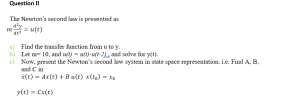 Question 11 The Newton's second law is presented as mat mały = u(t) a) Find the transfer function from u to y. b) Let m= 10, and u(t) = u(t)-uſt-2, and solve for y(t). Now, present the Newton's second law system in state space representation. i.e. Find A, B, and C in i(t) = Ax(t) + Bu(t) x(to) = xo y(t) = Cx(t)
(d) If you were to naively apply Newton's second law to this situation, what is the magnitude of ...
 n8m.5
(d) If you were to naively apply Newton's second law to this situation, what is the magnitude of the apparent centrifugal force acting on the child? N8M.5 An elevator is accelerating upward at 1.8 m/s. Someone is standing on a bathroom scale in the elevator, and it reads 180 lb. Use equation N8.12 to calculate the per- son's true weight. N8M.6 A test tube is placed in a centrifuge. When the cen- trifuge rotates at full speed, the test...
n8m.5
(d) If you were to naively apply Newton's second law to this situation, what is the magnitude of the apparent centrifugal force acting on the child? N8M.5 An elevator is accelerating upward at 1.8 m/s. Someone is standing on a bathroom scale in the elevator, and it reads 180 lb. Use equation N8.12 to calculate the per- son's true weight. N8M.6 A test tube is placed in a centrifuge. When the cen- trifuge rotates at full speed, the test...
please give the answer for this questions Machine on Laboratory Experiment "Newton's Second Law: Atwood's in...
 please give the answer for this questions
Machine on Laboratory Experiment "Newton's Second Law: Atwood's in NOTE: We can leave all masses in grams (&) since all calculations involve ratios of masses. DATA TABLE Trial 1 Trial 2 Trial 3 Trial 4 Mass of pulley M, g 00.049 Mass of the first weight holder 51.339 Mass of the weight, placed in the weight holder 1 dm Total ascending masS m Mum ascendingmassmt(g) |ち1.331|71339|91.339|111.33i 1339 Mass of the second weight holder3G...
please give the answer for this questions
Machine on Laboratory Experiment "Newton's Second Law: Atwood's in NOTE: We can leave all masses in grams (&) since all calculations involve ratios of masses. DATA TABLE Trial 1 Trial 2 Trial 3 Trial 4 Mass of pulley M, g 00.049 Mass of the first weight holder 51.339 Mass of the weight, placed in the weight holder 1 dm Total ascending masS m Mum ascendingmassmt(g) |ち1.331|71339|91.339|111.33i 1339 Mass of the second weight holder3G...
 Newton's Second Law: Cart and hanging mass Here is another example of Newton's Second Law. A cart rests on a horizontal frictionless surface. It is attached to a cart hanging mass with a string that rides on a frictionless pulley. Once this system is released, it will accelerate according to Newton's Second Law. The only force on the system is caused by Hanging mass the weight of the hanging mass (mi). Fsys mig This system force is applied to the...
 Newton's universal law of gravity tells us that F=G 2 Newton's second law tells us that Review Submit Request Answer a = Part B How does this equation tell you whether or not your gravitational acceleration depends on your mass? Essay answers are limited to about 500 words (3800 characters maximum, including spaces 3800 Character(s) remaining Submit Request Answer
 Lab Activity: Newton's Second Law The goal of this exercise is to examine a system of connected objects and verify that Newton's second law correctly describes the motion. Work through the following sections answering all questions and filling in all blanks and charts directly on these sheets. Make sure that you follow the instructions carefully. Apparatus The setup consists of a cart on a track, a smart pulley, a hanger, various masses, and a computer. The motion of the cart...
 Motion Newton's second law of motion state's that F = ma, or F = mu, where v-a Since the fast an object moves the more resistance it will encounter it is reasonable to assume that the resisting force is proportional to the objects velocity. Write the differential equation to model this observation. Then use Newton's second law to replace the Force in order to obtain a separable differential equation. Solve the DE forv
 Question 11 The Newton's second law is presented as mat mały = u(t) a) Find the transfer function from u to y. b) Let m= 10, and u(t) = u(t)-uſt-2, and solve for y(t). Now, present the Newton's second law system in state space representation. i.e. Find A, B, and C in i(t) = Ax(t) + Bu(t) x(to) = xo y(t) = Cx(t)
 n8m.5
(d) If you were to naively apply Newton's second law to this situation, what is the magnitude of the apparent centrifugal force acting on the child? N8M.5 An elevator is accelerating upward at 1.8 m/s. Someone is standing on a bathroom scale in the elevator, and it reads 180 lb. Use equation N8.12 to calculate the per- son's true weight. N8M.6 A test tube is placed in a centrifuge. When the cen- trifuge rotates at full speed, the test...
n8m.5
(d) If you were to naively apply Newton's second law to this situation, what is the magnitude of the apparent centrifugal force acting on the child? N8M.5 An elevator is accelerating upward at 1.8 m/s. Someone is standing on a bathroom scale in the elevator, and it reads 180 lb. Use equation N8.12 to calculate the per- son's true weight. N8M.6 A test tube is placed in a centrifuge. When the cen- trifuge rotates at full speed, the test...
 please give the answer for this questions
Machine on Laboratory Experiment "Newton's Second Law: Atwood's in NOTE: We can leave all masses in grams (&) since all calculations involve ratios of masses. DATA TABLE Trial 1 Trial 2 Trial 3 Trial 4 Mass of pulley M, g 00.049 Mass of the first weight holder 51.339 Mass of the weight, placed in the weight holder 1 dm Total ascending masS m Mum ascendingmassmt(g) |ち1.331|71339|91.339|111.33i 1339 Mass of the second weight holder3G...
please give the answer for this questions
Machine on Laboratory Experiment "Newton's Second Law: Atwood's in NOTE: We can leave all masses in grams (&) since all calculations involve ratios of masses. DATA TABLE Trial 1 Trial 2 Trial 3 Trial 4 Mass of pulley M, g 00.049 Mass of the first weight holder 51.339 Mass of the weight, placed in the weight holder 1 dm Total ascending masS m Mum ascendingmassmt(g) |ち1.331|71339|91.339|111.33i 1339 Mass of the second weight holder3G...
Most questions answered within 3 hours.
-
Where is the error in this code sequence?
String s1 = "Hello";
String s2 = "ello";...
asked 10 months ago -
Financial data for Joel de Paris, Inc., for last year
follow:
Joel de Paris, Inc.
Balance...
asked 10 months ago -
Consider this reaction:
Al2(SO4)3 (aq)+ BaCl3
(aq) Al2Cl6 (aq)- +
3BaSO4(s) . What is the...
asked 10 months ago -
Suppose that Savneet is considering increasing her
recent random sample from 20 car rentals to 40...
asked 10 months ago -
Trucks arrive at an unloading terminal at an average rate of 120
per hour.
Trucks arrive...
asked 10 months ago -
Why are methanol and ethanol completely soluble in water while
octanol is not very little soluble....
asked 10 months ago -
A facilities manager at a university reads in a research report
that the mean amount of...
asked 10 months ago -
When the CuSO4 is rehydrated by adding water to the anhydrous
compound, is this an endothermic...
asked 10 months ago -
A ray of sunlight is passing from diamond into crown glass; the
angle of incidence is...
asked 10 months ago -
A block of mass 0.249 kg is placed on top of a light, vertical
spring of...
asked 10 months ago -
how do the kidneys compensate in the presences of acidosis
a) trigger hyperventilate
b) reserve acid...
asked 10 months ago -
Question 501 pts
The rental rate of capital to the firm increases. Which of the
following...
asked 10 months ago