

Homework Answers
Add Answer to:
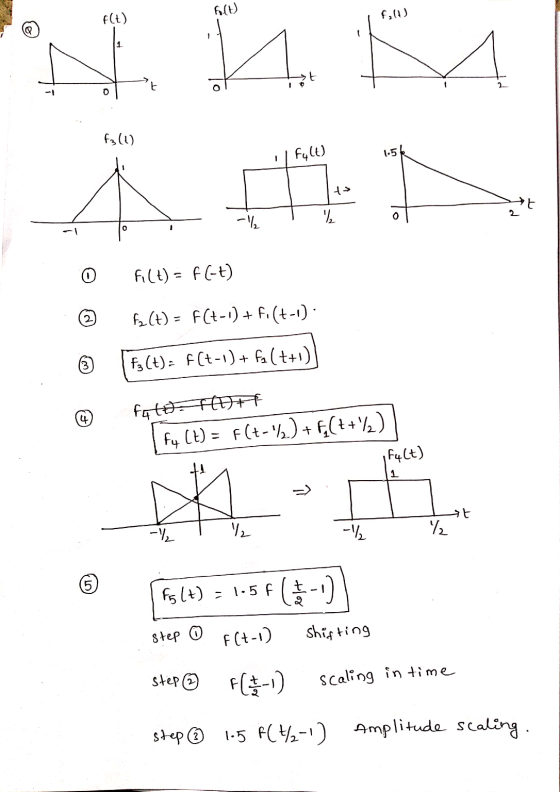
..3-1 In Fig. P1.3-1, the signal fi(t) = f(-). Express signals fa(t), f(t), fu(t), and f(t)...
22 Transformation of Continuous-Time Signals Given the signals f), Jtt) and s(t) (quadratic piecewise functions) in...
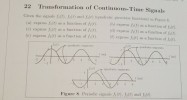 22 Transformation of Continuous-Time Signals Given the signals f), Jtt) and s(t) (quadratic piecewise functions) in Figure S (a) express flt) as a function of tt) (b) express fi(t) as a function of t) (o) express at) as a function of ) ( (e) express falt) as a function of )(express falt) as a fiunuction of fat). (d) express f:(t) as a function of fa(t) (f) express fa(t) as a function of f2(t) c) expres tt)uadratic soegments falt quadratic segnents...
Question (1) Find the Trigonometrie Fourier Series (FS) for the signals shown in Figure 1 and...
 Question (1) Find the Trigonometrie Fourier Series (FS) for the signals shown in Figure 1 and Figure 2. M -6rt 41 -2 4r Figure 1 Figure 2 Question (2) (a) Find the power of x(t) = 5 + 10 cos (100t + 3) (b) Express signal x1(t) in terms of signal x(t) and its time-shifter, time-scaled, or time reversed versions. Figure 3
(b) The signal f(t) is shown in the figure below 3 2 f(t) _ 0 I...
 (b) The signal f(t) is shown in the figure below 3 2 f(t) _ 0 I 1 -4 -3 -2 -1 0 1 2 3 4 5 6 7 t and is given by 21 (1) + 3A (132), where A is the triangle function defined as 10-{ It a It <a It > a 0 Write the Fourier transform F [A(t)] (s) of f(t) exploiting the fact that FA(t)](s) = sinc-(s) where sin(TTS) sinc(s) ITS and the theorem for...
Question 1: (25 marks) Compute the convolution f(t) = fi(t) + f(t) of the following two...
 Question 1: (25 marks) Compute the convolution f(t) = fi(t) + f(t) of the following two time-functions fi(t) and fu(t). Provide a complete analytical solution (formula) and also a plot of your final result f(t). You are allowed to use, if you wish, any of the properties of convolution that we have studied, but you need to explain clearly how/where you have used them. fit) f2t) +3 +4 +5 -1 0 + 1 t -1 0 +1 +2
Fig.1 (a) shows a staircase like signal x(t) and Fig.1 (b) shows the rectangular pulse g(t)...
 Fig.1 (a) shows a staircase like signal x(t) and Fig.1 (b) shows the rectangular pulse g(t) Express x(t) in terms of g(t). xit) 4 2 g(t) -1 0 1 Fig.1
Digital Signal Processing (EEC 4963) Assignment 1 Discrete-Time Signals Express the signal 1. 1, 3sns-1 71 elsewher...
 Digital Signal Processing (EEC 4963) Assignment 1 Discrete-Time Signals Express the signal 1. 1, 3sns-1 71 elsewhere 0, using each of the following representation methods (a) Graphical representation. (b) Sequence representation. (c) In terms of the unit sample function, δ[n], unit step function, u[n], and the unit ramp function, r[n].
Digital Signal Processing (EEC 4963) Assignment 1 Discrete-Time Signals Express the signal 1. 1, 3sns-1 71 elsewhere 0, using each of the following representation methods (a) Graphical representation. (b) Sequence...
Digital Signal Processing (EEC 4963) Assignment 1 Discrete-Time Signals Express the signal 1. 1, 3sns-1 71 elsewhere 0, using each of the following representation methods (a) Graphical representation. (b) Sequence representation. (c) In terms of the unit sample function, δ[n], unit step function, u[n], and the unit ramp function, r[n].
Digital Signal Processing (EEC 4963) Assignment 1 Discrete-Time Signals Express the signal 1. 1, 3sns-1 71 elsewhere 0, using each of the following representation methods (a) Graphical representation. (b) Sequence...
1. Determine the Laplace transform of the following signals e* .11(t) ; (b) g(t)=Icos(2) + sin(2t)j.u(1-3)...
 1. Determine the Laplace transform of the following signals e* .11(t) ; (b) g(t)=Icos(2) + sin(2t)j.u(1-3) ; (c) h(t)-t-e-21. cos(30.11(1) 2. Determine the Laplace transform of the non-periodic signal shown below: h(t) 0 1 2 3 4 t 3. Determine the Laplace transform of the periodic waveforms shown below: fa) f(t) 0 2T 4T 6T 8T 4. Determine the inverse Laplace transform of the following signals 2s (b) G)6s+12 H(s) =s.(14%) (a) F(s)-De (c) (2s +1)(s1 +5s +6 5. Using...
Problem 3: Let x(n) be an arbitrary signal, not necessarily real valued, with Fourier transform X (w). Express the Fourier transforms of the following signals in terms of X() (C) y(n) = x(n)-x(n-1) (...
 Problem 3: Let x(n) be an arbitrary signal, not necessarily real valued, with Fourier transform X (w). Express the Fourier transforms of the following signals in terms of X() (C) y(n) = x(n)-x(n-1) (d) v(n) -00x(k) (e) y(n)=x(2n) (f) y n even n odd , x(n/2), (n) 0 Problem 4: etermine the signal x(n) if its Fourier transform is as given in Fig. P4.12. X(a) 0 10 10 10 X(o) 0 X(a) Figure P4.12
Problem 3: Let x(n) be an...
Problem 3: Let x(n) be an arbitrary signal, not necessarily real valued, with Fourier transform X (w). Express the Fourier transforms of the following signals in terms of X() (C) y(n) = x(n)-x(n-1) (d) v(n) -00x(k) (e) y(n)=x(2n) (f) y n even n odd , x(n/2), (n) 0 Problem 4: etermine the signal x(n) if its Fourier transform is as given in Fig. P4.12. X(a) 0 10 10 10 X(o) 0 X(a) Figure P4.12
Problem 3: Let x(n) be an...
Question 1: Compute graphically the convolution, f(t) fit) f2(t), of the following two time-functions (t) and...
 Question 1: Compute graphically the convolution, f(t) fit) f2(t), of the following two time-functions (t) and f2(t). Sketch your final result f(t)· (Hint: To avoid having to do twice as many calculations, you may want to use these properties of convolution: the distributive and the shift properties.) fi(t) f2(t) +3 +4 +5 -1 0 +1 t -1 0
this is Q1 please solve Q2 2. Consider the same signal x(t) shown above in question...
 this is Q1 please solve Q2
2. Consider the same signal x(t) shown above in question 1 (a) write down the equation of the signal y(t) in terms x(t) in Fig. I and Fig.2 (b) Specify the operation(s) performed on X(t) to obtain each of signals of Fig.1 and Fig2 0.5 1 (Fig. 1) (Fig.2) 1 -2 -1 0 +1 +2 X(t) Questions Set # 3 CT signals combined time and amplitude Operations 1. Consider the signal x(1) (a) Sketch...
this is Q1 please solve Q2
2. Consider the same signal x(t) shown above in question 1 (a) write down the equation of the signal y(t) in terms x(t) in Fig. I and Fig.2 (b) Specify the operation(s) performed on X(t) to obtain each of signals of Fig.1 and Fig2 0.5 1 (Fig. 1) (Fig.2) 1 -2 -1 0 +1 +2 X(t) Questions Set # 3 CT signals combined time and amplitude Operations 1. Consider the signal x(1) (a) Sketch...
 22 Transformation of Continuous-Time Signals Given the signals f), Jtt) and s(t) (quadratic piecewise functions) in Figure S (a) express flt) as a function of tt) (b) express fi(t) as a function of t) (o) express at) as a function of ) ( (e) express falt) as a function of )(express falt) as a fiunuction of fat). (d) express f:(t) as a function of fa(t) (f) express fa(t) as a function of f2(t) c) expres tt)uadratic soegments falt quadratic segnents...
 Question (1) Find the Trigonometrie Fourier Series (FS) for the signals shown in Figure 1 and Figure 2. M -6rt 41 -2 4r Figure 1 Figure 2 Question (2) (a) Find the power of x(t) = 5 + 10 cos (100t + 3) (b) Express signal x1(t) in terms of signal x(t) and its time-shifter, time-scaled, or time reversed versions. Figure 3
 (b) The signal f(t) is shown in the figure below 3 2 f(t) _ 0 I 1 -4 -3 -2 -1 0 1 2 3 4 5 6 7 t and is given by 21 (1) + 3A (132), where A is the triangle function defined as 10-{ It a It <a It > a 0 Write the Fourier transform F [A(t)] (s) of f(t) exploiting the fact that FA(t)](s) = sinc-(s) where sin(TTS) sinc(s) ITS and the theorem for...
 Question 1: (25 marks) Compute the convolution f(t) = fi(t) + f(t) of the following two time-functions fi(t) and fu(t). Provide a complete analytical solution (formula) and also a plot of your final result f(t). You are allowed to use, if you wish, any of the properties of convolution that we have studied, but you need to explain clearly how/where you have used them. fit) f2t) +3 +4 +5 -1 0 + 1 t -1 0 +1 +2
 Fig.1 (a) shows a staircase like signal x(t) and Fig.1 (b) shows the rectangular pulse g(t) Express x(t) in terms of g(t). xit) 4 2 g(t) -1 0 1 Fig.1
 Digital Signal Processing (EEC 4963) Assignment 1 Discrete-Time Signals Express the signal 1. 1, 3sns-1 71 elsewhere 0, using each of the following representation methods (a) Graphical representation. (b) Sequence representation. (c) In terms of the unit sample function, δ[n], unit step function, u[n], and the unit ramp function, r[n].
Digital Signal Processing (EEC 4963) Assignment 1 Discrete-Time Signals Express the signal 1. 1, 3sns-1 71 elsewhere 0, using each of the following representation methods (a) Graphical representation. (b) Sequence...
Digital Signal Processing (EEC 4963) Assignment 1 Discrete-Time Signals Express the signal 1. 1, 3sns-1 71 elsewhere 0, using each of the following representation methods (a) Graphical representation. (b) Sequence representation. (c) In terms of the unit sample function, δ[n], unit step function, u[n], and the unit ramp function, r[n].
Digital Signal Processing (EEC 4963) Assignment 1 Discrete-Time Signals Express the signal 1. 1, 3sns-1 71 elsewhere 0, using each of the following representation methods (a) Graphical representation. (b) Sequence...
 1. Determine the Laplace transform of the following signals e* .11(t) ; (b) g(t)=Icos(2) + sin(2t)j.u(1-3) ; (c) h(t)-t-e-21. cos(30.11(1) 2. Determine the Laplace transform of the non-periodic signal shown below: h(t) 0 1 2 3 4 t 3. Determine the Laplace transform of the periodic waveforms shown below: fa) f(t) 0 2T 4T 6T 8T 4. Determine the inverse Laplace transform of the following signals 2s (b) G)6s+12 H(s) =s.(14%) (a) F(s)-De (c) (2s +1)(s1 +5s +6 5. Using...
 Problem 3: Let x(n) be an arbitrary signal, not necessarily real valued, with Fourier transform X (w). Express the Fourier transforms of the following signals in terms of X() (C) y(n) = x(n)-x(n-1) (d) v(n) -00x(k) (e) y(n)=x(2n) (f) y n even n odd , x(n/2), (n) 0 Problem 4: etermine the signal x(n) if its Fourier transform is as given in Fig. P4.12. X(a) 0 10 10 10 X(o) 0 X(a) Figure P4.12
Problem 3: Let x(n) be an...
Problem 3: Let x(n) be an arbitrary signal, not necessarily real valued, with Fourier transform X (w). Express the Fourier transforms of the following signals in terms of X() (C) y(n) = x(n)-x(n-1) (d) v(n) -00x(k) (e) y(n)=x(2n) (f) y n even n odd , x(n/2), (n) 0 Problem 4: etermine the signal x(n) if its Fourier transform is as given in Fig. P4.12. X(a) 0 10 10 10 X(o) 0 X(a) Figure P4.12
Problem 3: Let x(n) be an...
 Question 1: Compute graphically the convolution, f(t) fit) f2(t), of the following two time-functions (t) and f2(t). Sketch your final result f(t)· (Hint: To avoid having to do twice as many calculations, you may want to use these properties of convolution: the distributive and the shift properties.) fi(t) f2(t) +3 +4 +5 -1 0 +1 t -1 0
 this is Q1 please solve Q2
2. Consider the same signal x(t) shown above in question 1 (a) write down the equation of the signal y(t) in terms x(t) in Fig. I and Fig.2 (b) Specify the operation(s) performed on X(t) to obtain each of signals of Fig.1 and Fig2 0.5 1 (Fig. 1) (Fig.2) 1 -2 -1 0 +1 +2 X(t) Questions Set # 3 CT signals combined time and amplitude Operations 1. Consider the signal x(1) (a) Sketch...
this is Q1 please solve Q2
2. Consider the same signal x(t) shown above in question 1 (a) write down the equation of the signal y(t) in terms x(t) in Fig. I and Fig.2 (b) Specify the operation(s) performed on X(t) to obtain each of signals of Fig.1 and Fig2 0.5 1 (Fig. 1) (Fig.2) 1 -2 -1 0 +1 +2 X(t) Questions Set # 3 CT signals combined time and amplitude Operations 1. Consider the signal x(1) (a) Sketch...
Most questions answered within 3 hours.
-
Where is the error in this code sequence?
String s1 = "Hello";
String s2 = "ello";...
asked 11 months ago -
Financial data for Joel de Paris, Inc., for last year
follow:
Joel de Paris, Inc.
Balance...
asked 11 months ago -
Consider this reaction:
Al2(SO4)3 (aq)+ BaCl3
(aq) Al2Cl6 (aq)- +
3BaSO4(s) . What is the...
asked 11 months ago -
Suppose that Savneet is considering increasing her
recent random sample from 20 car rentals to 40...
asked 11 months ago -
Trucks arrive at an unloading terminal at an average rate of 120
per hour.
Trucks arrive...
asked 11 months ago -
Why are methanol and ethanol completely soluble in water while
octanol is not very little soluble....
asked 11 months ago -
A facilities manager at a university reads in a research report
that the mean amount of...
asked 11 months ago -
When the CuSO4 is rehydrated by adding water to the anhydrous
compound, is this an endothermic...
asked 11 months ago -
A ray of sunlight is passing from diamond into crown glass; the
angle of incidence is...
asked 11 months ago -
A block of mass 0.249 kg is placed on top of a light, vertical
spring of...
asked 11 months ago -
how do the kidneys compensate in the presences of acidosis
a) trigger hyperventilate
b) reserve acid...
asked 11 months ago -
Question 501 pts
The rental rate of capital to the firm increases. Which of the
following...
asked 11 months ago