Please I want someone to answer it clearly and step by step
Homework Answers
Add Answer to:
Please I want someone to answer it clearly and step by step
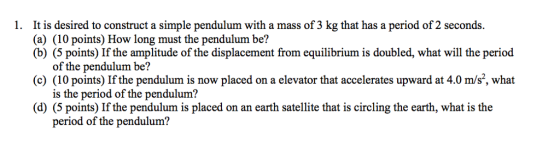
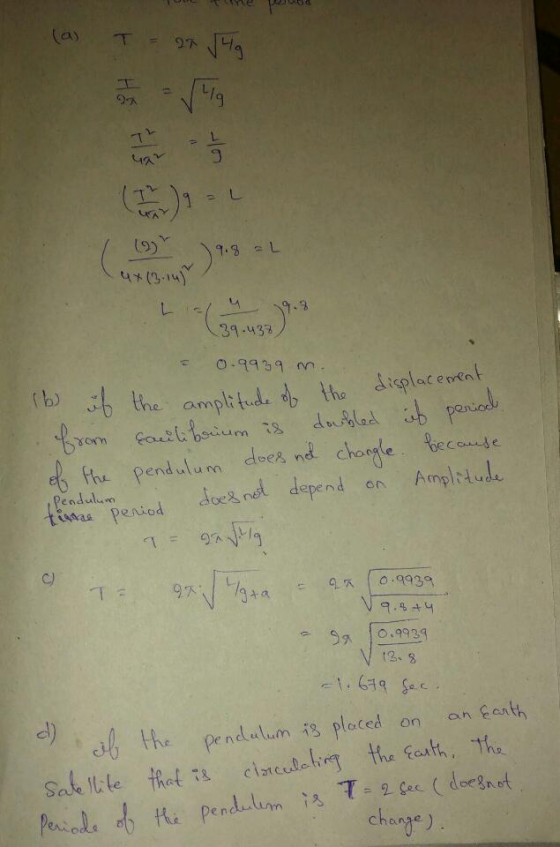
It is desired to...
The answer is 1 day. I need to know how to solve this step by step....
The answer is 1 day. I need to know how to solve this step by step. thank you The moon has a period of 27.3 d and is an average distance from Earth of 3.84 × 10⁵km. A communications satellite is placed in an Earth orbit at 4.23 × 10⁴ km from the center of Earth. What is the period of this satellite?
Please help with any or all problems I can’t seem to figure them out thanks Need...
 Please help with any or all problems I can’t seem to
figure them out thanks
Need Help?Read -3 points SerCP10 13 P.040. A simple pendulum is 7.00 m long My Notes Ask Your (a) What is the period of simple harmonic motion for this pendulum if it is located in an elevator accelerating upward at 4.55 m/s (b) What is its period if the elevator is accelerating downward at 4.55 m/s of simple harmonic motion for the pendulum if it...
Please help with any or all problems I can’t seem to
figure them out thanks
Need Help?Read -3 points SerCP10 13 P.040. A simple pendulum is 7.00 m long My Notes Ask Your (a) What is the period of simple harmonic motion for this pendulum if it is located in an elevator accelerating upward at 4.55 m/s (b) What is its period if the elevator is accelerating downward at 4.55 m/s of simple harmonic motion for the pendulum if it...
Please I want some to do answer it clearly and step by step A potter works...
 Please I want some to do answer it clearly and step by step
A potter works with a uniform solid grindstone wheel that has a mass of 18 kg and a radius of 25 cm. The grindstone initially rotates at 1200 rev/min. The grindstone's motor is turned off and the potter presses an instrument perpendicular against the grindstone with a force of 40 N to bring it to a stop. The coefficient of friction with the grindstone is 0.7. The...
Please I want some to do answer it clearly and step by step
A potter works with a uniform solid grindstone wheel that has a mass of 18 kg and a radius of 25 cm. The grindstone initially rotates at 1200 rev/min. The grindstone's motor is turned off and the potter presses an instrument perpendicular against the grindstone with a force of 40 N to bring it to a stop. The coefficient of friction with the grindstone is 0.7. The...
can someone please help me answer these questions? A simple harmonic oscillator consists of a 10...
 can someone please help me answer these questions?
A simple harmonic oscillator consists of a 10 kg mass attached to a spring with a spring constant of 120 N/m. The mass is displaced 20.37 m from the equilibrium position, held motionless, and then released. (a) Calculate the angular frequency and the period. For radians, enterrad" as the unit. For a full list of accepted units, use the "Units Help" link below. Number Units T Number Units (b) Calculate the maximum...
can someone please help me answer these questions?
A simple harmonic oscillator consists of a 10 kg mass attached to a spring with a spring constant of 120 N/m. The mass is displaced 20.37 m from the equilibrium position, held motionless, and then released. (a) Calculate the angular frequency and the period. For radians, enterrad" as the unit. For a full list of accepted units, use the "Units Help" link below. Number Units T Number Units (b) Calculate the maximum...
Please show every step and write clearly. I want to learn how to perform this mechanism....
 Please show every step and write clearly. I want to learn how to
perform this mechanism. Thank you, will rate asap
Two Step Reaction 1. What reagent(s) would you use in the first step? 2. Draw the proposed intermediate product. 3. What reagent(s) would you use in the second step? 4. Draw the complete mechanism from the starting reactant to the end product
Please show every step and write clearly. I want to learn how to
perform this mechanism. Thank you, will rate asap
Two Step Reaction 1. What reagent(s) would you use in the first step? 2. Draw the proposed intermediate product. 3. What reagent(s) would you use in the second step? 4. Draw the complete mechanism from the starting reactant to the end product
Please show every step and write clearly. I want to learn how to perform this mechanism....
 Please show every step and write clearly. I want to learn how
to perform this mechanism. Thank you, will rate asap
Two Step Reaction 1. What reagent(s) would you use in the first step? 2. Draw the proposed intermediate product. 3. What reagent(s) would you use in the second step? 4. Draw the complete mechanism from the starting reactant to the end product
Please show every step and write clearly. I want to learn how
to perform this mechanism. Thank you, will rate asap
Two Step Reaction 1. What reagent(s) would you use in the first step? 2. Draw the proposed intermediate product. 3. What reagent(s) would you use in the second step? 4. Draw the complete mechanism from the starting reactant to the end product
Equations of Simple Harmonic Motion (basic) PLEASE! show work and only answer if you know how...
 Equations of Simple Harmonic Motion (basic)
PLEASE! show work and only answer if you know how to do it.
People keeps giving me the wrong answer.
Analyzing Newton's 2^nd Law for a mass spring system, we found a_x = -k/m X. Comparing this to the x-component of uniform circular motion, we found as a possible solution for the above equation: x = Acos(omega t) v_x = - omega Asin(omega t) a_x = - omega^2 Acos(omega t) with omega = square...
Equations of Simple Harmonic Motion (basic)
PLEASE! show work and only answer if you know how to do it.
People keeps giving me the wrong answer.
Analyzing Newton's 2^nd Law for a mass spring system, we found a_x = -k/m X. Comparing this to the x-component of uniform circular motion, we found as a possible solution for the above equation: x = Acos(omega t) v_x = - omega Asin(omega t) a_x = - omega^2 Acos(omega t) with omega = square...
Please, please, explain the process and step by step how to solve this problem, I want to get the...
 please, please, explain the process and step by step how to
solve this problem, I want to get the logic and process:
>> Do not simplify the answer. I already saw other
answers and still do not get the process how to solve
it<<
1. In class we found that the Fourier series of a unit amplitude square wave of period 2 seconds was given by x(t) = Σ 그etjnitt HTT odd (a) Show that this series can be rewritten...
please, please, explain the process and step by step how to
solve this problem, I want to get the logic and process:
>> Do not simplify the answer. I already saw other
answers and still do not get the process how to solve
it<<
1. In class we found that the Fourier series of a unit amplitude square wave of period 2 seconds was given by x(t) = Σ 그etjnitt HTT odd (a) Show that this series can be rewritten...
A first course in differential equations: HW question chapter 5.1 Simple Harmonic Motion Please solve Problem 21 all parts, thanks 21. A 64-lb weight attached to the end of a spring stretches it 0.32...
 A first course in differential equations: HW question chapter
5.1 Simple Harmonic Motion
Please solve Problem 21 all parts, thanks
21. A 64-lb weight attached to the end of a spring stretches it 0.32 ft. From a position 8 in. above the equilibrium position the weight is given a down ward velocitv of 5 ft/s. (a) Find the equation of motion. (b) What are the amplitude and period of motion? 191 SECTION 5.1 Simple Harmonic Motion (c) How many complete...
A first course in differential equations: HW question chapter
5.1 Simple Harmonic Motion
Please solve Problem 21 all parts, thanks
21. A 64-lb weight attached to the end of a spring stretches it 0.32 ft. From a position 8 in. above the equilibrium position the weight is given a down ward velocitv of 5 ft/s. (a) Find the equation of motion. (b) What are the amplitude and period of motion? 191 SECTION 5.1 Simple Harmonic Motion (c) How many complete...
Please Answer the following question in detail showing the step to derive the answer. Please show...
 Please Answer the following question in detail showing the
step to derive the answer. Please show all work clearly and circle
final answer.
ll T-Mobile 18:35 Exit A negative charge with a mass of 0.4 kg is placed on a string which is placed between a capacitor which is orientated vertically as shown. The charge swings to an angle of 5.1 degrees with the vertical before coming to equilibrium. Then, a positive charge with a magnitude twice as large as...
Please Answer the following question in detail showing the
step to derive the answer. Please show all work clearly and circle
final answer.
ll T-Mobile 18:35 Exit A negative charge with a mass of 0.4 kg is placed on a string which is placed between a capacitor which is orientated vertically as shown. The charge swings to an angle of 5.1 degrees with the vertical before coming to equilibrium. Then, a positive charge with a magnitude twice as large as...
 Please help with any or all problems I can’t seem to
figure them out thanks
Need Help?Read -3 points SerCP10 13 P.040. A simple pendulum is 7.00 m long My Notes Ask Your (a) What is the period of simple harmonic motion for this pendulum if it is located in an elevator accelerating upward at 4.55 m/s (b) What is its period if the elevator is accelerating downward at 4.55 m/s of simple harmonic motion for the pendulum if it...
Please help with any or all problems I can’t seem to
figure them out thanks
Need Help?Read -3 points SerCP10 13 P.040. A simple pendulum is 7.00 m long My Notes Ask Your (a) What is the period of simple harmonic motion for this pendulum if it is located in an elevator accelerating upward at 4.55 m/s (b) What is its period if the elevator is accelerating downward at 4.55 m/s of simple harmonic motion for the pendulum if it...
 Please I want some to do answer it clearly and step by step
A potter works with a uniform solid grindstone wheel that has a mass of 18 kg and a radius of 25 cm. The grindstone initially rotates at 1200 rev/min. The grindstone's motor is turned off and the potter presses an instrument perpendicular against the grindstone with a force of 40 N to bring it to a stop. The coefficient of friction with the grindstone is 0.7. The...
Please I want some to do answer it clearly and step by step
A potter works with a uniform solid grindstone wheel that has a mass of 18 kg and a radius of 25 cm. The grindstone initially rotates at 1200 rev/min. The grindstone's motor is turned off and the potter presses an instrument perpendicular against the grindstone with a force of 40 N to bring it to a stop. The coefficient of friction with the grindstone is 0.7. The...
 can someone please help me answer these questions?
A simple harmonic oscillator consists of a 10 kg mass attached to a spring with a spring constant of 120 N/m. The mass is displaced 20.37 m from the equilibrium position, held motionless, and then released. (a) Calculate the angular frequency and the period. For radians, enterrad" as the unit. For a full list of accepted units, use the "Units Help" link below. Number Units T Number Units (b) Calculate the maximum...
can someone please help me answer these questions?
A simple harmonic oscillator consists of a 10 kg mass attached to a spring with a spring constant of 120 N/m. The mass is displaced 20.37 m from the equilibrium position, held motionless, and then released. (a) Calculate the angular frequency and the period. For radians, enterrad" as the unit. For a full list of accepted units, use the "Units Help" link below. Number Units T Number Units (b) Calculate the maximum...
 Please show every step and write clearly. I want to learn how to
perform this mechanism. Thank you, will rate asap
Two Step Reaction 1. What reagent(s) would you use in the first step? 2. Draw the proposed intermediate product. 3. What reagent(s) would you use in the second step? 4. Draw the complete mechanism from the starting reactant to the end product
Please show every step and write clearly. I want to learn how to
perform this mechanism. Thank you, will rate asap
Two Step Reaction 1. What reagent(s) would you use in the first step? 2. Draw the proposed intermediate product. 3. What reagent(s) would you use in the second step? 4. Draw the complete mechanism from the starting reactant to the end product
 Please show every step and write clearly. I want to learn how
to perform this mechanism. Thank you, will rate asap
Two Step Reaction 1. What reagent(s) would you use in the first step? 2. Draw the proposed intermediate product. 3. What reagent(s) would you use in the second step? 4. Draw the complete mechanism from the starting reactant to the end product
Please show every step and write clearly. I want to learn how
to perform this mechanism. Thank you, will rate asap
Two Step Reaction 1. What reagent(s) would you use in the first step? 2. Draw the proposed intermediate product. 3. What reagent(s) would you use in the second step? 4. Draw the complete mechanism from the starting reactant to the end product
 Equations of Simple Harmonic Motion (basic)
PLEASE! show work and only answer if you know how to do it.
People keeps giving me the wrong answer.
Analyzing Newton's 2^nd Law for a mass spring system, we found a_x = -k/m X. Comparing this to the x-component of uniform circular motion, we found as a possible solution for the above equation: x = Acos(omega t) v_x = - omega Asin(omega t) a_x = - omega^2 Acos(omega t) with omega = square...
Equations of Simple Harmonic Motion (basic)
PLEASE! show work and only answer if you know how to do it.
People keeps giving me the wrong answer.
Analyzing Newton's 2^nd Law for a mass spring system, we found a_x = -k/m X. Comparing this to the x-component of uniform circular motion, we found as a possible solution for the above equation: x = Acos(omega t) v_x = - omega Asin(omega t) a_x = - omega^2 Acos(omega t) with omega = square...
 please, please, explain the process and step by step how to
solve this problem, I want to get the logic and process:
>> Do not simplify the answer. I already saw other
answers and still do not get the process how to solve
it<<
1. In class we found that the Fourier series of a unit amplitude square wave of period 2 seconds was given by x(t) = Σ 그etjnitt HTT odd (a) Show that this series can be rewritten...
please, please, explain the process and step by step how to
solve this problem, I want to get the logic and process:
>> Do not simplify the answer. I already saw other
answers and still do not get the process how to solve
it<<
1. In class we found that the Fourier series of a unit amplitude square wave of period 2 seconds was given by x(t) = Σ 그etjnitt HTT odd (a) Show that this series can be rewritten...
 A first course in differential equations: HW question chapter
5.1 Simple Harmonic Motion
Please solve Problem 21 all parts, thanks
21. A 64-lb weight attached to the end of a spring stretches it 0.32 ft. From a position 8 in. above the equilibrium position the weight is given a down ward velocitv of 5 ft/s. (a) Find the equation of motion. (b) What are the amplitude and period of motion? 191 SECTION 5.1 Simple Harmonic Motion (c) How many complete...
A first course in differential equations: HW question chapter
5.1 Simple Harmonic Motion
Please solve Problem 21 all parts, thanks
21. A 64-lb weight attached to the end of a spring stretches it 0.32 ft. From a position 8 in. above the equilibrium position the weight is given a down ward velocitv of 5 ft/s. (a) Find the equation of motion. (b) What are the amplitude and period of motion? 191 SECTION 5.1 Simple Harmonic Motion (c) How many complete...
 Please Answer the following question in detail showing the
step to derive the answer. Please show all work clearly and circle
final answer.
ll T-Mobile 18:35 Exit A negative charge with a mass of 0.4 kg is placed on a string which is placed between a capacitor which is orientated vertically as shown. The charge swings to an angle of 5.1 degrees with the vertical before coming to equilibrium. Then, a positive charge with a magnitude twice as large as...
Please Answer the following question in detail showing the
step to derive the answer. Please show all work clearly and circle
final answer.
ll T-Mobile 18:35 Exit A negative charge with a mass of 0.4 kg is placed on a string which is placed between a capacitor which is orientated vertically as shown. The charge swings to an angle of 5.1 degrees with the vertical before coming to equilibrium. Then, a positive charge with a magnitude twice as large as...
Most questions answered within 3 hours.
-
Where is the error in this code sequence?
String s1 = "Hello";
String s2 = "ello";...
asked 10 months ago -
Financial data for Joel de Paris, Inc., for last year
follow:
Joel de Paris, Inc.
Balance...
asked 10 months ago -
Consider this reaction:
Al2(SO4)3 (aq)+ BaCl3
(aq) Al2Cl6 (aq)- +
3BaSO4(s) . What is the...
asked 10 months ago -
Suppose that Savneet is considering increasing her
recent random sample from 20 car rentals to 40...
asked 10 months ago -
Trucks arrive at an unloading terminal at an average rate of 120
per hour.
Trucks arrive...
asked 10 months ago -
Why are methanol and ethanol completely soluble in water while
octanol is not very little soluble....
asked 10 months ago -
A facilities manager at a university reads in a research report
that the mean amount of...
asked 10 months ago -
When the CuSO4 is rehydrated by adding water to the anhydrous
compound, is this an endothermic...
asked 10 months ago -
A ray of sunlight is passing from diamond into crown glass; the
angle of incidence is...
asked 10 months ago -
A block of mass 0.249 kg is placed on top of a light, vertical
spring of...
asked 10 months ago -
how do the kidneys compensate in the presences of acidosis
a) trigger hyperventilate
b) reserve acid...
asked 10 months ago -
Question 501 pts
The rental rate of capital to the firm increases. Which of the
following...
asked 10 months ago