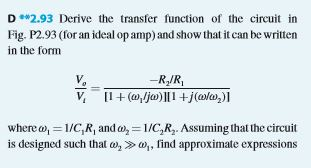
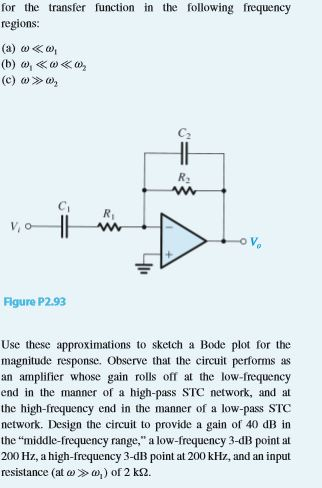
Derive the transfer function of the circuit in
Fig.P2.93(foranidealopamp)andshowthatitcanbewritten in the
form
Vo Vi = −R2/R1 [1+(ω1/jω)][1+j(ω/ω2)] whereω1=1/C1R1
andω2=1/C2R2.Assumingthatthecircuit is designed such that ω2 ω1,
find approximate expressions
for the transfer function in the following frequency regions: (a)
ωω1 (b) ω1 ωω2 (c) ωω2
Vo
FigureP2.93
Use these approximations to sketch a Bode plot for the magnitude
response. Observe that the circuit performs as an amplifier whose
gain rolls off at the low-frequency end in the manner of a
high-pass STC network, and at the high-frequency end in the manner
of a low-pass STC network. Design the circuit to provide a gain of
40 dB in the“middle-frequencyrange,”alow-frequency3-dBpointat
200Hz,ahigh-frequency3-dBpointat200kHz,andaninput resistance (at
ωω1) of 2 k.
Homework Answers
Request Answer!
We need at least 10 more requests to produce the answer.
0 / 10 have requested this problem solution
The more requests, the faster the answer.
Add Answer to:
Derive the transfer function of the circuit in
Fig.P2.93(foranidealopamp)andshowthatitcanbewritten in the
form
Vo Vi = −R2/R1...
R2 R1 1,C2 C1 Vo vin + The figure shows the circuit diagram of an active...
 R2 R1 1,C2 C1 Vo vin + The figure shows the circuit diagram of an active filter using an ideal operational amplifier. The values of the circuit components are as follows, R1 - 960 ohms, R2 - 2600 ohms, C1 - 1.0 microfarads, C2-0.8 microfarads. The magnitude of the circuit gain vo/vin at a frequency of 200Hz is determined as nearest to which of the following answers:- 00 O 0.7 O 1.5 22 3.3
Given the circuit below: R3 C1 Vout C2 R1 R3 Vin R2 ts 1 a) derive the transfer function between ...
 Given the circuit below: R3 C1 Vout C2 R1 R3 Vin R2 ts 1 a) derive the transfer function between the input and the output in terms of R1,C1,R2,C2 b) For this and all other parts below, assume Izl<Ipl, i..e that D(s) is a lead-type compensator. The transfer function is written in the following format ts 1 Express quantities K, z, p using R1,C1,R2,C2 Also, express Κα, α, τ using K,z, p c) Observe the values of s-jw on the...
Assuming an ideal op-amp find the 3dB frequency of the circuit, if R1=2.4 KS2, R2=13.4 K2,...
 Assuming an ideal op-amp find the 3dB frequency of the circuit, if R1=2.4 KS2, R2=13.4 K2, R3=20 KS2, and C=5 nF. HH C R2 R1 + Vi(jw) Vo R3 IH Answer: rad/s Consider the above circuit with the component values: R1=2.4 K12, R2=13.4 KS, R3=20 KN and C=5 nF. Find the DC gain of the circuit. Answer: Consider the above circuit with the component values: R1=13.4 KS, R2= 795.77 12, R3=20 K12, and C=100 nF. Find the angle of the...
Problem Consider a voltage amplifier having a frequency response of the low-pass STC 1ype with a de gain of 60 dB a...
 Problem Consider a voltage amplifier having a frequency response of the low-pass STC 1ype with a de gain of 60 dB and a 3-dB frequency of 1000 Hz Find the gain in dB at f- 10 Hz, 10kHz, 100 kHz, and 1 MHz Problem For the circuit shown below first, evalusteand the coresponding comer froquency. Second evalmt and the corresponding comer froquency. At the end caloulate overall transfer function T(w)= and reurite it in the standard fom ( and draw...
3. Calculate the transfer function Vo(o)/Vi(c) and then determine the type of filter (i.e. low pass,...
 3. Calculate the transfer function Vo(o)/Vi(c) and then determine the type of filter (i.e. low pass, high pass, band pass, band reject) and finally calculate the corner frequency fo vylt) 01 H vol)
Assuming an ideal op-amp find the 3dB frequency of the circuit, if R1=1.8 K2, R2=10.9 KQ,...
 Assuming an ideal op-amp find the 3dB frequency of the circuit, if R1=1.8 K2, R2=10.9 KQ, R3=20 K., and C=5 nF. HH с R2 Answer: orad/s R1 Vw R3 Consider the above circuit with the component values: R1=1.8 KO, R2=10.9 KO, R3=20 KQ and C=5 nF. Find the DC gain of the circuit. Answer: Consider the above circuit with the component values: R1=10.9 K2, R2= 795.77 2, R3=20 K, and C=100 nF. Find the angle of the transfer function in...
10. Derive the transfer function for the circuit below, where Vs is the input, and vo...
 10. Derive the transfer function for the circuit below, where Vs is the input, and vo is the output. Show the steps.
Derive the transfer function, vo/vi(s), in terms of G1, G2, G3, G4, G5 where Gį =...
 Derive the transfer function, vo/vi(s), in terms of G1, G2, G3, G4, G5 where Gį = 1/Zį. Z2 N Via Z1 Z3 ο νο a. Derive the transfer function, vo/vi(s), if Z1 = R1, Z2 = R2,23 = R3 (i.e., resistors) and 24 = 1/sC1,25 = 1/sC2 (i.e., capacitors). b. Using Excel/Matlab/Python, etc., to draw the Bode plot of the magnitude using the following design values: R1=180k22, R2=180k12, R3=100522, C1=100nF, C2=25nF. c. What are the values of w, and Q?
Find the transfer function H(jω) for the circuit above as a function of jω. (Leave R...
 Find the transfer function H(jω) for the
circuit above as a function of jω. (Leave R and L as variables).
Assume V R to be the output and V S to be the input.
С L RVR(t) vs (t) A. Find the transfer function H(jo) for the circuit above as a function of jaw. (Leave R and L as variables). Assume V to be the output and V to be the input. S R B. Find the Magnitude and Phase...
Find the transfer function H(jω) for the
circuit above as a function of jω. (Leave R and L as variables).
Assume V R to be the output and V S to be the input.
С L RVR(t) vs (t) A. Find the transfer function H(jo) for the circuit above as a function of jaw. (Leave R and L as variables). Assume V to be the output and V to be the input. S R B. Find the Magnitude and Phase...
Draw the circuit diagram and derive the frequency transfer function for the first-order passive RL low-pass...
Draw the circuit diagram and derive the frequency transfer function for the first-order passive RL low-pass filter (voltages as input and output). If this filter has a time constant of 2s and the input voltage signal is cos(πt) + sin(3πt) in the time domain, find the output signal in the time domain.
 R2 R1 1,C2 C1 Vo vin + The figure shows the circuit diagram of an active filter using an ideal operational amplifier. The values of the circuit components are as follows, R1 - 960 ohms, R2 - 2600 ohms, C1 - 1.0 microfarads, C2-0.8 microfarads. The magnitude of the circuit gain vo/vin at a frequency of 200Hz is determined as nearest to which of the following answers:- 00 O 0.7 O 1.5 22 3.3
 Given the circuit below: R3 C1 Vout C2 R1 R3 Vin R2 ts 1 a) derive the transfer function between the input and the output in terms of R1,C1,R2,C2 b) For this and all other parts below, assume Izl<Ipl, i..e that D(s) is a lead-type compensator. The transfer function is written in the following format ts 1 Express quantities K, z, p using R1,C1,R2,C2 Also, express Κα, α, τ using K,z, p c) Observe the values of s-jw on the...
 Assuming an ideal op-amp find the 3dB frequency of the circuit, if R1=2.4 KS2, R2=13.4 K2, R3=20 KS2, and C=5 nF. HH C R2 R1 + Vi(jw) Vo R3 IH Answer: rad/s Consider the above circuit with the component values: R1=2.4 K12, R2=13.4 KS, R3=20 KN and C=5 nF. Find the DC gain of the circuit. Answer: Consider the above circuit with the component values: R1=13.4 KS, R2= 795.77 12, R3=20 K12, and C=100 nF. Find the angle of the...
 Problem Consider a voltage amplifier having a frequency response of the low-pass STC 1ype with a de gain of 60 dB and a 3-dB frequency of 1000 Hz Find the gain in dB at f- 10 Hz, 10kHz, 100 kHz, and 1 MHz Problem For the circuit shown below first, evalusteand the coresponding comer froquency. Second evalmt and the corresponding comer froquency. At the end caloulate overall transfer function T(w)= and reurite it in the standard fom ( and draw...
 3. Calculate the transfer function Vo(o)/Vi(c) and then determine the type of filter (i.e. low pass, high pass, band pass, band reject) and finally calculate the corner frequency fo vylt) 01 H vol)
 Assuming an ideal op-amp find the 3dB frequency of the circuit, if R1=1.8 K2, R2=10.9 KQ, R3=20 K., and C=5 nF. HH с R2 Answer: orad/s R1 Vw R3 Consider the above circuit with the component values: R1=1.8 KO, R2=10.9 KO, R3=20 KQ and C=5 nF. Find the DC gain of the circuit. Answer: Consider the above circuit with the component values: R1=10.9 K2, R2= 795.77 2, R3=20 K, and C=100 nF. Find the angle of the transfer function in...
 10. Derive the transfer function for the circuit below, where Vs is the input, and vo is the output. Show the steps.
 Derive the transfer function, vo/vi(s), in terms of G1, G2, G3, G4, G5 where Gį = 1/Zį. Z2 N Via Z1 Z3 ο νο a. Derive the transfer function, vo/vi(s), if Z1 = R1, Z2 = R2,23 = R3 (i.e., resistors) and 24 = 1/sC1,25 = 1/sC2 (i.e., capacitors). b. Using Excel/Matlab/Python, etc., to draw the Bode plot of the magnitude using the following design values: R1=180k22, R2=180k12, R3=100522, C1=100nF, C2=25nF. c. What are the values of w, and Q?
 Find the transfer function H(jω) for the
circuit above as a function of jω. (Leave R and L as variables).
Assume V R to be the output and V S to be the input.
С L RVR(t) vs (t) A. Find the transfer function H(jo) for the circuit above as a function of jaw. (Leave R and L as variables). Assume V to be the output and V to be the input. S R B. Find the Magnitude and Phase...
Find the transfer function H(jω) for the
circuit above as a function of jω. (Leave R and L as variables).
Assume V R to be the output and V S to be the input.
С L RVR(t) vs (t) A. Find the transfer function H(jo) for the circuit above as a function of jaw. (Leave R and L as variables). Assume V to be the output and V to be the input. S R B. Find the Magnitude and Phase...
Most questions answered within 3 hours.
-
Where is the error in this code sequence?
String s1 = "Hello";
String s2 = "ello";...
asked 10 months ago -
Financial data for Joel de Paris, Inc., for last year
follow:
Joel de Paris, Inc.
Balance...
asked 10 months ago -
Consider this reaction:
Al2(SO4)3 (aq)+ BaCl3
(aq) Al2Cl6 (aq)- +
3BaSO4(s) . What is the...
asked 10 months ago -
Suppose that Savneet is considering increasing her
recent random sample from 20 car rentals to 40...
asked 10 months ago -
Trucks arrive at an unloading terminal at an average rate of 120
per hour.
Trucks arrive...
asked 10 months ago -
Why are methanol and ethanol completely soluble in water while
octanol is not very little soluble....
asked 10 months ago -
A facilities manager at a university reads in a research report
that the mean amount of...
asked 10 months ago -
When the CuSO4 is rehydrated by adding water to the anhydrous
compound, is this an endothermic...
asked 10 months ago -
A ray of sunlight is passing from diamond into crown glass; the
angle of incidence is...
asked 10 months ago -
A block of mass 0.249 kg is placed on top of a light, vertical
spring of...
asked 10 months ago -
how do the kidneys compensate in the presences of acidosis
a) trigger hyperventilate
b) reserve acid...
asked 10 months ago -
Question 501 pts
The rental rate of capital to the firm increases. Which of the
following...
asked 10 months ago