
Homework Answers
Add Answer to:
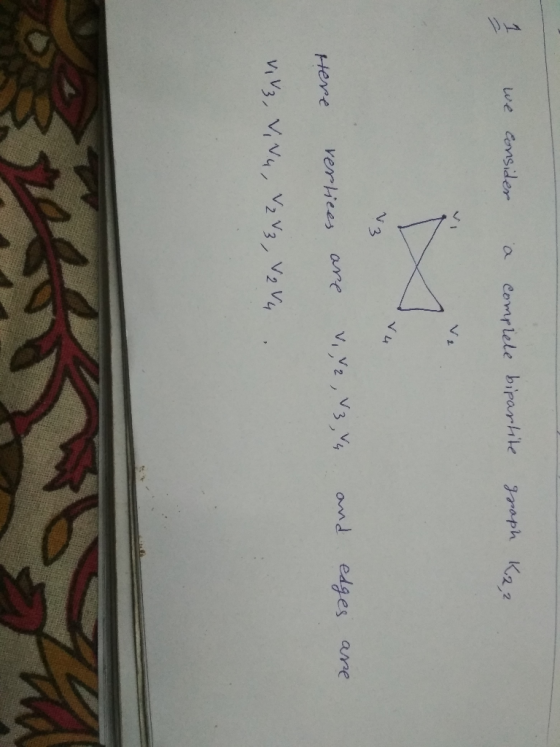
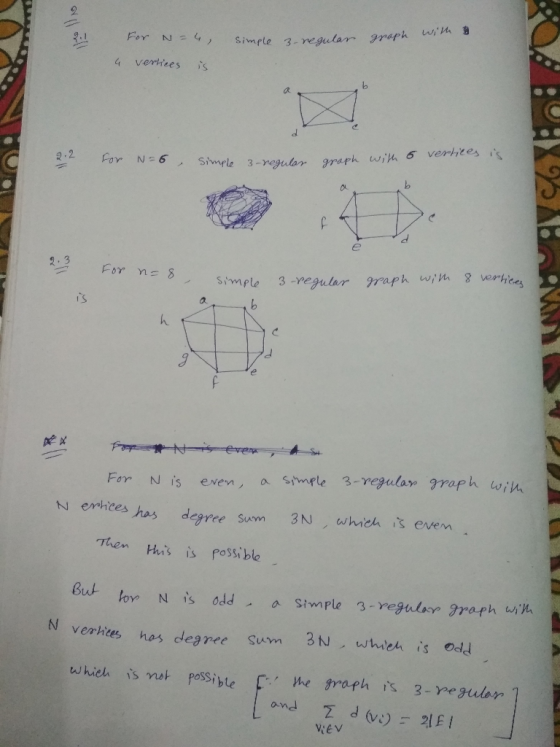
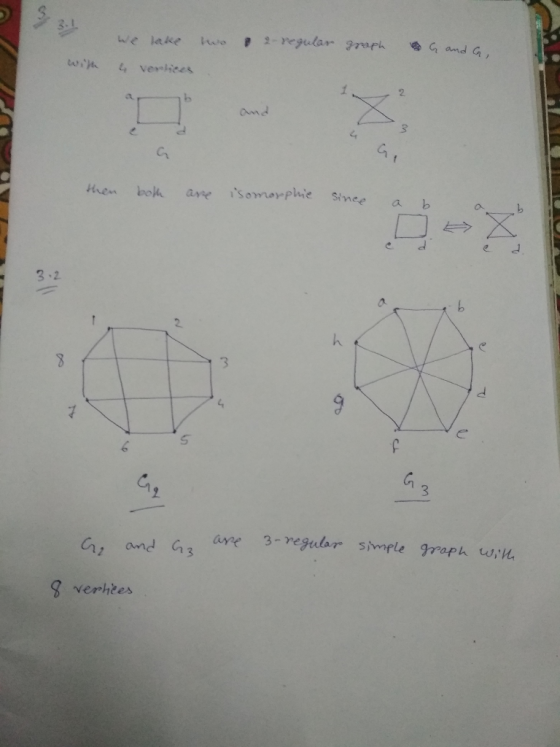
1: EDGES OF THE BIPARTITE GRAPH Please select file(s) Select image(s) 2: 3-regular graphs 2.1: FOR...
solve with steps 1. (20 points) True or false. Justify. Every planar graph is 4-colorable /2 The number of edges in a simple graph G is bounded by n(n 1) where n is the number of vertices. The number...
 solve with steps
1. (20 points) True or false. Justify. Every planar graph is 4-colorable /2 The number of edges in a simple graph G is bounded by n(n 1) where n is the number of vertices. The number of edges of a simple connected graph G is at least n-1 where n is the number of vertices. Two graphs are isomorphic if they have the same number of vertices and 1) the same mumber of edges
1. (20 points)...
solve with steps
1. (20 points) True or false. Justify. Every planar graph is 4-colorable /2 The number of edges in a simple graph G is bounded by n(n 1) where n is the number of vertices. The number of edges of a simple connected graph G is at least n-1 where n is the number of vertices. Two graphs are isomorphic if they have the same number of vertices and 1) the same mumber of edges
1. (20 points)...
1. Draw all non-isomorphic simple graphs with 5 vertices and 0, 1, 2, or 3 edges;...
 1. Draw all non-isomorphic simple graphs with 5 vertices and 0, 1, 2, or 3 edges; the graphs need not be connected. Do not label the vertices of your graphs. You should not include two graphs that are isomorphic. 2. Give the matrix representation of the graph H shown below.
1. Draw all non-isomorphic simple graphs with 5 vertices and 0, 1, 2, or 3 edges;...
 1. Draw all non-isomorphic simple graphs with 5 vertices and 0, 1, 2, or 3 edges; the graphs need not be connected. Do not label the vertices of your graphs. You should not include two graphs that are isomorphic. 2. Give the matrix representation of the graph H shown below. 3. Question 3 on next page. Place work in this box. Continue on back if needed. D E F А B
A graph has 4 vertices of degrees 3, 3, 4, 4. (a) How many edges such...
A graph has 4 vertices of degrees 3, 3, 4, 4. (a) How many edges such a graph have? (b) Draw two non isomorphic such graphs. (c) Explain why there is no such simple graph
8. For each of the following, either draw a undirected graph satisfying the given criteria or explain why it cannot be done. Your graphs should be simple, i.e. not having any multiple edges (more tha...
 8. For each of the following, either draw a undirected graph satisfying the given criteria or explain why it cannot be done. Your graphs should be simple, i.e. not having any multiple edges (more than one edge between the same pair of vertices) or self-loops (edges with both ends at the same vertex). [10 points] a. A graph with 3 connected components, 11 vertices, and 10 edges. b. A graph with 4 connected components, 10 vertices, and 30 edges. c....
1. [10 marks) Suppose a connected graph G has 10 vertices and 11 edges such that...
 1. [10 marks) Suppose a connected graph G has 10 vertices and 11 edges such that A(G) = 4 and 8(G) = 2. Let nd denote the number of vertices of degree d in G. (i) List all the possible triples (n2, N3, n4). (ii) For each triple (n2, n3, nd) in part (i), draw two non-isomorphic graphs G with n2 vertices of degree 2, në vertices of degree 3 and n4 vertices of degree 4. You need to explain...
Bipartite graph is a graph, which vertices can be partitioned into 2 parts - so that...
 Bipartite graph is a graph, which vertices can be partitioned into 2 parts - so that all edges connect only vertices from different parts. For example, this is a bipartite graph where one part has 3 vertices (a,b,c), and the other part - 4 vertices (d.e.f.g). Note there are NO edges in-between vertices coming from the same part. a b d f e g Give the order in which nodes are traversed with BFS. After listing a node, add its...
Graph 2 Prove the following statements using one example for each (consider n > 5). (a)...
Graph 2 Prove the following statements using one example for each (consider n > 5). (a) A graph G is bipartite if and only if it has no odd cycles. (b) The number of edges in a bipartite graph with n vertices is at most (n2 /2). (c) Given any two vertices u and v of a graph G, every u–v walk contains a u–v path. (d) A simple graph with n vertices and k components can have at most...
Problem 8. (2+4+4 points each) A bipartite graph G = (V. E) is a graph whose...
 Problem 8. (2+4+4 points each) A bipartite graph G = (V. E) is a graph whose vertices can be partitioned into two (disjoint) sets V1 and V2, such that every edge joins a vertex in V1 with a vertex in V2. This means no edges are within V1 or V2 (or symbolically: Vu, v E V1. {u, u} &E and Vu, v E V2.{u,v} &E). 8(a) Show that the complete graph K, is a bipartite graph. 8(b) Prove that no...
please help me make this into a contradiction or a direct proof please. i put the question, my answer, and the textbook i used. thank you also please write neatly proof 2.5 Prove har a Sim...
 please help me make this into a contradiction or a direct
proof please.
i put the question, my answer, and the textbook i used.
thank you
also please write neatly
proof 2.5 Prove har a Simple sraph and 13 cdges cannot be bipartite CHint ercattne gr apn in to ertex Sets and Court tne忤of edges Claim Splitting the graph into two vertex, Sets ves you a 8 Ver ices So if we Change tne书 apn and an A bipartite graph...
please help me make this into a contradiction or a direct
proof please.
i put the question, my answer, and the textbook i used.
thank you
also please write neatly
proof 2.5 Prove har a Simple sraph and 13 cdges cannot be bipartite CHint ercattne gr apn in to ertex Sets and Court tne忤of edges Claim Splitting the graph into two vertex, Sets ves you a 8 Ver ices So if we Change tne书 apn and an A bipartite graph...
 solve with steps
1. (20 points) True or false. Justify. Every planar graph is 4-colorable /2 The number of edges in a simple graph G is bounded by n(n 1) where n is the number of vertices. The number of edges of a simple connected graph G is at least n-1 where n is the number of vertices. Two graphs are isomorphic if they have the same number of vertices and 1) the same mumber of edges
1. (20 points)...
solve with steps
1. (20 points) True or false. Justify. Every planar graph is 4-colorable /2 The number of edges in a simple graph G is bounded by n(n 1) where n is the number of vertices. The number of edges of a simple connected graph G is at least n-1 where n is the number of vertices. Two graphs are isomorphic if they have the same number of vertices and 1) the same mumber of edges
1. (20 points)...
 1. Draw all non-isomorphic simple graphs with 5 vertices and 0, 1, 2, or 3 edges; the graphs need not be connected. Do not label the vertices of your graphs. You should not include two graphs that are isomorphic. 2. Give the matrix representation of the graph H shown below.
 1. Draw all non-isomorphic simple graphs with 5 vertices and 0, 1, 2, or 3 edges; the graphs need not be connected. Do not label the vertices of your graphs. You should not include two graphs that are isomorphic. 2. Give the matrix representation of the graph H shown below. 3. Question 3 on next page. Place work in this box. Continue on back if needed. D E F А B
 8. For each of the following, either draw a undirected graph satisfying the given criteria or explain why it cannot be done. Your graphs should be simple, i.e. not having any multiple edges (more than one edge between the same pair of vertices) or self-loops (edges with both ends at the same vertex). [10 points] a. A graph with 3 connected components, 11 vertices, and 10 edges. b. A graph with 4 connected components, 10 vertices, and 30 edges. c....
 1. [10 marks) Suppose a connected graph G has 10 vertices and 11 edges such that A(G) = 4 and 8(G) = 2. Let nd denote the number of vertices of degree d in G. (i) List all the possible triples (n2, N3, n4). (ii) For each triple (n2, n3, nd) in part (i), draw two non-isomorphic graphs G with n2 vertices of degree 2, në vertices of degree 3 and n4 vertices of degree 4. You need to explain...
 Bipartite graph is a graph, which vertices can be partitioned into 2 parts - so that all edges connect only vertices from different parts. For example, this is a bipartite graph where one part has 3 vertices (a,b,c), and the other part - 4 vertices (d.e.f.g). Note there are NO edges in-between vertices coming from the same part. a b d f e g Give the order in which nodes are traversed with BFS. After listing a node, add its...
 Problem 8. (2+4+4 points each) A bipartite graph G = (V. E) is a graph whose vertices can be partitioned into two (disjoint) sets V1 and V2, such that every edge joins a vertex in V1 with a vertex in V2. This means no edges are within V1 or V2 (or symbolically: Vu, v E V1. {u, u} &E and Vu, v E V2.{u,v} &E). 8(a) Show that the complete graph K, is a bipartite graph. 8(b) Prove that no...
 please help me make this into a contradiction or a direct
proof please.
i put the question, my answer, and the textbook i used.
thank you
also please write neatly
proof 2.5 Prove har a Simple sraph and 13 cdges cannot be bipartite CHint ercattne gr apn in to ertex Sets and Court tne忤of edges Claim Splitting the graph into two vertex, Sets ves you a 8 Ver ices So if we Change tne书 apn and an A bipartite graph...
please help me make this into a contradiction or a direct
proof please.
i put the question, my answer, and the textbook i used.
thank you
also please write neatly
proof 2.5 Prove har a Simple sraph and 13 cdges cannot be bipartite CHint ercattne gr apn in to ertex Sets and Court tne忤of edges Claim Splitting the graph into two vertex, Sets ves you a 8 Ver ices So if we Change tne书 apn and an A bipartite graph...
Most questions answered within 3 hours.
-
Where is the error in this code sequence?
String s1 = "Hello";
String s2 = "ello";...
asked 10 months ago -
Financial data for Joel de Paris, Inc., for last year
follow:
Joel de Paris, Inc.
Balance...
asked 10 months ago -
Consider this reaction:
Al2(SO4)3 (aq)+ BaCl3
(aq) Al2Cl6 (aq)- +
3BaSO4(s) . What is the...
asked 10 months ago -
Suppose that Savneet is considering increasing her
recent random sample from 20 car rentals to 40...
asked 10 months ago -
Trucks arrive at an unloading terminal at an average rate of 120
per hour.
Trucks arrive...
asked 10 months ago -
Why are methanol and ethanol completely soluble in water while
octanol is not very little soluble....
asked 10 months ago -
A facilities manager at a university reads in a research report
that the mean amount of...
asked 10 months ago -
When the CuSO4 is rehydrated by adding water to the anhydrous
compound, is this an endothermic...
asked 10 months ago -
A ray of sunlight is passing from diamond into crown glass; the
angle of incidence is...
asked 10 months ago -
A block of mass 0.249 kg is placed on top of a light, vertical
spring of...
asked 10 months ago -
how do the kidneys compensate in the presences of acidosis
a) trigger hyperventilate
b) reserve acid...
asked 10 months ago -
Question 501 pts
The rental rate of capital to the firm increases. Which of the
following...
asked 10 months ago