After exchange, collective rice production increased by how much?
After exchange, collective rice production increased by how much?
Homework Answers
Collective rice production is a process of rice production where a significant number of farmers contribute to the production together and work co-operatively to increase the production of rice. This collective farming technique helps the farmers to produce a higher amount of output due to increased availability of land, specialization of labors, the adaptation of better cultivation techniques, irrigation facilities, and minimized cost due to economies of scale. The rice-producing countries include a significant portion of Asian countries including, China, India, Bangladesh, Iran, etc., countries like Egypt, Nigeria, etc. in Africa and Brazil, Mexico and a few states in the US in American continents.
Change in the exchange rate affects the production of rice to some extent due to its value as an export product. So when the exchange rate of a rice-producing country depreciates against other currencies, the export value of rice in the international market appreciates i.e., the farmer can earn more by selling rice to other countries with high currency values rather than selling in the domestic market. And when the exchange rate of one currency appreciates against the other, the price of the product falls in the international market due to the higher international price of the product. Thus export does not fetch a good profit when the exchange rate of the rice-producing country appreciates.
In order to cut the cost of rice production, several farmers sign up for collective rice production to cope with the change in the exchange rate, when the exchange rate is unfavorable, that is when the currency appreciates, it is beneficial for the farmers to use the collective production technique to minimize cost and for better product quality to earn extra profit. As the rice-producing countries mostly include low-income Asian countries with a high population, it is tough for the farmers to maintain the quality and cut cost when the land is in pieces, thus several agreements have been entered into by the farmers to implement collective production. And due to a high population and hereditary allocation of land, an individual farmer is left with only a very small portion of land as his share and rice production becomes tough. To overcome such disadvantages, such farmers participate in collective rise production.
The land dedicated to rice-production is decreasing significantly worldwide and especially in Asian countries due to the higher population and an increase in land use for other purposes. This is contributing to the lower production rate of rice which is decreasing significantly in recent time. The rice production was 498.95 million tons approximately during the previous financial year as estimated by the United States Department of Agriculture. But the production is decreasing every month due to a significant fall in production in India and the US which calls for collective-production.
The low availability of land is decreasing the production, and to keep up with the demand scenario, collective rice-production is being implemented since the 90s in different rice-producing nations across the globe. The appreciation of the US dollar with respect to other Asian and African countries who are the major producers of rice increased the use of collective rice-production techniques internationally. This helped such countries to increase their export revenue and the collective rice production technique is gaining more popularity. Major researches have been undertaken by agricultural institutes to promote the growth of production. The demand for rice is rising substantially over the past years due to the higher population and to cope with the situation higher production of rice is required with low land availability, further contributing to collective production. The collective rice-production is increasing substantially from country to country with differing estimates and in connection with the prevailing exchange rate. Thus the exact percentage of increase in collective production internationally with relation to the exchange rate is not available, though the relative estimates of some countries are available with a change in the exchange rate and increase in collective rice-production. But we can understand that a significant percentage of farmers are applying this technique globally to increase rice production.
Answer: Collective rice-production increased significantly and by a higher percentage with every passing year due to decreased availability of land and high population growth. It is expected to grow further in the upcoming years and research is being carried out to improve the cultivation techniques. Though the exact percentage of increase in collective rice production is not available, the relevance of such a measure is increasing internationally which started even before the 90s.
Note - The exact increase in international production percentage is not available in relation to collective rice production.
Sri Lanka 1000 rice 3000 ten Kenya 1000 rice 1000 Tea production consuming 400 rice 1800...
 Sri Lanka 1000 rice 3000 ten Kenya 1000 rice 1000 Tea production consuming 400 rice 1800 tea 500 rice కాలం tee Is there any benefit if they trade with each other? teading price - I bag of rice for two bags of tea. & Kenya wishes to keep sso bags of rice after trade. Explain that the 2 countries can benefit by consuming more of both goods after trade. Supply Consumers' Surplus Producers' Surplus PRICE Demand 16 14 18 20...
Please answer A, B, C, and D. Thank you. 5. Use the graph of rice production...
 Please answer A, B, C, and D.
Thank you.
5. Use the graph of rice production below to answer the following questions. $10 8 4 2 2 4 6 8 10 12 Quantity per period (millions of kilos) a) Suppose that the government introduced a price floor of $8 per kilo. How much will consumers spend in total and how much will the government spend in total? [2 marks] b) Suppose that instead of a price floor, a $4 price...
Please answer A, B, C, and D.
Thank you.
5. Use the graph of rice production below to answer the following questions. $10 8 4 2 2 4 6 8 10 12 Quantity per period (millions of kilos) a) Suppose that the government introduced a price floor of $8 per kilo. How much will consumers spend in total and how much will the government spend in total? [2 marks] b) Suppose that instead of a price floor, a $4 price...
1. Rice prices normally rise after a typhoon destroys some of the country's prime rice growing...
 1. Rice prices normally rise after a typhoon destroys some of the country's prime rice growing land. A "street talk" feature on a TV show sought people's reaction to higher rice prices. Here is a typical response: "I don't like higher rice prices. I think the rice sell- ers just use the typhoon as an excuse to raise prices." How does this point of view differ from that of economists who use the model of demand and supply to explain...
Cross-price elasticities Rice & beans (-0.35) Rice & wheat (0.6) Rice & chicken (-0.1) Rice & milk (-0.05) Rice & other goods 0 Income elasticity of demand for rice (0.4) Questions...
Cross-price elasticities Rice & beans (-0.35) Rice & wheat (0.6) Rice & chicken (-0.1) Rice & milk (-0.05) Rice & other goods 0 Income elasticity of demand for rice (0.4) Questions: D) How much would the price of rice have to decrease in order to increase rice consumption by 5%? E) What would happen to bean consumption as a result of a 10 percent decrease in the price of rice? (Make sure to mention the direction and magnitude of the...
Consider a couple (a husband and a wife) that jointly represents their collective preferences between combinations...
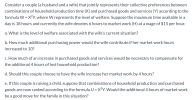 Consider a couple (a husband and a wife) that jointly represents their collective preferences between combinations of household production time (X) and purchased goods and services (Y) according to the formula W = x2Y, where W represents the level of welfare. Suppose the maximum time available in a day is 18 hours and currently the wife devotes 6 hours to market work (H) at a wage of $15 per hour. a. What is the level of welfare associated with the...
Consider a couple (a husband and a wife) that jointly represents their collective preferences between combinations...
Consider a couple (a husband and a wife) that jointly represents their collective preferences between combinations of household production time (X) and purchased goods and services (Y) according to the formula W = X2Y, where W represents the level of welfare. Suppose the maximum time available in a day is 18 hours and currently the wife devotes 6 hours to market work (H) at a wage of $15 per hour. a. What is the level of welfare associated with the...
1- Explain how increased market production (of final goods) affects GDP. Explain how increased production may...
1- Explain how increased market production (of final goods) affects GDP. Explain how increased production may affect pollution of the environment. Explain how each of these may affect our “happiness” or “standard of living.” 2- Suppose there are 1,000,000 persons in the adult population, 850,000 of whom are employed, 60,000 are unemployed. Economists estimate that 10,000 persons could be categorized as “discouraged workers.” Calculate the unemployment rate (round to one digit to the right of the decimal point). SHOW YOUR...
The exchange rate between Japan and the US is JPN1.385/$. If there is increased political uncertainty...
The exchange rate between Japan and the US is JPN1.385/$. If there is increased political uncertainty in Japan, how does this affect the exchange rate between Japan and the US?
Below table shows the production possibilities for the country of Emilon: Rice Beef Complete the following...
 Below table shows the production possibilities for the country of Emilon: Rice Beef Complete the following (approximate) possibilities for Emilon. a. Emilon can produce 52 rice and 2 beef. b. Emilon can produce 10 rice and 8 beef. Which of the following product combinations is Emilon capable of producing? c. Can Emilon produce 40 rice and 8 beef? No, it cannot be produced. d. Can Emilon produce 28 rice and 7 beef? Yes, it can be produced.
explain how vigorous exercise ( increased oxidation of NADH) stimulates the production of citrate
explain how vigorous exercise ( increased oxidation of NADH) stimulates the production of citrate
 Sri Lanka 1000 rice 3000 ten Kenya 1000 rice 1000 Tea production consuming 400 rice 1800 tea 500 rice కాలం tee Is there any benefit if they trade with each other? teading price - I bag of rice for two bags of tea. & Kenya wishes to keep sso bags of rice after trade. Explain that the 2 countries can benefit by consuming more of both goods after trade. Supply Consumers' Surplus Producers' Surplus PRICE Demand 16 14 18 20...
 Please answer A, B, C, and D.
Thank you.
5. Use the graph of rice production below to answer the following questions. $10 8 4 2 2 4 6 8 10 12 Quantity per period (millions of kilos) a) Suppose that the government introduced a price floor of $8 per kilo. How much will consumers spend in total and how much will the government spend in total? [2 marks] b) Suppose that instead of a price floor, a $4 price...
Please answer A, B, C, and D.
Thank you.
5. Use the graph of rice production below to answer the following questions. $10 8 4 2 2 4 6 8 10 12 Quantity per period (millions of kilos) a) Suppose that the government introduced a price floor of $8 per kilo. How much will consumers spend in total and how much will the government spend in total? [2 marks] b) Suppose that instead of a price floor, a $4 price...
 1. Rice prices normally rise after a typhoon destroys some of the country's prime rice growing land. A "street talk" feature on a TV show sought people's reaction to higher rice prices. Here is a typical response: "I don't like higher rice prices. I think the rice sell- ers just use the typhoon as an excuse to raise prices." How does this point of view differ from that of economists who use the model of demand and supply to explain...
 Consider a couple (a husband and a wife) that jointly represents their collective preferences between combinations of household production time (X) and purchased goods and services (Y) according to the formula W = x2Y, where W represents the level of welfare. Suppose the maximum time available in a day is 18 hours and currently the wife devotes 6 hours to market work (H) at a wage of $15 per hour. a. What is the level of welfare associated with the...
 Below table shows the production possibilities for the country of Emilon: Rice Beef Complete the following (approximate) possibilities for Emilon. a. Emilon can produce 52 rice and 2 beef. b. Emilon can produce 10 rice and 8 beef. Which of the following product combinations is Emilon capable of producing? c. Can Emilon produce 40 rice and 8 beef? No, it cannot be produced. d. Can Emilon produce 28 rice and 7 beef? Yes, it can be produced.
Most questions answered within 3 hours.
-
Where is the error in this code sequence?
String s1 = "Hello";
String s2 = "ello";...
asked 10 months ago -
Financial data for Joel de Paris, Inc., for last year
follow:
Joel de Paris, Inc.
Balance...
asked 10 months ago -
Consider this reaction:
Al2(SO4)3 (aq)+ BaCl3
(aq) Al2Cl6 (aq)- +
3BaSO4(s) . What is the...
asked 10 months ago -
Suppose that Savneet is considering increasing her
recent random sample from 20 car rentals to 40...
asked 10 months ago -
Trucks arrive at an unloading terminal at an average rate of 120
per hour.
Trucks arrive...
asked 10 months ago -
Why are methanol and ethanol completely soluble in water while
octanol is not very little soluble....
asked 10 months ago -
A facilities manager at a university reads in a research report
that the mean amount of...
asked 10 months ago -
When the CuSO4 is rehydrated by adding water to the anhydrous
compound, is this an endothermic...
asked 10 months ago -
A ray of sunlight is passing from diamond into crown glass; the
angle of incidence is...
asked 10 months ago -
A block of mass 0.249 kg is placed on top of a light, vertical
spring of...
asked 10 months ago -
how do the kidneys compensate in the presences of acidosis
a) trigger hyperventilate
b) reserve acid...
asked 10 months ago -
Question 501 pts
The rental rate of capital to the firm increases. Which of the
following...
asked 10 months ago