

Homework Answers
| treatment | I | II | III | |||
| count, ni = | 3 | 3 | 4 | |||
| mean , x̅ i = | 4.100 | 3.23 | 0.825 | |||
| std. dev., si = | 0.656 | 1.137 | 1.170 | |||
| sample variances, si^2 = | 0.430 | 1.293 | 1.369 | |||
| total sum | 12.3 | 9.7 | 3.3 | 25.3 | (grand sum) | |
| grand mean , x̅̅ = | Σni*x̅i/Σni = | 2.53 | ||||
| square of deviation of sample mean from grand mean,( x̅ - x̅̅)² | 2.465 | 0.495 | 2.907 | |||
| TOTAL | ||||||
| SS(between)= SSB = Σn( x̅ - x̅̅)² = | 7.395 | 1.484 | 11.628 | 20.50683 | ||
| SS(within ) = SSW = Σ(n-1)s² = | 0.860 | 2.587 | 4.108 | 7.554 | ||
no. of treatment , k = 3
df between = k-1 = 2
N = Σn = 10
df within = N-k = 7
mean square between groups , MSB = SSB/k-1 =
10.2534
mean square within groups , MSW = SSW/N-k =
1.0792
F-stat = MSB/MSW = 9.5012
| anova table | |||||
| SS | df | MS | F | p-value | |
| Between: | 20.507 | 2 | 10.2534 | 9.501 | 0.0101 |
| Within: | 7.554 | 7 | 1.0792 | ||
| Total: | 28.061 | 9 |
================
The Bonferroni correction sets the significance cut-off at α/n = 0.06/3 = 0.02
MSE= 1.079
test statistic = ( x̅ i -x̅ j) /√(MSE(1/ni+1/nj))
answer: 1.02 , 4.13 , 3.04
b)
α=0.02
no. of treatments,k= 3
DF error =N-k= 7
t-critical value,t(α/2,df)= 2.9980
if test stat > critical value, means are significantly different
| t-critical value | test statistic | result | |||||
| µ1-µ2 | 2.998 | 1.02 | means are not different | ||||
| µ1-µ3 | 2.998 | 4.13 | means are different | ||||
| µ2-µ3 | 2.998 | 3.04 | means are different | ||||
answer: option H)
Add Answer to:
- Strategies for treating hypertensive patients by nonpharmacologic methods are compared by establishing three groups of...
Strategies for treating hypertensive patients by nonpharmacologic methods are compared by establishing three groups of hypertensive...
 Strategies for treating hypertensive patients by nonpharmacologic methods are compared by establishing three groups of hypertensive patients who receive the following types of nonpharmacologic therapy: Group 1 Patients receive counseling for weight reduction Group 2: Patients receive counseling for meditation Group 3: Patients receive no counseling at all The reduction in diastolic blood pressure is noted in these patients after a 1-month period and are given in the table below Group 1 Group 2 Group 3 4.2 5.7 4.5 1.2...
Strategies for treating hypertensive patients by nonpharmacologic methods are compared by establishing three groups of hypertensive...
Strategies for treating hypertensive patients by nonpharmacologic methods are compared by establishing three groups of hypertensive patients who receive the following types of nonpharmacologic therapy: Group 1: Patients receive counseling for weight reduction Group 2: Patients receive counseling for meditation Group 3: Patients receive no counseling at all The reduction in diastolic blood pressure is noted in these patients after a 1-month period and are given in the table below. Group 1 Group 2 Group 3 4.2 4.5 1.2 4.9 2.2 −0.3 3.4...
Problem #6: Strategies for treating hypertensive patients by nonpharmacologic methods are compared by establishing three groups...
 Problem #6: Strategies for treating hypertensive patients by nonpharmacologic methods are compared by establishing three groups of hypertensive patients who receive the following types of nonpharmacologic therapy: Group 1: Patients receive counseling for weight reduction Group 2: Patients receive counseling for meditation Group 3: Patients receive no counseling at all The reduction in diastolic blood pressure is noted in these patients after a 1-month period and are given in the table below. Group 1 Group 2 Group 3 4.5 1.2...
Some common strategies for treating hypertensive patients by nonpharmacologic methods include (1) weight reduction and (2)...
Some common strategies for treating hypertensive patients by nonpharmacologic methods include (1) weight reduction and (2) trying to get the patient to relax more by meditational or other techniques. These strategies were evaluated by randomizing hypertensive patients to four groups who receive the following types of nonpharmacologic therapy: Group 1: patients receive counselling for both weight reduction and meditation. Group 2: patients receive counselling for weight reduction but not for meditation. Group 3: patients receive counselling for meditation but not...
I dont know why the answer for question is incorrect, please help me Problem #1: Strategies...
 I dont know why the
answer for question is incorrect, please help me
Problem #1: Strategies for treating hypertensive patients by nonpharmacologic methods are compared by establishing three groups of hypertensive patients who receive the following types of nonpharmacologic therapy: Group 1: Patients receive counseling for weight reduction Group 2: Patients receive counseling for meditation Group 3: Patients receive no counseling at all The reduction in diastolic blood pressure is noted in these patients after a 1-month period and are...
I dont know why the
answer for question is incorrect, please help me
Problem #1: Strategies for treating hypertensive patients by nonpharmacologic methods are compared by establishing three groups of hypertensive patients who receive the following types of nonpharmacologic therapy: Group 1: Patients receive counseling for weight reduction Group 2: Patients receive counseling for meditation Group 3: Patients receive no counseling at all The reduction in diastolic blood pressure is noted in these patients after a 1-month period and are...
Group 1 Group 2 Group 3 4.2 4.5 1.2 5.4 2.3 −0.3 3.4 2.3 0.4 2.4...
Group 1 Group 2 Group 3 4.2 4.5 1.2 5.4 2.3 −0.3 3.4 2.3 0.4 2.4 Using the data from Problem #1 above, we want to use the Bonferonni method to test the following hyptheses at the 3% significance level: H0 : μ1 = μ2 H1 : μ1 ≠ μ2 H0 : μ1 = μ3 H1 : μ1 ≠ μ3 H0 : μ2 = μ3 H1 : μ2 ≠ μ3 (a) Find the value of the test statistic for each of the above...
PLEASE SOLVE USING ALL MANUAL CALCULATIONS, Z-SCORE TABLES, T-SCORE TABLES, ETC. Problem #2: Using the data...
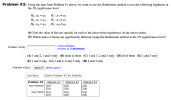 PLEASE SOLVE USING ALL MANUAL CALCULATIONS, Z-SCORE
TABLES, T-SCORE TABLES, ETC.
Problem #2: Using the data from Problem #1 above, we want to use the Bonferonni method to test the following hyptheses at the 3% significance level (a) Find the value of the test statistic for each of the above three hypotheses (in the above order) (b) which pairs of means are significantly different (using the Bonferonni method at the 3% significance level)? 3 test statistics (correct to 2 decimals)...
PLEASE SOLVE USING ALL MANUAL CALCULATIONS, Z-SCORE
TABLES, T-SCORE TABLES, ETC.
Problem #2: Using the data from Problem #1 above, we want to use the Bonferonni method to test the following hyptheses at the 3% significance level (a) Find the value of the test statistic for each of the above three hypotheses (in the above order) (b) which pairs of means are significantly different (using the Bonferonni method at the 3% significance level)? 3 test statistics (correct to 2 decimals)...
Question 5 3 pts The following data concerns a randomized controlled trial. Two groups of 100...
 Question 5 3 pts The following data concerns a randomized controlled trial. Two groups of 100 men with systolic blood pressure in the 120 to 130 range and diastolic blood pressure in the 80 to 90 range are treated to reduce the “pre-hypertensive” state. The men are in the age range 30 to 40 years. The control group 1 is given placebo and the experimental group 2 is given a treatment.to reduce blood pressure. Assume the standard deviations are equal...
Question 5 3 pts The following data concerns a randomized controlled trial. Two groups of 100...
 Question 5 3 pts The following data concerns a randomized controlled trial. Two groups of 100 men with systolic blood pressure in the 120 to 130 range and diastolic blood pressure in the 80 to 90 range are treated to reduce the “pre-hypertensive” state. The men are in the age range 30 to 40 years. The control group 1 is given placebo and the experimental group 2 is given a treatment.to reduce blood pressure. Assume the standard deviations are equal...
use first chart to answer questions 18-20 D Question 18 5 pts Suppose 20 hypertensive patients...
 use
first chart to answer questions 18-20
D Question 18 5 pts Suppose 20 hypertensive patients are assigned at random to each of four therapy groups, and the change of in diastolic blood pressure (DBP) is noted in these patients after a 1-month period. We want to see whether there is any difference in mean changes in DBP among the therapy groups. The results are given in the following table (please use this table to answer questions 18 through 20):...
use
first chart to answer questions 18-20
D Question 18 5 pts Suppose 20 hypertensive patients are assigned at random to each of four therapy groups, and the change of in diastolic blood pressure (DBP) is noted in these patients after a 1-month period. We want to see whether there is any difference in mean changes in DBP among the therapy groups. The results are given in the following table (please use this table to answer questions 18 through 20):...
 Strategies for treating hypertensive patients by nonpharmacologic methods are compared by establishing three groups of hypertensive patients who receive the following types of nonpharmacologic therapy: Group 1 Patients receive counseling for weight reduction Group 2: Patients receive counseling for meditation Group 3: Patients receive no counseling at all The reduction in diastolic blood pressure is noted in these patients after a 1-month period and are given in the table below Group 1 Group 2 Group 3 4.2 5.7 4.5 1.2...
 Problem #6: Strategies for treating hypertensive patients by nonpharmacologic methods are compared by establishing three groups of hypertensive patients who receive the following types of nonpharmacologic therapy: Group 1: Patients receive counseling for weight reduction Group 2: Patients receive counseling for meditation Group 3: Patients receive no counseling at all The reduction in diastolic blood pressure is noted in these patients after a 1-month period and are given in the table below. Group 1 Group 2 Group 3 4.5 1.2...
 I dont know why the
answer for question is incorrect, please help me
Problem #1: Strategies for treating hypertensive patients by nonpharmacologic methods are compared by establishing three groups of hypertensive patients who receive the following types of nonpharmacologic therapy: Group 1: Patients receive counseling for weight reduction Group 2: Patients receive counseling for meditation Group 3: Patients receive no counseling at all The reduction in diastolic blood pressure is noted in these patients after a 1-month period and are...
I dont know why the
answer for question is incorrect, please help me
Problem #1: Strategies for treating hypertensive patients by nonpharmacologic methods are compared by establishing three groups of hypertensive patients who receive the following types of nonpharmacologic therapy: Group 1: Patients receive counseling for weight reduction Group 2: Patients receive counseling for meditation Group 3: Patients receive no counseling at all The reduction in diastolic blood pressure is noted in these patients after a 1-month period and are...
 PLEASE SOLVE USING ALL MANUAL CALCULATIONS, Z-SCORE
TABLES, T-SCORE TABLES, ETC.
Problem #2: Using the data from Problem #1 above, we want to use the Bonferonni method to test the following hyptheses at the 3% significance level (a) Find the value of the test statistic for each of the above three hypotheses (in the above order) (b) which pairs of means are significantly different (using the Bonferonni method at the 3% significance level)? 3 test statistics (correct to 2 decimals)...
PLEASE SOLVE USING ALL MANUAL CALCULATIONS, Z-SCORE
TABLES, T-SCORE TABLES, ETC.
Problem #2: Using the data from Problem #1 above, we want to use the Bonferonni method to test the following hyptheses at the 3% significance level (a) Find the value of the test statistic for each of the above three hypotheses (in the above order) (b) which pairs of means are significantly different (using the Bonferonni method at the 3% significance level)? 3 test statistics (correct to 2 decimals)...
 Question 5 3 pts The following data concerns a randomized controlled trial. Two groups of 100 men with systolic blood pressure in the 120 to 130 range and diastolic blood pressure in the 80 to 90 range are treated to reduce the “pre-hypertensive” state. The men are in the age range 30 to 40 years. The control group 1 is given placebo and the experimental group 2 is given a treatment.to reduce blood pressure. Assume the standard deviations are equal...
 Question 5 3 pts The following data concerns a randomized controlled trial. Two groups of 100 men with systolic blood pressure in the 120 to 130 range and diastolic blood pressure in the 80 to 90 range are treated to reduce the “pre-hypertensive” state. The men are in the age range 30 to 40 years. The control group 1 is given placebo and the experimental group 2 is given a treatment.to reduce blood pressure. Assume the standard deviations are equal...
 use
first chart to answer questions 18-20
D Question 18 5 pts Suppose 20 hypertensive patients are assigned at random to each of four therapy groups, and the change of in diastolic blood pressure (DBP) is noted in these patients after a 1-month period. We want to see whether there is any difference in mean changes in DBP among the therapy groups. The results are given in the following table (please use this table to answer questions 18 through 20):...
use
first chart to answer questions 18-20
D Question 18 5 pts Suppose 20 hypertensive patients are assigned at random to each of four therapy groups, and the change of in diastolic blood pressure (DBP) is noted in these patients after a 1-month period. We want to see whether there is any difference in mean changes in DBP among the therapy groups. The results are given in the following table (please use this table to answer questions 18 through 20):...
Most questions answered within 3 hours.
-
Where is the error in this code sequence?
String s1 = "Hello";
String s2 = "ello";...
asked 10 months ago -
Financial data for Joel de Paris, Inc., for last year
follow:
Joel de Paris, Inc.
Balance...
asked 10 months ago -
Consider this reaction:
Al2(SO4)3 (aq)+ BaCl3
(aq) Al2Cl6 (aq)- +
3BaSO4(s) . What is the...
asked 10 months ago -
Suppose that Savneet is considering increasing her
recent random sample from 20 car rentals to 40...
asked 10 months ago -
Trucks arrive at an unloading terminal at an average rate of 120
per hour.
Trucks arrive...
asked 10 months ago -
Why are methanol and ethanol completely soluble in water while
octanol is not very little soluble....
asked 10 months ago -
A facilities manager at a university reads in a research report
that the mean amount of...
asked 10 months ago -
When the CuSO4 is rehydrated by adding water to the anhydrous
compound, is this an endothermic...
asked 10 months ago -
A ray of sunlight is passing from diamond into crown glass; the
angle of incidence is...
asked 10 months ago -
A block of mass 0.249 kg is placed on top of a light, vertical
spring of...
asked 10 months ago -
how do the kidneys compensate in the presences of acidosis
a) trigger hyperventilate
b) reserve acid...
asked 10 months ago -
Question 501 pts
The rental rate of capital to the firm increases. Which of the
following...
asked 10 months ago