The glass tube inside the photocell that contains the anode and the cathode must be evacuated...
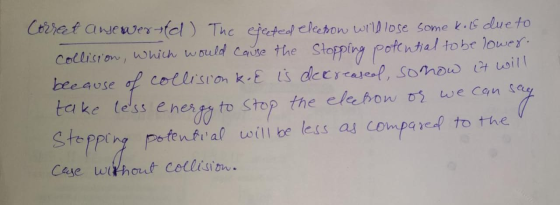
The glass tube inside the photocell that contains the anode and the cathode must be evacuated of all air molecules. This is done in order to prevent any potential collisions between the ejected electrons and the air molecules. What would be the result of such a collision occurring? Select one: a. The ejected electron will lose some of its kinetic energy due to a collision with an air molecule which would cause the stopping potential recorded to be higher. b. The ejected electron will lose some of its kinetic energy due to a collision with an air molecule, but that will not interfere with the results of the experiment in any way. c. The ejected electron will gain more kinetic energy due to a collision with an air molecule which would cause the stopping potential recorded to be lower. d. The ejected electron will lose some of its kinetic energy due to a collision with an air molecule which would cause the stopping potential recorded to be lower.
Stopping potential as in (Vs)
Homework Answers
Add Answer to:
The glass tube inside the photocell that contains the anode and
the cathode must be evacuated...
mastering physics 13
 An atom of massis initially at rest, in its ground state. Amoving(nonrelativistic) electron of mass collides with theatom. The atom+electron system canexist in an excited state in which the electron is absorbed intothe atom. The excited state has an extra, "internal,"energyrelative to the atom's ground state.(Intro1figure)A)Find the kinetic energy that the electron must have inorder to excite theatom.Express your answer in terms of,, and .We can use the result from Part A to study a process of interestin atomic physics:...
some context Problem 3: Use simple kinetic theory of gases discussed in section 1.3.2 as well...
 some context
Problem 3: Use simple kinetic theory of gases discussed in section 1.3.2 as well as Fourer's law of condustion to prove: 2 R373 D11 = 3113/202pm Dal We were unable to transcribe this imageof a nes. the xed the led negligible The following assumptions about the structure of the cases are made in order to investigate the statistical rules of the random motion of the molecules: The size of the gas molecules is negligible compared with the distance...
some context
Problem 3: Use simple kinetic theory of gases discussed in section 1.3.2 as well as Fourer's law of condustion to prove: 2 R373 D11 = 3113/202pm Dal We were unable to transcribe this imageof a nes. the xed the led negligible The following assumptions about the structure of the cases are made in order to investigate the statistical rules of the random motion of the molecules: The size of the gas molecules is negligible compared with the distance...
Chapter6 Electron Deflection Learning Objectives By the end of this activity, you should be able to:...
 Chapter6 Electron Deflection Learning Objectives By the end of this activity, you should be able to: Describe qualitatively how charged particles are deflected by an electric field. Describe qualitatively and quantitatively how charged particles are deflected by a magnetic field. 6.1 Pre-lab Find a reasonably reliable source on cathode ray tubes (CRT). Study the inner workings of a CRT and answer the following questions: [6.1] Question: What particle is undergoing motion in a CRT? List the name, mass, and charge...
Electron transport chains (ETCs), large proteins through which electrons move, play important roles in two of...
Electron transport chains (ETCs), large proteins through which electrons move, play important roles in two of nature's fundamental processes: (1) the conversion of electromagnetic energy from the Sun into the energy in the chemical bonds in glucose molecules and (2) the conversion of the energy in these glucose molecules into useful forms for metabolic processes, such as muscle contraction, building proteins, and respiration. Respiratory ETCs are located in the inner membranes of mitochondria, the power plants of eukaryotic cells. ETCs...
*SHOW YOUR WORK* (Boyle's Law): 1. What is the final volume (in mL) or argon gas...
*SHOW YOUR WORK* (Boyle's Law): 1. What is the final volume (in mL) or argon gas is 50.0 mL at 705 torr is compressed to a pressure of 2.75 atm, at constant temperature? (Lewis Dot Structures): 2. Draw Lewis structures for the following molecules. Include partial charges, AXE designation, (example: AX2 E2), Electron-pair geometry and geometric-molecular shapes. Is it Polar or Non-Polar? CH2Cl2 SO2 3. Which of the following explains why the pressure of a gas increases when the temperature...
Note: a lowercase letter indicates a q The PlLb address in your Lab Narrative questions is to pro...
 i need a, b, and c
Note: a lowercase letter indicates a q The PlLb address in your Lab Narrative questions is to prompt / reminough answetion ok. The pul to write in your to a few questions is Thoughtful and thorough answers ferred over quick answers o every question rticle in a Magnetie Field Demo Description of e/m apparatus: air ch of helium gas is inserted. We it glows in The heart of this instrument is a evacuated and...
i need a, b, and c
Note: a lowercase letter indicates a q The PlLb address in your Lab Narrative questions is to prompt / reminough answetion ok. The pul to write in your to a few questions is Thoughtful and thorough answers ferred over quick answers o every question rticle in a Magnetie Field Demo Description of e/m apparatus: air ch of helium gas is inserted. We it glows in The heart of this instrument is a evacuated and...
e. 18 Test Your Knowledge MULTIPLE CHOICE: Choose the one best answer. 1. Each element has...
 e. 18 Test Your Knowledge MULTIPLE CHOICE: Choose the one best answer. 1. Each element has its own characteristic atom in which a. the atomic mass is constant. b. the atomic number is constant. c. the mass number is constant. d. Two of the above are correct. e. All of the above are correct. 2. Which of the following is not a trace element in the human body? a. iodine b. zinc c. iron d. calcium e. fluorine 3. A...
OAL Combine the concepts of conservation of energy and conservation of momentum in inelastic collisions. In...
OAL Combine the concepts of conservation of energy and conservation of momentum in inelastic collisions. In figure a, a bullet and a wooden block are shown in two configurations. In the first configuration, the block, labeled m2, hangs vertically from a ceiling. A bullet, labeled m1, approaches the block horizontally from the left. A rightward arrow points from the bullet and is labeled vector v1i. A rightward arrow, shorter than the first, points from the block and is labeled vector...
I.(20p) Fill the following spaces with or circle the appropriate answers (can be more than one!)....
I.(20p) Fill the following spaces with or circle the appropriate answers (can be more than one!). I.1. In Tom's frame of reference, two events A and B take place at different locations along the x axis but are observed by Tom to be simultaneous. Which of the following statements is true? (1) No observers moving relative to Tom will find A and B to be simultaneous, but some may see A before B and others B before A. (2) No...
1.) Saltwater is slightly denser than fresh water. If you swim below the surface in saltwater,...
 1.) Saltwater is slightly denser than fresh water. If you swim below the surface in saltwater, will the pressure be greater than in freshwater at the same depth?/1 2.) Suppose that you balance a5 kg ball on the tip of your finger, which has an area of 0.0001 m. Find the pressure on your finger in Pa Don't forget to first find the force of gravity on the ball/3 3) Why isn't there a horizontal buoyant force on an object...
 some context
Problem 3: Use simple kinetic theory of gases discussed in section 1.3.2 as well as Fourer's law of condustion to prove: 2 R373 D11 = 3113/202pm Dal We were unable to transcribe this imageof a nes. the xed the led negligible The following assumptions about the structure of the cases are made in order to investigate the statistical rules of the random motion of the molecules: The size of the gas molecules is negligible compared with the distance...
some context
Problem 3: Use simple kinetic theory of gases discussed in section 1.3.2 as well as Fourer's law of condustion to prove: 2 R373 D11 = 3113/202pm Dal We were unable to transcribe this imageof a nes. the xed the led negligible The following assumptions about the structure of the cases are made in order to investigate the statistical rules of the random motion of the molecules: The size of the gas molecules is negligible compared with the distance...
 Chapter6 Electron Deflection Learning Objectives By the end of this activity, you should be able to: Describe qualitatively how charged particles are deflected by an electric field. Describe qualitatively and quantitatively how charged particles are deflected by a magnetic field. 6.1 Pre-lab Find a reasonably reliable source on cathode ray tubes (CRT). Study the inner workings of a CRT and answer the following questions: [6.1] Question: What particle is undergoing motion in a CRT? List the name, mass, and charge...
 i need a, b, and c
Note: a lowercase letter indicates a q The PlLb address in your Lab Narrative questions is to prompt / reminough answetion ok. The pul to write in your to a few questions is Thoughtful and thorough answers ferred over quick answers o every question rticle in a Magnetie Field Demo Description of e/m apparatus: air ch of helium gas is inserted. We it glows in The heart of this instrument is a evacuated and...
i need a, b, and c
Note: a lowercase letter indicates a q The PlLb address in your Lab Narrative questions is to prompt / reminough answetion ok. The pul to write in your to a few questions is Thoughtful and thorough answers ferred over quick answers o every question rticle in a Magnetie Field Demo Description of e/m apparatus: air ch of helium gas is inserted. We it glows in The heart of this instrument is a evacuated and...
 e. 18 Test Your Knowledge MULTIPLE CHOICE: Choose the one best answer. 1. Each element has its own characteristic atom in which a. the atomic mass is constant. b. the atomic number is constant. c. the mass number is constant. d. Two of the above are correct. e. All of the above are correct. 2. Which of the following is not a trace element in the human body? a. iodine b. zinc c. iron d. calcium e. fluorine 3. A...
 1.) Saltwater is slightly denser than fresh water. If you swim below the surface in saltwater, will the pressure be greater than in freshwater at the same depth?/1 2.) Suppose that you balance a5 kg ball on the tip of your finger, which has an area of 0.0001 m. Find the pressure on your finger in Pa Don't forget to first find the force of gravity on the ball/3 3) Why isn't there a horizontal buoyant force on an object...
Most questions answered within 3 hours.
-
Where is the error in this code sequence?
String s1 = "Hello";
String s2 = "ello";...
asked 11 months ago -
Financial data for Joel de Paris, Inc., for last year
follow:
Joel de Paris, Inc.
Balance...
asked 11 months ago -
Consider this reaction:
Al2(SO4)3 (aq)+ BaCl3
(aq) Al2Cl6 (aq)- +
3BaSO4(s) . What is the...
asked 11 months ago -
Suppose that Savneet is considering increasing her
recent random sample from 20 car rentals to 40...
asked 11 months ago -
Trucks arrive at an unloading terminal at an average rate of 120
per hour.
Trucks arrive...
asked 11 months ago -
Why are methanol and ethanol completely soluble in water while
octanol is not very little soluble....
asked 11 months ago -
A facilities manager at a university reads in a research report
that the mean amount of...
asked 11 months ago -
When the CuSO4 is rehydrated by adding water to the anhydrous
compound, is this an endothermic...
asked 11 months ago -
A ray of sunlight is passing from diamond into crown glass; the
angle of incidence is...
asked 11 months ago -
A block of mass 0.249 kg is placed on top of a light, vertical
spring of...
asked 11 months ago -
how do the kidneys compensate in the presences of acidosis
a) trigger hyperventilate
b) reserve acid...
asked 11 months ago -
Question 501 pts
The rental rate of capital to the firm increases. Which of the
following...
asked 11 months ago