
Homework Answers
Thank you. Please upvote it. ??
Add Answer to:
#2 In HW #9 problem #2, you solved for the velocity profile of pressure driven flow...
Determine from Navier-Stroke equation the velocity profile Couette flow with a constant pressure gradient dp/dx. Couette...
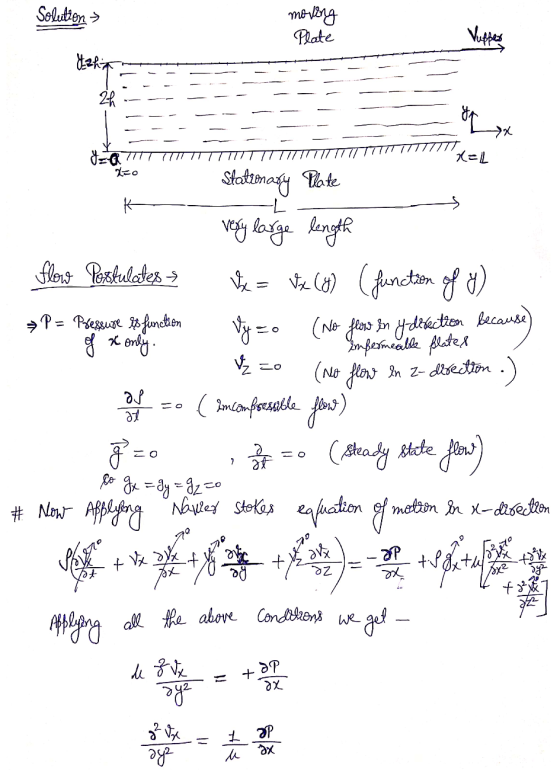
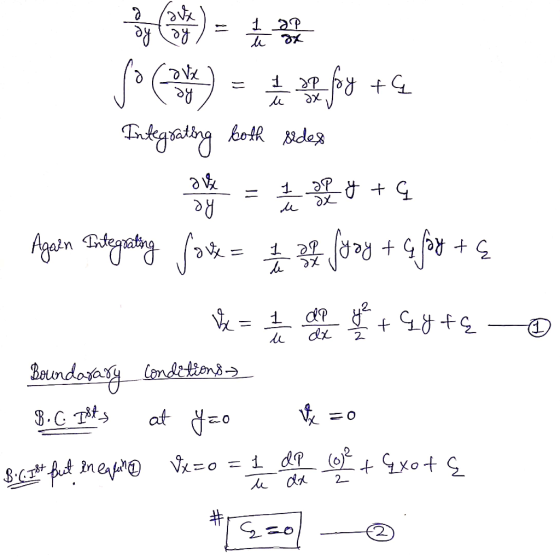
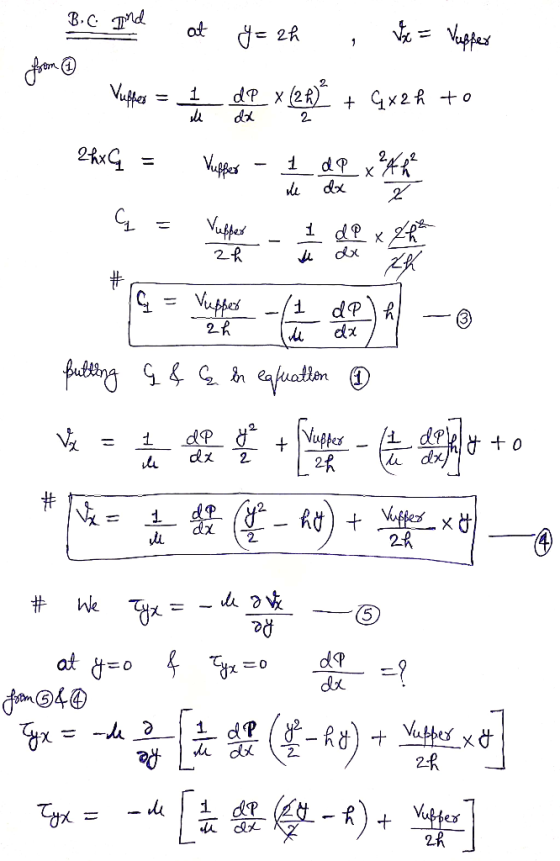
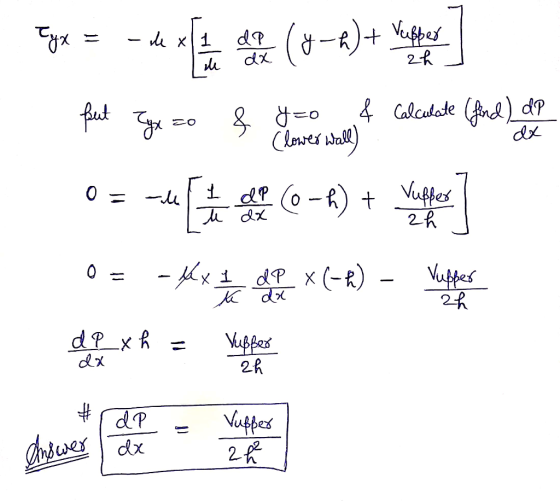
Determine from Navier-Stroke equation the velocity profile Couette flow with a constant pressure gradient dp/dx. Couette flow is a laminar flow between parallel plates, one of the plates is at rest while other is moving at a constant velocity U. The separation between the plates is h.
please solve (va20) for me thanks!! :) V VISCOUS FLOWS Page 38 nar flow between two infinite plates a distance h apart driven by a pressure gra- Va20. For lami dient, the velocity profile is [constan...
 please solve (va20) for me thanks!! :)
V VISCOUS FLOWS Page 38 nar flow between two infinite plates a distance h apart driven by a pressure gra- Va20. For lami dient, the velocity profile is [constant] [linear] [parabolic] [hyperbolic] [elliptic] [error func- tion], and the flow rate Q is proportional to h to the power is driven by the top plate moving at a speed U in the absence of any pressure gradient, the velocity profile is [constant] linearl Iparabolic]...
please solve (va20) for me thanks!! :)
V VISCOUS FLOWS Page 38 nar flow between two infinite plates a distance h apart driven by a pressure gra- Va20. For lami dient, the velocity profile is [constant] [linear] [parabolic] [hyperbolic] [elliptic] [error func- tion], and the flow rate Q is proportional to h to the power is driven by the top plate moving at a speed U in the absence of any pressure gradient, the velocity profile is [constant] linearl Iparabolic]...
Consider the case of a Newtonian fluid undergoing laminar, pressure-driven flow between two parallel, infinite flat...
 Consider the case of a Newtonian fluid undergoing laminar, pressure-driven flow between two parallel, infinite flat plates separated by a distance B (Figure). The bottom plate is stationary and the top plate moves at a constant velocity Vup. For a constant dynamic pressure gradient, AP/AX, P-p-g r, we wish to calculate the resulting velocity profile. 9--(%) + mai Differentiation equation: B.C.v. (y=0) -0,vxly - B) - Vu Figure 1.10 Pressure-driven flow between two infinite, parallel, flat plates. (i) () Use...
For viscous flow between two plates. The lower plate is fixed and the upper plate moves...
For viscous flow between two plates. The lower plate is fixed and the upper plate moves with velocity u0 . If there is no pressure what would the velocity profile look like and explain why?
P.2 Fluid flows steadily between two infinitely large plates separated by a distance of h, as...
 P.2 Fluid flows steadily between two infinitely large plates separated by a distance of h, as shown below. Flow is driven by a pressure gradient in the x-direction, with the pressure decreasing from left to right. Both plates are held still. a) Find and plot the velocity profile between the plates, and b) determine the force per unit area (F/A) exerted by the fluid onto the plates (magnitude and direction). Hint: Find the magnitude of the shear stress at the...
Please attempt the FULL QUESTION Question 4 For pressure-driven laminar flow between two horizontal infinite parallel...
 Please attempt the FULL QUESTION
Question 4 For pressure-driven laminar flow between two horizontal infinite parallel plates separated by a distance 2h, the velocity components are: v = 0 where U is the centreline velocity and the x-axis is located at the centreline. Assume steady, fully developed and incompressible laminar flow. For the problem above, obtain the final form of the energy equation after applying the given assumptions. (10 marks) b) Identify the fluid temperature distribution T(y), for a constant...
Please attempt the FULL QUESTION
Question 4 For pressure-driven laminar flow between two horizontal infinite parallel plates separated by a distance 2h, the velocity components are: v = 0 where U is the centreline velocity and the x-axis is located at the centreline. Assume steady, fully developed and incompressible laminar flow. For the problem above, obtain the final form of the energy equation after applying the given assumptions. (10 marks) b) Identify the fluid temperature distribution T(y), for a constant...
A laminar flow of constant density and constant viscosity at steady state flows thought the two...
 A laminar flow of constant density and constant viscosity at steady state flows thought the two flat and parallel infinite plate. The upper plate is mowing while lower plate is stationary. The flow upper plate: moving is driven by the pressure gradient in the x direction. The velocity profile is desired to be derived for this system. Then - What are the correct answers? 20 lower plate: stationary ay c) PS, 0 200 b- Write the equation to find out...
help b) Laminar viscous flow between two parallel plates are shown in the figure below. Both...
 help
b) Laminar viscous flow between two parallel plates are shown in the figure below. Both bottom plate and top plate moving in the same direction, their velocities are U6,U respectively and they are not equal to each other. Assume that pressure gradient between point A and point B is zero. By using Navier Stokes equations find the shear stress distribution and velocity profile for that fluiği. Plot both velocity profile and shear distribution. (Show assumptions that you make and...
help
b) Laminar viscous flow between two parallel plates are shown in the figure below. Both bottom plate and top plate moving in the same direction, their velocities are U6,U respectively and they are not equal to each other. Assume that pressure gradient between point A and point B is zero. By using Navier Stokes equations find the shear stress distribution and velocity profile for that fluiği. Plot both velocity profile and shear distribution. (Show assumptions that you make and...
please help?? b) Laminar viscous flow between two parallel plates are shown in the figure below....
 please help??
b) Laminar viscous flow between two parallel plates are shown in the figure below. Both bottom plate and top plate moving in the same direction, their velocities are Un,Ut respectively and they are not equal to each other. Assume that pressure gradient between point A and point B is zero. By using Navier Stokes equations find the shear stress distribution and velocity profile for that fluid. Plot both velocity profile and shear distribution. (Show assumptions that you make...
please help??
b) Laminar viscous flow between two parallel plates are shown in the figure below. Both bottom plate and top plate moving in the same direction, their velocities are Un,Ut respectively and they are not equal to each other. Assume that pressure gradient between point A and point B is zero. By using Navier Stokes equations find the shear stress distribution and velocity profile for that fluid. Plot both velocity profile and shear distribution. (Show assumptions that you make...
Problem 1: Differential Relations for a Fluid Particle (25 points) Two horizontal, infinite, parallel plates are...
 Problem 1: Differential Relations for a Fluid Particle (25 points) Two horizontal, infinite, parallel plates are spaced a distance b apart. A viscous liquid is contained between the plates. The bottom plate is fixed, and the upper plate moves parallel to the bottom plate with a velocity U. Assume no-slip boundary conditions. There is no pressure gradient in the direction of flow (a) Demonstrate using the Navier-Stokes equation in the x-direction that the velocity profile is of the form: (15...
 please solve (va20) for me thanks!! :)
V VISCOUS FLOWS Page 38 nar flow between two infinite plates a distance h apart driven by a pressure gra- Va20. For lami dient, the velocity profile is [constant] [linear] [parabolic] [hyperbolic] [elliptic] [error func- tion], and the flow rate Q is proportional to h to the power is driven by the top plate moving at a speed U in the absence of any pressure gradient, the velocity profile is [constant] linearl Iparabolic]...
please solve (va20) for me thanks!! :)
V VISCOUS FLOWS Page 38 nar flow between two infinite plates a distance h apart driven by a pressure gra- Va20. For lami dient, the velocity profile is [constant] [linear] [parabolic] [hyperbolic] [elliptic] [error func- tion], and the flow rate Q is proportional to h to the power is driven by the top plate moving at a speed U in the absence of any pressure gradient, the velocity profile is [constant] linearl Iparabolic]...
 Consider the case of a Newtonian fluid undergoing laminar, pressure-driven flow between two parallel, infinite flat plates separated by a distance B (Figure). The bottom plate is stationary and the top plate moves at a constant velocity Vup. For a constant dynamic pressure gradient, AP/AX, P-p-g r, we wish to calculate the resulting velocity profile. 9--(%) + mai Differentiation equation: B.C.v. (y=0) -0,vxly - B) - Vu Figure 1.10 Pressure-driven flow between two infinite, parallel, flat plates. (i) () Use...
 P.2 Fluid flows steadily between two infinitely large plates separated by a distance of h, as shown below. Flow is driven by a pressure gradient in the x-direction, with the pressure decreasing from left to right. Both plates are held still. a) Find and plot the velocity profile between the plates, and b) determine the force per unit area (F/A) exerted by the fluid onto the plates (magnitude and direction). Hint: Find the magnitude of the shear stress at the...
 Please attempt the FULL QUESTION
Question 4 For pressure-driven laminar flow between two horizontal infinite parallel plates separated by a distance 2h, the velocity components are: v = 0 where U is the centreline velocity and the x-axis is located at the centreline. Assume steady, fully developed and incompressible laminar flow. For the problem above, obtain the final form of the energy equation after applying the given assumptions. (10 marks) b) Identify the fluid temperature distribution T(y), for a constant...
Please attempt the FULL QUESTION
Question 4 For pressure-driven laminar flow between two horizontal infinite parallel plates separated by a distance 2h, the velocity components are: v = 0 where U is the centreline velocity and the x-axis is located at the centreline. Assume steady, fully developed and incompressible laminar flow. For the problem above, obtain the final form of the energy equation after applying the given assumptions. (10 marks) b) Identify the fluid temperature distribution T(y), for a constant...
 A laminar flow of constant density and constant viscosity at steady state flows thought the two flat and parallel infinite plate. The upper plate is mowing while lower plate is stationary. The flow upper plate: moving is driven by the pressure gradient in the x direction. The velocity profile is desired to be derived for this system. Then - What are the correct answers? 20 lower plate: stationary ay c) PS, 0 200 b- Write the equation to find out...
 help
b) Laminar viscous flow between two parallel plates are shown in the figure below. Both bottom plate and top plate moving in the same direction, their velocities are U6,U respectively and they are not equal to each other. Assume that pressure gradient between point A and point B is zero. By using Navier Stokes equations find the shear stress distribution and velocity profile for that fluiği. Plot both velocity profile and shear distribution. (Show assumptions that you make and...
help
b) Laminar viscous flow between two parallel plates are shown in the figure below. Both bottom plate and top plate moving in the same direction, their velocities are U6,U respectively and they are not equal to each other. Assume that pressure gradient between point A and point B is zero. By using Navier Stokes equations find the shear stress distribution and velocity profile for that fluiği. Plot both velocity profile and shear distribution. (Show assumptions that you make and...
 please help??
b) Laminar viscous flow between two parallel plates are shown in the figure below. Both bottom plate and top plate moving in the same direction, their velocities are Un,Ut respectively and they are not equal to each other. Assume that pressure gradient between point A and point B is zero. By using Navier Stokes equations find the shear stress distribution and velocity profile for that fluid. Plot both velocity profile and shear distribution. (Show assumptions that you make...
please help??
b) Laminar viscous flow between two parallel plates are shown in the figure below. Both bottom plate and top plate moving in the same direction, their velocities are Un,Ut respectively and they are not equal to each other. Assume that pressure gradient between point A and point B is zero. By using Navier Stokes equations find the shear stress distribution and velocity profile for that fluid. Plot both velocity profile and shear distribution. (Show assumptions that you make...
 Problem 1: Differential Relations for a Fluid Particle (25 points) Two horizontal, infinite, parallel plates are spaced a distance b apart. A viscous liquid is contained between the plates. The bottom plate is fixed, and the upper plate moves parallel to the bottom plate with a velocity U. Assume no-slip boundary conditions. There is no pressure gradient in the direction of flow (a) Demonstrate using the Navier-Stokes equation in the x-direction that the velocity profile is of the form: (15...
Most questions answered within 3 hours.
-
Where is the error in this code sequence?
String s1 = "Hello";
String s2 = "ello";...
asked 10 months ago -
Financial data for Joel de Paris, Inc., for last year
follow:
Joel de Paris, Inc.
Balance...
asked 10 months ago -
Consider this reaction:
Al2(SO4)3 (aq)+ BaCl3
(aq) Al2Cl6 (aq)- +
3BaSO4(s) . What is the...
asked 10 months ago -
Suppose that Savneet is considering increasing her
recent random sample from 20 car rentals to 40...
asked 10 months ago -
Trucks arrive at an unloading terminal at an average rate of 120
per hour.
Trucks arrive...
asked 10 months ago -
Why are methanol and ethanol completely soluble in water while
octanol is not very little soluble....
asked 10 months ago -
A facilities manager at a university reads in a research report
that the mean amount of...
asked 10 months ago -
When the CuSO4 is rehydrated by adding water to the anhydrous
compound, is this an endothermic...
asked 10 months ago -
A ray of sunlight is passing from diamond into crown glass; the
angle of incidence is...
asked 10 months ago -
A block of mass 0.249 kg is placed on top of a light, vertical
spring of...
asked 10 months ago -
how do the kidneys compensate in the presences of acidosis
a) trigger hyperventilate
b) reserve acid...
asked 10 months ago -
Question 501 pts
The rental rate of capital to the firm increases. Which of the
following...
asked 10 months ago