
Homework Answers
Add Answer to:
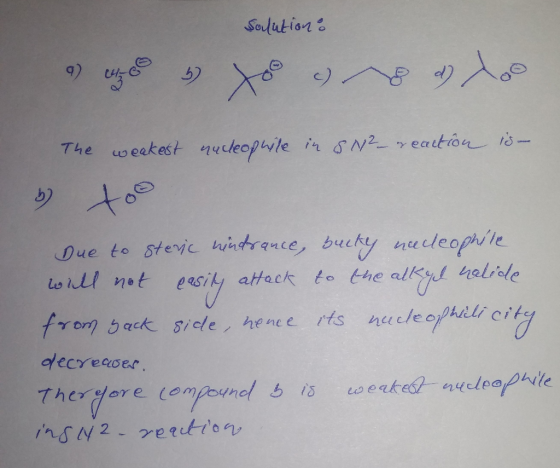
Which of the following is the weakest nucleophile in SN2 reaction,
other favorable factors kept constant?...
Arrange the following species in order of increasing nucleophile strength in an SN2 reaction. H: CH3NHCH3OH...
 Arrange the following species in order of increasing nucleophile strength in an SN2 reaction. H: CH3NHCH3OH a. (Weakest nucleophile) H:1- < CH3OH < CH3NH- (Strongest Nucleophile) C b. (Weakest nucleophile) CH3NH1- < CH3OH < H:1- (Strongest Nucleophile) (Weakest nucleophile) CH3OH <H:1- < CH3NHL- (Strongest Nucleophile) d. (Weakest nucleophile) CH3NH1 <H:1- < CH3OH (Strongest Nucleophile) e. (Weakest nucleophile) H:1- < CH3NH1- < CH3OH (Strongest Nucleophile) (Weakest nucleophile) CH3OH < CH3NH2- < H:1- (Strongest Nucleophile) f.
(S)-3-Chlorooctane m DMSO S SN2 Factors Nucleophile Strength Leaving Group Solvent d) Cla . NaBrº DMSO...
 (S)-3-Chlorooctane m DMSO S SN2 Factors Nucleophile Strength Leaving Group Solvent d) Cla . NaBrº DMSO Syl SN2 Factors Nucleophile Strength Leaving Group Solvent SN1 and SN2 Reactions 1. For each of the following reactions • Provide a complete detailed mechanism and predict the products. Indicate if the reaction proceeds via a Snl or Sn2 mechanism • Include the specific stereochemistry where appropriate.
In the SN2 reaction, the unstable arrangement of atoms in which both the nucleophile and the...
In the SN2 reaction, the unstable arrangement of atoms in which both the nucleophile and the leaving group are partially bonded to the same carbon atom is called the
For the following SN2 reaction, draw the organic and inorganic products of the reaction, and identify the nucleophile
 For the following SN2 reaction, draw the organic and inorganic
products of the reaction, and identify the nucleophile, substrate,
and leaving group. Include wedge/dash bonds and H on a
stereocenter.Select the statement that property identifies the nucleophile, substrate, and leaving group. Cl- is the substrate. CH3CH(CH2)2CH3Cl is the nucleophile, and CN- is the leaving group. CH3CH(CH2)2CH3Cl is the substrate. CN- is the nucleophile. and Cl- is the leaving group. CN- is the substrate. Cl- is the nucleophile, and CH3CH(CH2)2CH3Cl is...
For the following SN2 reaction, draw the organic and inorganic
products of the reaction, and identify the nucleophile, substrate,
and leaving group. Include wedge/dash bonds and H on a
stereocenter.Select the statement that property identifies the nucleophile, substrate, and leaving group. Cl- is the substrate. CH3CH(CH2)2CH3Cl is the nucleophile, and CN- is the leaving group. CH3CH(CH2)2CH3Cl is the substrate. CN- is the nucleophile. and Cl- is the leaving group. CN- is the substrate. Cl- is the nucleophile, and CH3CH(CH2)2CH3Cl is...
For the following SN2 reaction, draw the organic and inorganic products of the reaction, and identify the nucleophile, substrate, and leaving group.
 For the following SN2 reaction, draw the organic and inorganic
products of the reaction, and identify the nucleophile, substrate,
and leaving group.Select the statement that properly identifies the nucleophile, substrate, and leaving group.
For the following SN2 reaction, draw the organic and inorganic
products of the reaction, and identify the nucleophile, substrate,
and leaving group.Select the statement that properly identifies the nucleophile, substrate, and leaving group.
For the following SN2 reaction, draw the organic and inorganic products of the reaction, and identify the nucleophile, substrate, and leaving group.
 For the following SN2 reaction, draw the organic and inorganic products of the reaction, and identify the nucleophile, substrate, and leaving group. Select the statement that properly identifies the nucleophile, substrate, and leaving group.
For the following SN2 reaction, draw the organic and inorganic products of the reaction, and identify the nucleophile, substrate, and leaving group.
 For the following SN2 reaction, draw the organic and inorganic products of the reaction, and identify the nucleophile, substrate, and leaving group. Include wedge/dash bonds and H on a stereocenter. Select the statement that properly identifies the nucleophile, substrate, and leaving group.
If you desire to perform a "clean" E2 reaction, which of the following factors helps avoid...
If you desire to perform a "clean" E2 reaction, which of the following factors helps avoid competition with SN2 mechanism? a. use of a polar solvent b. use of a hindered bulky base c. use of a good nucleophile d. use of a good leaving group Alcohol dehydration is mechanistically an: a. SN2 reaction b. E2 reaction c. E1 reaction d. SN1 reaction
3. Circle the best nucleophile for the SN2 reaction. NACEN Nal NaOCH; NASH Question 1: There...
 3. Circle the best nucleophile for the SN2 reaction. NACEN Nal NaOCH; NASH Question 1: There are two characteristics that make a good nucleophile for the SN2 reaction. What are they? Characteristic #1: Characteristic #2: Question 2: Why is the nucleophile you chose the best one? Although you don't have to rank the nucleophiles, you will need to address why the other nucleophiles aren't good in order to make a case for the one you chose.
Arrange the following species in order of increasing nucleophile strength in an S N^ 2 reaction...
 Arrange the following species in order of increasing
nucleophile strength in an S N^ 2 reaction
Arrange the following species in order of increasing nucleophile strength in an S2 reaction. H:'-, CH3NH!-, CH3OH a. (Weakest nucleophile) H:1- < CH3NH!- < CH3OH (Strongest Nucleophile) b. (Weakest nucleophile) H:1- < CH3OH < CH3NH'- (Strongest Nucleophile) d. ((Weakest nucleophile) CH3NH- < CH3OH <H:- (Strongest Nucleophile) (Weakest nucleophile) CH3OH < H:- < CH3NH1- (Strongest Nucleophile) e. (Weakest nucleophile) CH3OH < CH3NH - < H:'-...
Arrange the following species in order of increasing
nucleophile strength in an S N^ 2 reaction
Arrange the following species in order of increasing nucleophile strength in an S2 reaction. H:'-, CH3NH!-, CH3OH a. (Weakest nucleophile) H:1- < CH3NH!- < CH3OH (Strongest Nucleophile) b. (Weakest nucleophile) H:1- < CH3OH < CH3NH'- (Strongest Nucleophile) d. ((Weakest nucleophile) CH3NH- < CH3OH <H:- (Strongest Nucleophile) (Weakest nucleophile) CH3OH < H:- < CH3NH1- (Strongest Nucleophile) e. (Weakest nucleophile) CH3OH < CH3NH - < H:'-...
 Arrange the following species in order of increasing nucleophile strength in an SN2 reaction. H: CH3NHCH3OH a. (Weakest nucleophile) H:1- < CH3OH < CH3NH- (Strongest Nucleophile) C b. (Weakest nucleophile) CH3NH1- < CH3OH < H:1- (Strongest Nucleophile) (Weakest nucleophile) CH3OH <H:1- < CH3NHL- (Strongest Nucleophile) d. (Weakest nucleophile) CH3NH1 <H:1- < CH3OH (Strongest Nucleophile) e. (Weakest nucleophile) H:1- < CH3NH1- < CH3OH (Strongest Nucleophile) (Weakest nucleophile) CH3OH < CH3NH2- < H:1- (Strongest Nucleophile) f.
 (S)-3-Chlorooctane m DMSO S SN2 Factors Nucleophile Strength Leaving Group Solvent d) Cla . NaBrº DMSO Syl SN2 Factors Nucleophile Strength Leaving Group Solvent SN1 and SN2 Reactions 1. For each of the following reactions • Provide a complete detailed mechanism and predict the products. Indicate if the reaction proceeds via a Snl or Sn2 mechanism • Include the specific stereochemistry where appropriate.
 For the following SN2 reaction, draw the organic and inorganic
products of the reaction, and identify the nucleophile, substrate,
and leaving group. Include wedge/dash bonds and H on a
stereocenter.Select the statement that property identifies the nucleophile, substrate, and leaving group. Cl- is the substrate. CH3CH(CH2)2CH3Cl is the nucleophile, and CN- is the leaving group. CH3CH(CH2)2CH3Cl is the substrate. CN- is the nucleophile. and Cl- is the leaving group. CN- is the substrate. Cl- is the nucleophile, and CH3CH(CH2)2CH3Cl is...
For the following SN2 reaction, draw the organic and inorganic
products of the reaction, and identify the nucleophile, substrate,
and leaving group. Include wedge/dash bonds and H on a
stereocenter.Select the statement that property identifies the nucleophile, substrate, and leaving group. Cl- is the substrate. CH3CH(CH2)2CH3Cl is the nucleophile, and CN- is the leaving group. CH3CH(CH2)2CH3Cl is the substrate. CN- is the nucleophile. and Cl- is the leaving group. CN- is the substrate. Cl- is the nucleophile, and CH3CH(CH2)2CH3Cl is...
 3. Circle the best nucleophile for the SN2 reaction. NACEN Nal NaOCH; NASH Question 1: There are two characteristics that make a good nucleophile for the SN2 reaction. What are they? Characteristic #1: Characteristic #2: Question 2: Why is the nucleophile you chose the best one? Although you don't have to rank the nucleophiles, you will need to address why the other nucleophiles aren't good in order to make a case for the one you chose.
 Arrange the following species in order of increasing
nucleophile strength in an S N^ 2 reaction
Arrange the following species in order of increasing nucleophile strength in an S2 reaction. H:'-, CH3NH!-, CH3OH a. (Weakest nucleophile) H:1- < CH3NH!- < CH3OH (Strongest Nucleophile) b. (Weakest nucleophile) H:1- < CH3OH < CH3NH'- (Strongest Nucleophile) d. ((Weakest nucleophile) CH3NH- < CH3OH <H:- (Strongest Nucleophile) (Weakest nucleophile) CH3OH < H:- < CH3NH1- (Strongest Nucleophile) e. (Weakest nucleophile) CH3OH < CH3NH - < H:'-...
Arrange the following species in order of increasing
nucleophile strength in an S N^ 2 reaction
Arrange the following species in order of increasing nucleophile strength in an S2 reaction. H:'-, CH3NH!-, CH3OH a. (Weakest nucleophile) H:1- < CH3NH!- < CH3OH (Strongest Nucleophile) b. (Weakest nucleophile) H:1- < CH3OH < CH3NH'- (Strongest Nucleophile) d. ((Weakest nucleophile) CH3NH- < CH3OH <H:- (Strongest Nucleophile) (Weakest nucleophile) CH3OH < H:- < CH3NH1- (Strongest Nucleophile) e. (Weakest nucleophile) CH3OH < CH3NH - < H:'-...
Most questions answered within 3 hours.
-
Where is the error in this code sequence?
String s1 = "Hello";
String s2 = "ello";...
asked 11 months ago -
Financial data for Joel de Paris, Inc., for last year
follow:
Joel de Paris, Inc.
Balance...
asked 11 months ago -
Consider this reaction:
Al2(SO4)3 (aq)+ BaCl3
(aq) Al2Cl6 (aq)- +
3BaSO4(s) . What is the...
asked 11 months ago -
Suppose that Savneet is considering increasing her
recent random sample from 20 car rentals to 40...
asked 11 months ago -
Trucks arrive at an unloading terminal at an average rate of 120
per hour.
Trucks arrive...
asked 11 months ago -
Why are methanol and ethanol completely soluble in water while
octanol is not very little soluble....
asked 11 months ago -
A facilities manager at a university reads in a research report
that the mean amount of...
asked 11 months ago -
When the CuSO4 is rehydrated by adding water to the anhydrous
compound, is this an endothermic...
asked 11 months ago -
A ray of sunlight is passing from diamond into crown glass; the
angle of incidence is...
asked 11 months ago -
A block of mass 0.249 kg is placed on top of a light, vertical
spring of...
asked 11 months ago -
how do the kidneys compensate in the presences of acidosis
a) trigger hyperventilate
b) reserve acid...
asked 11 months ago -
Question 501 pts
The rental rate of capital to the firm increases. Which of the
following...
asked 11 months ago