
Homework Answers
 HOPE IT HELPS
Add Answer to:
Dilute H, SO, solutie Red 21/ 04) . " HD) Consider the electrochemical cell shown in...
3. Consider the following electrochemical cell. Standard reduction potentials are given on the next page. Tl(s)...
3. Consider the following electrochemical cell. Standard reduction potentials are given on the next page. Tl(s) | Tl+(aq, 0.50 mol L−1) || H+(aq, x mol L−1) | H2(g, 1 atm) | Pt(s) The concentration of H+ is unknown and the pressure of H2 is kept constant at 1 atm. The cell voltage is initially measured as 0.139 V, with the Pt | H2 | H+ half-cell acting as the cathode. (a) (6 marks) Write out the oxidation and reduction half...
8) An electrochemical cell consists of a Pt|H+(aq,1.00 M)|H2(g) cathode connected to a Pt|H+(aq)|...
8) An electrochemical cell consists of a Pt|H+(aq,1.00 M)|H2(g) cathode connected to a Pt|H+(aq)|H2(g) anode in which the H+concentration is that of a buffer consisting of a weak acid, HA(0.115 M), mixed with its conjugate base, A-(0.192 M). The measured cell voltage is E°cell = 0.168 V at 25 °C, with PH2 = 1.00 atm at both electrodes. Calculate the pH in the buffer solution and the Ka of the weak acid. pH = Ka =
An electrochemical cell consists of a Pt|H+(aq,1.00 M)|H2(g) cathode connected to a Pt|H+(aq)|H2(g) anode in which...
An electrochemical cell consists of a Pt|H+(aq,1.00 M)|H2(g) cathode connected to a Pt|H+(aq)|H2(g) anode in which the H+ concentration is that of a buffer consisting of a weak acid, HA(0.160 M), mixed with its conjugate base, A-(0.120 M). The measured cell voltage is E°cell = 0.228 V at 25 °C, with PH2 = 1.00 atm at both electrodes. Calculate the pH in the buffer solution and the Ka of the weak acid. pH = Ka =
An electrochemical cell consists of a Pt|H+(aq,1.00 M)|H2(g) cathode connected to a Pt|H+(aq)|H2(g) anode in which...
An electrochemical cell consists of a Pt|H+(aq,1.00 M)|H2(g) cathode connected to a Pt|H+(aq)|H2(g) anode in which the H+ concentration is that of a buffer consisting of a weak acid, HA(0.136 M), mixed with its conjugate base, A-(0.142 M). The measured cell voltage is E°cell = 0.196 V at 25 °C, with PH2 = 1.00 atm at both electrodes. Calculate the pH in the buffer solution and the Ka of the weak acid. pH = _______ Ka = _______
H aq H g anode An electrochemical cell consists of a H aq 1 .00 M H g) cat ode connected to a which e H concentration a ofa u er cons nu of a weak acid HA(0.116 M), mixed with its conjugate base, A (...
 H aq H g anode An electrochemical cell consists of a H aq 1 .00 M H g) cat ode connected to a which e H concentration a ofa u er cons nu of a weak acid HA(0.116 M), mixed with its conjugate base, A (0.143 M). The measured cell voltage is E°ell 0.163 V at 25 °C, with PH2-1.00 atm at both electrodes. Calculate the pH in the buffer solution and the K of the weak acid. Ka
H...
H aq H g anode An electrochemical cell consists of a H aq 1 .00 M H g) cat ode connected to a which e H concentration a ofa u er cons nu of a weak acid HA(0.116 M), mixed with its conjugate base, A (0.143 M). The measured cell voltage is E°ell 0.163 V at 25 °C, with PH2-1.00 atm at both electrodes. Calculate the pH in the buffer solution and the K of the weak acid. Ka
H...
meter Zn Ag Consider the electrochemical cell shown above. When the red wire from the voltmeter...
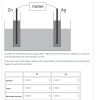 meter Zn Ag Consider the electrochemical cell shown above. When the red wire from the voltmeter is connected to the Ag electrode, the meter displays +1.59 V Choose the correct descriptions below of the characteristics of each electrode and the reactions that happen to each metal electrode. Zn Ag polarity [Select ] Select [ Select ] Select name electrode reaction Select ] [Select]
given this electrochemical cell: Concentration of H+ is unknown, Pressure of H2 is constant at 1...
 given this electrochemical cell:
Concentration of H+ is unknown, Pressure of H2 is constant at 1
atm. Initial cell voltage is 0.139V, with the Pt | H2 | H+
half-cell acting as the cathode.
a) write out the oxidization and reduction half reactions, and
the overall chemical reaction occurring, and find the initial pH in
the H+ | H2 | Pt cell
b) What is the equilibrium constant of the reaction happening in
the cell?
Tl(s) | Tl*(aq, 0.50 mol...
given this electrochemical cell:
Concentration of H+ is unknown, Pressure of H2 is constant at 1
atm. Initial cell voltage is 0.139V, with the Pt | H2 | H+
half-cell acting as the cathode.
a) write out the oxidization and reduction half reactions, and
the overall chemical reaction occurring, and find the initial pH in
the H+ | H2 | Pt cell
b) What is the equilibrium constant of the reaction happening in
the cell?
Tl(s) | Tl*(aq, 0.50 mol...
need help with the rest of the table EXPERIMENT 10 DETERMINATION OF THE ELECTROCHEMICAL SERIES PURPOSE...
 need help with the rest of the table
EXPERIMENT 10 DETERMINATION OF THE ELECTROCHEMICAL SERIES PURPOSE To determine the standard cell potential values of several electrochemical coll INTRODUCTION The basis for an electrochemical cell is an oxidation reduction Corredor be divided into two half reactions reaction. This reaction can Oxidation half reaction Gloss of electrons) takes place at the anode, which is the positive electrode that the anions migrate to Chence the name anode) Reduction half reaction (gain of electrons)...
need help with the rest of the table
EXPERIMENT 10 DETERMINATION OF THE ELECTROCHEMICAL SERIES PURPOSE To determine the standard cell potential values of several electrochemical coll INTRODUCTION The basis for an electrochemical cell is an oxidation reduction Corredor be divided into two half reactions reaction. This reaction can Oxidation half reaction Gloss of electrons) takes place at the anode, which is the positive electrode that the anions migrate to Chence the name anode) Reduction half reaction (gain of electrons)...
5. What was the purpose of the NaNO3 solution in this experiment? 6. Could a solution...
 5. What was the purpose of the NaNO3 solution in this experiment? 6. Could a solution of NaCl be used instead of NaNO3? 7. What was the purpose of FeSO4 solution in this experiment? 8. Could a solution of FeCl, be used instead of FeSO4? 9. Could a solution of NaSO4 be used instead of FeSO4? 10. Calculate the standard cell potential for the spontaneous redox reaction between a Pb(s)/Pb(NO3)2(aq) half-cell and a Ag(s)/AgNO3(aq) half-cell. Which metal would be oxidized?...
A chemistry teacher needs to make 2.30 L of a potassium chloride solution for an experimen...
 A chemistry teacher needs to make 2.30 L of a potassium chloride solution for an experimen The concentration of the required solution is 3.10 M. How many grams of KCI will she need to use? 0 7.13 g KCI 0 231 g KCI O 532 g KCI 0.0956 g KCI What is the equation for the ion product constant of water at 25 °C? Kw [H,0+][OH-] [H,O] = 1.00 x 10⁻¹⁴ Kw [H,0+1 [OH-] = 1.00 x 10⁻¹⁴ Kw =...
 H aq H g anode An electrochemical cell consists of a H aq 1 .00 M H g) cat ode connected to a which e H concentration a ofa u er cons nu of a weak acid HA(0.116 M), mixed with its conjugate base, A (0.143 M). The measured cell voltage is E°ell 0.163 V at 25 °C, with PH2-1.00 atm at both electrodes. Calculate the pH in the buffer solution and the K of the weak acid. Ka
H...
H aq H g anode An electrochemical cell consists of a H aq 1 .00 M H g) cat ode connected to a which e H concentration a ofa u er cons nu of a weak acid HA(0.116 M), mixed with its conjugate base, A (0.143 M). The measured cell voltage is E°ell 0.163 V at 25 °C, with PH2-1.00 atm at both electrodes. Calculate the pH in the buffer solution and the K of the weak acid. Ka
H...
 meter Zn Ag Consider the electrochemical cell shown above. When the red wire from the voltmeter is connected to the Ag electrode, the meter displays +1.59 V Choose the correct descriptions below of the characteristics of each electrode and the reactions that happen to each metal electrode. Zn Ag polarity [Select ] Select [ Select ] Select name electrode reaction Select ] [Select]
 given this electrochemical cell:
Concentration of H+ is unknown, Pressure of H2 is constant at 1
atm. Initial cell voltage is 0.139V, with the Pt | H2 | H+
half-cell acting as the cathode.
a) write out the oxidization and reduction half reactions, and
the overall chemical reaction occurring, and find the initial pH in
the H+ | H2 | Pt cell
b) What is the equilibrium constant of the reaction happening in
the cell?
Tl(s) | Tl*(aq, 0.50 mol...
given this electrochemical cell:
Concentration of H+ is unknown, Pressure of H2 is constant at 1
atm. Initial cell voltage is 0.139V, with the Pt | H2 | H+
half-cell acting as the cathode.
a) write out the oxidization and reduction half reactions, and
the overall chemical reaction occurring, and find the initial pH in
the H+ | H2 | Pt cell
b) What is the equilibrium constant of the reaction happening in
the cell?
Tl(s) | Tl*(aq, 0.50 mol...
 need help with the rest of the table
EXPERIMENT 10 DETERMINATION OF THE ELECTROCHEMICAL SERIES PURPOSE To determine the standard cell potential values of several electrochemical coll INTRODUCTION The basis for an electrochemical cell is an oxidation reduction Corredor be divided into two half reactions reaction. This reaction can Oxidation half reaction Gloss of electrons) takes place at the anode, which is the positive electrode that the anions migrate to Chence the name anode) Reduction half reaction (gain of electrons)...
need help with the rest of the table
EXPERIMENT 10 DETERMINATION OF THE ELECTROCHEMICAL SERIES PURPOSE To determine the standard cell potential values of several electrochemical coll INTRODUCTION The basis for an electrochemical cell is an oxidation reduction Corredor be divided into two half reactions reaction. This reaction can Oxidation half reaction Gloss of electrons) takes place at the anode, which is the positive electrode that the anions migrate to Chence the name anode) Reduction half reaction (gain of electrons)...
 5. What was the purpose of the NaNO3 solution in this experiment? 6. Could a solution of NaCl be used instead of NaNO3? 7. What was the purpose of FeSO4 solution in this experiment? 8. Could a solution of FeCl, be used instead of FeSO4? 9. Could a solution of NaSO4 be used instead of FeSO4? 10. Calculate the standard cell potential for the spontaneous redox reaction between a Pb(s)/Pb(NO3)2(aq) half-cell and a Ag(s)/AgNO3(aq) half-cell. Which metal would be oxidized?...
 A chemistry teacher needs to make 2.30 L of a potassium chloride solution for an experimen The concentration of the required solution is 3.10 M. How many grams of KCI will she need to use? 0 7.13 g KCI 0 231 g KCI O 532 g KCI 0.0956 g KCI What is the equation for the ion product constant of water at 25 °C? Kw [H,0+][OH-] [H,O] = 1.00 x 10⁻¹⁴ Kw [H,0+1 [OH-] = 1.00 x 10⁻¹⁴ Kw =...
Most questions answered within 3 hours.
-
Where is the error in this code sequence?
String s1 = "Hello";
String s2 = "ello";...
asked 10 months ago -
Financial data for Joel de Paris, Inc., for last year
follow:
Joel de Paris, Inc.
Balance...
asked 10 months ago -
Consider this reaction:
Al2(SO4)3 (aq)+ BaCl3
(aq) Al2Cl6 (aq)- +
3BaSO4(s) . What is the...
asked 10 months ago -
Suppose that Savneet is considering increasing her
recent random sample from 20 car rentals to 40...
asked 10 months ago -
Trucks arrive at an unloading terminal at an average rate of 120
per hour.
Trucks arrive...
asked 10 months ago -
Why are methanol and ethanol completely soluble in water while
octanol is not very little soluble....
asked 10 months ago -
A facilities manager at a university reads in a research report
that the mean amount of...
asked 10 months ago -
When the CuSO4 is rehydrated by adding water to the anhydrous
compound, is this an endothermic...
asked 10 months ago -
A ray of sunlight is passing from diamond into crown glass; the
angle of incidence is...
asked 10 months ago -
A block of mass 0.249 kg is placed on top of a light, vertical
spring of...
asked 10 months ago -
how do the kidneys compensate in the presences of acidosis
a) trigger hyperventilate
b) reserve acid...
asked 10 months ago -
Question 501 pts
The rental rate of capital to the firm increases. Which of the
following...
asked 10 months ago