
Homework Answers

Add Answer to:
2. The nickel in a 0.3824 g sample of an ore is precipitated with dimethylglyoxime. If...
The nickel in a 0.3824 g sample of an ore is precipitated with dimethylglyoxime. If the...
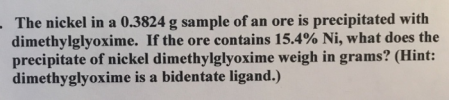 The nickel in a 0.3824 g sample of an ore is precipitated with dimethylglyoxime. If the ore contains 15.4% Ni, what does the precipitate of nickel dimethylglyoxime weigh in grams? (Hint: dimethyglyoxime is a bidentate ligand.)
10) How many mL of dimethylglyoxime at 2.15% by weight in alcohol should be used to...
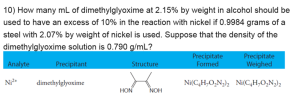 10) How many mL of dimethylglyoxime at 2.15% by weight in alcohol should be used to have an excess of 10% in the reaction with nickel if 0.9984 grams of a steel with 2.07% by weight of nickel is used. Suppose that the density of the dimethylglyoxime solution is 0.790 g/mL? Precipitate Formed Precipitate Weighed Analyte Precipitant Structure Ni2 Ni(C4H2O2N2)2 Ni(C4H2O2N2)2 dimethylglyoxime HON NOH
hexahydrate 3. A lab student analyzed her nickel-en complex for ethylenediamine, en, content. A 0.579 g...
 hexahydrate 3. A lab student analyzed her nickel-en complex for ethylenediamine, en, content. A 0.579 g sample of the synthesized Ni-en complex was dissolved in about 50 mL of water and titrated with 0.181 M HCl (ag). Endpoint required 38.02 mL of the HCl (ag). What is the mass (in grams) of en in the Ni-en complex analyzed? a. 0.153 g b. 0.207 g c. 0.413 g d. 0.104 g e. 0.199 g 4. Continuing on with the analysis of...
1. A certain ore is 24.6% nickel by mass. How many kilograms of this ore would...
1. A certain ore is 24.6% nickel by mass. How many kilograms of this ore would you need to dig up to have 15.0 g of nickel? 2. How many grams of salt are needed to make 613 g of saltwater that is 31.5% salt by mass?
A 5.000 gram sample of hydrated nickel (II) cyanide, Ni(CN)2·xH2O is heated according to the procedure...
A 5.000 gram sample of hydrated nickel (II) cyanide, Ni(CN)2·xH2O is heated according to the procedure described in this laboratory. After heating, the sample is found to weigh 3.029 grams. How many moles of H2O were present in the sample? How many moles of Ni(CN)2 were present?
A solid sample of a complex salt, with ideal composition Ni(NH3)6(NO3)2, was analyzed for nickel by...
 A solid sample of a complex salt, with ideal composition
Ni(NH3)6(NO3)2, was
analyzed for nickel by dissolution in slightly acidic solution and
precipitation as the dimethylglyoximate, Ni(DMG)2.
A sintered glass crucible of mass 13.2379 g was used to filter
off the precipitate. The dried crucible and precipitate had a
combined mass of 13.3319 g.
Calculate the theoretical mass of the original
Ni(NH3)6(NO3)2
sample.
0.0927 g
You are correct.
Your receipt no. is 152-9832
Previous Tries
Calculate the mass of nickel...
A solid sample of a complex salt, with ideal composition
Ni(NH3)6(NO3)2, was
analyzed for nickel by dissolution in slightly acidic solution and
precipitation as the dimethylglyoximate, Ni(DMG)2.
A sintered glass crucible of mass 13.2379 g was used to filter
off the precipitate. The dried crucible and precipitate had a
combined mass of 13.3319 g.
Calculate the theoretical mass of the original
Ni(NH3)6(NO3)2
sample.
0.0927 g
You are correct.
Your receipt no. is 152-9832
Previous Tries
Calculate the mass of nickel...
Question 2 (5 marks) A nickel ore contains the following valuable and gangue minerals: Valuable minerals:...
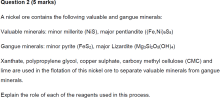 Question 2 (5 marks) A nickel ore contains the following valuable and gangue minerals: Valuable minerals: minor millerite (NiS), major pentlandite (Fe,Ni)Ss) Gangue minerals: minor pyrite (FeS2), major Lizardite (MgsSi2Os(OH)) Xanthate, polypropylene glycol, copper sulphate, carboxy methyl cellulose (CMC) and lime are used in the flotation of this nickel ore to separate valuable minerals from gangue minerals. Explain the role of each of the reagents used in this process.
1. A 5.000 gram sample of hydrated nickel (II) cyanide, Ni(CN)2·xH2O is heated according to the...
1. A 5.000 gram sample of hydrated nickel (II) cyanide, Ni(CN)2·xH2O is heated according to the procedure described in this laboratory. After heating, the sample is found to weigh 3.029 grams. How many moles of H2O were present in the sample? How many moles of Ni(CN)2 were present? 2. Determine the empirical formula of the hydrated salt from question 1. Write your answer in the format, Ni(CN)2∙ x H2O, where “x” is an integer.
A sample weighing 2.40g contains an unknown amount of nickel (II) nitrate. The sample was heated...
A sample weighing 2.40g contains an unknown amount of nickel (II) nitrate. The sample was heated and the following reaction occurred: 2Ni (NO3) 2 (s) 2NiO (s) + 4NO2 (g) + O2 (g) What is the percentage of nickel (II) nitrate in the sample if 265ml of gas was formed at 160oC and 1.0 atmosphere pressure? The rest of the substance in the sample does not emit gas upon heating. (Hint: Use Table and Formula Collection).
A 10.00 mL sample of an unknown aqueous nickel(II) solution (density = 1.00 to produce 0.0532...
 A 10.00 mL sample of an unknown aqueous nickel(II) solution (density = 1.00 to produce 0.0532 g of Ni(DMG)2 (Molar Mass=288.9155g/mol) precipitate. aqueous nickel(II) solution (density = 1.00 g/mL) was treated and found of nickel in the unknown solution. olar Mass - 288.9755e/molnrecinitate. Calculate the mass percentage
 The nickel in a 0.3824 g sample of an ore is precipitated with dimethylglyoxime. If the ore contains 15.4% Ni, what does the precipitate of nickel dimethylglyoxime weigh in grams? (Hint: dimethyglyoxime is a bidentate ligand.)
 10) How many mL of dimethylglyoxime at 2.15% by weight in alcohol should be used to have an excess of 10% in the reaction with nickel if 0.9984 grams of a steel with 2.07% by weight of nickel is used. Suppose that the density of the dimethylglyoxime solution is 0.790 g/mL? Precipitate Formed Precipitate Weighed Analyte Precipitant Structure Ni2 Ni(C4H2O2N2)2 Ni(C4H2O2N2)2 dimethylglyoxime HON NOH
 hexahydrate 3. A lab student analyzed her nickel-en complex for ethylenediamine, en, content. A 0.579 g sample of the synthesized Ni-en complex was dissolved in about 50 mL of water and titrated with 0.181 M HCl (ag). Endpoint required 38.02 mL of the HCl (ag). What is the mass (in grams) of en in the Ni-en complex analyzed? a. 0.153 g b. 0.207 g c. 0.413 g d. 0.104 g e. 0.199 g 4. Continuing on with the analysis of...
 Question 2 (5 marks) A nickel ore contains the following valuable and gangue minerals: Valuable minerals: minor millerite (NiS), major pentlandite (Fe,Ni)Ss) Gangue minerals: minor pyrite (FeS2), major Lizardite (MgsSi2Os(OH)) Xanthate, polypropylene glycol, copper sulphate, carboxy methyl cellulose (CMC) and lime are used in the flotation of this nickel ore to separate valuable minerals from gangue minerals. Explain the role of each of the reagents used in this process.
 A 10.00 mL sample of an unknown aqueous nickel(II) solution (density = 1.00 to produce 0.0532 g of Ni(DMG)2 (Molar Mass=288.9155g/mol) precipitate. aqueous nickel(II) solution (density = 1.00 g/mL) was treated and found of nickel in the unknown solution. olar Mass - 288.9755e/molnrecinitate. Calculate the mass percentage
Most questions answered within 3 hours.
-
Where is the error in this code sequence?
String s1 = "Hello";
String s2 = "ello";...
asked 11 months ago -
Financial data for Joel de Paris, Inc., for last year
follow:
Joel de Paris, Inc.
Balance...
asked 11 months ago -
Consider this reaction:
Al2(SO4)3 (aq)+ BaCl3
(aq) Al2Cl6 (aq)- +
3BaSO4(s) . What is the...
asked 11 months ago -
Suppose that Savneet is considering increasing her
recent random sample from 20 car rentals to 40...
asked 11 months ago -
Trucks arrive at an unloading terminal at an average rate of 120
per hour.
Trucks arrive...
asked 11 months ago -
Why are methanol and ethanol completely soluble in water while
octanol is not very little soluble....
asked 11 months ago -
A facilities manager at a university reads in a research report
that the mean amount of...
asked 11 months ago -
When the CuSO4 is rehydrated by adding water to the anhydrous
compound, is this an endothermic...
asked 11 months ago -
A ray of sunlight is passing from diamond into crown glass; the
angle of incidence is...
asked 11 months ago -
A block of mass 0.249 kg is placed on top of a light, vertical
spring of...
asked 11 months ago -
how do the kidneys compensate in the presences of acidosis
a) trigger hyperventilate
b) reserve acid...
asked 11 months ago -
Question 501 pts
The rental rate of capital to the firm increases. Which of the
following...
asked 11 months ago