
Homework Answers
 kindly
give rating
kindly
give ratingAdd Answer to:
D Question 5 2 pts Jack is pushing Jill on a sled, total mass 25 kg....
QUESTION ? 1 poi A child on a sled (total mass-35k) is pushed by another child...
 QUESTION ? 1 poi A child on a sled (total mass-35k) is pushed by another child along a horizontal surface at a constant velocity. The pushing force has a magnitude 463 N which is applied at 8 = 26 90 angle as shown above. Frictional force is also present. Draw a free-body diagram for the child-sled system and determine the normal force in N with 3 significant figures Acceleration due to gravity - 9.30 m QUESTIONS A child on a...
Question: At one instant, a 17.5-kg sled is moving over a horizontal surface of snow at...
Question: At one instant, a 17.5-kg sled is moving over a horizontal surface of snow at 3.50 m/s. After 8.75 s has elapsed, the sled stops. Use a momentum approach to find the average friction force acting on the sled while it was moving. Please check my work. If it is incorrect please provide detail. Sled mass (m) = 17.5kg moving over a horizontal surface initial velocity of (U) = 3.5 m/s Initial momentum of the sledge (P1)=mU (P1)=(17.5kg)(3.50 m/s)...
A light rope(negligable mass) is used to pull a 4.8 kg sled up a 25° slope....
A light rope(negligable mass) is used to pull a 4.8 kg sled up a 25° slope. If the rope is kept parallel to the slope, and there is a constant frictional force of 120 N, what force must be applied to the rope to accelerate the sled at a rate of 2.5 m/s^2?
A sled with mass 30 kg slides 40 m down a hill angled at 20 degrees...
A sled with mass 30 kg slides 40 m down a hill angled at 20 degrees to the horizontal. The coefficient of friction between the sled and the ground is 0.2. a) How much work does gravity do on the sled? b) How much work does the normal force do on the sled? c) How much work does friction do on the sled? d) What is the net work done on the sled e) if the sled begins at rest...
QUESTION 3 A 60-kg (including the passenger) sled is subject to a net force of 20...
 QUESTION 3 A 60-kg (including the passenger) sled is subject to a net force of 20 N pushing in the direction of the sled's motion as it is moving over a horizontal surface for a distance of 11 m after having started from rest. At this point the sled is released as it starts down a 10.0" incline. However, the snow is not very deep, and the sled stops after having moved an additional 35 m. What is the work...
Question 2 (5 points) A child on a sled (total mass 75 kg) coasts over a...
 Question 2 (5 points) A child on a sled (total mass 75 kg) coasts over a small hill in the snow at a speed of 3.5 m/s. The top of the hill can be modeled as a circle of radius 4.1 m. The coefficient of kinetic friction between the sled and the snow is 0.12 What friction force is exerted on the sled by the snow as the child goes over the hill? 27 N 88N 61N 740 N 120...
QUESTION 1 Two skaters, one of mass 80 kg, the other of mass 40 kg, are...
 QUESTION 1 Two skaters, one of mass 80 kg, the other of mass 40 kg, are standing next to each other on frictionless ice rink. The 40 kg skater pushes the 80 kg skater. After the push, the 80 kg skater is going at 1 m/s. How fast and in what direction is the 40 kg skater going after the push? (HINT: use the fact that since there are no external forces, the velocity of the center of mass of...
3a. Jill has a mass of 50 kg and rides her 5 kg bicycle up a...
3a. Jill has a mass of 50 kg and rides her 5 kg bicycle up a 20% grade at 4.5 m/s. Cd = 0.9; A = 0.25m2; p = 1.2 kg/m3. Assume there is no rolling resistance. What is her mechanical power output? How fast can Jill ride on level-ground?
Canvas Ā 10.5 pts D Question 2 An object with a mass of 10 kg lies...
 Canvas Ā 10.5 pts D Question 2 An object with a mass of 10 kg lies is moving on a horizontal surface with a coefficient of kinetic friction of 0.74. A force of 9 Nis applied to it downwards, perpendicular to the surface, a force of 4 N is applied to it in the -x direction, and a force of which is variable given by F(x) = 2xN/m2.4 x N/m. The mass moves from x = 0 to x =...
Question 6 7 pts A mass of 5 kg is moving across a frictionless surface at...
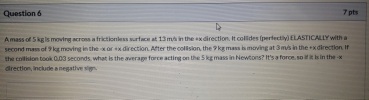 Question 6 7 pts A mass of 5 kg is moving across a frictionless surface at 13 m/s in the +x direction. It collides (perfectly) ELASTICALLY with a second mass of 9 kg moving in the -x or +x direction. After the collision, the 9 kg mass is moving at 3 m/s in the +x direction. If the collision took 0.03 seconds, what is the average force acting on the 5 kg mass in Newtons? It's a force, so if...
 QUESTION ? 1 poi A child on a sled (total mass-35k) is pushed by another child along a horizontal surface at a constant velocity. The pushing force has a magnitude 463 N which is applied at 8 = 26 90 angle as shown above. Frictional force is also present. Draw a free-body diagram for the child-sled system and determine the normal force in N with 3 significant figures Acceleration due to gravity - 9.30 m QUESTIONS A child on a...
 QUESTION 3 A 60-kg (including the passenger) sled is subject to a net force of 20 N pushing in the direction of the sled's motion as it is moving over a horizontal surface for a distance of 11 m after having started from rest. At this point the sled is released as it starts down a 10.0" incline. However, the snow is not very deep, and the sled stops after having moved an additional 35 m. What is the work...
 Question 2 (5 points) A child on a sled (total mass 75 kg) coasts over a small hill in the snow at a speed of 3.5 m/s. The top of the hill can be modeled as a circle of radius 4.1 m. The coefficient of kinetic friction between the sled and the snow is 0.12 What friction force is exerted on the sled by the snow as the child goes over the hill? 27 N 88N 61N 740 N 120...
 QUESTION 1 Two skaters, one of mass 80 kg, the other of mass 40 kg, are standing next to each other on frictionless ice rink. The 40 kg skater pushes the 80 kg skater. After the push, the 80 kg skater is going at 1 m/s. How fast and in what direction is the 40 kg skater going after the push? (HINT: use the fact that since there are no external forces, the velocity of the center of mass of...
 Canvas Ā 10.5 pts D Question 2 An object with a mass of 10 kg lies is moving on a horizontal surface with a coefficient of kinetic friction of 0.74. A force of 9 Nis applied to it downwards, perpendicular to the surface, a force of 4 N is applied to it in the -x direction, and a force of which is variable given by F(x) = 2xN/m2.4 x N/m. The mass moves from x = 0 to x =...
 Question 6 7 pts A mass of 5 kg is moving across a frictionless surface at 13 m/s in the +x direction. It collides (perfectly) ELASTICALLY with a second mass of 9 kg moving in the -x or +x direction. After the collision, the 9 kg mass is moving at 3 m/s in the +x direction. If the collision took 0.03 seconds, what is the average force acting on the 5 kg mass in Newtons? It's a force, so if...
Most questions answered within 3 hours.
-
Where is the error in this code sequence?
String s1 = "Hello";
String s2 = "ello";...
asked 10 months ago -
Financial data for Joel de Paris, Inc., for last year
follow:
Joel de Paris, Inc.
Balance...
asked 10 months ago -
Consider this reaction:
Al2(SO4)3 (aq)+ BaCl3
(aq) Al2Cl6 (aq)- +
3BaSO4(s) . What is the...
asked 10 months ago -
Suppose that Savneet is considering increasing her
recent random sample from 20 car rentals to 40...
asked 10 months ago -
Trucks arrive at an unloading terminal at an average rate of 120
per hour.
Trucks arrive...
asked 10 months ago -
Why are methanol and ethanol completely soluble in water while
octanol is not very little soluble....
asked 10 months ago -
A facilities manager at a university reads in a research report
that the mean amount of...
asked 10 months ago -
When the CuSO4 is rehydrated by adding water to the anhydrous
compound, is this an endothermic...
asked 10 months ago -
A ray of sunlight is passing from diamond into crown glass; the
angle of incidence is...
asked 10 months ago -
A block of mass 0.249 kg is placed on top of a light, vertical
spring of...
asked 10 months ago -
how do the kidneys compensate in the presences of acidosis
a) trigger hyperventilate
b) reserve acid...
asked 10 months ago -
Question 501 pts
The rental rate of capital to the firm increases. Which of the
following...
asked 10 months ago