
Homework Answers
Add Answer to:
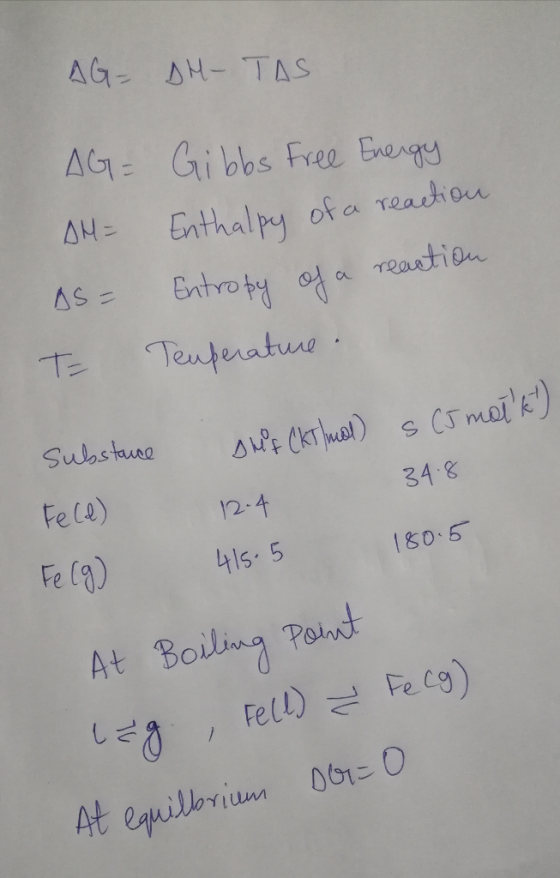
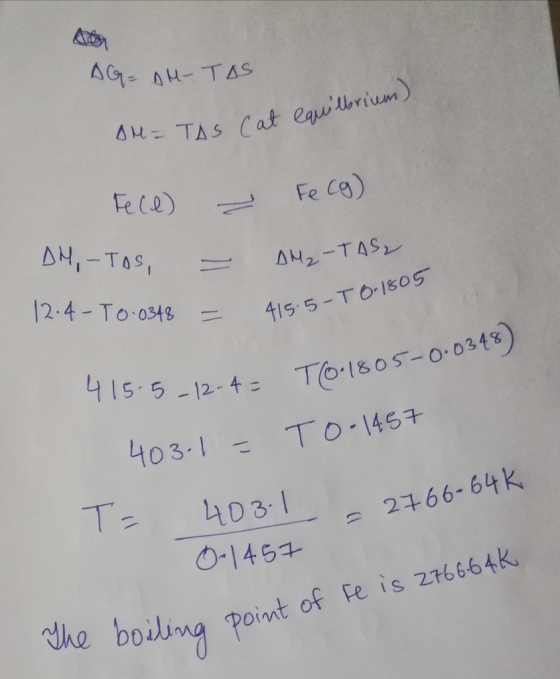
sure to include the decimal ) S*(J mork 34.8 180.5 (kannol) Substance Fe () 12.4 415.5...
Using the Thermodynamic Data table and the following data, determine S° (in J/K) for Fe(CO)5(g). Fe(s)...
Using the Thermodynamic Data table and the following data, determine S° (in J/K) for Fe(CO)5(g). Fe(s) + 5 CO(g) → Fe(CO)5(g) ΔS° = ? Fe(CO)5(l) → Fe(CO)5(g) ΔS° = 101 J/K Fe(s) + 5 CO(g) → Fe(CO)5(l) ΔS° = −679 J/K I already added the 101 and -679 together but it's saying incorrect.
Consider the reaction: FeO (s) + Fe (s) + O_2 (g) rightarrow Fe_2O_3 (s) Given the...
 Consider the reaction: FeO (s) + Fe (s) + O_2 (g) rightarrow Fe_2O_3 (s) Given the following table of thermodynamic data, Substance Delta H_f degree S degree FeO (S) -271.9 kJ/mol 60.75 J/mol - K Fe (s) 0 27.15 O_2 (g) 0 205.0 Fe_2O_3 (S) -822.16 89.96 determine the temperature (in degree C) above which the reaction is nonspontaneous.
Consider the reaction: FeO (s) + Fe (s) + O2(g) → Fe2O3 (s) Given the following...
Consider the reaction: FeO (s) + Fe (s) + O2(g) → Fe2O3 (s) Given the following table of thermodynamic data at 298 K: Substance ΔHf° (kJ/mol) S° (J/K⋅mol) FeO (s) -271.9 60.75 Fe (s) 0 27.15 O2 (g) 0 205.0 Fe2O3 (s) -822.16 89.96 The value K for the reaction at 25 °C is ________. A.370 B.7.1 x 1085 C.3.8 x 10-14 D.5.9 x 104 E.8.1 x 1019
When Fe(s) reacts with Ch() according to the following reaction, 400 J of energy are evolved...
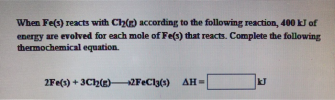 When Fe(s) reacts with Ch() according to the following reaction, 400 J of energy are evolved for each mole of Fe(s) that reacts. Complete the following thermochemical equation 2Fe(s)+3Che)2FeCl3(3) AH= C H
→ Fe(s) + CO2(g), AGº is - 5.8 kJ and AH° is -11 kJ. Sº (J...
 → Fe(s) + CO2(g), AGº is - 5.8 kJ and AH° is -11 kJ. Sº (J mol-? K-'); 4. For the reaction Fe(s) + CO(g) Fe (27.3), CO(197.5), CO (213.7) a) What is AS sur? [37 JK-'] b) Use AG to determine whether the reaction is spontaneous or nonspontaneous under standard conditions. Explain. c) Use AS univ to determine whether the reaction is spontaneous or nonspontaneous under standard conditions. Explain. d) What is Sº for FeO? [61 J mol-'K-']
Consider the following unbalanced equation. H1+(aq) + Fe(s) H2(g) + Fe2+(aq) (a) What are the following...
 Consider the following
unbalanced
equation.
H1+(aq) + Fe(s) H2(g)
+ Fe2+(aq)
(a) What are the following standard voltages? Include the sign.
Change the sign as appropriate. Use the standard reduction
potentials in these
Reference Tables.
Enter the number of decimal places allowed by the data in the
table.
standard oxidation potential for the oxidation half-cell
V
reduction potential for the reduction half-cell
V
potential for the entire cell
V
(b)
Select all that apply for the reaction under standard
conditions....
Consider the following
unbalanced
equation.
H1+(aq) + Fe(s) H2(g)
+ Fe2+(aq)
(a) What are the following standard voltages? Include the sign.
Change the sign as appropriate. Use the standard reduction
potentials in these
Reference Tables.
Enter the number of decimal places allowed by the data in the
table.
standard oxidation potential for the oxidation half-cell
V
reduction potential for the reduction half-cell
V
potential for the entire cell
V
(b)
Select all that apply for the reaction under standard
conditions....
Calculate ΔS° for the reaction 4Cr(s) + 3O2(g) → 2Cr2O3(s) Substance: Cr(s) O2(g) Cr2O3(s) S°(J/K·mol): 24.56...
Calculate ΔS° for the reaction 4Cr(s) + 3O2(g) → 2Cr2O3(s) Substance: Cr(s) O2(g) Cr2O3(s) S°(J/K·mol): 24.56 206.14 82.0
For the reaction Fe(s) + 2HCI(aq)FeCl2(s) + H2(g) ΔΗο--7.4 kJ and ΔS°-107.9 J/K The standard free...
 For the reaction Fe(s) + 2HCI(aq)FeCl2(s) + H2(g) ΔΗο--7.4 kJ and ΔS°-107.9 J/K The standard free energy change for the reaction of 2.11 moles of Fe(s) at 278 K, 1 atm would be -37.4kJ This reaction is (reactant, product) -78.9 favored under standard conditions at 278 K Assume that Δ Ho and Δ are independent of temperature. For the reaction N2(g) + O2(g)2 NO(g) Δσ 172.7 kJ and ΔS°-24.9 J/K at 318 K and 1 atm. This reaction is (reactant,...
If the number is a decimal please include 4 digits past the decimal point if available....
 If the number is a decimal
please include 4 digits past the decimal point if available.
1. -12 points PSE6 4.P.002. My Notes A golf ball is hit off a tee at the edge of a cliff. Its x and y coordinates as functions of time are given by the following expressions. x (20.0 m/s)t y (4.90 m/s)t -(4.76 m/s2)t2 (a) Write a vector expression for the ball's position as a function of time, using the unit vectors i and...
If the number is a decimal
please include 4 digits past the decimal point if available.
1. -12 points PSE6 4.P.002. My Notes A golf ball is hit off a tee at the edge of a cliff. Its x and y coordinates as functions of time are given by the following expressions. x (20.0 m/s)t y (4.90 m/s)t -(4.76 m/s2)t2 (a) Write a vector expression for the ball's position as a function of time, using the unit vectors i and...
Write a balanced net ionic equation (include physical states) for the following reaction: Fe(NO3)3(aq) + LiOH(aq) → LiNO3(aq) + Fe(OH)3(s)
Write a balanced net ionic equation (include physical states) for the following reaction:Fe(NO3)3(aq) + LiOH(aq) → LiNO3(aq) + Fe(OH)3(s)
 Consider the reaction: FeO (s) + Fe (s) + O_2 (g) rightarrow Fe_2O_3 (s) Given the following table of thermodynamic data, Substance Delta H_f degree S degree FeO (S) -271.9 kJ/mol 60.75 J/mol - K Fe (s) 0 27.15 O_2 (g) 0 205.0 Fe_2O_3 (S) -822.16 89.96 determine the temperature (in degree C) above which the reaction is nonspontaneous.
 When Fe(s) reacts with Ch() according to the following reaction, 400 J of energy are evolved for each mole of Fe(s) that reacts. Complete the following thermochemical equation 2Fe(s)+3Che)2FeCl3(3) AH= C H
 → Fe(s) + CO2(g), AGº is - 5.8 kJ and AH° is -11 kJ. Sº (J mol-? K-'); 4. For the reaction Fe(s) + CO(g) Fe (27.3), CO(197.5), CO (213.7) a) What is AS sur? [37 JK-'] b) Use AG to determine whether the reaction is spontaneous or nonspontaneous under standard conditions. Explain. c) Use AS univ to determine whether the reaction is spontaneous or nonspontaneous under standard conditions. Explain. d) What is Sº for FeO? [61 J mol-'K-']
 Consider the following
unbalanced
equation.
H1+(aq) + Fe(s) H2(g)
+ Fe2+(aq)
(a) What are the following standard voltages? Include the sign.
Change the sign as appropriate. Use the standard reduction
potentials in these
Reference Tables.
Enter the number of decimal places allowed by the data in the
table.
standard oxidation potential for the oxidation half-cell
V
reduction potential for the reduction half-cell
V
potential for the entire cell
V
(b)
Select all that apply for the reaction under standard
conditions....
Consider the following
unbalanced
equation.
H1+(aq) + Fe(s) H2(g)
+ Fe2+(aq)
(a) What are the following standard voltages? Include the sign.
Change the sign as appropriate. Use the standard reduction
potentials in these
Reference Tables.
Enter the number of decimal places allowed by the data in the
table.
standard oxidation potential for the oxidation half-cell
V
reduction potential for the reduction half-cell
V
potential for the entire cell
V
(b)
Select all that apply for the reaction under standard
conditions....
 For the reaction Fe(s) + 2HCI(aq)FeCl2(s) + H2(g) ΔΗο--7.4 kJ and ΔS°-107.9 J/K The standard free energy change for the reaction of 2.11 moles of Fe(s) at 278 K, 1 atm would be -37.4kJ This reaction is (reactant, product) -78.9 favored under standard conditions at 278 K Assume that Δ Ho and Δ are independent of temperature. For the reaction N2(g) + O2(g)2 NO(g) Δσ 172.7 kJ and ΔS°-24.9 J/K at 318 K and 1 atm. This reaction is (reactant,...
 If the number is a decimal
please include 4 digits past the decimal point if available.
1. -12 points PSE6 4.P.002. My Notes A golf ball is hit off a tee at the edge of a cliff. Its x and y coordinates as functions of time are given by the following expressions. x (20.0 m/s)t y (4.90 m/s)t -(4.76 m/s2)t2 (a) Write a vector expression for the ball's position as a function of time, using the unit vectors i and...
If the number is a decimal
please include 4 digits past the decimal point if available.
1. -12 points PSE6 4.P.002. My Notes A golf ball is hit off a tee at the edge of a cliff. Its x and y coordinates as functions of time are given by the following expressions. x (20.0 m/s)t y (4.90 m/s)t -(4.76 m/s2)t2 (a) Write a vector expression for the ball's position as a function of time, using the unit vectors i and...
Most questions answered within 3 hours.
-
Where is the error in this code sequence?
String s1 = "Hello";
String s2 = "ello";...
asked 10 months ago -
Financial data for Joel de Paris, Inc., for last year
follow:
Joel de Paris, Inc.
Balance...
asked 10 months ago -
Consider this reaction:
Al2(SO4)3 (aq)+ BaCl3
(aq) Al2Cl6 (aq)- +
3BaSO4(s) . What is the...
asked 10 months ago -
Suppose that Savneet is considering increasing her
recent random sample from 20 car rentals to 40...
asked 10 months ago -
Trucks arrive at an unloading terminal at an average rate of 120
per hour.
Trucks arrive...
asked 10 months ago -
Why are methanol and ethanol completely soluble in water while
octanol is not very little soluble....
asked 10 months ago -
A facilities manager at a university reads in a research report
that the mean amount of...
asked 10 months ago -
When the CuSO4 is rehydrated by adding water to the anhydrous
compound, is this an endothermic...
asked 10 months ago -
A ray of sunlight is passing from diamond into crown glass; the
angle of incidence is...
asked 10 months ago -
A block of mass 0.249 kg is placed on top of a light, vertical
spring of...
asked 10 months ago -
how do the kidneys compensate in the presences of acidosis
a) trigger hyperventilate
b) reserve acid...
asked 10 months ago -
Question 501 pts
The rental rate of capital to the firm increases. Which of the
following...
asked 10 months ago