
Homework Answers
Add Answer to:
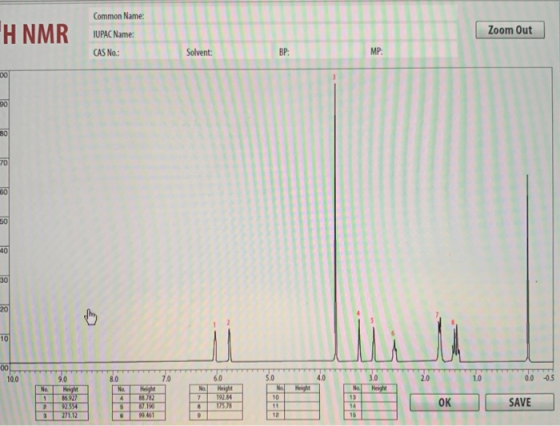
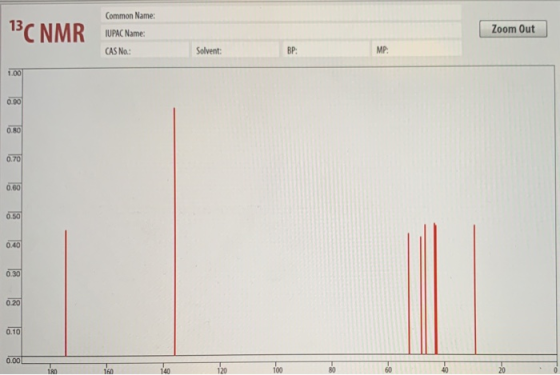
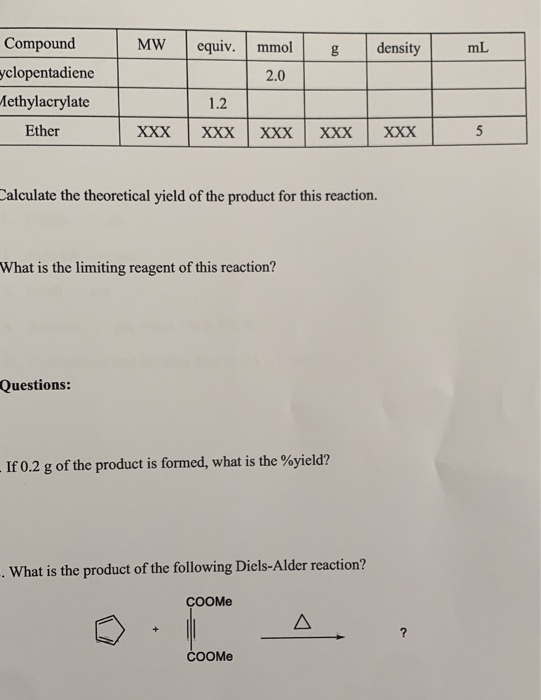
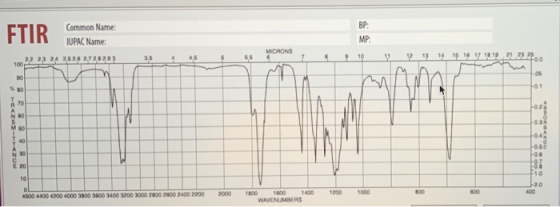
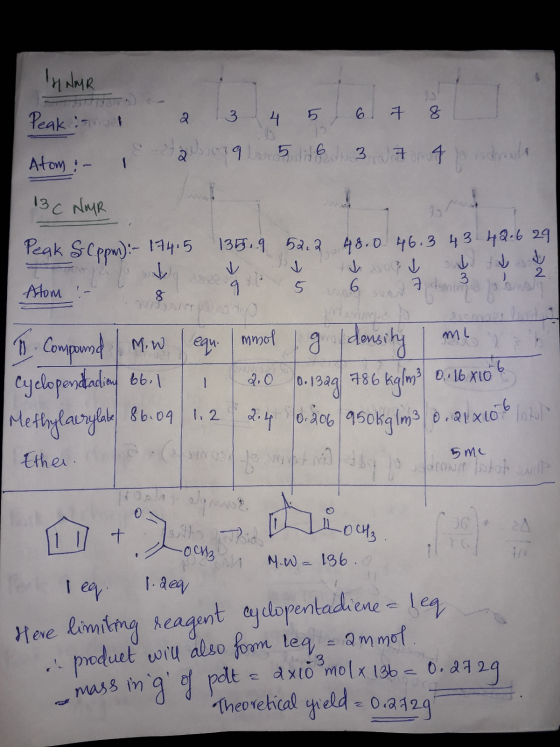
Interprate the given spectra for
bicyclo(2.2.1)hept-5-ene-2-carboxylic acid methyl ester, fill out
the table and answer the...
Using the data provided below. Fill out the tables regarding the FTIR and NMR Spectra for...
 Using the data provided below. Fill out the tables regarding the
FTIR and NMR Spectra for 2-methyl-2-ethoxypropane.
FTIR and NMR Spectra After completing a reaction and working up the products, it is still necessary to confirm that the correct product was formed. The most common tools used for this analysis are Fourier Transform Infrared (FTIR) and Nuclear Magnetic Resonance (NMR) spectroscopy. In the virtual laboratory, 'H and ''C NMR spectra are available. Details on interpreting FTIR and NMR spectra are...
Using the data provided below. Fill out the tables regarding the
FTIR and NMR Spectra for 2-methyl-2-ethoxypropane.
FTIR and NMR Spectra After completing a reaction and working up the products, it is still necessary to confirm that the correct product was formed. The most common tools used for this analysis are Fourier Transform Infrared (FTIR) and Nuclear Magnetic Resonance (NMR) spectroscopy. In the virtual laboratory, 'H and ''C NMR spectra are available. Details on interpreting FTIR and NMR spectra are...
Please do 5 and 6 with given spectra FTIR and NMR Spectra After completing a reaction...
 Please do 5 and 6 with given spectra
FTIR and NMR Spectra After completing a reaction and working up the products, it is still necessary to confirm that the correct product was formed. The most common tools used for this analysis are Fourier Transform Infrared (FTIR) and Nuclear Magnetic Resonance (NMR) spectroscopy. In the virtual laboratory, 'H and C NMR spectra are available. Details on interpreting FTIR and NMR spectra are found in your textbook. Your instructor may or may...
Please do 5 and 6 with given spectra
FTIR and NMR Spectra After completing a reaction and working up the products, it is still necessary to confirm that the correct product was formed. The most common tools used for this analysis are Fourier Transform Infrared (FTIR) and Nuclear Magnetic Resonance (NMR) spectroscopy. In the virtual laboratory, 'H and C NMR spectra are available. Details on interpreting FTIR and NMR spectra are found in your textbook. Your instructor may or may...
synthesize of 3,3-dimethyl-1,2-epoxybutan Identify the relevant peaks in the FTIR spectrum and record the position and...
 synthesize of 3,3-dimethyl-1,2-epoxybutan
Identify the relevant peaks in the FTIR spectrum and
record the position and associated functional group for each in the
FTIR table below:
Identify all of the peaks in the NMR spectrum and record
the chemical shift, the splitting, and the number of hydrogens for
each peak in the NMR table below:
Do the FTIR and NMR spectra you measured and recorded in
the tables above confirm that you synthesized the assigned target
compound? Explain
BP: FTIR...
synthesize of 3,3-dimethyl-1,2-epoxybutan
Identify the relevant peaks in the FTIR spectrum and
record the position and associated functional group for each in the
FTIR table below:
Identify all of the peaks in the NMR spectrum and record
the chemical shift, the splitting, and the number of hydrogens for
each peak in the NMR table below:
Do the FTIR and NMR spectra you measured and recorded in
the tables above confirm that you synthesized the assigned target
compound? Explain
BP: FTIR...
Please interpret the NMR spectra and fill out the chart: Peak Chemical Shift (δ) Multiplicity† H‡...
 Please interpret the NMR spectra and fill out the chart:
Peak
Chemical Shift (δ)
Multiplicity†
H‡
Peak
Chemical Shift (δ)
Multiplicity†
H‡
1.
7.
2.
8.
3.
9.
4.
10.
5.
11.
6.
12.
Common Name: IUPAC Name CAS No.: Zoom Out ALDR CH Solvent: ВР: MP: 1.00 0.80 0.70 0.60 0.40 0.20 0.10 7.0 6.0 5.0 4.0 3.0 2.0 1.0
Please interpret the NMR spectra and fill out the chart:
Peak
Chemical Shift (δ)
Multiplicity†
H‡
Peak
Chemical Shift (δ)
Multiplicity†
H‡
1.
7.
2.
8.
3.
9.
4.
10.
5.
11.
6.
12.
Common Name: IUPAC Name CAS No.: Zoom Out ALDR CH Solvent: ВР: MP: 1.00 0.80 0.70 0.60 0.40 0.20 0.10 7.0 6.0 5.0 4.0 3.0 2.0 1.0
I need help with questions 5, 6, & 7. The FTIR and NMR is provided. I...
 I need help with questions 5, 6, & 7. The FTIR and NMR is
provided. I also need help creating a reaction mechanism using the
following:
Starting material: 1,7-Dimethyl-heptanedioate
Solvent: Diethyl ether
Reagent: sodium methoxide
Product: 3-oxo-cyclohexane carboxylic acid methyl ester
THANK YOU!!!!!
Ö 11-11: Dieckmann Reaction For this assignment, the target compound that you should synthesize is 2-oxo-cyclohexane carboxylic acid methyl ester.This is an intramolecular carbonyl addition variation. Examine the product and determine which ester is the nucleophile and...
I need help with questions 5, 6, & 7. The FTIR and NMR is
provided. I also need help creating a reaction mechanism using the
following:
Starting material: 1,7-Dimethyl-heptanedioate
Solvent: Diethyl ether
Reagent: sodium methoxide
Product: 3-oxo-cyclohexane carboxylic acid methyl ester
THANK YOU!!!!!
Ö 11-11: Dieckmann Reaction For this assignment, the target compound that you should synthesize is 2-oxo-cyclohexane carboxylic acid methyl ester.This is an intramolecular carbonyl addition variation. Examine the product and determine which ester is the nucleophile and...
1 H NMR 2-METHYL 2- PENTANOL Peak Chemical Shift (δ) Multiplicity† H‡ Peak Chemical...
 1
H NMR
2-METHYL
2- PENTANOL
Peak
Chemical
Shift
(δ)
Multiplicity†
H‡
Peak
Chemical
Shift
(δ)
Multiplicity†
H‡
1
7
2
8
3
9
4
10
5
11
6
12
Specify the multiplicity as a singlet (s), doublet (d),
triplet (t), quartet (q), or multiplet (m).
Specify the number of hydrogens associated with each
peak.
THE TOPIC IS RELATED TO H-NMR AND THE GRAPH IS RELATED TO THAT
ALSO.
THE GRAPH SHOWN ABOVE IS FOR 2-methyl 2-pentanol ....
1
H NMR
2-METHYL
2- PENTANOL
Peak
Chemical
Shift
(δ)
Multiplicity†
H‡
Peak
Chemical
Shift
(δ)
Multiplicity†
H‡
1
7
2
8
3
9
4
10
5
11
6
12
Specify the multiplicity as a singlet (s), doublet (d),
triplet (t), quartet (q), or multiplet (m).
Specify the number of hydrogens associated with each
peak.
THE TOPIC IS RELATED TO H-NMR AND THE GRAPH IS RELATED TO THAT
ALSO.
THE GRAPH SHOWN ABOVE IS FOR 2-methyl 2-pentanol ....
I need help with questions 5, 6, & 7. The FTIR and NMR is provided. I...
 I need help with questions 5,
6, & 7. The FTIR and NMR is provided. I also need help creating
a reaction mechanism using the following:
Starting material: methyl acetate.
Solvent: diethyl ether
Reagent: sodium methoxide
Product: methyl acetoacetate
THANK YOU!!!!!
11-8: Claisen Condensation - 1 For this assignment, the target compound that you should synthesize is methyl acetoacetate.This is another carbonyl addition variation. Examine the product and determine which ester is the nucleophile and which is the electrophile. Keep...
I need help with questions 5,
6, & 7. The FTIR and NMR is provided. I also need help creating
a reaction mechanism using the following:
Starting material: methyl acetate.
Solvent: diethyl ether
Reagent: sodium methoxide
Product: methyl acetoacetate
THANK YOU!!!!!
11-8: Claisen Condensation - 1 For this assignment, the target compound that you should synthesize is methyl acetoacetate.This is another carbonyl addition variation. Examine the product and determine which ester is the nucleophile and which is the electrophile. Keep...
List positions of functional groups for the FTIR and for the NMR the chemical shift, multiplicity...
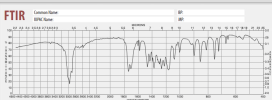 List positions of functional groups for the FTIR and for the NMR
the chemical shift, multiplicity and H. The compound is propanoic
acid, 1,1-dimethylethylester.
Common Name: BP: FTIR JUPAC Name: MP: MICRONS 3.5 4.5 5 100 2,2 2,3 2,4 2,5 2,8 272.02.03 6.5 10 12 13 14 15 16 17 18 19 21 23 25 LILL+0.0 90 4.05 -0.1 %B0 T R 70 N 60 -0.28 S M 50 WA F0.3 R B 140 W -0.4 N N 30 C...
List positions of functional groups for the FTIR and for the NMR
the chemical shift, multiplicity and H. The compound is propanoic
acid, 1,1-dimethylethylester.
Common Name: BP: FTIR JUPAC Name: MP: MICRONS 3.5 4.5 5 100 2,2 2,3 2,4 2,5 2,8 272.02.03 6.5 10 12 13 14 15 16 17 18 19 21 23 25 LILL+0.0 90 4.05 -0.1 %B0 T R 70 N 60 -0.28 S M 50 WA F0.3 R B 140 W -0.4 N N 30 C...
List positions of functional groups for the FTIR and for the NMR the chemical shift, multiplicity...
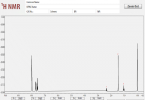 List positions of functional groups for the FTIR and for the NMR
the chemical shift, multiplicity and H. The compound is propanoic
acid, 1,1-dimethylethylester.
Common Name: TH NMR IUPAC Name: Zoom Out CAS No.: Solvent: BP: MP: 1.00 0.90 0.80 0.70 0.60 0.50 0.40 0.30 0.20 0.10 0.00 10.0 8.0 7.0 5.0 4.0 2.0 1.0 0.0 -0.5 9.0 Height 6.0 Height 3.0 Height No. Height Height Common Name: BP: FTIR JUPAC Name: MP: MICRONS 3.5 4.5 5 100 2,2 2,3...
List positions of functional groups for the FTIR and for the NMR
the chemical shift, multiplicity and H. The compound is propanoic
acid, 1,1-dimethylethylester.
Common Name: TH NMR IUPAC Name: Zoom Out CAS No.: Solvent: BP: MP: 1.00 0.90 0.80 0.70 0.60 0.50 0.40 0.30 0.20 0.10 0.00 10.0 8.0 7.0 5.0 4.0 2.0 1.0 0.0 -0.5 9.0 Height 6.0 Height 3.0 Height No. Height Height Common Name: BP: FTIR JUPAC Name: MP: MICRONS 3.5 4.5 5 100 2,2 2,3...
Only need help with 5,6,7 and mechanism FTIR and NMR Spectra After completing a reaction and...
 Only need help with 5,6,7
and mechanism
FTIR and NMR Spectra After completing a reaction and working up the products, it is still necessary to confirm that the correct product was formed. The most common tools used for this analysis are Fourier Transform Infrared (FTIR) and Nuclear Magnetic Resonance (NMR) spectroscopy. In the virtual laboratory, 'H and C NMR spectra are available. Details on interpreting FTIR and NMR spectra are found in your textbook. Your instructor may or may not...
Only need help with 5,6,7
and mechanism
FTIR and NMR Spectra After completing a reaction and working up the products, it is still necessary to confirm that the correct product was formed. The most common tools used for this analysis are Fourier Transform Infrared (FTIR) and Nuclear Magnetic Resonance (NMR) spectroscopy. In the virtual laboratory, 'H and C NMR spectra are available. Details on interpreting FTIR and NMR spectra are found in your textbook. Your instructor may or may not...
 Using the data provided below. Fill out the tables regarding the
FTIR and NMR Spectra for 2-methyl-2-ethoxypropane.
FTIR and NMR Spectra After completing a reaction and working up the products, it is still necessary to confirm that the correct product was formed. The most common tools used for this analysis are Fourier Transform Infrared (FTIR) and Nuclear Magnetic Resonance (NMR) spectroscopy. In the virtual laboratory, 'H and ''C NMR spectra are available. Details on interpreting FTIR and NMR spectra are...
Using the data provided below. Fill out the tables regarding the
FTIR and NMR Spectra for 2-methyl-2-ethoxypropane.
FTIR and NMR Spectra After completing a reaction and working up the products, it is still necessary to confirm that the correct product was formed. The most common tools used for this analysis are Fourier Transform Infrared (FTIR) and Nuclear Magnetic Resonance (NMR) spectroscopy. In the virtual laboratory, 'H and ''C NMR spectra are available. Details on interpreting FTIR and NMR spectra are...
 Please do 5 and 6 with given spectra
FTIR and NMR Spectra After completing a reaction and working up the products, it is still necessary to confirm that the correct product was formed. The most common tools used for this analysis are Fourier Transform Infrared (FTIR) and Nuclear Magnetic Resonance (NMR) spectroscopy. In the virtual laboratory, 'H and C NMR spectra are available. Details on interpreting FTIR and NMR spectra are found in your textbook. Your instructor may or may...
Please do 5 and 6 with given spectra
FTIR and NMR Spectra After completing a reaction and working up the products, it is still necessary to confirm that the correct product was formed. The most common tools used for this analysis are Fourier Transform Infrared (FTIR) and Nuclear Magnetic Resonance (NMR) spectroscopy. In the virtual laboratory, 'H and C NMR spectra are available. Details on interpreting FTIR and NMR spectra are found in your textbook. Your instructor may or may...
 synthesize of 3,3-dimethyl-1,2-epoxybutan
Identify the relevant peaks in the FTIR spectrum and
record the position and associated functional group for each in the
FTIR table below:
Identify all of the peaks in the NMR spectrum and record
the chemical shift, the splitting, and the number of hydrogens for
each peak in the NMR table below:
Do the FTIR and NMR spectra you measured and recorded in
the tables above confirm that you synthesized the assigned target
compound? Explain
BP: FTIR...
synthesize of 3,3-dimethyl-1,2-epoxybutan
Identify the relevant peaks in the FTIR spectrum and
record the position and associated functional group for each in the
FTIR table below:
Identify all of the peaks in the NMR spectrum and record
the chemical shift, the splitting, and the number of hydrogens for
each peak in the NMR table below:
Do the FTIR and NMR spectra you measured and recorded in
the tables above confirm that you synthesized the assigned target
compound? Explain
BP: FTIR...
 Please interpret the NMR spectra and fill out the chart:
Peak
Chemical Shift (δ)
Multiplicity†
H‡
Peak
Chemical Shift (δ)
Multiplicity†
H‡
1.
7.
2.
8.
3.
9.
4.
10.
5.
11.
6.
12.
Common Name: IUPAC Name CAS No.: Zoom Out ALDR CH Solvent: ВР: MP: 1.00 0.80 0.70 0.60 0.40 0.20 0.10 7.0 6.0 5.0 4.0 3.0 2.0 1.0
Please interpret the NMR spectra and fill out the chart:
Peak
Chemical Shift (δ)
Multiplicity†
H‡
Peak
Chemical Shift (δ)
Multiplicity†
H‡
1.
7.
2.
8.
3.
9.
4.
10.
5.
11.
6.
12.
Common Name: IUPAC Name CAS No.: Zoom Out ALDR CH Solvent: ВР: MP: 1.00 0.80 0.70 0.60 0.40 0.20 0.10 7.0 6.0 5.0 4.0 3.0 2.0 1.0
 I need help with questions 5, 6, & 7. The FTIR and NMR is
provided. I also need help creating a reaction mechanism using the
following:
Starting material: 1,7-Dimethyl-heptanedioate
Solvent: Diethyl ether
Reagent: sodium methoxide
Product: 3-oxo-cyclohexane carboxylic acid methyl ester
THANK YOU!!!!!
Ö 11-11: Dieckmann Reaction For this assignment, the target compound that you should synthesize is 2-oxo-cyclohexane carboxylic acid methyl ester.This is an intramolecular carbonyl addition variation. Examine the product and determine which ester is the nucleophile and...
I need help with questions 5, 6, & 7. The FTIR and NMR is
provided. I also need help creating a reaction mechanism using the
following:
Starting material: 1,7-Dimethyl-heptanedioate
Solvent: Diethyl ether
Reagent: sodium methoxide
Product: 3-oxo-cyclohexane carboxylic acid methyl ester
THANK YOU!!!!!
Ö 11-11: Dieckmann Reaction For this assignment, the target compound that you should synthesize is 2-oxo-cyclohexane carboxylic acid methyl ester.This is an intramolecular carbonyl addition variation. Examine the product and determine which ester is the nucleophile and...
 1
H NMR
2-METHYL
2- PENTANOL
Peak
Chemical
Shift
(δ)
Multiplicity†
H‡
Peak
Chemical
Shift
(δ)
Multiplicity†
H‡
1
7
2
8
3
9
4
10
5
11
6
12
Specify the multiplicity as a singlet (s), doublet (d),
triplet (t), quartet (q), or multiplet (m).
Specify the number of hydrogens associated with each
peak.
THE TOPIC IS RELATED TO H-NMR AND THE GRAPH IS RELATED TO THAT
ALSO.
THE GRAPH SHOWN ABOVE IS FOR 2-methyl 2-pentanol ....
1
H NMR
2-METHYL
2- PENTANOL
Peak
Chemical
Shift
(δ)
Multiplicity†
H‡
Peak
Chemical
Shift
(δ)
Multiplicity†
H‡
1
7
2
8
3
9
4
10
5
11
6
12
Specify the multiplicity as a singlet (s), doublet (d),
triplet (t), quartet (q), or multiplet (m).
Specify the number of hydrogens associated with each
peak.
THE TOPIC IS RELATED TO H-NMR AND THE GRAPH IS RELATED TO THAT
ALSO.
THE GRAPH SHOWN ABOVE IS FOR 2-methyl 2-pentanol ....
 I need help with questions 5,
6, & 7. The FTIR and NMR is provided. I also need help creating
a reaction mechanism using the following:
Starting material: methyl acetate.
Solvent: diethyl ether
Reagent: sodium methoxide
Product: methyl acetoacetate
THANK YOU!!!!!
11-8: Claisen Condensation - 1 For this assignment, the target compound that you should synthesize is methyl acetoacetate.This is another carbonyl addition variation. Examine the product and determine which ester is the nucleophile and which is the electrophile. Keep...
I need help with questions 5,
6, & 7. The FTIR and NMR is provided. I also need help creating
a reaction mechanism using the following:
Starting material: methyl acetate.
Solvent: diethyl ether
Reagent: sodium methoxide
Product: methyl acetoacetate
THANK YOU!!!!!
11-8: Claisen Condensation - 1 For this assignment, the target compound that you should synthesize is methyl acetoacetate.This is another carbonyl addition variation. Examine the product and determine which ester is the nucleophile and which is the electrophile. Keep...
 List positions of functional groups for the FTIR and for the NMR
the chemical shift, multiplicity and H. The compound is propanoic
acid, 1,1-dimethylethylester.
Common Name: BP: FTIR JUPAC Name: MP: MICRONS 3.5 4.5 5 100 2,2 2,3 2,4 2,5 2,8 272.02.03 6.5 10 12 13 14 15 16 17 18 19 21 23 25 LILL+0.0 90 4.05 -0.1 %B0 T R 70 N 60 -0.28 S M 50 WA F0.3 R B 140 W -0.4 N N 30 C...
List positions of functional groups for the FTIR and for the NMR
the chemical shift, multiplicity and H. The compound is propanoic
acid, 1,1-dimethylethylester.
Common Name: BP: FTIR JUPAC Name: MP: MICRONS 3.5 4.5 5 100 2,2 2,3 2,4 2,5 2,8 272.02.03 6.5 10 12 13 14 15 16 17 18 19 21 23 25 LILL+0.0 90 4.05 -0.1 %B0 T R 70 N 60 -0.28 S M 50 WA F0.3 R B 140 W -0.4 N N 30 C...
 List positions of functional groups for the FTIR and for the NMR
the chemical shift, multiplicity and H. The compound is propanoic
acid, 1,1-dimethylethylester.
Common Name: TH NMR IUPAC Name: Zoom Out CAS No.: Solvent: BP: MP: 1.00 0.90 0.80 0.70 0.60 0.50 0.40 0.30 0.20 0.10 0.00 10.0 8.0 7.0 5.0 4.0 2.0 1.0 0.0 -0.5 9.0 Height 6.0 Height 3.0 Height No. Height Height Common Name: BP: FTIR JUPAC Name: MP: MICRONS 3.5 4.5 5 100 2,2 2,3...
List positions of functional groups for the FTIR and for the NMR
the chemical shift, multiplicity and H. The compound is propanoic
acid, 1,1-dimethylethylester.
Common Name: TH NMR IUPAC Name: Zoom Out CAS No.: Solvent: BP: MP: 1.00 0.90 0.80 0.70 0.60 0.50 0.40 0.30 0.20 0.10 0.00 10.0 8.0 7.0 5.0 4.0 2.0 1.0 0.0 -0.5 9.0 Height 6.0 Height 3.0 Height No. Height Height Common Name: BP: FTIR JUPAC Name: MP: MICRONS 3.5 4.5 5 100 2,2 2,3...
 Only need help with 5,6,7
and mechanism
FTIR and NMR Spectra After completing a reaction and working up the products, it is still necessary to confirm that the correct product was formed. The most common tools used for this analysis are Fourier Transform Infrared (FTIR) and Nuclear Magnetic Resonance (NMR) spectroscopy. In the virtual laboratory, 'H and C NMR spectra are available. Details on interpreting FTIR and NMR spectra are found in your textbook. Your instructor may or may not...
Only need help with 5,6,7
and mechanism
FTIR and NMR Spectra After completing a reaction and working up the products, it is still necessary to confirm that the correct product was formed. The most common tools used for this analysis are Fourier Transform Infrared (FTIR) and Nuclear Magnetic Resonance (NMR) spectroscopy. In the virtual laboratory, 'H and C NMR spectra are available. Details on interpreting FTIR and NMR spectra are found in your textbook. Your instructor may or may not...
Most questions answered within 3 hours.
-
Where is the error in this code sequence?
String s1 = "Hello";
String s2 = "ello";...
asked 10 months ago -
Financial data for Joel de Paris, Inc., for last year
follow:
Joel de Paris, Inc.
Balance...
asked 10 months ago -
Consider this reaction:
Al2(SO4)3 (aq)+ BaCl3
(aq) Al2Cl6 (aq)- +
3BaSO4(s) . What is the...
asked 10 months ago -
Suppose that Savneet is considering increasing her
recent random sample from 20 car rentals to 40...
asked 10 months ago -
Trucks arrive at an unloading terminal at an average rate of 120
per hour.
Trucks arrive...
asked 10 months ago -
Why are methanol and ethanol completely soluble in water while
octanol is not very little soluble....
asked 10 months ago -
A facilities manager at a university reads in a research report
that the mean amount of...
asked 10 months ago -
When the CuSO4 is rehydrated by adding water to the anhydrous
compound, is this an endothermic...
asked 10 months ago -
A ray of sunlight is passing from diamond into crown glass; the
angle of incidence is...
asked 10 months ago -
A block of mass 0.249 kg is placed on top of a light, vertical
spring of...
asked 10 months ago -
how do the kidneys compensate in the presences of acidosis
a) trigger hyperventilate
b) reserve acid...
asked 10 months ago -
Question 501 pts
The rental rate of capital to the firm increases. Which of the
following...
asked 10 months ago