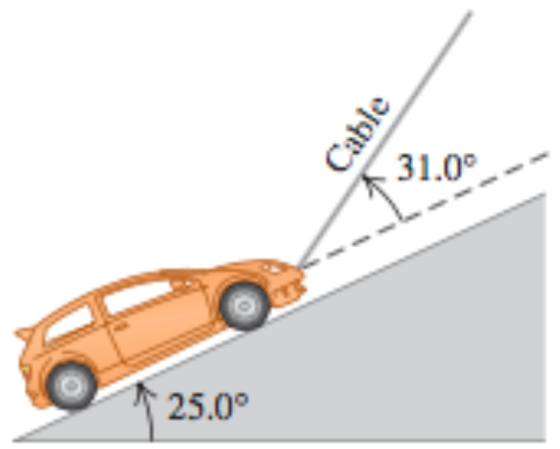
A 1000 kg car slowly descends 20 meters down a hill covered with ice (no friction). See the figure.
(a) How much force tension does the cable do?
(b) How much work does the weight of the car do?
(c) How much work does cable tension do?
(d) What is the total work on the car?
Homework Answers

Add Answer to:
A 1000 kg car slowly descends 20 meters down a hill covered with
ice (no friction)....
The 1930 kg cable car shown in the figure descends a 200-m-high hill. In addition to...
 The 1930 kg cable car shown in the figure descends a 200-m-high hill. In addition to its brakes, the cable car controls its speed by pulling an 1760 kg counterweight up the other side of the hill. The rolling friction of both the cable car and the counterweight are negligible. (Figure 1) Part A How much braking force does the cable car need to descend at constant speed? Express your answer with the appropriate units. Value Units Submit Request Answer...
Problem # 4 The 3000 kg cable car shown in figure descends a 200 m-high hill....
 Problem # 4 The 3000 kg cable car shown in figure descends a 200 m-high hill. In addition to its brakes, the cable car controls its speed by pulling a 2500 kg counterweight up the other side of the hill. The rolling friction of both the cable car and the counterweight are negligible. Counterweight 200 m 25° 35 A. Draw the free body diagrams of cable car (call it m,) and the counterweight (call it m2) mass. Draw component diagrams....
A car of mass 1000 Kg descends a hill inclined with horizontal by 30°, the car...
 A car of mass 1000 Kg descends a hill inclined with horizontal by 30°, the car is traveling at 80 km/h is uniformly brought to rest over a distance of 40 m. Calculate using work-energy method the average braking force required. The resistance to the motion is 200 N. 40 0 = 30°
The figure below shows a 4800 kg cable car descending a high hill. A counterweight of...
 The figure below shows a 4800 kg cable car descending a high hill. A counterweight of mass 4400 kg on the other side of the hill aids the breaks in controlling the cable car's speed. The rolling friction of both the cable car and the counterweight are negligible. a. How much braking force does the cable car need to descend with an acceleration of 0.15 m/s? b. What is the tension in the cable connecting the two cars in part...
A135° 1. 25° Problem #4 Counterweight The 3000 kg cable car shown in figure descends a...
 A135° 1. 25° Problem #4 Counterweight The 3000 kg cable car shown in figure descends a 200 m-high hill. In addition to its brakes, the cable car controls its speed by pulling a 2500 kg 200 m counterweight up the other side of the hill. The rolling friction of both the cable car and the counterweight are negligible. A. Draw the free body diagrams of cable car (call it m ) and the counterweight (call it m2) mass. Draw component...
A man pulls a 20-kg sled 35 meters along an angled hill with a force of...
A man pulls a 20-kg sled 35 meters along an angled hill with a force of 250 N, which elevates the man 32 meters above the bottom of the hill. The man then hops on his sled and slides from rest to the bottom of the hill back along his 35 meter path, during which a 30 N frictional force acts upon his sled. How much work in Joules does the man do against friction in pulling the sled up...
A sled with mass 30 kg slides 40 m down a hill angled at 20 degrees...
A sled with mass 30 kg slides 40 m down a hill angled at 20 degrees to the horizontal. The coefficient of friction between the sled and the ground is 0.2. a) How much work does gravity do on the sled? b) How much work does the normal force do on the sled? c) How much work does friction do on the sled? d) What is the net work done on the sled e) if the sled begins at rest...
a rock is sliding down a hill. Assume that the hill is 20 meters high and...
a rock is sliding down a hill. Assume that the hill is 20 meters high and the rock hs a mass of 1000 kilograms. If the rock started at the top of the hill with no initial speed, How much work is its kinetic energy when it reaches the bottom of the hill? use Gn 10m/s^v Give answer in kilojoules.
A car of mass 1100 kg starts from rest at sea level and climbs a hill...
A car of mass 1100 kg starts from rest at sea level and climbs a hill of height 50.0 m. At the top of the hill, the car has a speed of 25.0 m/s, and at this instant, the driver shuts off the engine of the car. The car then coasts down the other side of the hill to height of 15.0 m above sea level. Assume that friction and air resistance are negligibly small. a) (6 pts) How much...
A 20 kg child slides down a hill where the coefficient of friction is 0.25. Draw...
A 20 kg child slides down a hill where the coefficient of friction is 0.25. Draw and label a qualitative force diagram for the child. * On your force diagram, draw the components of gravity that are parallel and perpendicular to the hill. * On your component triangle, correctly locate the 38˚ angle. * Calculate the gravitational force. Show your work. * Calculate the component of gravity perpendicular to the hill. Show your work. * Calculate the component of gravity...
 The 1930 kg cable car shown in the figure descends a 200-m-high hill. In addition to its brakes, the cable car controls its speed by pulling an 1760 kg counterweight up the other side of the hill. The rolling friction of both the cable car and the counterweight are negligible. (Figure 1) Part A How much braking force does the cable car need to descend at constant speed? Express your answer with the appropriate units. Value Units Submit Request Answer...
 Problem # 4 The 3000 kg cable car shown in figure descends a 200 m-high hill. In addition to its brakes, the cable car controls its speed by pulling a 2500 kg counterweight up the other side of the hill. The rolling friction of both the cable car and the counterweight are negligible. Counterweight 200 m 25° 35 A. Draw the free body diagrams of cable car (call it m,) and the counterweight (call it m2) mass. Draw component diagrams....
 A car of mass 1000 Kg descends a hill inclined with horizontal by 30°, the car is traveling at 80 km/h is uniformly brought to rest over a distance of 40 m. Calculate using work-energy method the average braking force required. The resistance to the motion is 200 N. 40 0 = 30°
 The figure below shows a 4800 kg cable car descending a high hill. A counterweight of mass 4400 kg on the other side of the hill aids the breaks in controlling the cable car's speed. The rolling friction of both the cable car and the counterweight are negligible. a. How much braking force does the cable car need to descend with an acceleration of 0.15 m/s? b. What is the tension in the cable connecting the two cars in part...
 A135° 1. 25° Problem #4 Counterweight The 3000 kg cable car shown in figure descends a 200 m-high hill. In addition to its brakes, the cable car controls its speed by pulling a 2500 kg 200 m counterweight up the other side of the hill. The rolling friction of both the cable car and the counterweight are negligible. A. Draw the free body diagrams of cable car (call it m ) and the counterweight (call it m2) mass. Draw component...
Most questions answered within 3 hours.
-
Where is the error in this code sequence?
String s1 = "Hello";
String s2 = "ello";...
asked 11 months ago -
Financial data for Joel de Paris, Inc., for last year
follow:
Joel de Paris, Inc.
Balance...
asked 11 months ago -
Consider this reaction:
Al2(SO4)3 (aq)+ BaCl3
(aq) Al2Cl6 (aq)- +
3BaSO4(s) . What is the...
asked 11 months ago -
Suppose that Savneet is considering increasing her
recent random sample from 20 car rentals to 40...
asked 11 months ago -
Trucks arrive at an unloading terminal at an average rate of 120
per hour.
Trucks arrive...
asked 11 months ago -
Why are methanol and ethanol completely soluble in water while
octanol is not very little soluble....
asked 11 months ago -
A facilities manager at a university reads in a research report
that the mean amount of...
asked 11 months ago -
When the CuSO4 is rehydrated by adding water to the anhydrous
compound, is this an endothermic...
asked 11 months ago -
A ray of sunlight is passing from diamond into crown glass; the
angle of incidence is...
asked 11 months ago -
A block of mass 0.249 kg is placed on top of a light, vertical
spring of...
asked 11 months ago -
how do the kidneys compensate in the presences of acidosis
a) trigger hyperventilate
b) reserve acid...
asked 11 months ago -
Question 501 pts
The rental rate of capital to the firm increases. Which of the
following...
asked 11 months ago