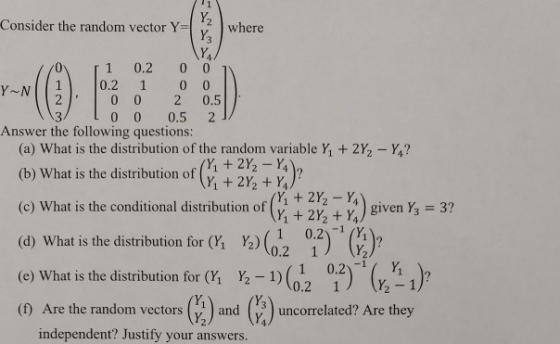
Statistical Linear Models.
Multivaruate Normal Distribution
For the conditional distributuon this is the
formula

Homework Answers
Add Answer to:
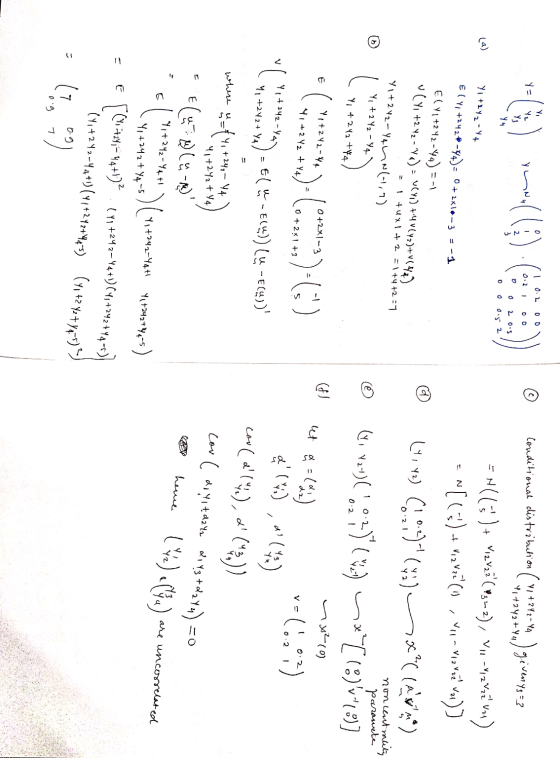
Statistical Linear Models.
Multivaruate Normal Distribution
For the conditional distributuon this is the
formula
Consider the...
Problem 4.12 & Problem 4.14 ? 4.12 Suppose y is N4(u, 2), where 8 9 -3...
 Problem 4.12 & Problem 4.14 ?
4.12 Suppose y is N4(u, 2), where 8 9 -3 6 3-3 23 μ= PROBLEMS 107 (a) Find the distribution ofz-: 4y1-2y2 + y3-3y4 (b) Find the joint distribution of zy y2y3y4 and z22yi + (c) Find the joint distribution of zı = 3y1 +N2-4y3-N4, z2--yı-3y2+ (d) What is the distribution of y3? (e) What is the joint distribution of y2 and y4? (f) Find the joint distribution of yi, 1(yi + y2), yit...
Problem 4.12 & Problem 4.14 ?
4.12 Suppose y is N4(u, 2), where 8 9 -3 6 3-3 23 μ= PROBLEMS 107 (a) Find the distribution ofz-: 4y1-2y2 + y3-3y4 (b) Find the joint distribution of zy y2y3y4 and z22yi + (c) Find the joint distribution of zı = 3y1 +N2-4y3-N4, z2--yı-3y2+ (d) What is the distribution of y3? (e) What is the joint distribution of y2 and y4? (f) Find the joint distribution of yi, 1(yi + y2), yit...
3) Recall the Hardy-Weinberg problem described in your text (page 273-274). The multinomial distribution for random...
 3) Recall the Hardy-Weinberg problem described in your text (page 273-274). The multinomial distribution for random variables Yı, Y2, Y3 (can extend to more than 3) is given by n! P(Yı y1, Y2 = y2, Y3 = ya) Ул!ур!у! Рі Р2 р. where y + y3 = n and the parameters pi,P2, P3 are subject to the constraint p1 +p2 +p3 = 1. This distribution is an extension of the binomial distribution. In fact, the distribution of each Y, i=...
2. [x] Suppose that Y1, Y2, Y3 denote a random sample from an exponential distribution whose...
 2. [x] Suppose that Y1, Y2, Y3 denote a random sample from an exponential distribution whose pdf and cdf are given by f(y) = (1/0)e¬y/® and F(y) =1 – e-y/0, 0 > 0. It is also known that E[Y;] = 0. ', y > 0, respectively, with some unknown (a) Let X = min{Y1,Y2, Y3}. Show that X has pdf given by f(æ) = (3/0)e-3y/º. Start by thinking about 1- F(x) = Pr(min{Y1,Y2, Y3} > x) = Pr(Y1 > x,...
For purposes of studying sampling distribution, we consider a small population of N = 4 units,...
 For purposes of studying sampling distribution, we consider a small population of N = 4 units, labeled 1, 2, 3, 4, with respective y-values yı = 3, y2 = 1, y3 = 0, y4 = 5. (c) Plan 2: Consider a simple random sample with replacement (SRSWR) design with sample size n=2. (i) Find the number of possible SRSs of size n = 2. List every possible sample. For each sample, what is the probability that it is the one...
bos on 559 2. Random variable X and Y have a bivariate normal distribution. The conditional...
 bos on 559 2. Random variable X and Y have a bivariate normal distribution. The conditional density of X given Y = y is a OVH a. bivariate normal distribution Bossiu b. chi-square distribution c. linear distribution oms d. normal distribution e. not necessarily any of the above distributions. 3. The probability distribution for the random variable X is shown by the table. Use the transformation technique to construct the table for the probability distribution of Y = x2 +...
3. Consider the joint probability distribution for Y and X. X/Y 2 4 6 1 0.2...
 3. Consider the joint probability distribution for Y and X. X/Y 2 4 6 1 0.2 0.21 2 10 201 3 5.2 0 2 a) Calculate the marginal densities for both Y and X. b) Show using the conditional distribution for Y and the marginal distribution for Y, that X and Y are not independent. c) Calculate the E(Y|x = 1)and V(Y | x = 1).
(20 points) Consider the following joint distribution of X and Y ㄨㄧㄚ 0 0.1 0.2 1 0.3 0.4 (a) Find the marginal distributions of X and Y. (i.e., Px(x) and Py()) (b) Find the conditional distributio...
 (20 points) Consider the following joint distribution of X and Y ㄨㄧㄚ 0 0.1 0.2 1 0.3 0.4 (a) Find the marginal distributions of X and Y. (i.e., Px(x) and Py()) (b) Find the conditional distribution of X given Y-0. (i.e., Pxjy (xY-0)) (c) Compute EXIY-01 and Var(X)Y = 0). (d) Find the covariance between X and Y. (i.e., Cov(X, Y)) (e) Are X and Y independent? Justify your answer.
(20 points) Consider the following joint distribution of X and...
(20 points) Consider the following joint distribution of X and Y ㄨㄧㄚ 0 0.1 0.2 1 0.3 0.4 (a) Find the marginal distributions of X and Y. (i.e., Px(x) and Py()) (b) Find the conditional distribution of X given Y-0. (i.e., Pxjy (xY-0)) (c) Compute EXIY-01 and Var(X)Y = 0). (d) Find the covariance between X and Y. (i.e., Cov(X, Y)) (e) Are X and Y independent? Justify your answer.
(20 points) Consider the following joint distribution of X and...
Suppose X, Y and Z are three different random variables. Let X obey Bernoulli Distribution. The...
Suppose X, Y and Z are three different random variables. Let X obey Bernoulli Distribution. The probability distribution function is p(x) = Let Y obeys the standard Normal (Gaussian) distribution, which can be written as Y ∼ N(0, 1). X and Y are independent. Meanwhile, let Z = XY . (a) What is the Expectation (mean value) of X? (b) Are Y and Z independent? (Just clarify, do not need to prove) (c) Show that Z is also a standard...
The time that university students spend on the internet follows a normal distribution. At flinders university,...
The time that university students spend on the internet follows a normal distribution. At flinders university, the mean time is 5 hours with a standard deviation of 1.2 hours. What is the probability that the average time 100 random students on campus willl spend more than 5 hours on the internet? a) 0.5 b) 1 c) 0.2 d) 0
e.) Find and sketch the PSD of V(t). What does the system in Fig. 1 do? Problem 4 (10 points, Graduate Students Only). Suppose X is a binary random variable, with PIX = ol = 0.8 and PIX = 1] = 0.2. S...
 e.) Find and sketch the PSD of V(t). What does the system in Fig. 1 do? Problem 4 (10 points, Graduate Students Only). Suppose X is a binary random variable, with PIX = ol = 0.8 and PIX = 1] = 0.2. Suppose Y is a Gaussian random variable conditioned on X. Specifically, when X 0, py)x (ulz) is a Gaussian distribution with 0 mean and variance σ2. Similarly, when X-1, prix(ylz) Is a Gaussian distribution with mean A (A...
 Problem 4.12 & Problem 4.14 ?
4.12 Suppose y is N4(u, 2), where 8 9 -3 6 3-3 23 μ= PROBLEMS 107 (a) Find the distribution ofz-: 4y1-2y2 + y3-3y4 (b) Find the joint distribution of zy y2y3y4 and z22yi + (c) Find the joint distribution of zı = 3y1 +N2-4y3-N4, z2--yı-3y2+ (d) What is the distribution of y3? (e) What is the joint distribution of y2 and y4? (f) Find the joint distribution of yi, 1(yi + y2), yit...
Problem 4.12 & Problem 4.14 ?
4.12 Suppose y is N4(u, 2), where 8 9 -3 6 3-3 23 μ= PROBLEMS 107 (a) Find the distribution ofz-: 4y1-2y2 + y3-3y4 (b) Find the joint distribution of zy y2y3y4 and z22yi + (c) Find the joint distribution of zı = 3y1 +N2-4y3-N4, z2--yı-3y2+ (d) What is the distribution of y3? (e) What is the joint distribution of y2 and y4? (f) Find the joint distribution of yi, 1(yi + y2), yit...
 3) Recall the Hardy-Weinberg problem described in your text (page 273-274). The multinomial distribution for random variables Yı, Y2, Y3 (can extend to more than 3) is given by n! P(Yı y1, Y2 = y2, Y3 = ya) Ул!ур!у! Рі Р2 р. where y + y3 = n and the parameters pi,P2, P3 are subject to the constraint p1 +p2 +p3 = 1. This distribution is an extension of the binomial distribution. In fact, the distribution of each Y, i=...
 2. [x] Suppose that Y1, Y2, Y3 denote a random sample from an exponential distribution whose pdf and cdf are given by f(y) = (1/0)e¬y/® and F(y) =1 – e-y/0, 0 > 0. It is also known that E[Y;] = 0. ', y > 0, respectively, with some unknown (a) Let X = min{Y1,Y2, Y3}. Show that X has pdf given by f(æ) = (3/0)e-3y/º. Start by thinking about 1- F(x) = Pr(min{Y1,Y2, Y3} > x) = Pr(Y1 > x,...
 For purposes of studying sampling distribution, we consider a small population of N = 4 units, labeled 1, 2, 3, 4, with respective y-values yı = 3, y2 = 1, y3 = 0, y4 = 5. (c) Plan 2: Consider a simple random sample with replacement (SRSWR) design with sample size n=2. (i) Find the number of possible SRSs of size n = 2. List every possible sample. For each sample, what is the probability that it is the one...
 bos on 559 2. Random variable X and Y have a bivariate normal distribution. The conditional density of X given Y = y is a OVH a. bivariate normal distribution Bossiu b. chi-square distribution c. linear distribution oms d. normal distribution e. not necessarily any of the above distributions. 3. The probability distribution for the random variable X is shown by the table. Use the transformation technique to construct the table for the probability distribution of Y = x2 +...
 3. Consider the joint probability distribution for Y and X. X/Y 2 4 6 1 0.2 0.21 2 10 201 3 5.2 0 2 a) Calculate the marginal densities for both Y and X. b) Show using the conditional distribution for Y and the marginal distribution for Y, that X and Y are not independent. c) Calculate the E(Y|x = 1)and V(Y | x = 1).
 (20 points) Consider the following joint distribution of X and Y ㄨㄧㄚ 0 0.1 0.2 1 0.3 0.4 (a) Find the marginal distributions of X and Y. (i.e., Px(x) and Py()) (b) Find the conditional distribution of X given Y-0. (i.e., Pxjy (xY-0)) (c) Compute EXIY-01 and Var(X)Y = 0). (d) Find the covariance between X and Y. (i.e., Cov(X, Y)) (e) Are X and Y independent? Justify your answer.
(20 points) Consider the following joint distribution of X and...
(20 points) Consider the following joint distribution of X and Y ㄨㄧㄚ 0 0.1 0.2 1 0.3 0.4 (a) Find the marginal distributions of X and Y. (i.e., Px(x) and Py()) (b) Find the conditional distribution of X given Y-0. (i.e., Pxjy (xY-0)) (c) Compute EXIY-01 and Var(X)Y = 0). (d) Find the covariance between X and Y. (i.e., Cov(X, Y)) (e) Are X and Y independent? Justify your answer.
(20 points) Consider the following joint distribution of X and...
 e.) Find and sketch the PSD of V(t). What does the system in Fig. 1 do? Problem 4 (10 points, Graduate Students Only). Suppose X is a binary random variable, with PIX = ol = 0.8 and PIX = 1] = 0.2. Suppose Y is a Gaussian random variable conditioned on X. Specifically, when X 0, py)x (ulz) is a Gaussian distribution with 0 mean and variance σ2. Similarly, when X-1, prix(ylz) Is a Gaussian distribution with mean A (A...
Most questions answered within 3 hours.
-
Where is the error in this code sequence?
String s1 = "Hello";
String s2 = "ello";...
asked 11 months ago -
Financial data for Joel de Paris, Inc., for last year
follow:
Joel de Paris, Inc.
Balance...
asked 11 months ago -
Consider this reaction:
Al2(SO4)3 (aq)+ BaCl3
(aq) Al2Cl6 (aq)- +
3BaSO4(s) . What is the...
asked 11 months ago -
Suppose that Savneet is considering increasing her
recent random sample from 20 car rentals to 40...
asked 11 months ago -
Trucks arrive at an unloading terminal at an average rate of 120
per hour.
Trucks arrive...
asked 11 months ago -
Why are methanol and ethanol completely soluble in water while
octanol is not very little soluble....
asked 11 months ago -
A facilities manager at a university reads in a research report
that the mean amount of...
asked 11 months ago -
When the CuSO4 is rehydrated by adding water to the anhydrous
compound, is this an endothermic...
asked 11 months ago -
A ray of sunlight is passing from diamond into crown glass; the
angle of incidence is...
asked 11 months ago -
A block of mass 0.249 kg is placed on top of a light, vertical
spring of...
asked 11 months ago -
how do the kidneys compensate in the presences of acidosis
a) trigger hyperventilate
b) reserve acid...
asked 11 months ago -
Question 501 pts
The rental rate of capital to the firm increases. Which of the
following...
asked 11 months ago