
Homework Answers
#include <iostream>
using namespace std;
int main()
{
int arr[] = {82,17,40,28,15,55,46,93,6,67,11,3};
int n= sizeof(arr)/sizeof(arr[0]);
int temp;
for(int i = 0; i < n; i++)
{
for(int j = 0; j < n-i-1; j++)
if(arr[j] > arr[j+1])
{
temp=arr[j];
arr[j]=arr[j+1];
arr[j+1]=temp;
}
cout<<"\n\nIteration "<<i+1<<endl;
for (int k=0; k < n; k++)
cout<<arr[k]<<" ";
}
cout<<"\n\nFinal Sorted List: ";
for (int i=0; i < n; i++)
cout<<arr[i]<<" ";
cout<<endl;
return 0;
}
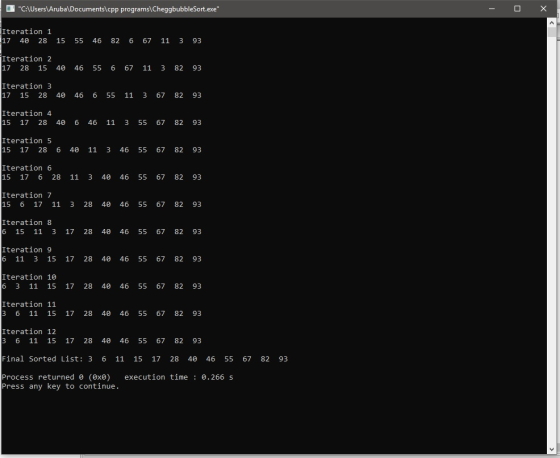
Output of the Program:
Elaboration
int n= sizeof(arr)/sizeof(arr[0]); // Finds
number of elements in the list.
sizeof(arr) = Total size, [12*4 bytes = 48 bytes]
sizeof(arr[0]) = size of an element in the array, [ 4 bytes for integer]
- In each iteration we swap each consecutive elements till the end of the array.
- This makes the array sorted one by one from the last to the first.
Add Answer to:
in c++
Sort the following list using the bubble sort algorithm as discussed in this chapter....
Sort the following list using the bubble sort algorithm as discussed in this chapter. Show the...
Sort the following list using the bubble sort algorithm as discussed in this chapter. Show the list after each iteration of the outer for loop. 46, 58, 16, 25, 83, 98, 8, 70, 5, 62
C++ help please Sort the following list using MERGE sort as discussed in this chapter. Show...
C++ help please Sort the following list using MERGE sort as discussed in this chapter. Show the list after each iteration of the outer for loop. 26, 45, 17, 65, 33, 55, 12, 18, 2, 12 Sort the following list using MERGE sort as discussed in this chapter. Show the list after each iteration of the outer for loop. 36, 55, 17, 35, 63, 85, 12, 48, 3, 66, 15
How to write this in c++? 1. Sort the following list using the selection sort algorithm...
 How to write this in c++?
1. Sort the following list using the selection sort algorithm as discussed in this chapter. Show the list after each iteration of the outer for loop. 36, 55, 17, 35, 63, 85, 12, 48, 3, 66 (10 points)
How to write this in c++?
1. Sort the following list using the selection sort algorithm as discussed in this chapter. Show the list after each iteration of the outer for loop. 36, 55, 17, 35, 63, 85, 12, 48, 3, 66 (10 points)
Recall the insertion sort algorithm as discussed in this chapter. Assume the following list of keys:...
 Recall the insertion sort algorithm as discussed in this chapter. Assume the following list of keys: 30, 20, 35, 27, 96, 82, 60, 48, 75, 5, 80 Exactly how many key comparisons are executed to sort this list using insertion sort? Show the values and the number of comparisons after each iteration for the loop.
C++ Sorting and Searching 1. Mark the following statements as true or false. a. A sequential...
C++ Sorting and Searching 1. Mark the following statements as true or false. a. A sequential search of a list assumes that the list elements are sorted in ascending order. b. A binary search of a list assumes that the list is sorted. 2. Consider the following list: 63 45 32 98 46 57 28 100 Using a sequential search, how many comparisons are required to determine whether the following items are in the list or not? (Recall that comparisons...
1.Show the state of the following array after the outer loop of the bubble sort algorithm...
1.Show the state of the following array after the outer loop of the bubble sort algorithm has executed one time. [0] [1] [2] [3] [4] [5] 19 23 2 4 99 1 2. Show the state of the following array after the outer loop of the selection sort algorithm has executed two times. [0] [1] [2] [3] [4] [5] 12 1 9 23 17 11 3. Show the state of the following array after the outer loop of the insertion...
3. Modify the insertion sort algorithm discussed in class so that it can sort strings. That...
 3. Modify the insertion sort algorithm discussed in class so
that it can sort strings. That is, its input will be an array, the
type of which is string. The insertion sort algorithm will sort the
elements in this array. Finally, its output will be a sorted
array.
As the solution of this problem, you need to submit the
following answer(s): (1). The implementation of your algorithm in
C# (20points).
Algorithm: At each array-position, it checks the value there against...
3. Modify the insertion sort algorithm discussed in class so
that it can sort strings. That is, its input will be an array, the
type of which is string. The insertion sort algorithm will sort the
elements in this array. Finally, its output will be a sorted
array.
As the solution of this problem, you need to submit the
following answer(s): (1). The implementation of your algorithm in
C# (20points).
Algorithm: At each array-position, it checks the value there against...
Consider the following python code that will sort the list of numbers using the Bubble Sort...
 Consider the following python code that will sort the list of numbers using the Bubble Sort algorithm def bubbleSort(alist): print(alist) for j in range (len(alist) - 1, 8, -1): for i in range(): if alist[i] > alist[i + 1]: temp = alist[i] alist[i] = alist[i+1] alist[i+1] = temp print(alist) alist = [52, 25, 94, 17, 25, 52] bubbleSort (alist) print(alist) Sort the following series of values into ascending order using the Bubble Sort algorithm. Write out the complete row of...
in C please 20. Change the bubble sort algorithm (Program 12-5) as follows: Use two directional...
 in C please
20. Change the bubble sort algorithm (Program 12-5) as follows: Use two directional bubbling in each pass. In the first bubbling, the smallest ele. ment is bubbled up; in the second bubbling, the largest element is bubbled I down. This sort is known as the shaker sort. 12-5 Bubble Sort (continued) // Statements // Each iteration is one sort pass for (int current = 0, sorted = 0; current <= last && !sorted; current++) for (int walker...
in C please
20. Change the bubble sort algorithm (Program 12-5) as follows: Use two directional bubbling in each pass. In the first bubbling, the smallest ele. ment is bubbled up; in the second bubbling, the largest element is bubbled I down. This sort is known as the shaker sort. 12-5 Bubble Sort (continued) // Statements // Each iteration is one sort pass for (int current = 0, sorted = 0; current <= last && !sorted; current++) for (int walker...
Bubble sort is a popular, but inefficient, sorting algorithm. It works by repeatedly swapping adjacent elements...
Bubble sort is a popular, but inefficient, sorting algorithm. It works by repeatedly swapping adjacent elements that out of order. BUBBLESORT(A) 1. for i = 1 to A.length – 1 2. for j = i + 1 to A.length 3. if A[j] < A[i] 4. exchange A[j] with A[i] a) A loop invariant for the outer for loop in lines 1 – 4 is: At iteration i, the sub-array A[1..i] is sorted and any element in A[i+1..A.size] is greater or...
 How to write this in c++?
1. Sort the following list using the selection sort algorithm as discussed in this chapter. Show the list after each iteration of the outer for loop. 36, 55, 17, 35, 63, 85, 12, 48, 3, 66 (10 points)
How to write this in c++?
1. Sort the following list using the selection sort algorithm as discussed in this chapter. Show the list after each iteration of the outer for loop. 36, 55, 17, 35, 63, 85, 12, 48, 3, 66 (10 points)
 Recall the insertion sort algorithm as discussed in this chapter. Assume the following list of keys: 30, 20, 35, 27, 96, 82, 60, 48, 75, 5, 80 Exactly how many key comparisons are executed to sort this list using insertion sort? Show the values and the number of comparisons after each iteration for the loop.
 3. Modify the insertion sort algorithm discussed in class so
that it can sort strings. That is, its input will be an array, the
type of which is string. The insertion sort algorithm will sort the
elements in this array. Finally, its output will be a sorted
array.
As the solution of this problem, you need to submit the
following answer(s): (1). The implementation of your algorithm in
C# (20points).
Algorithm: At each array-position, it checks the value there against...
3. Modify the insertion sort algorithm discussed in class so
that it can sort strings. That is, its input will be an array, the
type of which is string. The insertion sort algorithm will sort the
elements in this array. Finally, its output will be a sorted
array.
As the solution of this problem, you need to submit the
following answer(s): (1). The implementation of your algorithm in
C# (20points).
Algorithm: At each array-position, it checks the value there against...
 Consider the following python code that will sort the list of numbers using the Bubble Sort algorithm def bubbleSort(alist): print(alist) for j in range (len(alist) - 1, 8, -1): for i in range(): if alist[i] > alist[i + 1]: temp = alist[i] alist[i] = alist[i+1] alist[i+1] = temp print(alist) alist = [52, 25, 94, 17, 25, 52] bubbleSort (alist) print(alist) Sort the following series of values into ascending order using the Bubble Sort algorithm. Write out the complete row of...
 in C please
20. Change the bubble sort algorithm (Program 12-5) as follows: Use two directional bubbling in each pass. In the first bubbling, the smallest ele. ment is bubbled up; in the second bubbling, the largest element is bubbled I down. This sort is known as the shaker sort. 12-5 Bubble Sort (continued) // Statements // Each iteration is one sort pass for (int current = 0, sorted = 0; current <= last && !sorted; current++) for (int walker...
in C please
20. Change the bubble sort algorithm (Program 12-5) as follows: Use two directional bubbling in each pass. In the first bubbling, the smallest ele. ment is bubbled up; in the second bubbling, the largest element is bubbled I down. This sort is known as the shaker sort. 12-5 Bubble Sort (continued) // Statements // Each iteration is one sort pass for (int current = 0, sorted = 0; current <= last && !sorted; current++) for (int walker...
Most questions answered within 3 hours.
-
Where is the error in this code sequence?
String s1 = "Hello";
String s2 = "ello";...
asked 10 months ago -
Financial data for Joel de Paris, Inc., for last year
follow:
Joel de Paris, Inc.
Balance...
asked 10 months ago -
Consider this reaction:
Al2(SO4)3 (aq)+ BaCl3
(aq) Al2Cl6 (aq)- +
3BaSO4(s) . What is the...
asked 10 months ago -
Suppose that Savneet is considering increasing her
recent random sample from 20 car rentals to 40...
asked 10 months ago -
Trucks arrive at an unloading terminal at an average rate of 120
per hour.
Trucks arrive...
asked 10 months ago -
Why are methanol and ethanol completely soluble in water while
octanol is not very little soluble....
asked 10 months ago -
A facilities manager at a university reads in a research report
that the mean amount of...
asked 10 months ago -
When the CuSO4 is rehydrated by adding water to the anhydrous
compound, is this an endothermic...
asked 10 months ago -
A ray of sunlight is passing from diamond into crown glass; the
angle of incidence is...
asked 10 months ago -
A block of mass 0.249 kg is placed on top of a light, vertical
spring of...
asked 10 months ago -
how do the kidneys compensate in the presences of acidosis
a) trigger hyperventilate
b) reserve acid...
asked 10 months ago -
Question 501 pts
The rental rate of capital to the firm increases. Which of the
following...
asked 10 months ago