

Homework Answers
Add Answer to:
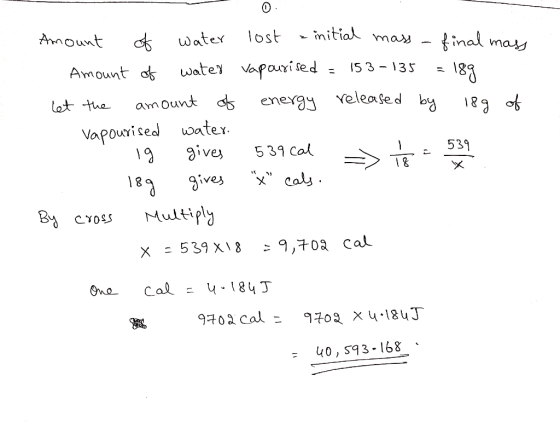
In the Energy and Light experiment, the initial mass of the container and water before they...
A 15-g sample of the candy is placed in a small aluminum container of mass 0.325...
A 15-g sample of the candy is placed in a small aluminum container of mass 0.325 kg filled with oxygen. This container is placed in 1.75 kg of water in an aluminum calorimeter cup of mass 0.624 kg at an initial temperature of 15.0 ∘C. The oxygen-candy mixture in the small container (a "bomb calorimeter") is ignited, and the final temperature of the whole system is 53.5 ∘C.The value of specific heat for aluminum is 0.22 Cal/kg⋅C∘, and for water...
Mass of the calorimeter cup = 60 gm; mass of water= 100 gm; water equivalent mass...
 Mass of the calorimeter cup = 60 gm; mass of water= 100 gm; water equivalent mass of coil =2.5 gm; initial temperature of the water = 20° C; final temperature of water in cup = 41° C; total heating time = 20 minutes. Using this initial data set, complete the rest of the data sheet. Take the specific heat of the water as 1cal/gmº C and cup as 0.22 cal/gmº C. The average current and voltages are 2.75 A and...
In an insulated container of negligible mass, 900 g of water at 25.0oC is mixed with...
In an insulated container of negligible mass, 900 g of water at 25.0oC is mixed with 765 g of ice at -18.0oC. After several minutes, it is observed that only part of the ice has melted and that the remaining ice is in thermal equilibrium with the surrounding water. What is the temperature of the unmelted ice? Calculate the heat lost by the 900g of water. Calculate the mass of ice that is melted in this process. The specific heat...
Scientists are conducting an experiment with a gas in a sealed container. The mass of the...
Scientists are conducting an experiment with a gas in a sealed container. The mass of the gas is measured, and the scientists realize that the gas is leaking over time in a linear way. Its mass is leaking by 8.6 grams per minute. Five minutes since the experiment started, the remaining gas had a mass of 369.8 grams. Let x be the number of minutes that have passed since the experiment started, and let y be the mass of the...
How much energy (Joules) needs to be absorbed by 20kg mass of water from the environment...
How much energy (Joules) needs to be absorbed by 20kg mass of water from the environment for the water mass to completely evaporate? Latent Heat of vaporization = 2.5 *106 J/kg.
Suppose an oven’s radiation wavelength is 0.125 m. A container with 350.00 g of water was...
Suppose an oven’s radiation wavelength is 0.125 m. A container with 350.00 g of water was placed in the oven, and the temperature of the water rose from 20.0°C to 80.0°C. How many photons of this microwave radiation were required to heat the water? (Assume that all the energy from the radiation was used to raise the temperature of the water.)
Mass of can (9) 12.65 Mass of can and water (9) 112.24 1.91 Initial mass of...
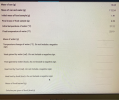 Mass of can (9) 12.65 Mass of can and water (9) 112.24 1.91 Initial mass of food sample (g) Final mass of food sample (9) 0.52 Initial temperature of water (*C) 21.12 Final temperature of water (*C) 23.19 Mass of water (9) Temperature change of water (*C). Do not include a negative sign. Heat gained by water (cal). Do not include a negative sign. Heat gained by water (kcal). Do not include a negative sign. Heat lost by food (cal)....
Suppose an oven's radiation wavelength is 0.125 m. A container with 175.00 g of water was placed in the oven, and t...
 Suppose an oven's radiation wavelength is 0.125 m. A container with 175.00 g of water was placed in the oven, and the temperature of the water rose from 20.0°C to 80.0°C. How many photons of this microwave radiation were required to heat the water? (Assume that all the energy from the radiation was used to raise the temperature of the water.) photons
Problem #3 A container is filled with a mass m of water at room temperature T,...
 Problem #3 A container is filled with a mass m of water at room temperature T, (specific heat c,' latent heat of vaporization L, density at room temperature p, coefficient of volume expansion B). A very hot mass m2 of copper (specific heat c2) is put into the water and when equilibrium is reached half the water has evaporated. Assume that there is no significant exchange of heat with the suroundings. (note: T-0°C, T100-100°C) a) What is the initial volume...
The following data were recorded in the experiment (E106): mass of calorimeter 60g mass of calorimeter...
The following data were recorded in the experiment (E106): mass of calorimeter 60g mass of calorimeter with water 230 g mass of metal specimen 58 g initial temperature of water and calorimeter 20 ᵒC initial temperature of the metal 100 ᵒC Specific Heat Capacity of Calorimeter 0.22 cal/g. Cᵒ Final temperature of the mixture 27 ᵒC What is the heat gained by water in calories? A. 420 B. 1,610 C.1,190 D. 4,234
 Mass of the calorimeter cup = 60 gm; mass of water= 100 gm; water equivalent mass of coil =2.5 gm; initial temperature of the water = 20° C; final temperature of water in cup = 41° C; total heating time = 20 minutes. Using this initial data set, complete the rest of the data sheet. Take the specific heat of the water as 1cal/gmº C and cup as 0.22 cal/gmº C. The average current and voltages are 2.75 A and...
 Mass of can (9) 12.65 Mass of can and water (9) 112.24 1.91 Initial mass of food sample (g) Final mass of food sample (9) 0.52 Initial temperature of water (*C) 21.12 Final temperature of water (*C) 23.19 Mass of water (9) Temperature change of water (*C). Do not include a negative sign. Heat gained by water (cal). Do not include a negative sign. Heat gained by water (kcal). Do not include a negative sign. Heat lost by food (cal)....
 Suppose an oven's radiation wavelength is 0.125 m. A container with 175.00 g of water was placed in the oven, and the temperature of the water rose from 20.0°C to 80.0°C. How many photons of this microwave radiation were required to heat the water? (Assume that all the energy from the radiation was used to raise the temperature of the water.) photons
 Problem #3 A container is filled with a mass m of water at room temperature T, (specific heat c,' latent heat of vaporization L, density at room temperature p, coefficient of volume expansion B). A very hot mass m2 of copper (specific heat c2) is put into the water and when equilibrium is reached half the water has evaporated. Assume that there is no significant exchange of heat with the suroundings. (note: T-0°C, T100-100°C) a) What is the initial volume...
Most questions answered within 3 hours.
-
Where is the error in this code sequence?
String s1 = "Hello";
String s2 = "ello";...
asked 10 months ago -
Financial data for Joel de Paris, Inc., for last year
follow:
Joel de Paris, Inc.
Balance...
asked 10 months ago -
Consider this reaction:
Al2(SO4)3 (aq)+ BaCl3
(aq) Al2Cl6 (aq)- +
3BaSO4(s) . What is the...
asked 10 months ago -
Suppose that Savneet is considering increasing her
recent random sample from 20 car rentals to 40...
asked 10 months ago -
Trucks arrive at an unloading terminal at an average rate of 120
per hour.
Trucks arrive...
asked 10 months ago -
Why are methanol and ethanol completely soluble in water while
octanol is not very little soluble....
asked 10 months ago -
A facilities manager at a university reads in a research report
that the mean amount of...
asked 10 months ago -
When the CuSO4 is rehydrated by adding water to the anhydrous
compound, is this an endothermic...
asked 10 months ago -
A ray of sunlight is passing from diamond into crown glass; the
angle of incidence is...
asked 10 months ago -
A block of mass 0.249 kg is placed on top of a light, vertical
spring of...
asked 10 months ago -
how do the kidneys compensate in the presences of acidosis
a) trigger hyperventilate
b) reserve acid...
asked 10 months ago -
Question 501 pts
The rental rate of capital to the firm increases. Which of the
following...
asked 10 months ago