

Homework Answers

Add Answer to:
Part D: what magnetic field would be needed if the particle
weee a proton instead of...
(1 point) d A particle is shot into a magnetic field region as shown in the...
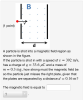 (1 point) d A particle is shot into a magnetic field region as shown in the figure. If the particle is shot in with a speed of u = 392 m/s has a charge of q = 33.6 uC and a mass of m = 0.3 mg, how strong must the magnetic field be so the particle just misses the right plate, given that the plates are separated by a distance d = 0.16 m? The magnetic field is equal...
Use the following figure for both questions. Uo 10.0 cm 1. An electron at point A...
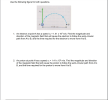 Use the following figure for both questions. Uo 10.0 cm 1. An electron at point A has a speed vo 1.41 x 10⁶ m/s. Find the magnitude and direction of the magnetic field that will cause the electron to follow the semi-circular path from A to B, and the time required for the electron to move from A to B. 2. An proton at point A has a speed vo 1.41 x 10⁶ m/s. Find the magnitude and direction of...
A proton enters a region of constant magnetic field, perpendicular to the fie and after being...
 A proton enters a region of constant magnetic field, perpendicular to the fie and after being accelerated from rest by an electric field through an electric potential difference of - 350 V. Determine the magnitude of the magnetic field, if the proton travels in a circular path with a radius of 21 cm. mt As shown in the figure below, when a charged particle enters a region of magnetic field traveling in a direction perpendicular to the field, it will...
(a) At what speed (in m/s) will a proton move in a circular path of the...
 (a) At what speed (in m/s) will a proton move in a circular path of the same radius as an electron that travels at 7.95 x 10⁶ m/s perpendicular to the Earth's magnetic field at an altitude where the field strength is 1.25 x 10⁻⁵ T? cm/s (b) What would the radius (in m) of the path be if the proton had the same speed as the electron? 1 m (c) What would the radius (in m) be if the...
Figure 20.12 region of magnetic field 1 Path of the particle 1) In Figure 20.12, a...
 Figure 20.12 region of magnetic field 1 Path of the particle 1) In Figure 20.12, a small particle of charge q =-1.9 x 10⁻⁶ C and mass m 3.1 x 10⁻¹² kg has velocity vo 8.1 x 10³ m/s as it enters a region of uniform magnetic field. The particle is observed to travel in the semicircular path shown, with radius R 5.0 cm. Calculate the (a) magnitude and (b) direction of the magnetic field in the region.
I . A particle with the same mass and load as a proton enters a region...
I . A particle with the same mass and load as a proton enters a region where the magnetic field has a magnitude of 4000 G. The particle moves in a circular radius trajectory of 20 cm. Determine the speed and period of the particle in the magnetic field II. A proton in a particle accelerator has a speed of 5.0 x 10^6 m / s. The proton is found with a magnetic field whose magnitude is 0.40 T and...
26.1 The figure shows a proton in a magnetic field. (1) For which of the three...
 26.1 The figure shows a proton in a magnetic field. (1) For which of the three proton velocities shown will the magnetic force be greatest? (2) What will be the direction of the force in all three cases? (a) (b) (c) GOT IT? Problem 4 In the "Got it" question 26.1, a proton moves in a magnetic field. The field is to the right, and three different velocities are shown: straight up, at 45 degrees up and to the right,...
A proton and an electron traveling at the same speed enter a uniform magnetic field. The...
 A proton and an electron traveling at the same speed enter a uniform magnetic field. The velocity vector of each particle is perpendicular to the magnetic field. What will be ratio of the radii of their circular orbits (r proton/electron)? 5.5E-4 0.5 1.0 1800 3600
An antiproton is a particle with the same mass as a proton, but charge of an...
An antiproton is a particle with the same mass as a proton, but charge of an electron. An antiproton traveling with a speed of 2.0 × 10⁷ m/s in the −y direction enters a region of uniform magnetic and electric fields. The magnetic field has magnitude 0.5 T oriented along the +x direction. What is the magnitude and direction of an electric field required for the antiproton to maintain a constant speed and direction?
A charged particle moving through a magnetic field at right angles to the field with a...
 A charged particle moving through a magnetic field at right angles to the field with a speed of 24.7 m/s experiences a magnetic force of 2.38 x 10* N. Determine the magnetic force on an identical particle when it travels through the same magnetic field with a speed of 5.44 m/s at an angle of 26.2° relative to the magnetic field. N What is the maximum force on a rod with a 0.100 C charge that you pass between the...
 (1 point) d A particle is shot into a magnetic field region as shown in the figure. If the particle is shot in with a speed of u = 392 m/s has a charge of q = 33.6 uC and a mass of m = 0.3 mg, how strong must the magnetic field be so the particle just misses the right plate, given that the plates are separated by a distance d = 0.16 m? The magnetic field is equal...
 Use the following figure for both questions. Uo 10.0 cm 1. An electron at point A has a speed vo 1.41 x 10⁶ m/s. Find the magnitude and direction of the magnetic field that will cause the electron to follow the semi-circular path from A to B, and the time required for the electron to move from A to B. 2. An proton at point A has a speed vo 1.41 x 10⁶ m/s. Find the magnitude and direction of...
 A proton enters a region of constant magnetic field, perpendicular to the fie and after being accelerated from rest by an electric field through an electric potential difference of - 350 V. Determine the magnitude of the magnetic field, if the proton travels in a circular path with a radius of 21 cm. mt As shown in the figure below, when a charged particle enters a region of magnetic field traveling in a direction perpendicular to the field, it will...
 (a) At what speed (in m/s) will a proton move in a circular path of the same radius as an electron that travels at 7.95 x 10⁶ m/s perpendicular to the Earth's magnetic field at an altitude where the field strength is 1.25 x 10⁻⁵ T? cm/s (b) What would the radius (in m) of the path be if the proton had the same speed as the electron? 1 m (c) What would the radius (in m) be if the...
 Figure 20.12 region of magnetic field 1 Path of the particle 1) In Figure 20.12, a small particle of charge q =-1.9 x 10⁻⁶ C and mass m 3.1 x 10⁻¹² kg has velocity vo 8.1 x 10³ m/s as it enters a region of uniform magnetic field. The particle is observed to travel in the semicircular path shown, with radius R 5.0 cm. Calculate the (a) magnitude and (b) direction of the magnetic field in the region.
 26.1 The figure shows a proton in a magnetic field. (1) For which of the three proton velocities shown will the magnetic force be greatest? (2) What will be the direction of the force in all three cases? (a) (b) (c) GOT IT? Problem 4 In the "Got it" question 26.1, a proton moves in a magnetic field. The field is to the right, and three different velocities are shown: straight up, at 45 degrees up and to the right,...
 A proton and an electron traveling at the same speed enter a uniform magnetic field. The velocity vector of each particle is perpendicular to the magnetic field. What will be ratio of the radii of their circular orbits (r proton/electron)? 5.5E-4 0.5 1.0 1800 3600
 A charged particle moving through a magnetic field at right angles to the field with a speed of 24.7 m/s experiences a magnetic force of 2.38 x 10* N. Determine the magnetic force on an identical particle when it travels through the same magnetic field with a speed of 5.44 m/s at an angle of 26.2° relative to the magnetic field. N What is the maximum force on a rod with a 0.100 C charge that you pass between the...
Most questions answered within 3 hours.
-
Where is the error in this code sequence?
String s1 = "Hello";
String s2 = "ello";...
asked 10 months ago -
Financial data for Joel de Paris, Inc., for last year
follow:
Joel de Paris, Inc.
Balance...
asked 10 months ago -
Consider this reaction:
Al2(SO4)3 (aq)+ BaCl3
(aq) Al2Cl6 (aq)- +
3BaSO4(s) . What is the...
asked 10 months ago -
Suppose that Savneet is considering increasing her
recent random sample from 20 car rentals to 40...
asked 10 months ago -
Trucks arrive at an unloading terminal at an average rate of 120
per hour.
Trucks arrive...
asked 10 months ago -
Why are methanol and ethanol completely soluble in water while
octanol is not very little soluble....
asked 10 months ago -
A facilities manager at a university reads in a research report
that the mean amount of...
asked 10 months ago -
When the CuSO4 is rehydrated by adding water to the anhydrous
compound, is this an endothermic...
asked 10 months ago -
A ray of sunlight is passing from diamond into crown glass; the
angle of incidence is...
asked 10 months ago -
A block of mass 0.249 kg is placed on top of a light, vertical
spring of...
asked 10 months ago -
how do the kidneys compensate in the presences of acidosis
a) trigger hyperventilate
b) reserve acid...
asked 10 months ago -
Question 501 pts
The rental rate of capital to the firm increases. Which of the
following...
asked 10 months ago