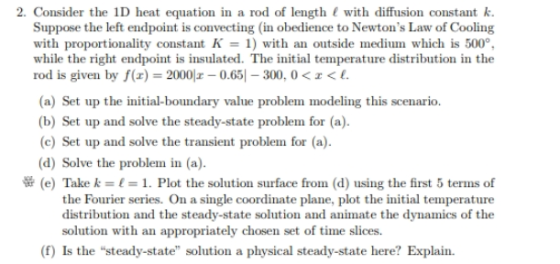
PDE. Please show all steps in detail.
Homework Answers
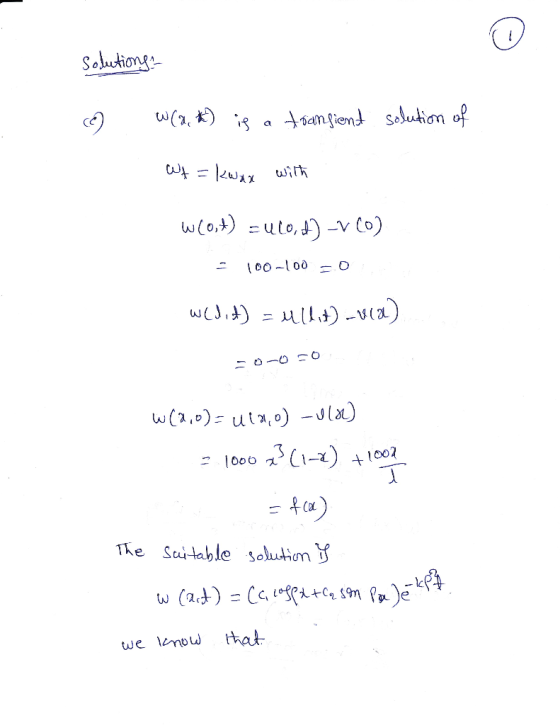
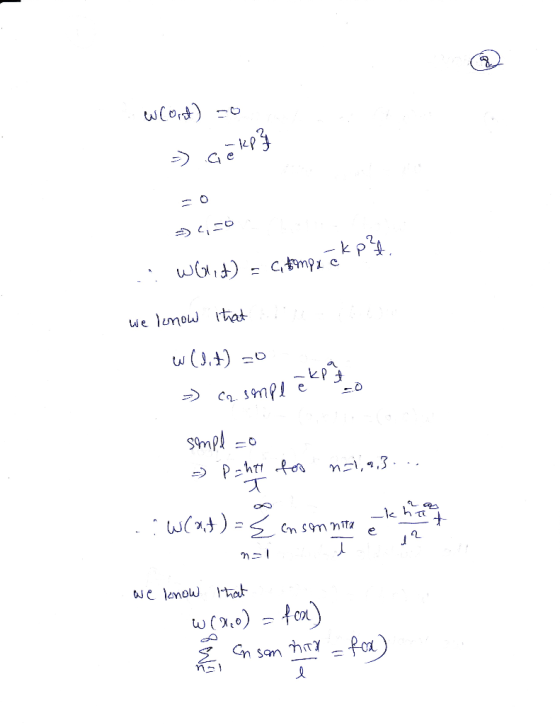
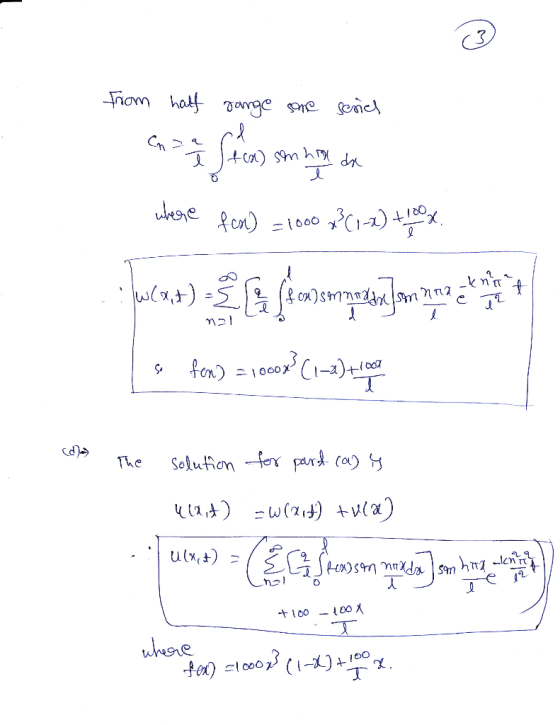
Add Answer to:
PDE. Please show all steps in detail.
2. Consider the 1D heat equation in a rod...
2. Consider the 1D heat equation in a rod of length with diffusion constant Suppose the left endp...
 PDE. Please show all steps in detail.
2. Consider the 1D heat equation in a rod of length with diffusion constant Suppose the left endpoint is convecting (in obedience to Newton's Law of Cooling with proportionality constant K-1) with an outside medium which is 5000. while the right endpoint is insulated. The initial temperature distribution in the rod is given by f(a)- 2000 -0.65 300, 0<
PDE. Please show all steps in detail.
2. Consider the 1D heat equation in a rod of length with diffusion constant Suppose the left endpoint is convecting (in obedience to Newton's Law of Cooling with proportionality constant K-1) with an outside medium which is 5000. while the right endpoint is insulated. The initial temperature distribution in the rod is given by f(a)- 2000 -0.65 300, 0<
2. Consider the initial-boundary value problem 0 0, t >0 Uz uェェ, Uz(0, t) _ u(0, t) = 0. a(z, 0...
 PDE questions. Please show all
steps in detail.
2. Consider the initial-boundary value problem 0
PDE questions. Please show all
steps in detail.
2. Consider the initial-boundary value problem 0
Consider a 2 m long metal rod. The temperature u(z,t) at a point along the rod at any time t is found by solving the heat equation k where k is the material property. The left end of the rod ( 0) is...
 Consider a 2 m long metal rod. The temperature u(z,t) at a point along the rod at any time t is found by solving the heat equation k where k is the material property. The left end of the rod ( 0) is maintained at 20°C and the right end is suddenly dipped into snow (0°C). The initial temperature distribution in the rod is given by u(x,0)- (i) Use the substitution u(z,t) ta,t)+20-10z to reduce the above problem to a...
This is PDE problem. Please show all steps in detail with neat handwriting. Problem . Consider...
 This is PDE problem. Please show all steps in detail with neat
handwriting.
Problem . Consider the function a) Find the full Fourier Series of F(x) a(0, y, t) = u(a, y, t) 0 u(z, 0, t ) = u(z, b, l) = 0 u(z,y,0) = f(z,y), u(x, y,0)-g(x,y), 0<y< b,t0 a) b) Solve the initial-boundary value problem for 2D wave equation. What is the physical interpretation of these boundary conditions
This is PDE problem. Please show all steps in detail with neat
handwriting.
Problem . Consider the function a) Find the full Fourier Series of F(x) a(0, y, t) = u(a, y, t) 0 u(z, 0, t ) = u(z, b, l) = 0 u(z,y,0) = f(z,y), u(x, y,0)-g(x,y), 0<y< b,t0 a) b) Solve the initial-boundary value problem for 2D wave equation. What is the physical interpretation of these boundary conditions
2. In lectures we solved the heat PDE in 1 +1 dimensions with constant-temperature boundary conditions u(0,t)u(L,t) -0. If these boundary conditions change from zero temperature, we need to do a litt...
 2. In lectures we solved the heat PDE in 1 +1 dimensions with constant-temperature boundary conditions u(0,t)u(L,t) -0. If these boundary conditions change from zero temperature, we need to do a little bit more work. Consider the following initial/boundary-value problem (IBVP) 2 (PDE) (BCs) (IC) u(0,t) = a, u(x,00, u(L, t)=b, st. and let's take L = 1, a = 1, b = 2 throughout for simplicity. Solve this problem using the following tricks b and A"(x)-0 (a) Find a...
2. Consider the heat equation on a bounded domain with a zero heat-flux condition, 0<a <1...
 2. Consider the heat equation on a bounded domain with a zero heat-flux condition, 0<a <1 t > 0, u(z,0) = 2(1-2), (0, t) = 0, 14(1, t) = 0, t >0, t > 0, where σ > 0 is a constant. Such an equation is a model for the distribution of head throughout a rod which is thermally insulated on both ends. (a) Find the solution of the above PDE using separation of variables. You may use anything we...
2. (16pts) Consider the following heat equation for a rod of length L=1 with constant thermal...
 2. (16pts) Consider the following heat equation for a rod of length L=1 with constant thermal properties (assume k=1): - xe" (0 < x <l, t>0) 04 (0,1) = 0 (1,1)= 1 a) Determine the equilibrium temperature distribution, and plot it on the interval [0, 1] b) Where does the energy enter, and where does it leave the rod? Explain your answers.
Problem 1. Find the general solution of an 1D heat equation: T(x, t) = 4Txx(x, t)...
 Problem 1. Find the general solution of an 1D heat equation: T(x, t) = 4Txx(x, t) with the boundary conditions T(0,t) = T(2,t) = 0. Note that T(x,t) denotes the temperature profile along x of a uniform rod of length 2. Problem 2. Solve the following 1D wave equation: 0ct(x, t) = 0xx(x, t) with the boundary conditions 0(0,t) = 0,(1,t) = 0, where 8(x, t) refers to the twist angle of a uniform rod of unit length. Problem 3....
2. In lecture, we talked about the heat equation on a thin, laterally insulated rod. There...
 2. In lecture, we talked about the heat equation on a thin, laterally insulated rod. There are many other domains on which you might want to determine the temperature. In this question, we explore the temperature on a wire that has been formed into a circle. thin wire, length 2L, laying flat on [-L,L] bend wire into a circular shape result is a circular wire where the ends x=L and x=-L correspond to one point now. While the PDE remains...
please show all steps! A heat-transfer experiment in CBE 154 investigates conductive heat transport within a...
 please show all steps!
A heat-transfer experiment in CBE 154 investigates conductive heat transport within a solid and convective heat transport at a solid gas interface. In this homework problem, you are to write the differential equations describing the experimental setup (but not solve them). The first part of the experiment involves measurement of a steady-state temperature profile along a brass rod to determine the conductivity of brass and the rate of heat loss through the insulation to the surrounding...
please show all steps!
A heat-transfer experiment in CBE 154 investigates conductive heat transport within a solid and convective heat transport at a solid gas interface. In this homework problem, you are to write the differential equations describing the experimental setup (but not solve them). The first part of the experiment involves measurement of a steady-state temperature profile along a brass rod to determine the conductivity of brass and the rate of heat loss through the insulation to the surrounding...
 PDE. Please show all steps in detail.
2. Consider the 1D heat equation in a rod of length with diffusion constant Suppose the left endpoint is convecting (in obedience to Newton's Law of Cooling with proportionality constant K-1) with an outside medium which is 5000. while the right endpoint is insulated. The initial temperature distribution in the rod is given by f(a)- 2000 -0.65 300, 0<
PDE. Please show all steps in detail.
2. Consider the 1D heat equation in a rod of length with diffusion constant Suppose the left endpoint is convecting (in obedience to Newton's Law of Cooling with proportionality constant K-1) with an outside medium which is 5000. while the right endpoint is insulated. The initial temperature distribution in the rod is given by f(a)- 2000 -0.65 300, 0<
 PDE questions. Please show all
steps in detail.
2. Consider the initial-boundary value problem 0
PDE questions. Please show all
steps in detail.
2. Consider the initial-boundary value problem 0
 Consider a 2 m long metal rod. The temperature u(z,t) at a point along the rod at any time t is found by solving the heat equation k where k is the material property. The left end of the rod ( 0) is maintained at 20°C and the right end is suddenly dipped into snow (0°C). The initial temperature distribution in the rod is given by u(x,0)- (i) Use the substitution u(z,t) ta,t)+20-10z to reduce the above problem to a...
 This is PDE problem. Please show all steps in detail with neat
handwriting.
Problem . Consider the function a) Find the full Fourier Series of F(x) a(0, y, t) = u(a, y, t) 0 u(z, 0, t ) = u(z, b, l) = 0 u(z,y,0) = f(z,y), u(x, y,0)-g(x,y), 0<y< b,t0 a) b) Solve the initial-boundary value problem for 2D wave equation. What is the physical interpretation of these boundary conditions
This is PDE problem. Please show all steps in detail with neat
handwriting.
Problem . Consider the function a) Find the full Fourier Series of F(x) a(0, y, t) = u(a, y, t) 0 u(z, 0, t ) = u(z, b, l) = 0 u(z,y,0) = f(z,y), u(x, y,0)-g(x,y), 0<y< b,t0 a) b) Solve the initial-boundary value problem for 2D wave equation. What is the physical interpretation of these boundary conditions
 2. In lectures we solved the heat PDE in 1 +1 dimensions with constant-temperature boundary conditions u(0,t)u(L,t) -0. If these boundary conditions change from zero temperature, we need to do a little bit more work. Consider the following initial/boundary-value problem (IBVP) 2 (PDE) (BCs) (IC) u(0,t) = a, u(x,00, u(L, t)=b, st. and let's take L = 1, a = 1, b = 2 throughout for simplicity. Solve this problem using the following tricks b and A"(x)-0 (a) Find a...
 2. Consider the heat equation on a bounded domain with a zero heat-flux condition, 0<a <1 t > 0, u(z,0) = 2(1-2), (0, t) = 0, 14(1, t) = 0, t >0, t > 0, where σ > 0 is a constant. Such an equation is a model for the distribution of head throughout a rod which is thermally insulated on both ends. (a) Find the solution of the above PDE using separation of variables. You may use anything we...
 2. (16pts) Consider the following heat equation for a rod of length L=1 with constant thermal properties (assume k=1): - xe" (0 < x <l, t>0) 04 (0,1) = 0 (1,1)= 1 a) Determine the equilibrium temperature distribution, and plot it on the interval [0, 1] b) Where does the energy enter, and where does it leave the rod? Explain your answers.
 Problem 1. Find the general solution of an 1D heat equation: T(x, t) = 4Txx(x, t) with the boundary conditions T(0,t) = T(2,t) = 0. Note that T(x,t) denotes the temperature profile along x of a uniform rod of length 2. Problem 2. Solve the following 1D wave equation: 0ct(x, t) = 0xx(x, t) with the boundary conditions 0(0,t) = 0,(1,t) = 0, where 8(x, t) refers to the twist angle of a uniform rod of unit length. Problem 3....
 2. In lecture, we talked about the heat equation on a thin, laterally insulated rod. There are many other domains on which you might want to determine the temperature. In this question, we explore the temperature on a wire that has been formed into a circle. thin wire, length 2L, laying flat on [-L,L] bend wire into a circular shape result is a circular wire where the ends x=L and x=-L correspond to one point now. While the PDE remains...
 please show all steps!
A heat-transfer experiment in CBE 154 investigates conductive heat transport within a solid and convective heat transport at a solid gas interface. In this homework problem, you are to write the differential equations describing the experimental setup (but not solve them). The first part of the experiment involves measurement of a steady-state temperature profile along a brass rod to determine the conductivity of brass and the rate of heat loss through the insulation to the surrounding...
please show all steps!
A heat-transfer experiment in CBE 154 investigates conductive heat transport within a solid and convective heat transport at a solid gas interface. In this homework problem, you are to write the differential equations describing the experimental setup (but not solve them). The first part of the experiment involves measurement of a steady-state temperature profile along a brass rod to determine the conductivity of brass and the rate of heat loss through the insulation to the surrounding...
Most questions answered within 3 hours.
-
Where is the error in this code sequence?
String s1 = "Hello";
String s2 = "ello";...
asked 10 months ago -
Financial data for Joel de Paris, Inc., for last year
follow:
Joel de Paris, Inc.
Balance...
asked 10 months ago -
Consider this reaction:
Al2(SO4)3 (aq)+ BaCl3
(aq) Al2Cl6 (aq)- +
3BaSO4(s) . What is the...
asked 10 months ago -
Suppose that Savneet is considering increasing her
recent random sample from 20 car rentals to 40...
asked 10 months ago -
Trucks arrive at an unloading terminal at an average rate of 120
per hour.
Trucks arrive...
asked 10 months ago -
Why are methanol and ethanol completely soluble in water while
octanol is not very little soluble....
asked 10 months ago -
A facilities manager at a university reads in a research report
that the mean amount of...
asked 10 months ago -
When the CuSO4 is rehydrated by adding water to the anhydrous
compound, is this an endothermic...
asked 10 months ago -
A ray of sunlight is passing from diamond into crown glass; the
angle of incidence is...
asked 10 months ago -
A block of mass 0.249 kg is placed on top of a light, vertical
spring of...
asked 10 months ago -
how do the kidneys compensate in the presences of acidosis
a) trigger hyperventilate
b) reserve acid...
asked 10 months ago -
Question 501 pts
The rental rate of capital to the firm increases. Which of the
following...
asked 10 months ago