Near planet Zorb the gravitational potential is known to follow the function U(x,y,z) = 3x4 +...
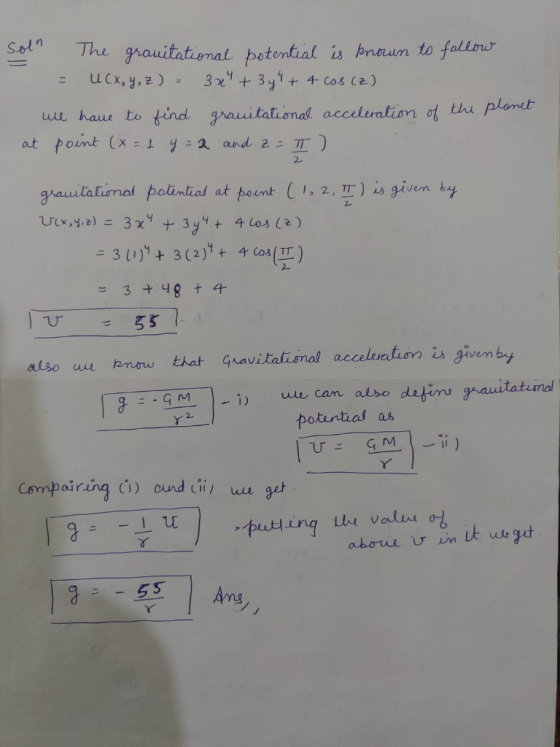
Near planet Zorb the gravitational potential is known to follow the function U(x,y,z) = 3x4 + 3y4 + 4cos(z). What is the magnitude of the gravitational acceleration of this planet at point (x = 1, y = 2, z = p/2= 3.14159/2.)?
Homework Answers
Add Answer to:
Near planet Zorb the gravitational potential is known to follow
the function U(x,y,z) = 3x4 +...
Select the Boolean expression that is not satisfiable. 3 (z+u)(z+x)(z+x")(u+y)(u+y) (z+u")(z+x)(z+x)(u+y)(u+y) (zº+u)(z+x)(z+x")(u+y)(u+y") (z+u")(z+x)(z+x")(u+y)(u+y") 6 a Question...
 Select the Boolean expression that is not satisfiable. 3 (z+u)(z+x)(z+x")(u+y)(u+y) (z+u")(z+x)(z+x)(u+y)(u+y) (zº+u)(z+x)(z+x")(u+y)(u+y") (z+u")(z+x)(z+x")(u+y)(u+y") 6 a Question 13 (1 point) Select the statement that is not a proposition. 12 5+4 = 8 It will be sunny tomorrow. 15 Take out the trash. 7 18 Chocolate is the best flavor. 20 21 Question 14 (1 point) p = T. q = F, and r = F. Select the expression that evaluates to true. 23 24 Срла -р avr
4. The equation mgy for gravitational potential energy is valid only for objects near the surface...
4. The equation mgy for gravitational potential energy is valid only for objects near the surface of a planet. Consider two very large objects of mass m1 and m2, such as stars or planets, whose centers are separated by the large distance r. These two large objects exert gravitational forces on each other.The gravitational potential energy is U = − Gm1m2 r where G = 6.67 × 10⁻¹¹Nm2/kg2 is the gravitational constant. (a) Sketch a graph of U versus r....
7. [MT, p. 210] Investigate whether or not the system u(x, y, z) = x +...
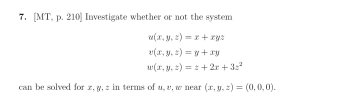 7. [MT, p. 210] Investigate whether or not the system u(x, y, z) = x + xyz V(x, y, z) y + xy W(x, y, z) = 2 + 2x + 322 = can be solved for x, y, z in terms of u, v, w near (x, y, z) = (0,0,0).
A potential function is given as: 1) Obtain the E(x,y,z) 2) Show that E is an...
 A potential function is given as:
1) Obtain the E(x,y,z)
2) Show that E is an acceptable static electric field
3) What is the charge density function
corresponding to this potential?
O(x, y, z) = -x²y- rz3
A potential function is given as:
1) Obtain the E(x,y,z)
2) Show that E is an acceptable static electric field
3) What is the charge density function
corresponding to this potential?
O(x, y, z) = -x²y- rz3
Show that the gravitational field F(x)--mMG is conservative with the potential function f(x) mMG(...
 Show that the gravitational field F(x)--mMG is conservative with the potential function f(x) mMG(--) and then (on another page) evaluate Jcxds for Ci: y=x2 ,-1〈x 1 xl
Show that the gravitational field F(x)--mMG is conservative with the potential function f(x) mMG(--) and then (on another page) evaluate Jcxds for Ci: y=x2 ,-1〈x 1 xl
Show that the gravitational field F(x)--mMG is conservative with the potential function f(x) mMG(--) and then (on another page) evaluate Jcxds for Ci: y=x2 ,-1〈x 1 xl
The equation of electric potential in space is given by: V(x,y,z) = 2xy/x 1. Calculate the...
The equation of electric potential in space is given by: V(x,y,z) = 2xy/x 1. Calculate the electric potential at point (x = 1, y = -2, z = 3) in space. 2. Find the electric field E vector as a function of x, y, z. 3. Calculate the electric field at point (x = 1, y = -2, z = 3) in space.
(1 point) The equations define u(x, y) and v(x, y) in terms of x and y near the point (x, y)-(1,1) and (u, v)-(1,1). Co...
 (1 point) The equations define u(x, y) and v(x, y) in terms of x and y near the point (x, y)-(1,1) and (u, v)-(1,1). Compute the partial derivatives ди du dx 0v dy dv ду Note that all answers are numbers.
(1 point) The equations define u(x, y) and v(x, y) in terms of x and y near the point (x, y)-(1,1) and (u, v)-(1,1). Compute the partial derivatives ди du dx 0v dy dv ду Note that all answers...
(1 point) The equations define u(x, y) and v(x, y) in terms of x and y near the point (x, y)-(1,1) and (u, v)-(1,1). Compute the partial derivatives ди du dx 0v dy dv ду Note that all answers are numbers.
(1 point) The equations define u(x, y) and v(x, y) in terms of x and y near the point (x, y)-(1,1) and (u, v)-(1,1). Compute the partial derivatives ди du dx 0v dy dv ду Note that all answers...
07. Show that the function u(x, y) In(5x +y) -5(z +y)2 is concave.
 07. Show that the function u(x, y) In(5x +y) -5(z +y)2 is concave.
07. Show that the function u(x, y) In(5x +y) -5(z +y)2 is concave.
07. Show that the function u(x, y) In(5x +y) -5(z +y)2 is concave.
Find the differential of the function u = f(x + y + z, x^2 +y^2 +...
Find the differential of the function u = f(x + y + z, x^2 +y^2 + z^2), where f : R^2 → R is a differentiable function.
which of the following is a potential function for F(x,y,z)= < y2 +y?ex?,x2 + 2ye*?,xy +...
 which of the following is a potential function for F(x,y,z)= < y2 +y?ex?,x2 + 2ye*?,xy + xy?e *V> f(x,y,z) = xyz + y2exyz f(x,y,z) = xyz + y2e*+2 b. F(x,y,z) has a potential function but it is not one of the other choices. F(x,y,z) does not have a potential function. d. f(x,y,z) = xyz + y2exZ e.
 Select the Boolean expression that is not satisfiable. 3 (z+u)(z+x)(z+x")(u+y)(u+y) (z+u")(z+x)(z+x)(u+y)(u+y) (zº+u)(z+x)(z+x")(u+y)(u+y") (z+u")(z+x)(z+x")(u+y)(u+y") 6 a Question 13 (1 point) Select the statement that is not a proposition. 12 5+4 = 8 It will be sunny tomorrow. 15 Take out the trash. 7 18 Chocolate is the best flavor. 20 21 Question 14 (1 point) p = T. q = F, and r = F. Select the expression that evaluates to true. 23 24 Срла -р avr
 7. [MT, p. 210] Investigate whether or not the system u(x, y, z) = x + xyz V(x, y, z) y + xy W(x, y, z) = 2 + 2x + 322 = can be solved for x, y, z in terms of u, v, w near (x, y, z) = (0,0,0).
 A potential function is given as:
1) Obtain the E(x,y,z)
2) Show that E is an acceptable static electric field
3) What is the charge density function
corresponding to this potential?
O(x, y, z) = -x²y- rz3
A potential function is given as:
1) Obtain the E(x,y,z)
2) Show that E is an acceptable static electric field
3) What is the charge density function
corresponding to this potential?
O(x, y, z) = -x²y- rz3
 Show that the gravitational field F(x)--mMG is conservative with the potential function f(x) mMG(--) and then (on another page) evaluate Jcxds for Ci: y=x2 ,-1〈x 1 xl
Show that the gravitational field F(x)--mMG is conservative with the potential function f(x) mMG(--) and then (on another page) evaluate Jcxds for Ci: y=x2 ,-1〈x 1 xl
Show that the gravitational field F(x)--mMG is conservative with the potential function f(x) mMG(--) and then (on another page) evaluate Jcxds for Ci: y=x2 ,-1〈x 1 xl
 (1 point) The equations define u(x, y) and v(x, y) in terms of x and y near the point (x, y)-(1,1) and (u, v)-(1,1). Compute the partial derivatives ди du dx 0v dy dv ду Note that all answers are numbers.
(1 point) The equations define u(x, y) and v(x, y) in terms of x and y near the point (x, y)-(1,1) and (u, v)-(1,1). Compute the partial derivatives ди du dx 0v dy dv ду Note that all answers...
(1 point) The equations define u(x, y) and v(x, y) in terms of x and y near the point (x, y)-(1,1) and (u, v)-(1,1). Compute the partial derivatives ди du dx 0v dy dv ду Note that all answers are numbers.
(1 point) The equations define u(x, y) and v(x, y) in terms of x and y near the point (x, y)-(1,1) and (u, v)-(1,1). Compute the partial derivatives ди du dx 0v dy dv ду Note that all answers...
 07. Show that the function u(x, y) In(5x +y) -5(z +y)2 is concave.
07. Show that the function u(x, y) In(5x +y) -5(z +y)2 is concave.
07. Show that the function u(x, y) In(5x +y) -5(z +y)2 is concave.
 which of the following is a potential function for F(x,y,z)= < y2 +y?ex?,x2 + 2ye*?,xy + xy?e *V> f(x,y,z) = xyz + y2exyz f(x,y,z) = xyz + y2e*+2 b. F(x,y,z) has a potential function but it is not one of the other choices. F(x,y,z) does not have a potential function. d. f(x,y,z) = xyz + y2exZ e.
Most questions answered within 3 hours.
-
Where is the error in this code sequence?
String s1 = "Hello";
String s2 = "ello";...
asked 11 months ago -
Financial data for Joel de Paris, Inc., for last year
follow:
Joel de Paris, Inc.
Balance...
asked 11 months ago -
Consider this reaction:
Al2(SO4)3 (aq)+ BaCl3
(aq) Al2Cl6 (aq)- +
3BaSO4(s) . What is the...
asked 11 months ago -
Suppose that Savneet is considering increasing her
recent random sample from 20 car rentals to 40...
asked 11 months ago -
Trucks arrive at an unloading terminal at an average rate of 120
per hour.
Trucks arrive...
asked 11 months ago -
Why are methanol and ethanol completely soluble in water while
octanol is not very little soluble....
asked 11 months ago -
A facilities manager at a university reads in a research report
that the mean amount of...
asked 11 months ago -
When the CuSO4 is rehydrated by adding water to the anhydrous
compound, is this an endothermic...
asked 11 months ago -
A ray of sunlight is passing from diamond into crown glass; the
angle of incidence is...
asked 11 months ago -
A block of mass 0.249 kg is placed on top of a light, vertical
spring of...
asked 11 months ago -
how do the kidneys compensate in the presences of acidosis
a) trigger hyperventilate
b) reserve acid...
asked 11 months ago -
Question 501 pts
The rental rate of capital to the firm increases. Which of the
following...
asked 11 months ago